Ammonia is a gas released from livestock waste. Ammonia dissolves in water to make an alkaline solution. Scientists think that this might harm germinating seeds by affecting amylase, an enzyme crucial for starch breakdown.
Amylase activity is controlled by enzymes. Which two statements explain how an alkaline solution could affect amylase activity?
- Alkali will increase the pH and cause the enzyme to change shape.
- Alkali will decrease the pH and cause the enzyme to change shape.
- Alkali will increase the pH and cause the substrate to change shape.
- The enzyme will not fit into the active site of the substrate.
- The substrate will denature.
- The substrate will not fit into the active site of the enzyme.
Students take some barley seeds and soak them in water containing different concentrations of ammonia. They then measure the amylase activity of the seeds. The graph shows their results:
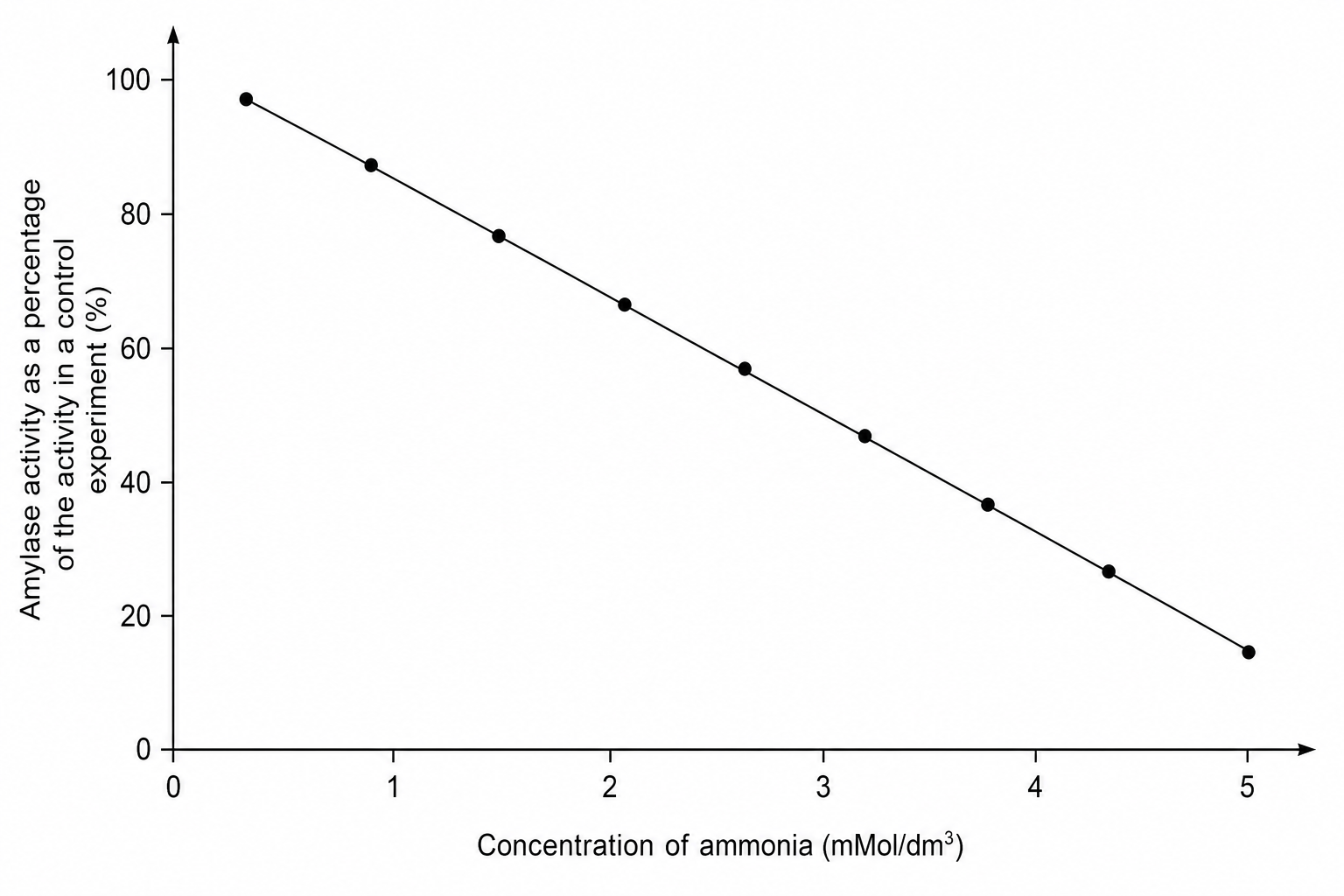
The students plotted the amylase activity as a percentage of the activity in a control experiment. The control experiment involved soaking the seeds in a different substance. Suggest what substance the students used as a control.
Students take some barley seeds and soak them in water containing different concentrations of ammonia. They then measure the amylase activity of the seeds. The graph shows their results:
One of the students makes this conclusion: 'The results of our experiment show that ammonia is affecting the seeds and it is doing this because it forms an alkaline solution.' Discuss whether this is a reasonable conclusion to make from the students' results.
Students take some barley seeds and soak them in water containing different concentrations of ammonia. They then measure the amylase activity of the seeds. The graph shows their results:
Suggest how the students could modify their experiment to prove that ammonia is affecting the seeds because it is alkaline.