Question 10
FCatalase is an enzyme found in many living cells. It breaks down hydrogen peroxide into water and oxygen.
A student investigates the effect of the concentration of hydrogen peroxide on the rate of this reaction.
The Figure shows the apparatus.
Figure
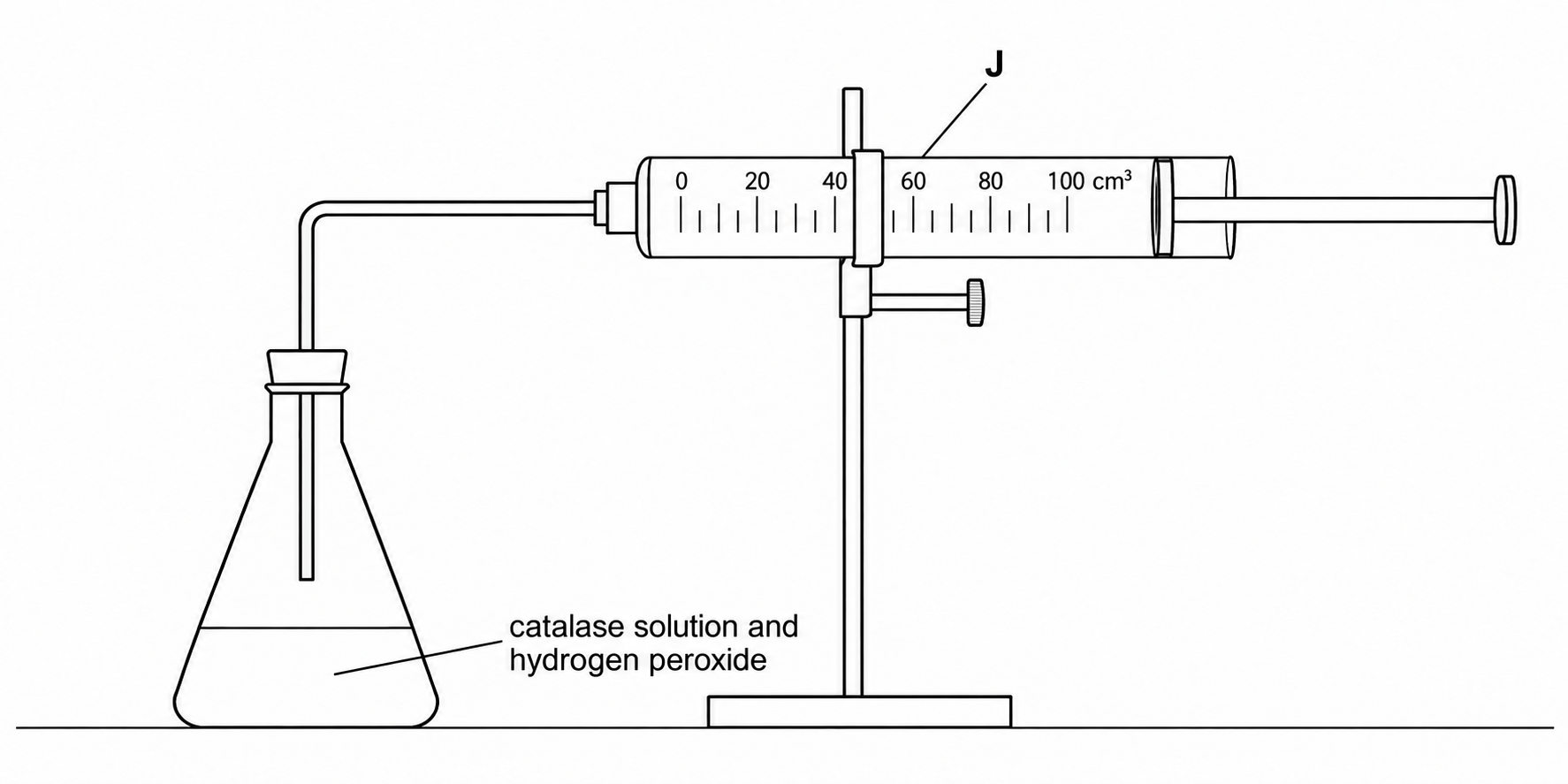 The student measures the volume of oxygen collected in 60 seconds, in cm3\text{cm}^3cm3. She does three trials at each concentration.
The Table shows her results.
Table
| Concentration of hydrogen peroxide in %\%% | Trial 1 | Trial 2 | Trial 3 | Mean |
|---|---|---|---|---|
| 1 | 8 | 9 | 7 | 8.0 |
| 2 | 15 | 17 | 16 | 16.0 |
| 3 | 25 | 23 | 12 | |
| 4 | 31 | 33 | 32 | 32.0 |
| 5 | 36 | 37 | 38 | 37.0 |
a.[1]
Name the piece of apparatus labelled J.
b.[1]
Identify the anomalous result in the Table.
c.[2]
Calculate the mean volume of oxygen collected at a concentration of 3%.
d.[2]
Calculate the rate of oxygen production at a concentration of 5%, in cm3\text{cm}^3cm3 per second.
Give your answer to 2 decimal places.
e.[2]
Give two variables the student must keep the same in this investigation.
1.2 What happens in cells (and what do cells need)? Questions
184 exam-style questions on OCR GCSE Biology 1.2 What happens in cells (and what do cells need)?, covering 1.2.1 Structure of DNA, 1.2.2 Nucleotides and complementary bases, 1.2.3 Protein synthesis, 1.2.4 DNA structure and the proteins made, 1.2.5 Investigating enzymatic reactions, and 1.2.6 Mechanism of enzyme action. Each one has a worked solution and a mark scheme showing where the marks go.