Whiteboard Revision GCSE Media Studies: Does It Work?
Whiteboard revision GCSE Media Studies: use active recall, set-product analysis and essay planning, while keeping your GCSE maths practice on track.
A whiteboard can look productive without producing much learning. You write a beautiful page of terminology, underline the headings, admire it for a moment and then wipe everything away. The board was busy. Your memory may not have been.
Used differently, however, whiteboard revision GCSE Media Studies can be genuinely useful. The key is to retrieve, organise, analyse and correct information rather than copy notes. A whiteboard is most effective when it becomes a temporary thinking space: somewhere to test what you know, expose gaps and rehearse the decisions an exam question requires.
This matters if Media Studies is competing with maths and several other GCSE subjects for your time. You do not need another elaborate revision project. You need a repeatable method that reveals what to do next.
The short answer: when is a whiteboard useful?
A whiteboard is useful for GCSE Media Studies when you use it to:
- recall terminology and theories without notes;
- connect set products to the theoretical framework;
- compare representations, audiences and contexts;
- plan analytical paragraphs under time pressure;
- practise responding to unseen media products;
- record mistakes before checking accurate course materials;
- explain an idea aloud and then simplify it.
It is less useful when you simply copy a textbook, decorate a mind map or leave the same information displayed for days.
Research into retrieval practice consistently suggests that actively trying to recall information can support learning more effectively than repeatedly rereading it. The attempt matters, even when the first answer is incomplete. Feedback matters too, because an unchecked whiteboard can turn a misconception into something familiar.
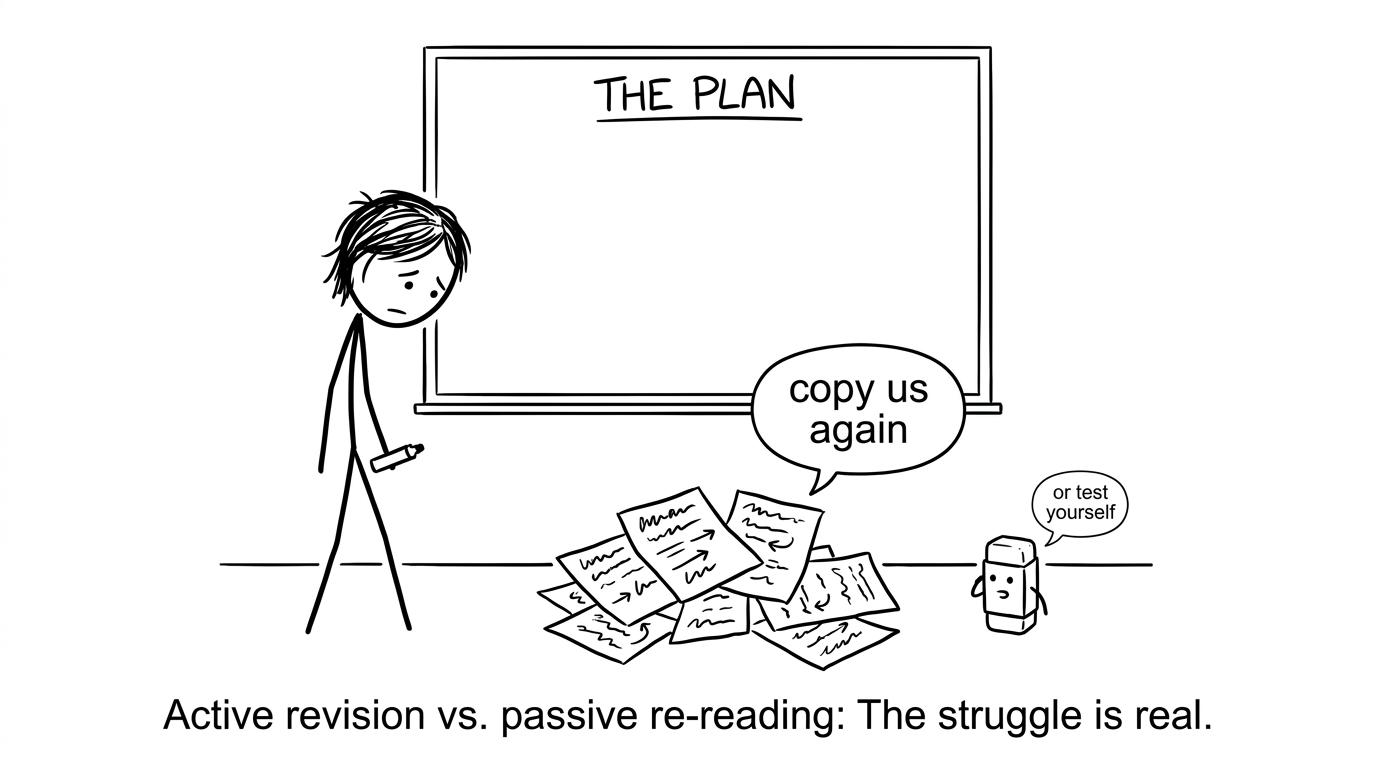 A student choosing between copying notes and testing their memory on a whiteboard
What GCSE Media Studies actually asks you to do
Media Studies is not just a memory test. Across specifications such as AQA, OCR and Eduqas, students develop knowledge and analysis through four broad areas of the theoretical framework:
- media language;
- representation;
- media industries;
- audiences.
You may also need to consider social, cultural, historical and political contexts. Written assessments can require knowledge, analysis, comparison, judgements and conclusions. Non-exam assessment involves applying understanding through media production.
That combination explains why copying notes has limited value. Knowing a definition is not the same as applying it to a magazine cover, television extract, advertisement or online product. Your whiteboard activities should therefore move through three stages:
| Revision stage | What to do on the whiteboard |
|---|---|
| Retrieve | Recall facts, terminology, theories and set-product details without looking |
| Apply | Connect the knowledge to a product, extract, question or comparison |
| Check | Use trusted notes, your specification or teacher feedback to correct the board |
Set products and assessment arrangements can change. Always confirm that you are revising the correct specification and current products for your examination year rather than relying on an old online checklist.
Whiteboard techniques that go beyond copying notes
Build a set-product memory map
Write the name of one set product in the centre of the board. Around it, create headings for media language, representation, industry, audience and context. Close your notes and add everything you can remember.
The valuable moment comes afterwards. Check your notes in a different-coloured pen and add only what was missing or inaccurate. Those additions identify the knowledge that needs another retrieval attempt.
Do not turn the map into a permanent poster. Wipe it clean and rebuild it after a delay. A map recreated from memory is revision; a map repeatedly admired is decoration.
Use four-corner framework recall
Divide the board into four areas, one for each part of the theoretical framework. Choose a set product or unseen image and place observations in the appropriate sections.
Then draw arrows between connected ideas. A production decision by an industry may influence how an audience is targeted. Media language may construct a particular representation. Context may help explain why conventions differ between historical and contemporary products.
These links encourage analysis rather than isolated fact collection. They also help you avoid treating each framework area as if it exists alone.
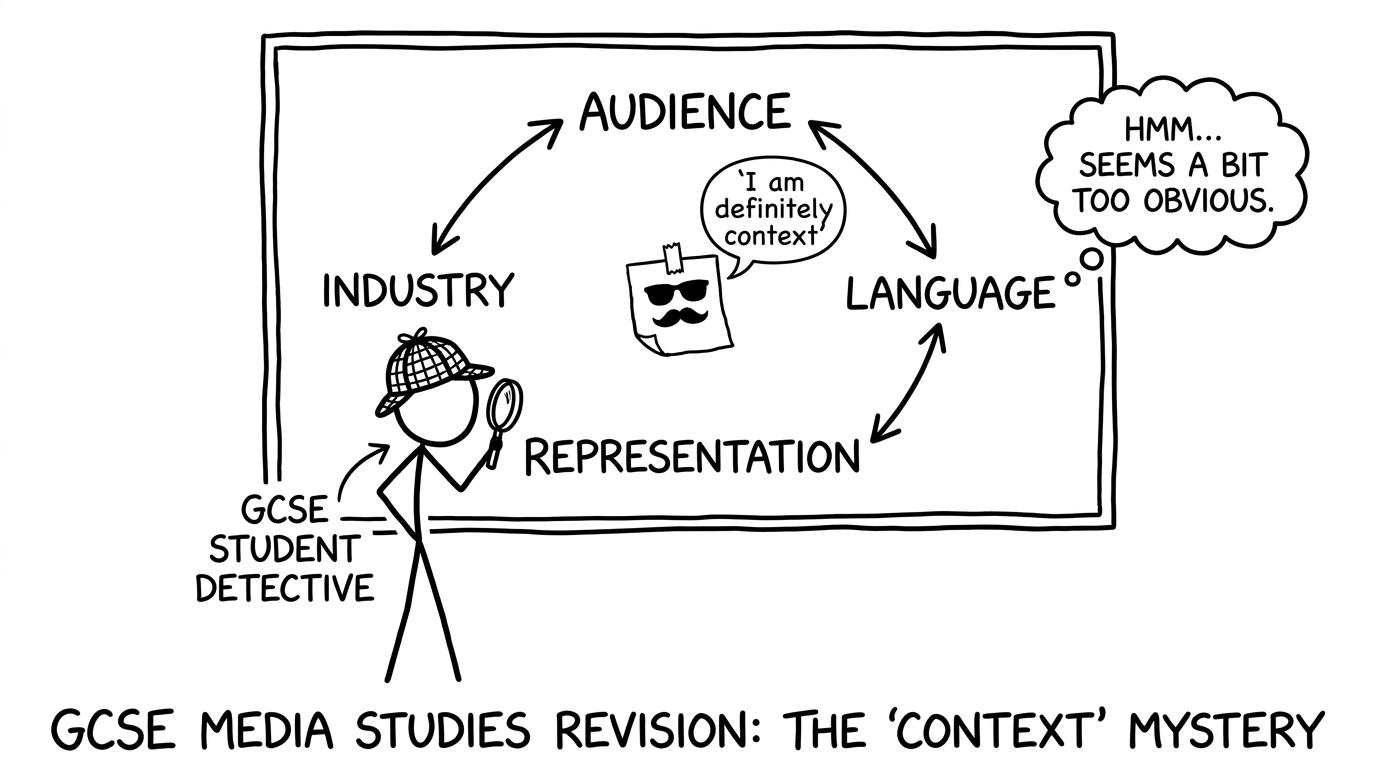 A GCSE student investigating links between the media framework areas
Run an unseen-media sprint
Display an appropriate advertisement, magazine cover, film poster or newspaper front page away from your revision notes. Give yourself a short, fixed period to identify:
- relevant codes and conventions;
- denotation and possible connotations;
- constructed representations;
- likely target audiences;
- possible interpretations;
- contextual details you can justify from the product.
The board makes it easy to rearrange weak first thoughts. However, the aim is not to create the longest list. Circle the observations that could become developed analytical arguments and cross out unsupported claims.
Plan paragraphs without writing the whole essay
Use the whiteboard to build the structure of an answer rather than composing polished paragraphs every time. For each paragraph, record a concise chain:
- claim;
- precise evidence;
- use of terminology;
- analysis of meaning;
- link to audience, context or theory where relevant;
- judgement linked to the question.
This reveals whether your answer has an argument. If the board contains several examples but no explanation of their effect or significance, you have found the weakness before spending time writing a full response.
You should still practise complete answers on paper. A real exam requires sustained, legible writing, so whiteboard planning should support written practice rather than replace it.
Create comparison lanes
Split the board vertically and place one product on each side. Compare the same category across both sides: representation, genre conventions, audience address, ownership or context.
Add a middle column for the actual relationship between the products. Useful comparisons include similarity, difference, change over time and different uses of a shared convention. This prevents two separate descriptions being mistaken for comparison.
Turn the board into a question generator
Write a broad topic at the top, then create possible exam prompts using command words such as analyse, compare, explain and evaluate. Underline what each question requires.
Next, write only the evidence and concepts that directly answer that wording. This builds the habit of selecting knowledge rather than unloading everything you remember about a product.
Teach an imaginary audience
Explain one concept aloud while using the board for keywords and connections. Your imagined audience should be intelligent but unfamiliar with Media Studies. If you rely on vague phrases such as “this makes the audience interested”, stop and make the explanation more precise.
Teaching aloud can reveal gaps hidden by silent rereading. It also forces you to translate terminology into a coherent explanation, which is closer to what extended writing demands.
Use an erase-and-rebuild revision cycle
A productive whiteboard session can be short:
- Prompt: choose one product, concept or exam question.
- Recall: work without notes.
- Apply: connect the recalled knowledge to evidence or an argument.
- Check: compare your board with reliable materials.
- Correct: add omissions and repair inaccurate ideas.
- Erase: remove the completed version.
- Return: attempt the task again after a delay.
Erasing can feel wasteful, but that is the point. The board is not the final record. Your memory, corrected by feedback, is what you are developing.
Keep a small paper or digital error log containing only the gaps that need revisiting. This approach resembles the diagnose-and-retest method in MathsGenie's guide to finding your weakest GCSE topics. The subject changes, but the principle remains: mistakes should determine the next revision task.
Balance Media Studies with GCSE maths revision
A whiteboard may help you revise Media Studies efficiently, but it should not consume the time reserved for maths. Maths requires written calculations, diagrams, accurate notation and exam-style problem solving. Use the board for quick recall or rough thinking, then complete proper questions with full working.
A balanced evening might contain one focused whiteboard retrieval session for Media Studies followed by a maths topic session. If time is limited, the MathsGenie GCSE maths revision hub provides free topic-based revision and exam questions. The 20-minute GCSE maths revision routine is also useful when several subjects are competing for attention.
Keep each resource tied to a purpose:
- use the whiteboard to identify Media Studies knowledge gaps;
- use written responses to develop Media Studies exam technique;
- use maths revision lessons to refresh methods;
- use practice questions to apply those methods;
- use mark schemes and video solutions to diagnose errors;
- use GCSE maths mini tests for focused recall and timed practice;
- use past papers when you need realistic exam experience.
MathsGenie's guide to when to start GCSE past papers can help you place paper practice sensibly in your revision planner. Nearer the exams, predicted papers can add fresh practice, but they should never narrow your revision to a guessed list of content. The guide to using predicted topics carefully explains that distinction.
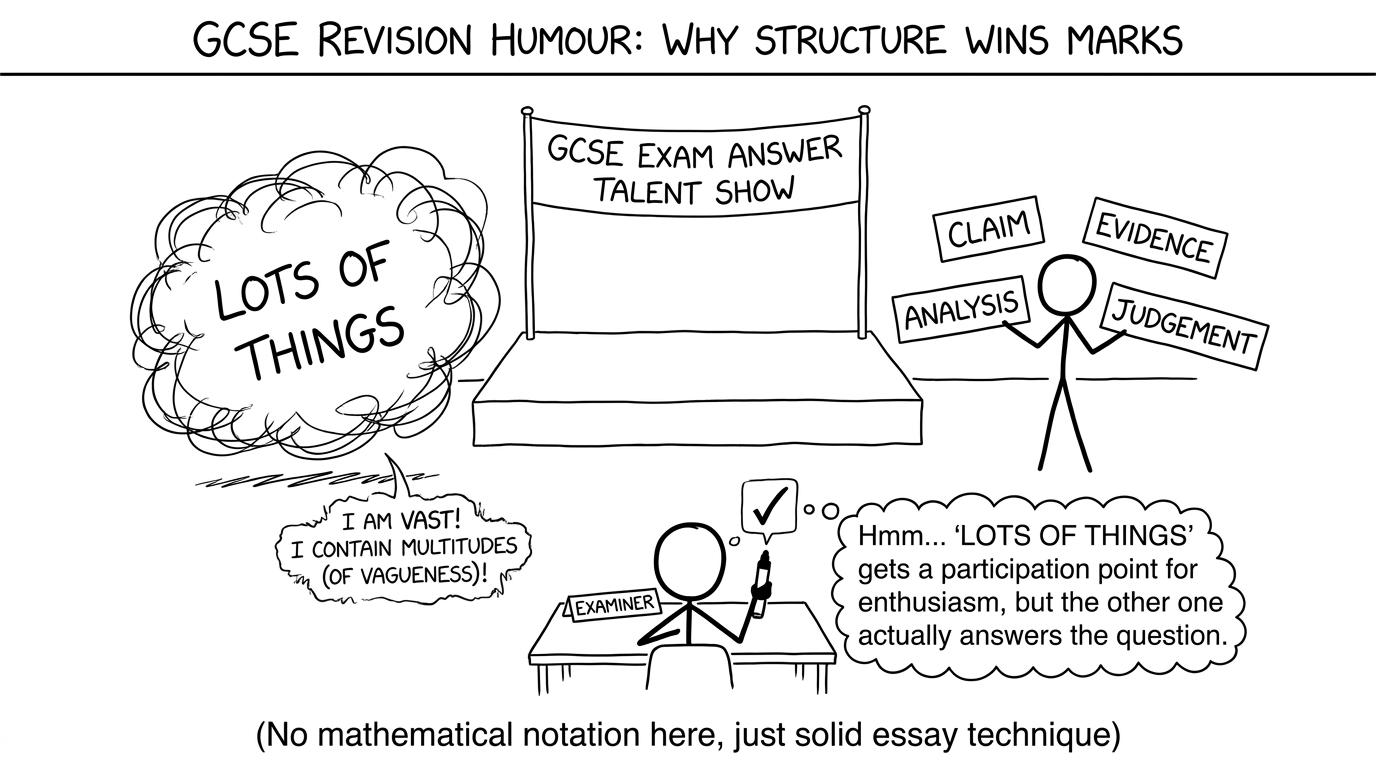 An analytical paragraph defeating a cloud of vague comments
Common whiteboard revision mistakes
Copying notes word for word
Copying creates activity without requiring retrieval. Start with the board blank and your notes closed. Check only after making a genuine attempt.
Making the board too attractive to erase
Colour can organise thinking, but elaborate decoration often consumes the time that should be spent recalling and applying knowledge. Your board should be disposable.
Writing vague analytical claims
Comments such as “the colour is effective” or “this attracts the audience” are rarely enough. Name the technique, identify precise evidence and explain how meaning or representation is constructed.
Revising outdated set products
Exam boards periodically update specifications and set products. Check your current specification, examination year and teacher guidance before building revision materials.
Never checking the content
Retrieval without feedback can preserve errors. Correct every session using dependable course materials, then retest the corrected information later.
Avoiding full written answers
A whiteboard is excellent for planning and diagnosis, but it does not reproduce the physical and intellectual demands of an examination. Include timed handwritten responses and mark them against appropriate criteria.
Using the board for every subject in the same way
Media Studies benefits from conceptual maps and analytical planning. Maths improvement depends heavily on completing questions and showing valid working. Adapt the tool to the task rather than forcing every subject into one revision style.
Make the whiteboard earn its place
A whiteboard is not inherently an effective revision resource. It becomes useful when it makes your thinking visible: what you remember, how ideas connect, where an argument breaks down and what you need to correct.
For Media Studies, use it to retrieve terminology, map set products, analyse unseen material, build comparisons and plan answers. Then transfer that thinking to timed writing. For maths, let the board support recall, but make exam questions the centre of your practice.
Build the rest of your revision around MathsGenie's free GCSE maths resources: begin with revision lessons, answer practice questions, check mark schemes and video solutions, and progress to mini tests, past papers and predicted papers. If an exam is close, the GCSE maths night-before plan will help you choose focused practice rather than panic-driven rereading.
The best revision tool is rarely the most impressive one. It is the one that shows you the truth about what you can do without help and gives you a clear next step.