When to Stop Revising GCSE Business the Night Before
When to stop revising GCSE Business the night before: choose a sensible cut-off, protect your sleep and complete a calm final review without overload.
Knowing when to stop revising GCSE Business the night before can feel harder than the revision itself. Every unfinished topic seems important. Every closed textbook feels like a risk.
The sensible answer is to stop at least an hour before bed, or around 909090 minutes beforehand if revision leaves you feeling alert or anxious. Plan your bedtime so you have the opportunity to get roughly 888 to 101010 hours of sleep, in line with NHS guidance for most teenagers. For many students, that means finishing revision between seven and eight o'clock rather than carrying on towards midnight.
Your final evening is not the moment to relearn the entire specification. It is for refreshing familiar knowledge, checking exam technique and arriving rested enough to use what you already know.
Your night-before checklist
Use this as a simple decision guide:
- Decide your bedtime first, based on your normal routine and morning alarm.
- Set a firm revision cut-off at least one hour before bed.
- Complete no more than one or two short, focused revision blocks.
- Review familiar material rather than opening a large new topic.
- Test recall instead of repeatedly reading notes.
- Check the paper, exam board, start time and required equipment.
- Pack your bag, set your alarm and move your phone away from the bed.
- Wind down without comparing revision hours with friends.
This approach also works for maths. MathsGenie's GCSE maths night-before plan follows the same principle: choose a small task, correct a few important gaps and stop before tired practice becomes unproductive.
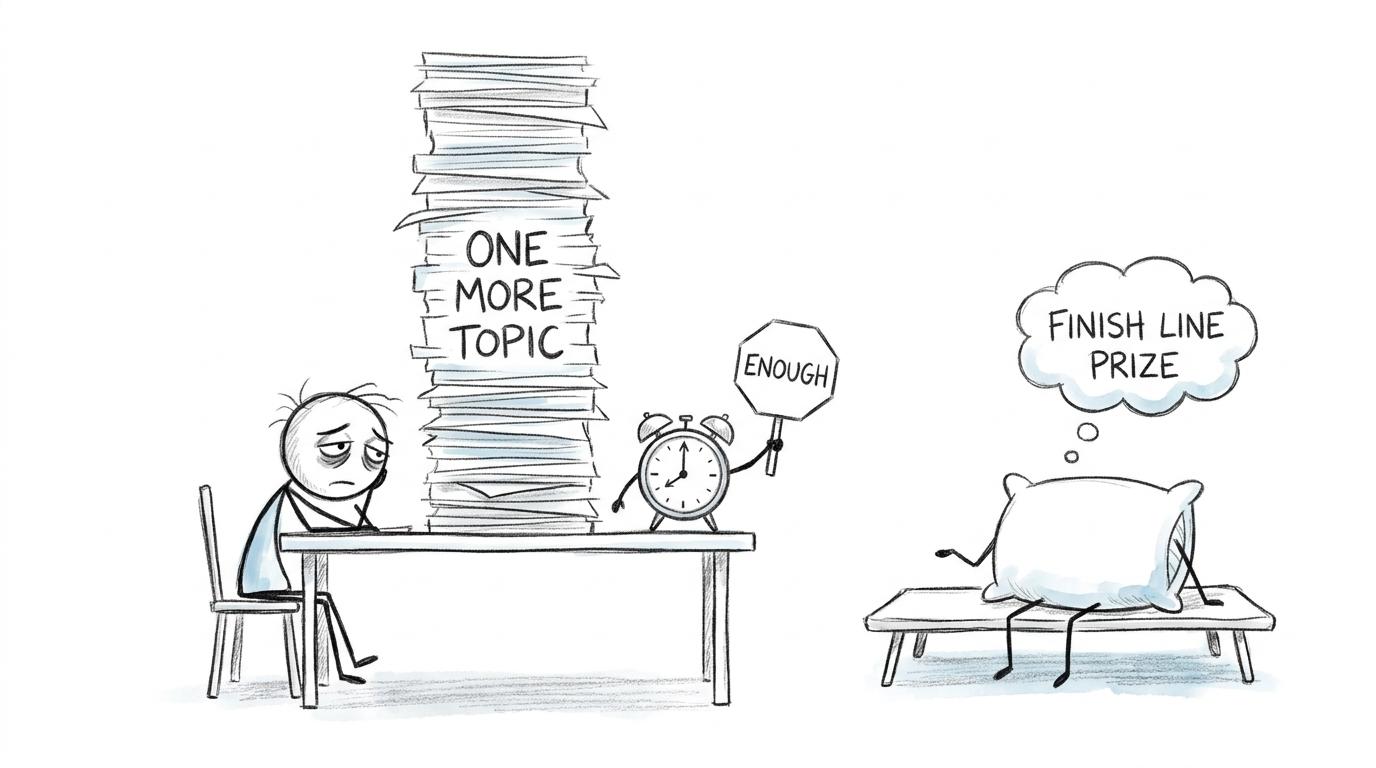 A tired GCSE student choosing an alarm clock's sensible stop sign over one more Business topic
Set your cut-off by working backwards
A fixed universal finishing time is less useful than a rule based on your morning. One student may need to wake before six o'clock for a long journey; another may live beside school. Their revision cut-offs should not be identical.
Begin with the time you must wake. Work backwards to create an opportunity for 888 to 101010 hours of sleep, then reserve at least an hour for winding down. That final hour should not contain an extended-response question, a frantic group chat or a new finance chapter.
For example, if your normal bedtime is around ten o'clock, aim to close your Business notes by nine o'clock at the latest. If you know your mind continues racing after revision, finish earlier. Your usual sleep pattern matters more than forcing an unusually early bedtime that leaves you staring at the ceiling.
The NHS notes that good sleep supports thinking and concentration. Research also indicates that sleep after learning contributes to memory consolidation, while sleep deprivation can impair memory and next-day learning. That does not mean one peaceful night can replace several weeks of preparation. It means sacrificing sleep for one more tired session is usually a poor final trade.
What should your final GCSE Business revision include?
GCSE Business is not simply a vocabulary test. Across regulated GCSE Business qualifications, the assessment objectives broadly require knowledge and understanding, application to contexts, and analysis or evaluation. The national weightings are 35%35\%35% for AO1, 35%35\%35% for AO2 and 30%30\%30% for AO3.
Your final review should therefore touch more than definitions.
Recall a small set of essential knowledge
Choose terms, calculations or relationships you have already encountered. You might review business ownership, stakeholders, marketing, operations, human resources, external influences or finance, depending on the paper you are sitting.
Use your own specification checklist. AQA, Pearson Edexcel, OCR and Eduqas organise content and papers differently, so do not assume a friend's revision list matches yours.
Cover your notes and retrieve the answer before checking it. If you cannot recall something, write a short correction. Do not begin copying an entire textbook chapter.
Refresh application and judgement
Look at one familiar business context and ask:
- Which detail from the case study would make the answer specific?
- What consequence could follow from a business decision?
- Who would be affected?
- What factor might change the final judgement?
This is more useful than memorising a generic paragraph. Application depends on using the business in the question, while evaluation requires a supported judgement rather than an unsupported opinion.
Review your recurring mistakes
Your teacher's feedback is more valuable tonight than a random topic chosen because someone mentioned it online. Read previous comments and identify two or three patterns, such as failing to use the context, giving only one side of an argument or ending without a justified conclusion.
This is the same diagnostic habit encouraged in MathsGenie's guide to finding your weakest GCSE topics. Evidence should decide what you revise; anxiety should not.
Use a traffic-light stopping rule
Sometimes the clock says stop, but worry argues back. A traffic-light check can make the decision less emotional.
Green: finish the session normally
Stop confidently if you can recall the main content you selected, explain how you would apply it and remember your common exam-technique reminders. You have completed the purpose of the session.
Amber: make one brief correction
If one small gap remains, spend no more than a few minutes checking it. Write a compact reminder for the morning, close the materials and stop. Amber does not mean opening another full topic.
Red: stop because your revision quality has fallen
Stop immediately if you are repeatedly rereading the same line, making careless mistakes, feeling increasingly panicked or losing sleep time. Continuing may create the appearance of effort without producing useful learning.
A planned revision timetable prevents this choice from arriving as a nightly crisis. MathsGenie's realistic GCSE maths revision timetable and one-month revision plan show how short retrieval, practice and feedback can be spread across several weeks.
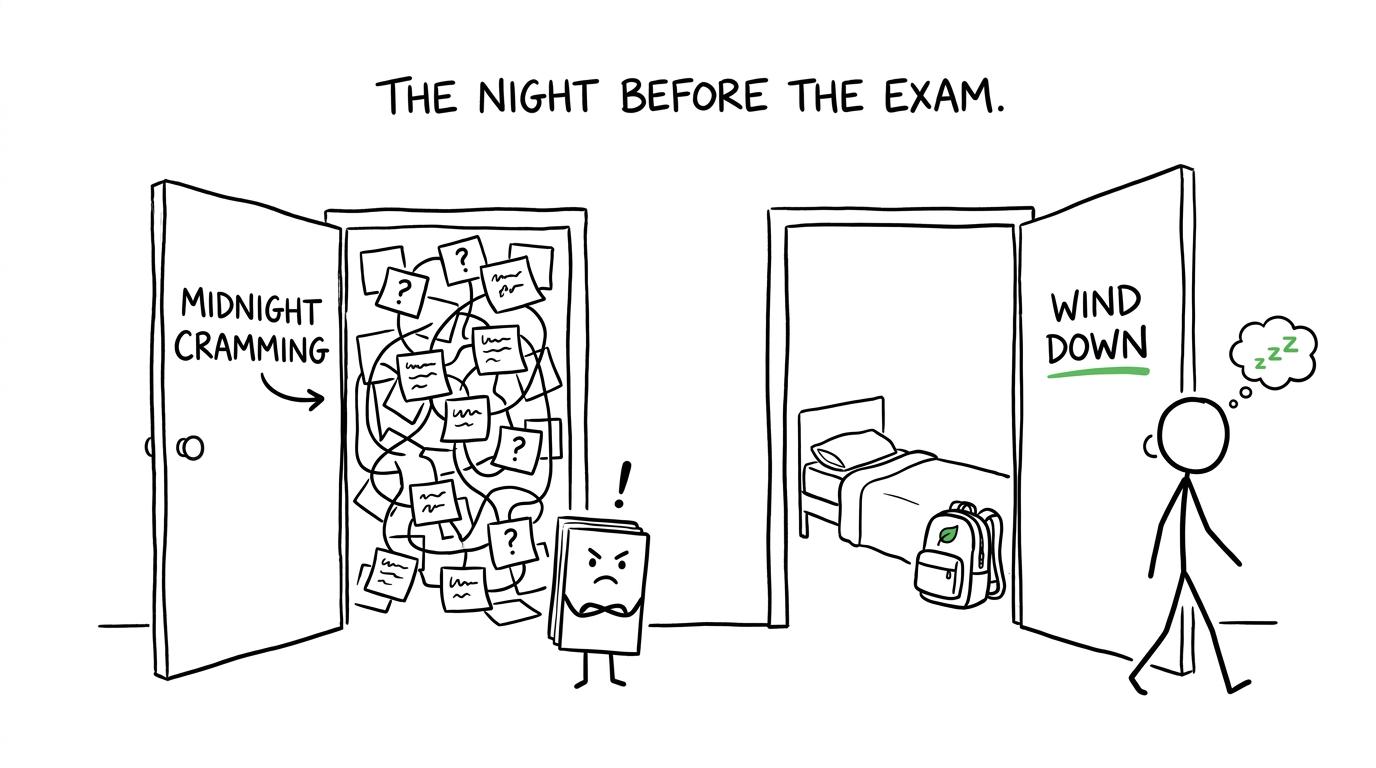 A student choosing the calm wind-down door instead of the midnight-cramming maze
What if you feel underprepared?
Feeling underprepared does not automatically mean staying awake is useful. It means your remaining time must be selective.
First, confirm which paper you are taking. Then identify the highest-priority areas from your specification, teacher guidance and previous assessments. Complete one short recall round and review the structure expected for the main question types. Stop at the planned cut-off even if the course still contains gaps.
That can feel uncomfortable because stopping makes the unfinished work visible. Yet a late evening cannot reliably repair months of missing knowledge. It can still protect tomorrow's concentration, reading accuracy and judgement.
Do not attempt a full paper immediately before bed. Longer exam practice is most valuable when there is enough time to mark it, understand the feedback and revisit weaknesses. MathsGenie's guidance on when to start GCSE past papers explains why papers should shape revision earlier rather than becoming a final-night endurance test.
If Business is not your only exam, protect the next day as a whole. Overloading one evening can affect the paper tomorrow and the revision needed for the examination after it.
Build a proper wind-down period
Stopping revision is not the same as moving directly from flashcards to an hour of stimulating scrolling. Your mind still needs a change of pace.
Use the final hour to:
- pack permitted equipment and check your timetable;
- prepare clothes and anything needed for the journey;
- set an alarm, with a sensible backup if required;
- have a calm conversation, read or listen to something relaxing;
- dim screens or put devices away;
- write down any practical worry that can be handled tomorrow.
Avoid caffeine and energy drinks late in the day. Keep your room calm, dark and comfortable where possible. If sleep does not arrive immediately, do not treat that as another exam you are failing. Rest quietly and avoid returning to demanding revision.
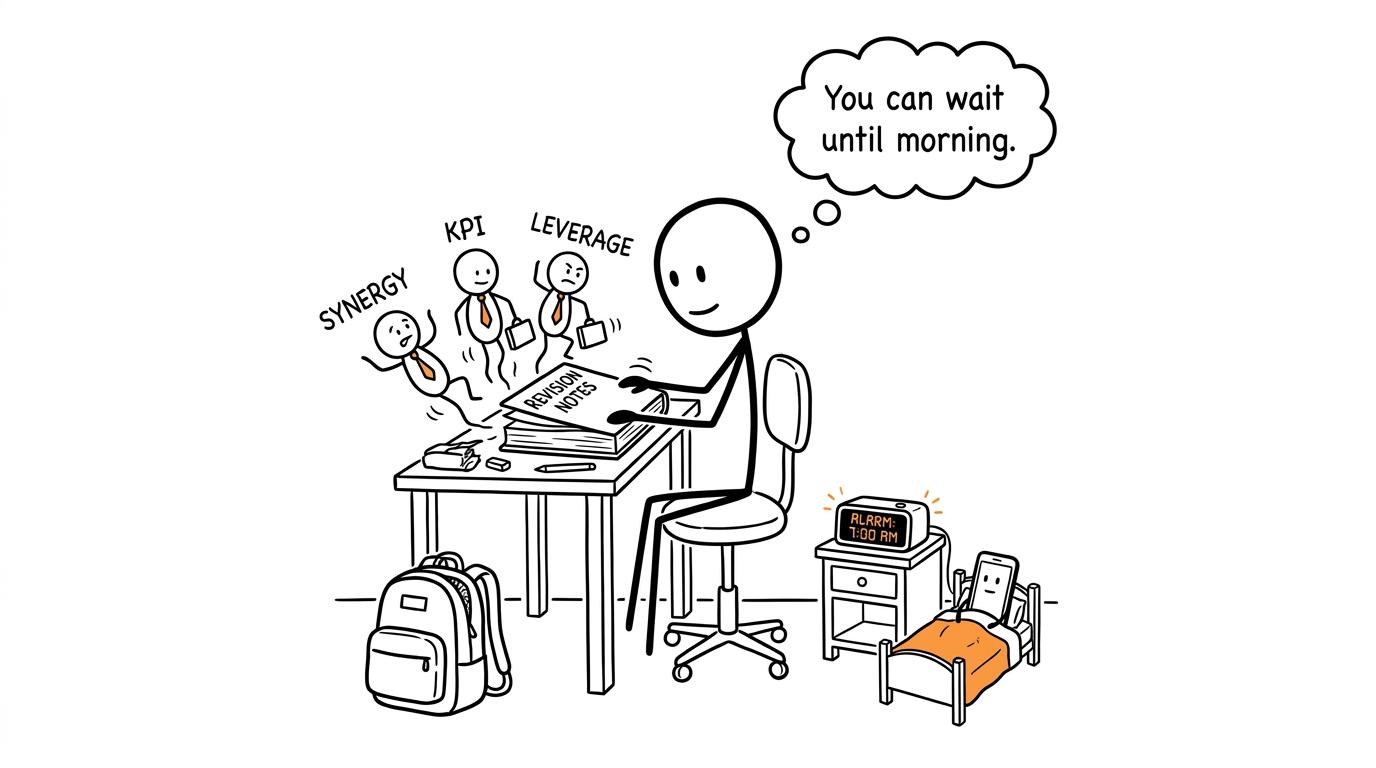 A calm student closing the revision book while the phone sleeps in its own tiny bed
Common mistakes the night before GCSE Business
Revising until you feel completely ready
There may never be a moment when every topic feels secure. Use a time-based cut-off, not a feeling-based one. Otherwise anxiety can keep extending the session.
Starting a major new topic
New content can reveal further gaps and increase panic. Unless your teacher has identified one small, essential omission, reinforce material you have already learned.
Only memorising definitions
Definitions support AO1, but Business papers also require application, analysis and evaluation. Briefly revisit how you will use case-study evidence and build a justified judgement.
Completing questions without reviewing them
Practice only helps when feedback changes your next attempt. Earlier in the revision process, use the cycle of attempt, mark, correct and retest. MathsGenie's GCSE maths revision hub brings together revision lessons, practice questions, mini tests, past papers, mark schemes and video solutions for applying that cycle to maths.
Comparing hours with other students
A message claiming someone revised until two o'clock tells you nothing reliable about the quality of their preparation. Their exam board, knowledge and circumstances may differ. Protect your own plan.
Turning the morning into another panic session
If a brief morning review helps, keep it familiar and calm. Read a small reminder sheet rather than testing yourself on everything you fear you have forgotten.
Stop while the revision is still useful
The night before an exam creates a strange temptation: because the remaining time is short, every minute seems more valuable. In reality, the value of a minute depends on what it costs. A final tired hour that removes an hour of sleep may be far less useful than it appears.
Set your bedtime, work backwards and finish GCSE Business revision at least an hour before it. Review familiar knowledge, application and exam technique. Then close the book.
For your maths papers, make that calm preparation repeatable with MathsGenie's one-week GCSE maths revision plan. Use free revision lessons and practice questions to repair gaps, then build confidence with mini tests, past papers, predicted papers, mark schemes and video solutions. The goal is not to revise until there is no time left. It is to arrive with enough knowledge, energy and composure to earn the marks you have prepared for.