Gamify Revision GCSE Arabic: Does It Really Help?
Gamify revision GCSE Arabic without letting streaks take over. Learn which rewards support recall, feedback, exam practice and a balanced GCSE maths plan today.
Revision can produce a strange kind of productivity. You complete a daily challenge, protect a streak and collect another badge. The screen congratulates you. Yet if someone asks you to speak Arabic without prompts, the words disappear.
So, does it help to gamify revision GCSE Arabic? Yes, when points, streaks and rewards encourage useful actions such as retrieval, correction and exam-style practice. No. when collecting rewards becomes the goal. Gamification can make starting easier and revision more consistent, but it cannot replace speaking, listening, reading, writing or honest feedback.
That distinction matters for students balancing Arabic with GCSE maths. Both subjects reward regular recall and correction, but the performance required is different. Arabic needs active language production; maths needs accurate methods applied to unfamiliar questions. The game should support those outcomes, not distract from them.
The quick verdict on gamified GCSE Arabic revision
A useful system should pass this checklist:
- The task matches the exam: you retrieve vocabulary, understand audio, speak, read or write.
- Points reward effort with feedback: completing a weak task earns more than repeating an easy one.
- Mistakes remain visible: wrong answers return in later sessions.
- Progress measures learning: you track accurate recall and exam performance, not just minutes logged.
- Rewards stay small: they help you begin without becoming more important than the work.
- Arabic does not consume the whole timetable: maths and other GCSE subjects retain protected revision time.
If your system cannot pass these tests, it may be entertaining without being effective.
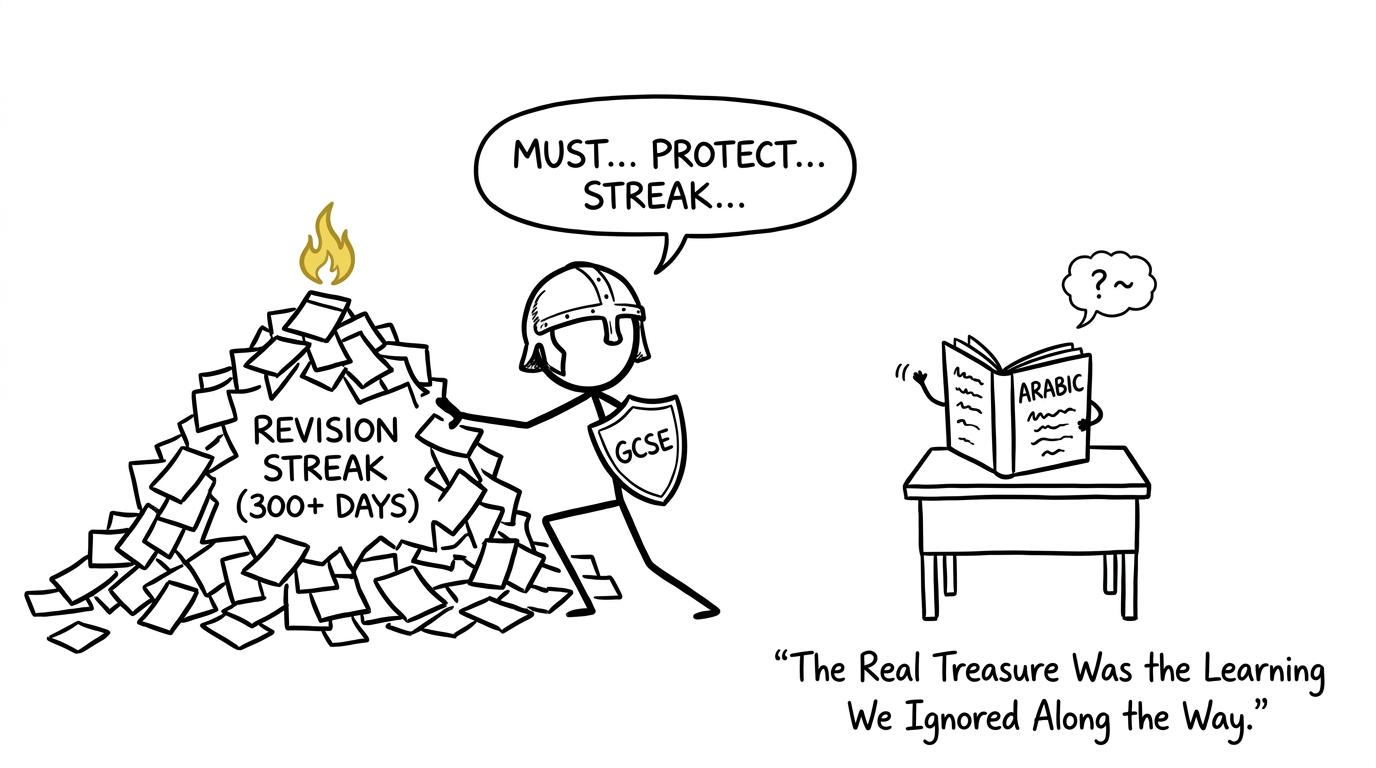 A student guarding a revision streak while the textbook waits
Why gamification can help
Gamification adds game-like features, including points, badges, levels, progress bars and streaks, to an activity that is not itself a game. Its first benefit is often behavioural rather than academic: it lowers the friction of beginning.
A student may resist the vague instruction to “revise Arabic”, yet accept a challenge to retrieve vocabulary for ten minutes. The task has a clear finish line. A progress bar makes completion visible, while a streak can encourage the student to return tomorrow.
Recent systematic reviews of gamification in education generally report benefits for engagement and motivation, with some evidence of improved attainment. However, results depend on the subject, students and design of the activity. Evidence for increased participation is more consistent than evidence that every gamified activity produces lasting academic improvement.
That is a useful warning. Motivation gets you to the desk. Learning depends on what happens there.
Retrieval matters more than the reward
Retrieval practice means attempting to recall previously learnt material without immediately looking at notes. Educational evidence strongly supports this active attempt to remember, especially when the level of difficulty is appropriate and feedback follows.
For GCSE Arabic, useful retrieval might involve:
- recalling a word from its English meaning;
- producing Arabic from a picture or topic prompt;
- listening before viewing a transcript;
- answering speaking prompts aloud;
- reconstructing sentence patterns from memory;
- writing a short response without copying a model answer.
A point awarded after genuine retrieval can reinforce a productive habit. A point awarded merely for opening an app tells you almost nothing.
The same principle applies to maths. Watching a solution can clarify a method, but attempting questions reveals whether you can use it. MathsGenie’s guide to finding your weakest GCSE topics explains how marked evidence can direct the next revision session.
Immediate feedback makes the game educational
A score is not automatically feedback. “Eight out of ten” tells you how many answers were accepted, but not why two were wrong.
Effective feedback identifies the gap and creates a next action. In Arabic, that could mean correcting spelling, agreement, tense, pronunciation or misunderstanding of a listening extract. The difficult item should then reappear after a delay.
Maths students need the same loop. Complete a task, mark it, identify the exact error and try an equivalent question later. The MathsGenie guide to using past papers properly treats the paper as a diagnosis, with the learning happening through review and repair.
When streaks, points and rewards become distractions
Gamification fails when the measurement system changes the target. If the target becomes “keep the streak alive”, students naturally choose the quickest activity that preserves it. That may be understandable, but it is not necessarily revision.
Streaks can reward attendance without progress
Consistency is valuable. Yet a streak records whether something happened, not whether it was difficult, accurate or remembered later.
A student may complete one familiar vocabulary round each evening while avoiding speaking and extended writing. The streak grows; the gaps remain. This is particularly risky in GCSE Arabic because the Pearson Edexcel qualification assesses listening, speaking, reading and writing separately, with each skill contributing 25%25\%25% of the qualification. Students also enter one tier across all four papers, either foundation or higher.
A balanced system should therefore distribute challenges across all four skills. It should also reflect the exact specification and guidance supplied by the student’s school and exam board.
Points can favour easy questions
When every correct answer earns the same reward, easy material becomes the fastest route to a high score. Productive revision usually points in the opposite direction: towards uncertain vocabulary, difficult listening and errors that recur.
A better scoring system values improvement. Give more credit for revisiting an error, completing an uncomfortable speaking task or correcting work after feedback. Award little or nothing for repeating material that is already secure.
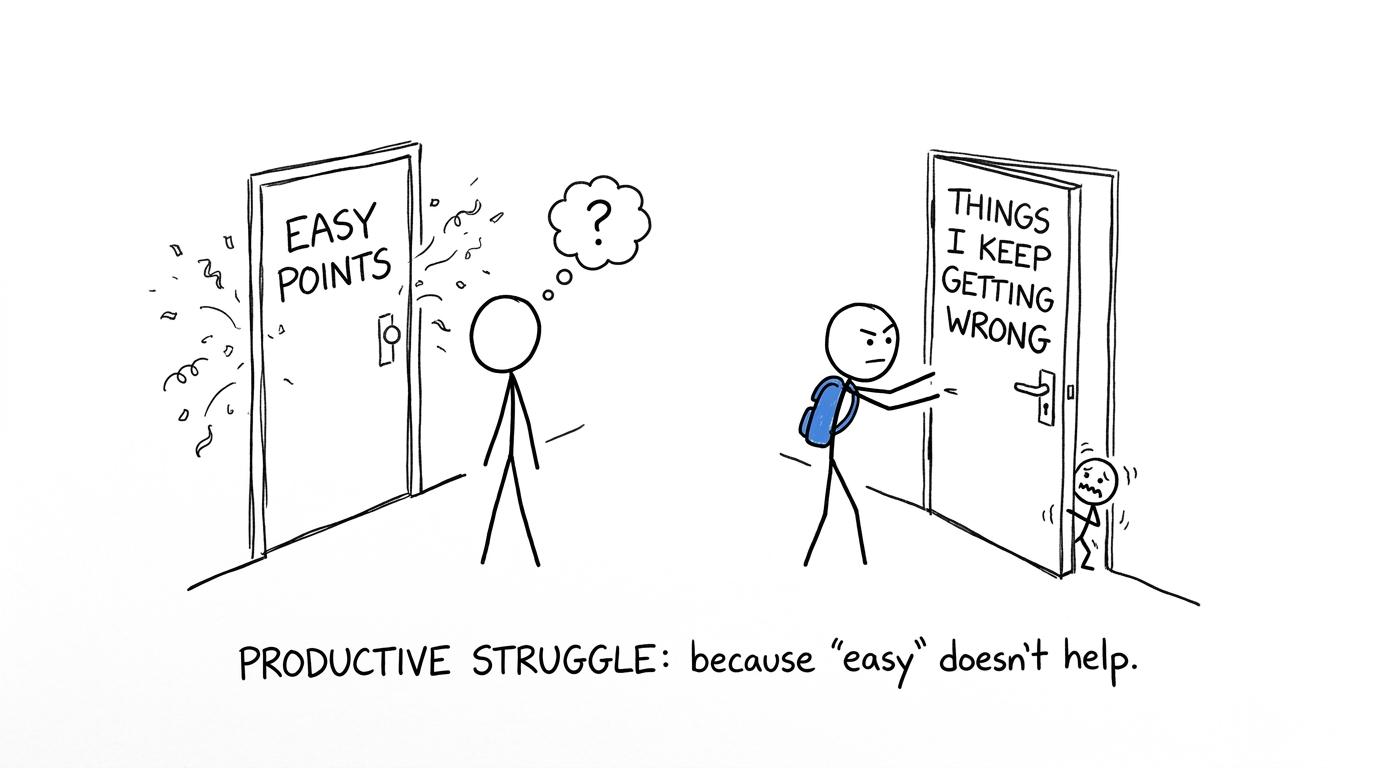 A student choosing difficult revision over easy points
Leaderboards can measure the wrong person
A leaderboard compares students with each other. The exam, however, asks whether you can perform the required skills.
Competition may energise some students, but it can discourage others or tempt people to chase volume rather than understanding. Personal measures are usually more informative: words accurately recalled after a delay, speaking prompts completed without notes, errors corrected, or marks gained under timed conditions.
How to gamify GCSE Arabic revision effectively
The strongest approach is a small game wrapped around a serious revision loop.
Build challenges around the four skills
Create separate listening, speaking, reading and writing quests. This prevents vocabulary quizzes from becoming the entire course.
For example, your challenge categories could include short retrieval, unseen listening, spoken responses, translation, reading comprehension and timed writing. The exact task should match your specification, tier and teacher’s guidance. Do not assume an app’s course structure mirrors an Edexcel paper.
Make weak areas worth more
Use an error log and assign greater value to tasks drawn from it. A corrected recurring mistake should be worth more than another perfect round on familiar content.
This is metacognitive revision: planning a task, monitoring performance and evaluating what to do next. A practical scoring model might reward:
- an honest attempt without notes;
- checking against reliable feedback;
- recording the reason for an error;
- repeating the skill on another day;
- completing an exam-style task under suitable conditions.
The score is not the evidence of learning. The corrected performance is.
Use rewards to start, not to negotiate
Keep rewards immediate and modest: a short break, a progress tick or choosing the next task. Avoid creating a system so elaborate that maintaining it takes longer than revising.
A useful test is simple: if the badges disappeared tomorrow, would the task still improve your exam performance? If not, redesign it.
Add a weekly reality check
Once a week, step outside the game. Complete a short, unseen task with no hints, streak protection or bonus lives. Mark it honestly and compare the result with your previous attempt.
This protects against the illusion of fluency that can arise from recognition-based quizzes. Recognising the right option is easier than producing language independently.
Maths revision needs the same reality check. Edexcel GCSE Maths past papers allow students to test methods under timed conditions, while Edexcel predicted papers can add fresh practice after topic weaknesses have been addressed.
Balancing Arabic gamification with GCSE maths
A revision system should solve a scheduling problem, not create one. Streak-based apps can feel urgent because missing a day has an immediate consequence. A maths exam several weeks away feels less urgent, even though it matters more.
Protect subject time before choosing daily challenges. The GCSE maths revision timetable guide can help turn a broad goal into manageable sessions. If exams are close, use a structured one-month GCSE maths plan or a focused one-week revision plan.
A balanced evening might contain one short Arabic retrieval challenge, one deeper language task and a protected maths block. In maths, use the sequence of revision lesson, practice questions, marking and re-testing. As confidence grows, introduce mini tests and timed papers.
Do not let an Arabic streak borrow time from a weak maths topic simply because the app sends a notification. Your timetable should reflect exam priorities, current weaknesses and energy, not whichever platform is most persistent.
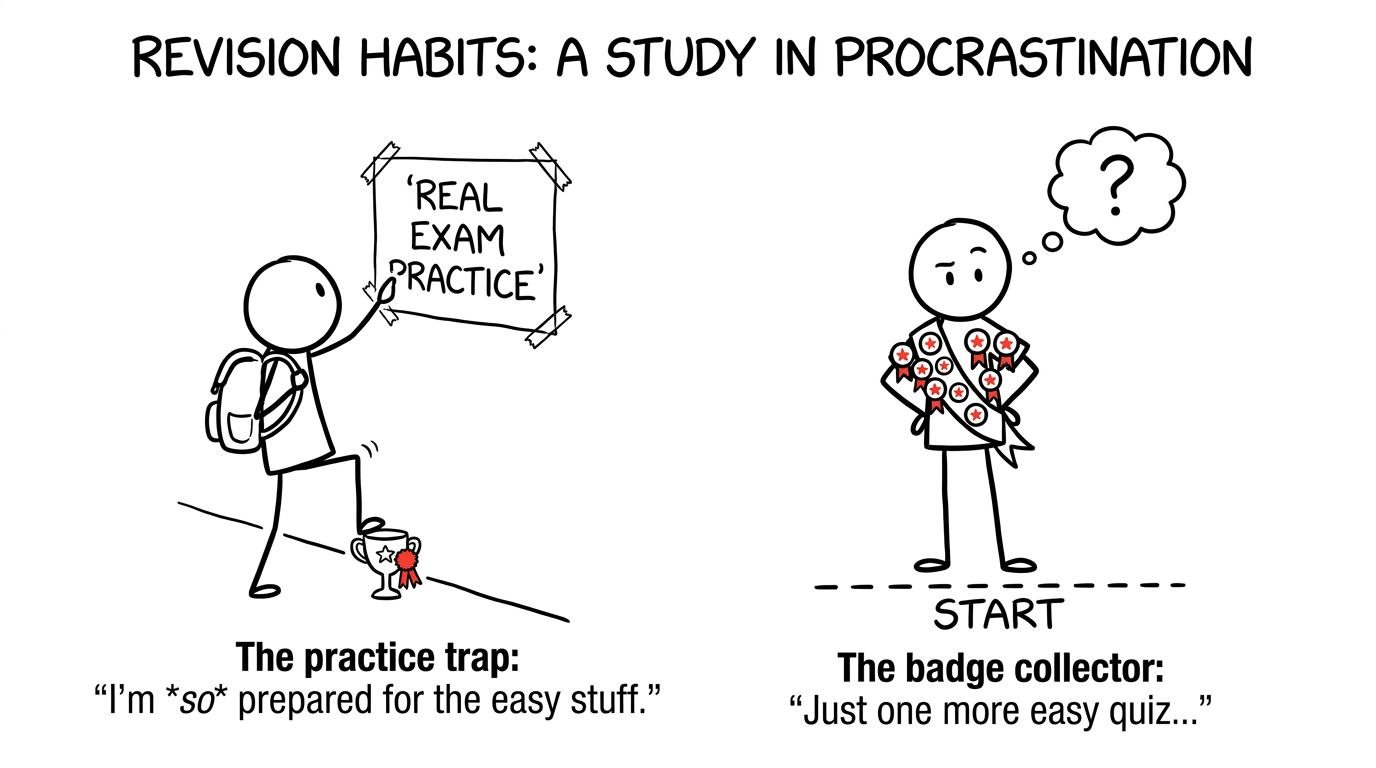 A trophy used as a step towards real exam practice
Common mistakes when gamifying revision
Counting activity instead of learning
Minutes, clicks and points are activity measures. Also track successful recall after a delay, corrected errors and performance on unseen tasks.
Revising only what feels rewarding
Fast vocabulary quizzes can feel satisfying. Speaking, listening and extended writing may expose more uncertainty, which is precisely why they need attention.
Protecting the streak at any cost
Missing one day is not academic failure. Restart calmly rather than completing meaningless tasks late at night. Sleep and a sustainable timetable matter more than a digital flame.
Accepting feedback without processing it
Seeing the correct answer is not the same as learning it. Explain the error, correct it and retrieve the item again later.
Replacing exam practice with games
Gamified tasks can build knowledge, but they should lead towards specification-matched questions and timed performance. Maths students should use past papers at the right stage, then review them with mark schemes and video solutions.
Building a complicated reward economy
If you spend an evening designing levels, currencies and badges, the system has become procrastination. A paper checklist with a few meaningful rules is enough.
The best game is one you eventually outgrow
Gamification is most valuable when it helps a student cross the gap between intention and action. A streak can bring you back tomorrow. Points can make progress visible. A reward can help you begin an uncomfortable task.
But the exam does not award marks for maintaining a streak. It rewards what you can understand, retrieve and produce independently. Use game mechanics as scaffolding, then test yourself without them.
For maths, make MathsGenie your free revision base. Start with revision lessons and practice questions, diagnose gaps with mini tests, and build exam confidence through past papers, predicted papers, mark schemes and video solutions. Let rewards get you started; then let accurate, independent work show that you are ready.