

University GCSE German Requirement: Does It Matter?
University GCSE German requirement explained: when the grade matters, when it rarely does, and how to protect maths revision time for future applications.
The worry often arrives in the middle of revision: could one subject you may never study again quietly limit what happens next? The short answer to the university GCSE German requirement question is reassuring. Universities may see your GCSE German result, but most UK courses do not ask for a particular German grade. It becomes important mainly for certain language degrees, courses with a language pathway, or admissions policies that assess your wider GCSE profile.
For most degrees, GCSE English and maths are far more likely to have stated minimum requirements. Your A Level subjects, predicted grades and course-specific qualifications will usually carry greater weight. Still, “usually” is not the same as “always”, so the safest habit is to check the entry requirements for each course you might eventually consider.
The quick university GCSE German requirement checklist
Use this checklist before allowing the question to consume valuable revision time:
- Most non-language degrees: a specific German grade is unlikely to be required.
- German or modern languages degrees: the grade may matter, depending on whether the course offers beginner and advanced routes.
- Joint degrees involving German: previous language study may be required or used to decide your starting level.
- Competitive applications: your wider GCSE profile may be considered, even when German is not named separately.
- General university requirements: GCSE English and maths are much more commonly specified.
- Final decision: check the current course page for your intended year of entry because universities set their own requirements.
The central point is simple: GCSE German can matter, but it is rarely a hidden universal barrier.
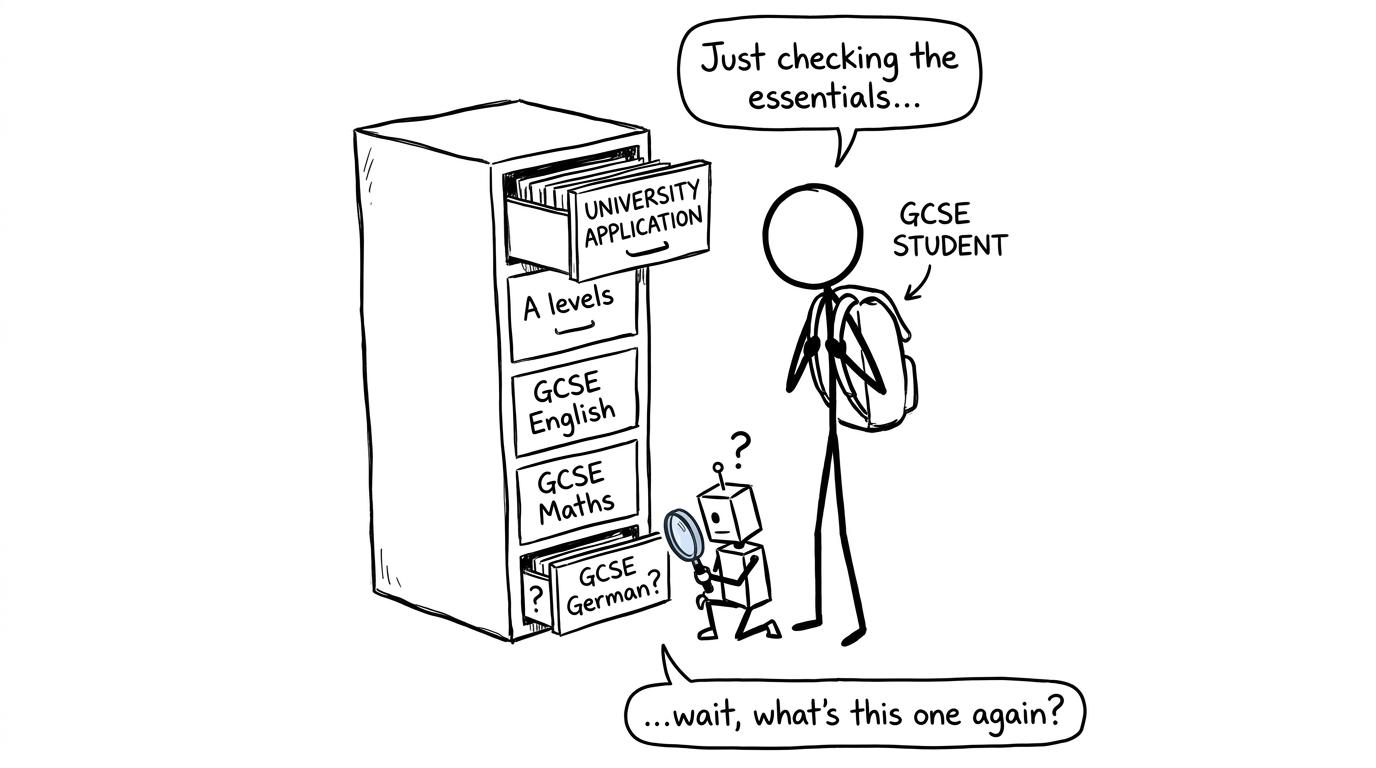 An admissions robot searches for the GCSE German drawer
Do universities actually see your GCSE German grade?
Universities can receive the qualifications declared in your application, which may include your GCSE subjects and grades. This means you should assume that an admissions team can see German alongside maths, English, sciences and your other subjects.
Seeing a grade, however, is not the same as requiring it.
Admissions teams assess applications against the published criteria for a particular course. UCAS guidance confirms that universities and colleges set their own entry requirements, which can include specified qualifications, subjects and grades. Most courses expect some pre-sixteen qualifications, particularly English and maths, but requirements vary between providers and subjects.
A university might therefore use your GCSE German result in one of three ways:
- as a specific subject requirement;
- as part of your overall academic profile;
- not as a meaningful selection factor at all.
The third situation is likely for many degrees unrelated to languages. An engineering department, for example, is generally more interested in whether you meet its mathematics and science requirements than in whether German was your strongest GCSE. You must still read the actual course criteria rather than relying on a general rule.
When does GCSE German genuinely matter?
German and modern languages degrees
Language courses are the clearest case. Yet even here, requirements are not identical.
Some universities offer separate beginner and advanced language routes. A beginner route may require no previous German, while an advanced route may expect A Level German or an equivalent qualification. Other courses ask applicants to demonstrate experience in any modern foreign language, potentially through a GCSE grade.
Current published course information illustrates that variation:
- some German degrees accept complete beginners and place students into an appropriate language stream;
- some advanced routes require German at A Level rather than relying on GCSE German;
- certain modern languages combinations ask for at least GCSE grade 666 in one or more of the languages being studied;
- some beginner pathways accept a strong GCSE in another modern or classical language as evidence of language-learning ability.
This is why searching only for “German degree requirements” can be misleading. You must check whether you are looking at a beginner, post-GCSE or post-A Level pathway.
Joint honours courses involving a language
A course such as German and history, German and business, or law with German may have its own language rule. One university might teach German from beginner level; another might require prior study because the course moves quickly.
The non-language half of the degree does not automatically remove the language requirement. Look under headings such as “required subjects”, “additional requirements” and “GCSE requirements”, not just the headline A Level offer.
Courses that consider your wider GCSE profile
Some universities state that they consider an applicant’s overall GCSE performance alongside specific requirements. In that situation, German is one part of a larger picture rather than a single gatekeeper.
A disappointing German result may contribute to that picture, but it is not sensible to treat one grade as though it controls the entire application. Admissions decisions may also involve Level Three qualifications, predicted or achieved grades, contextual information, admissions tests, interviews, portfolios or other course-specific evidence.
Progression to A Level German
Your GCSE result may matter indirectly if you want to take German at A Level. Schools and sixth forms set their own entry criteria, and a required GCSE grade could affect whether you can continue the subject.
That, in turn, may shape which advanced language courses are open to you later. If German is a serious university possibility, ask your sixth form about its progression requirement before choosing subjects.
When is the grade unlikely to matter?
For many courses in maths, engineering, computing, economics, sciences and unrelated humanities, German is unlikely to be a named GCSE condition. Published requirements more commonly focus on:
- GCSE English Language;
- GCSE Mathematics;
- relevant A Level subjects;
- the overall Level Three grade offer;
- an admissions test or interview where applicable.
A specific course may set a higher GCSE maths requirement than the university’s general minimum. This is especially relevant if you are considering a mathematical degree, so protecting your maths revision time is not simply about the next exam. It can preserve future choices.
Start with the GCSE Maths revision hub to select your exam board and tier. MathsGenie provides free revision lessons, practice questions, past papers and solutions for Edexcel, AQA, OCR and Eduqas, helping you focus on requirements that appear frequently across university course pages.
The sensible conclusion is not that German is unimportant. It is that the importance of a qualification depends on the route you choose.
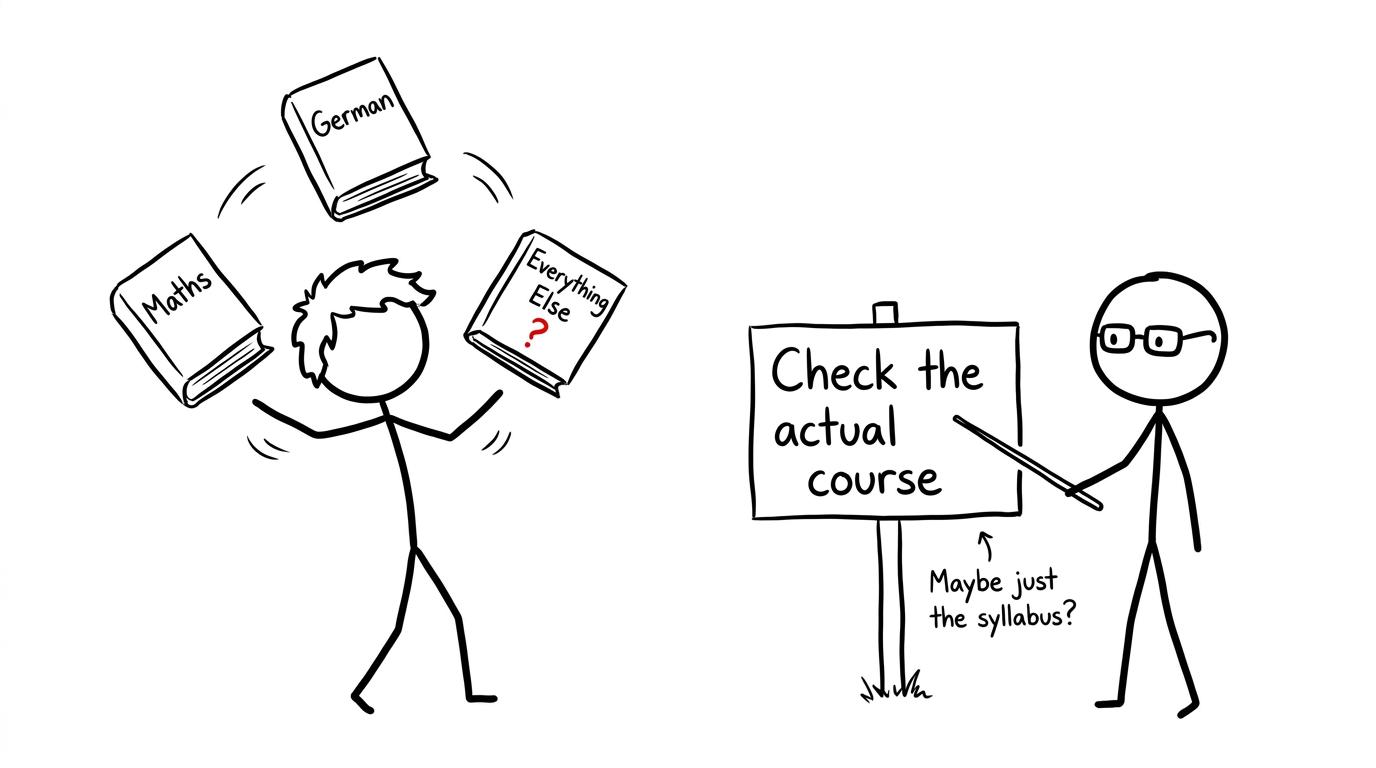 A student juggles revision books while being told to check the actual course
How to check a university course properly
Course requirements can change between entry years. A page describing one admissions cycle should not be treated as a permanent promise.
Read the provider’s current course page
Check the official page for the exact degree and year of entry. Do not assume that two universities offering courses with similar titles use the same criteria.
Look for:
- the standard and contextual offers;
- required A Level subjects;
- individual GCSE requirements;
- beginner or advanced language routes;
- accepted equivalent qualifications;
- English-language requirements;
- admissions tests, interviews or additional checks.
Separate “required” from “preferred”
These words have different consequences. A required qualification is normally a condition of entry. A preferred subject may strengthen preparation without being compulsory. A sentence describing useful experience is not necessarily a formal grade requirement.
If the wording remains unclear, contact the university admissions team. A short, precise question is better than building an entire revision strategy around an assumption.
Compare several realistic choices
University choice is partly an exercise in avoiding single points of failure. Compare courses with different requirements, including ambitious, realistic and safer possibilities. If one language programme requires prior German and another offers a beginner route, you have learned something useful about your options rather than something final about your ability.
| Possible course | Likely relevance of GCSE German |
|---|---|
| German or modern languages | May be required or used for placement |
| Joint degree involving German | Depends on whether a beginner route exists |
| Maths, engineering or computing | Usually not a named German requirement |
| Unrelated humanities or sciences | Usually part of the wider profile, if considered |
| Any highly selective course | Full GCSE performance may receive closer attention |
“Likely” matters in this table. The published requirement for the individual course always wins.
How this should change your GCSE maths revision
Future requirements can create an odd kind of panic: every grade begins to feel equally decisive. But equal anxiety does not produce equal value.
First, make sure you are preparing for the correct exam board and foundation or higher tier. Then diagnose where maths marks are being lost. The one-month GCSE maths revision plan offers a structured approach when time is limited, while the guide to starting GCSE past papers explains when to move from topic practice into timed work.
A reliable revision loop is:
- learn or refresh one weak topic;
- complete exam-style practice questions;
- mark the work carefully;
- identify why each mark was lost;
- revisit the lesson;
- retest the same skill later.
The detailed guide to using GCSE past papers properly helps turn a paper into diagnosis rather than judgement. If you take Edexcel, the efficient Edexcel revision guide shows how to combine topic work with exam practice.
Predicted papers can also help near the exam, but they should sharpen revision rather than replace the specification. Read the guide to using predicted GCSE topics sensibly before treating any topic list as a guarantee.
Common mistakes when thinking about GCSE requirements
Assuming every university follows one rule
Universities set course-specific requirements. A German grade accepted for one programme may be irrelevant, insufficient or unnecessary for another.
Confusing German GCSE with qualifications from Germany
GCSE German is a UK subject qualification. It is not the same as the German Abitur, and it does not automatically prove the level of language proficiency required to study at a German university. International applications need separate checking.
Reading only the headline A Level offer
An offer such as three A Level grades may sit above additional GCSE conditions. Always open the full entry-requirements section.
Believing one lower grade ruins every application
A grade matters most when it fails a stated condition. Outside that situation, it is usually considered in context rather than acting as an automatic rejection switch.
Neglecting maths because German feels more uncertain
Uncertainty attracts attention. Published requirements deserve it. GCSE maths is commonly specified across a wide range of degrees, so it should remain a revision priority. If panic appears the evening before an exam, use the GCSE maths night-before plan instead of attempting an unfocused late-night marathon.
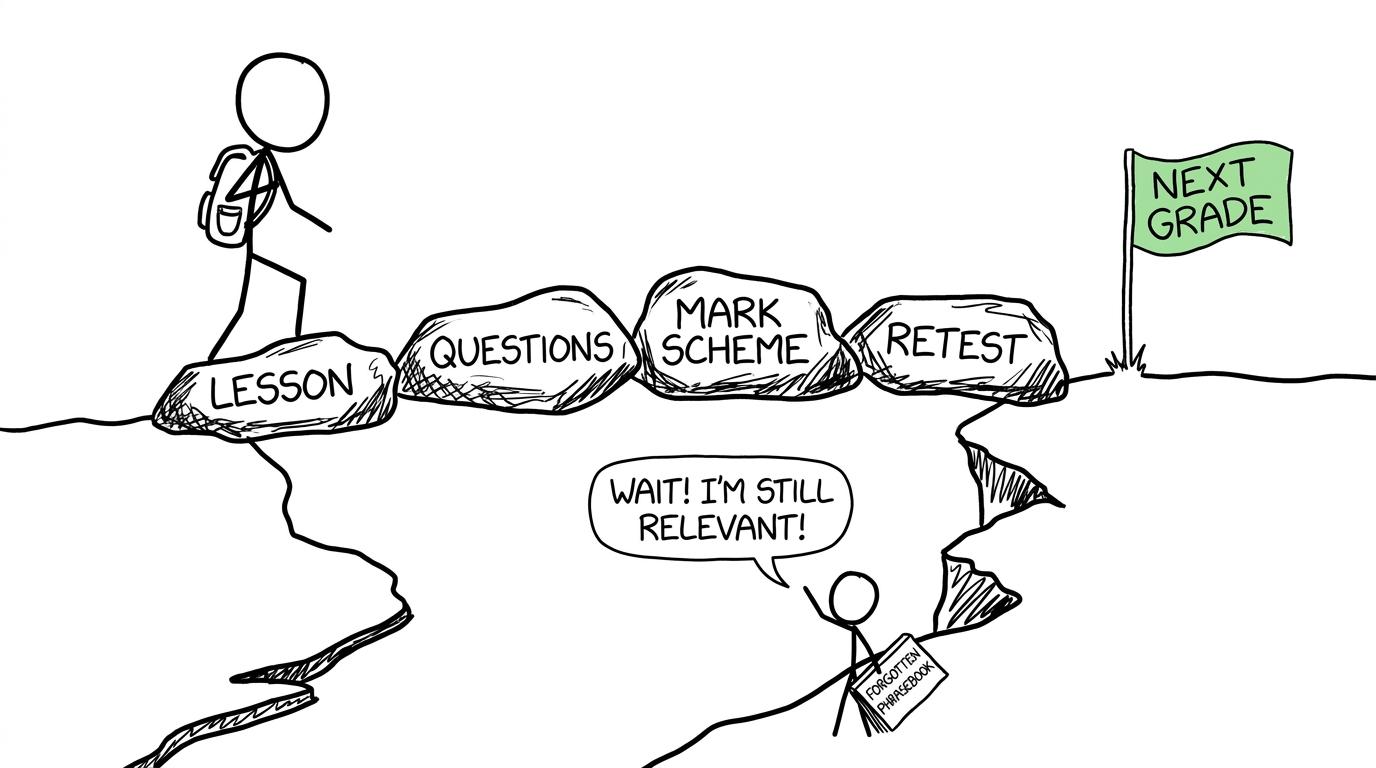 A student crosses the revision bridge towards the next grade
Keep the grade in perspective and keep your options open
Universities may look back at GCSE German, but for most non-language courses they will not demand a particular grade in it. The result matters most when a course names German, requires evidence of prior language learning, uses it to select a language pathway, or considers the whole GCSE profile closely.
So check rather than guess. Read the current requirements for each course, notice the difference between beginner and advanced routes, and ask admissions staff when the wording is unclear.
Then return to the work in front of you. Use MathsGenie’s free revision lessons to rebuild weak topics, practice questions and mini tests to develop accuracy, mark schemes and video solutions to understand lost marks, and past papers or predicted papers to prepare under exam conditions. A future application is built from many decisions. Today’s useful decision is simply to begin the next focused piece of revision.











