

Tracking Revision Progress for GCSE Media Studies
Tracking revision progress GCSE Media Studies: see when a spreadsheet reveals weak areas, improves recall and supports a realistic revision plan.
There is a particular kind of revision session that looks impressive but changes very little. The spreadsheet is colour-coded. The progress bars move. Every topic has a status. Yet no difficult question has been attempted.
Tracking revision progress for GCSE Media Studies can help, but only when the information changes what you do next. A spreadsheet or app does not improve your grade by itself. It becomes useful when it records evidence from recall, analysis and exam questions, identifies a specific weakness, and schedules another attempt.
This distinction matters for students balancing Media Studies with GCSE maths. Both subjects contain a lot to organise, but organisation is not the same as learning. The tracker should be the compass, not the journey.
The short answer: does tracking revision work?
A simple tracker is worthwhile if it helps you:
- cover the correct specification content;
- identify knowledge you cannot recall without notes;
- distinguish recall problems from analysis problems;
- plan spaced reviews rather than last-minute cramming;
- act on feedback from teachers, mark schemes and assessed work;
- spend less time deciding what to revise.
It is probably not helping if you:
- update it more often than you answer questions;
- mark topics as complete after reading notes once;
- track minutes rather than learning;
- avoid red or amber ratings because they feel discouraging;
- build charts that never influence your next session.
The principle is simple: tracking helps indirectly. It supports planning, monitoring and evaluation, elements of self-regulated learning highlighted in current Education Endowment Foundation guidance. But the learning still comes from activities such as retrieval practice, feedback, explanation and exam-style application.
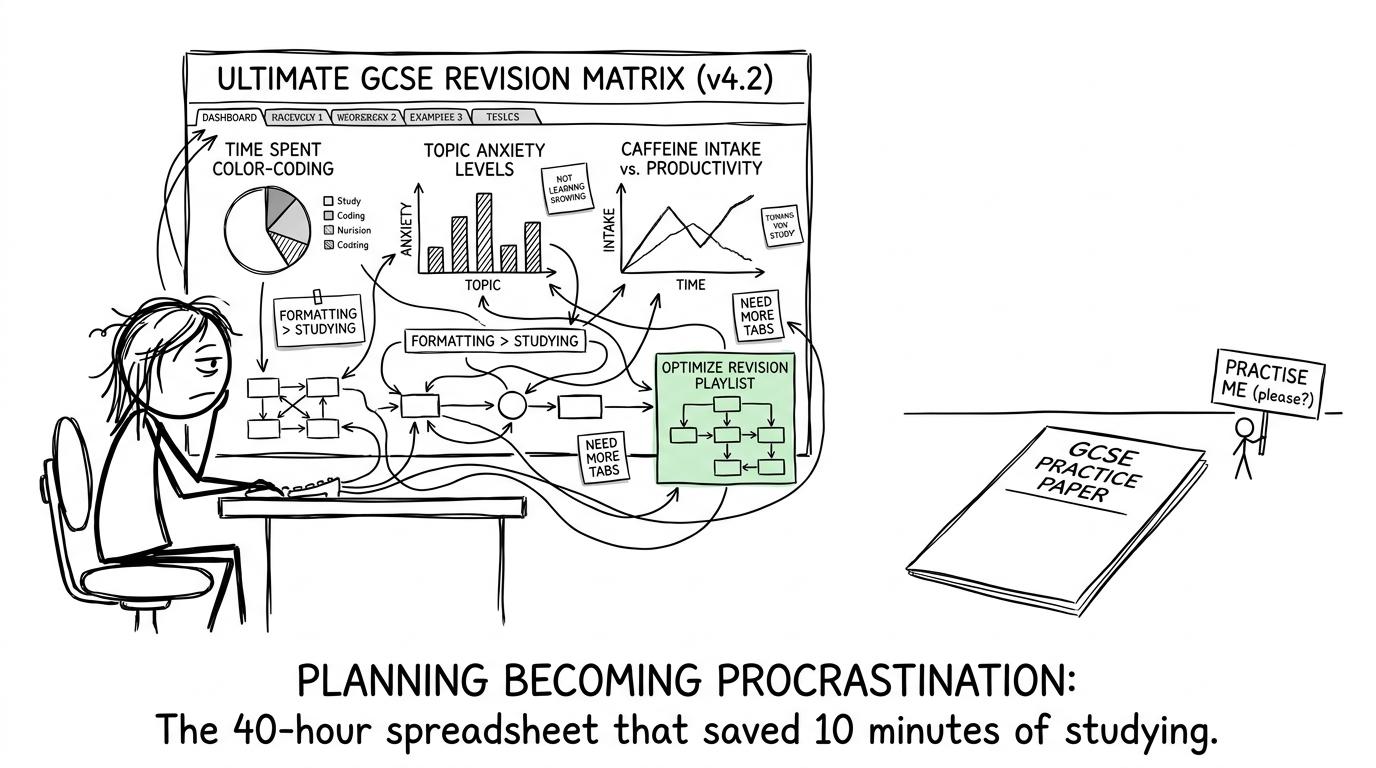 A student perfecting a revision dashboard while an exam paper asks to be practised
What progress means in GCSE Media Studies
A Media Studies tracker should reflect the qualification rather than becoming a generic to-do list. Across GCSE specifications, the assessment objectives cover three broad abilities:
- AO1: demonstrating knowledge and understanding of the theoretical framework and relevant contexts;
- AO2: analysing media products, making judgements and drawing conclusions;
- AO3: creating media products for an intended audience through non-exam assessment.
The precise papers, set products and component arrangements depend on your exam board and specification. AQA, OCR and Eduqas, for example, publish their own current requirements. Products can also change between assessment series, so use the list supplied by your teacher and check that it matches your examination year.
This means that “revised” is too vague to be a useful spreadsheet status. You might remember facts about a product but struggle to analyse an unseen source. You might explain representation clearly yet forget industry terminology. Those are different gaps requiring different actions.
Track skills as well as products
A useful Media Studies tracker separates:
- media language;
- representations;
- audiences;
- media industries;
- historical, social, cultural and political contexts where required;
- knowledge of set or close study products;
- unseen analysis;
- comparison;
- extended-response planning;
- specialist terminology.
This mirrors a lesson maths students learn from past papers: a total mark tells you how the paper went, but not what to repair. MathsGenie's guide to finding your weakest GCSE topics explains how categorising lost marks turns assessment into a practical revision plan.
Build a minimum viable revision spreadsheet
The best tracker is usually smaller than the one you first imagine. Start with columns that answer four questions: what did you revise, what evidence did you produce, what went wrong, and what happens next?
| Column | What to record |
|---|---|
| Topic or product | A precise area from your specification |
| Skill | Recall, analysis, comparison, planning or terminology |
| Revision activity | Closed-book recall, essay plan, timed question or self-quiz |
| Evidence | Mark, teacher feedback or a specific gap you noticed |
| Confidence | A consistent rating from 000 to 333 |
| Main weakness | One brief and honest diagnosis |
| Next action | The exact task that should repair the weakness |
| Review date | When you will retrieve or apply it again |
A sensible confidence scale might mean:
- 000: I cannot begin without notes;
- 111: I remember fragments but cannot use them reliably;
- 222: I can answer a standard question with some omissions;
- 333: I can retrieve and apply the material independently.
Treat these ratings as decisions, not measurements of your ability. Confidence is subjective, so combine it with evidence. If a topic feels like a 333 but your timed response lacks terminology and supporting detail, the response is more informative than the colour of the cell.
Measure outputs, not just time
Time can confirm that a session happened, but it cannot confirm that learning happened. A student could spend an hour copying notes and retain less than someone who spends twenty focused minutes retrieving information and checking errors.
More useful measures include:
- questions attempted;
- marks earned or lost;
- facts accurately recalled without prompts;
- essay plans completed under a time limit;
- misconceptions corrected;
- weak topics successfully retested.
If you want an overall coverage figure, calculate it honestly:
Coverage percentage=areas tested at least oncetotal areas listed×100%\text{Coverage percentage}=\frac{\text{areas tested at least once}}{\text{total areas listed}}\times 100\%Coverage percentage=total areas listedareas tested at least once×100%Coverage is not mastery. It merely tells you whether every area has produced some evidence. Keep confidence, accuracy and coverage separate rather than compressing everything into one reassuring percentage.
Turn each spreadsheet entry into revision
A tracker starts earning its place when a red or amber cell triggers a defined response. Use this loop:
- Retrieve: close your notes and write or say what you remember.
- Apply: analyse a source, plan a response or answer a question.
- Check: use feedback, class materials or a mark scheme.
- Diagnose: record the precise reason marks would be lost.
- Repair: revisit only the relevant knowledge or skill.
- Retest: attempt a fresh prompt after a gap.
For maths, the same cycle is supported by MathsGenie's GCSE maths revision hub, which brings together revision lessons, practice questions, mini tests, past papers, predicted papers, mark schemes and video solutions. The article on moving from GCSE notes to active recall is especially useful if your current tracker mainly records reading or highlighting.
Media Studies needs the same intellectual shift. Replace “read audience notes” with “retrieve three audience ideas, apply them to a set product, then check what was missing”. The second instruction creates evidence. The first merely records exposure.
Spreadsheet or revision app: which is better?
Neither format has an automatic learning advantage. Choose the tool that creates the least friction while preserving useful evidence.
A spreadsheet works well when you want to:
- customise categories around your specification;
- sort by confidence, review date or question type;
- see all products and skills together;
- keep an error log beside your schedule.
An app may be better when you want:
- quick reminders;
- flashcard scheduling;
- easy updates from a phone;
- fewer decisions about layout.
Paper can also work. A printed grid avoids notifications and prevents endless redesign. The question is not which tool looks most advanced. Ask which one gets you from evidence to practice fastest.
Set a limit on administration. Update the tracker briefly after a meaningful task, then leave it alone. If maintaining the system takes longer than marking the work that feeds it, simplify it.
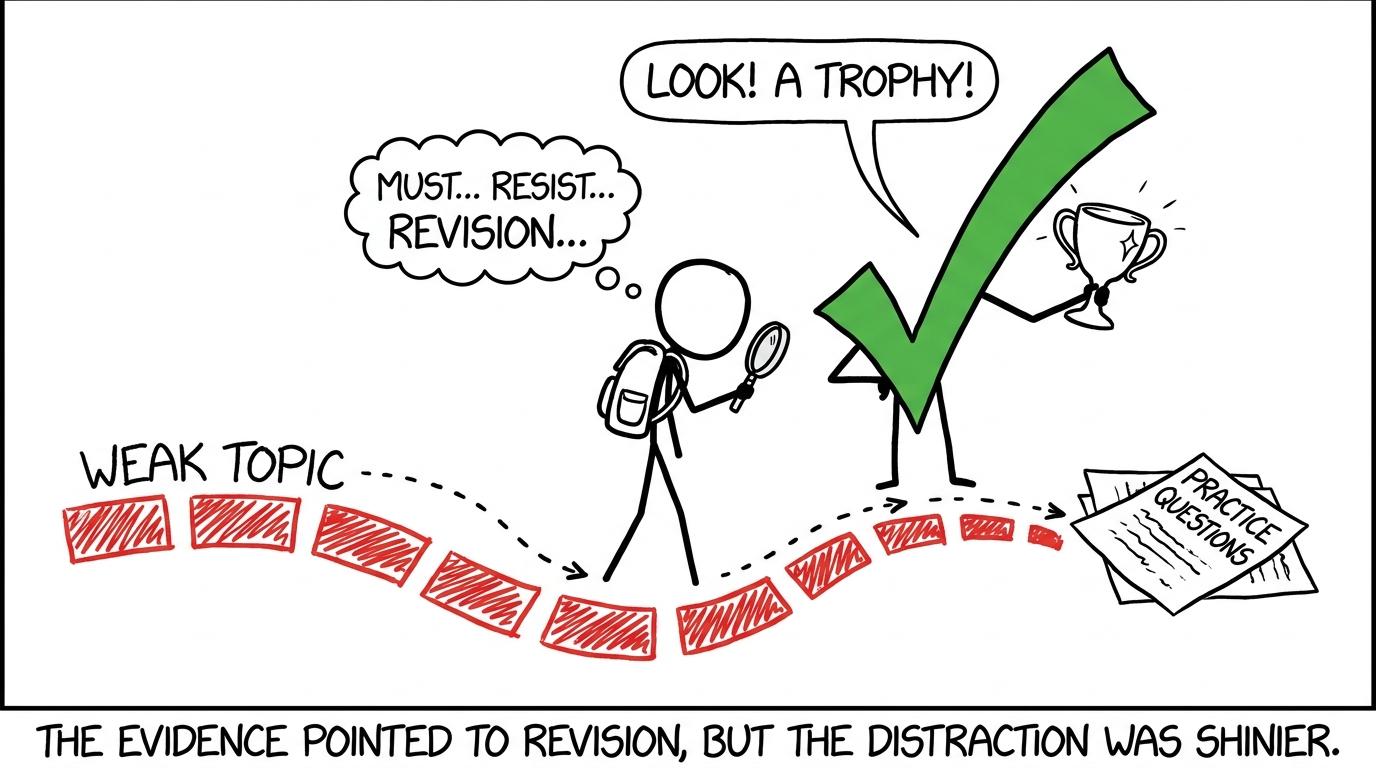 A revision detective follows weak-topic evidence towards practice questions
Use one system across Media Studies and maths
Students often have separate revision systems for every subject, each demanding attention. A better approach is to use the same process while changing the evidence.
For Media Studies, evidence might be a closed-book knowledge test, unseen analysis or extended-response plan. For maths, it might be a mini test, topic worksheet or timed paper. Foundation and higher tier apply to GCSE maths, not GCSE Media Studies, so your maths resources must match the tier you will sit.
Start maths sessions through the GCSE maths revision resources. If you take Edexcel, the Edexcel GCSE maths past papers provide papers and mark schemes for generating dependable evidence. Record the topics behind lost marks rather than writing only the paper total.
MathsGenie's advice on when to start GCSE past papers also explains why shorter diagnostics can come before regular full papers. The same principle suits Media Studies: begin with focused recall and question planning, then build towards longer timed responses.
A shared weekly review can then ask:
- Which weakness appeared more than once?
- Which topic has not been tested recently?
- Which improvement is supported by fresh evidence?
- What are the next two tasks for each subject?
The best order for learning GCSE maths topics can help you place those maths tasks in a sensible sequence, while your Media Studies specification should determine that subject's content list.
Common mistakes when tracking revision progress
Treating completion as mastery
Watching a video, reading a page or attending a lesson does not prove independent recall. Use statuses such as “tested” and “retested” rather than “done”.
Recording vague weaknesses
“Bad at audiences” is difficult to act upon. “Cannot apply the preferred reading concept to an unseen product” points towards a specific retrieval and analysis task.
Making every cell green
A tracker with no weaknesses is not encouraging; it is uninformative. Red cells are valuable because they protect you from revising only familiar material.
Tracking effort without feedback
Hours and streaks can support routine, but they should not replace marks, corrections or teacher comments. The guide to stopping GCSE maths content from being forgotten shows how retrieval and later review make a schedule more meaningful.
Building the system during revision time
Choose a few columns and begin. A plain spreadsheet that sends you towards difficult questions is better than an elegant dashboard that delays them.
Make the tracker prove its value
For two weeks, use the simplest version of the system. At the end, ask whether it helped you choose tasks faster, revisit weak material and produce better answers. If it only recorded activity, remove columns or abandon it. A revision tool should earn the time it consumes.
The useful idea behind tracking revision progress for GCSE Media Studies is not the spreadsheet itself. It is the habit of looking for evidence, responding to weaknesses and returning later to check whether learning lasted.
Use that same habit for maths. Open the MathsGenie GCSE maths revision hub, choose the correct exam board and tier, and begin with one diagnostic task. Then use free revision lessons, practice questions, mini tests, past papers, predicted papers, mark schemes and video solutions to repair what the result reveals. Pair the evidence with your revision planner, keep the tracker brief, and let actual practice move the cells.










