

Tracking Revision Progress: GCSE English Literature
Tracking revision progress GCSE English Literature: see when a spreadsheet improves recall and essays, when it wastes time, and what to record effectively.
Revision can look organised long before it becomes useful. A spreadsheet fills with colours. An app builds a streak. Every chapter receives a reassuring tick. Yet the uncomfortable question remains: could you plan an essay, recall evidence and respond to an unfamiliar question without your notes?
That is the test of whether tracking revision progress GCSE English Literature is worthwhile. A spreadsheet can help when it directs you towards retrieval, writing and feedback. It does not improve your result simply because you update it. The tracker is the map; recalling quotations, planning arguments and writing exam responses is the journey.
For students also preparing for GCSE maths, this distinction matters across both subjects. Progress comes from what you can produce independently, not how tidy your revision system appears.
The short answer: does tracking revision help?
Yes, potentially, but only indirectly.
Educational evidence supports metacognitive habits such as planning, monitoring and evaluating learning. A tracker can support those habits by showing what you have covered, where performance is weak and what you should do next. Evidence also supports retrieval practice, spaced review and feedback. A useful spreadsheet helps you organise those activities.
There is not good reason to assume that entering data into a spreadsheet, maintaining an app streak or colouring cells will improve an English Literature grade by itself. Tracking becomes valuable when it changes your next action.
Use this quick test:
- Does the tracker identify a specific weakness?
- Does it schedule a useful task rather than just “revise English”?
- Does it record evidence from recall, essay planning or writing?
- Does it lead to feedback and another attempt?
- Can you update it in less than a few minutes?
If the answer is mostly yes, keep it. If maintaining the system consumes the time intended for revision, simplify it.
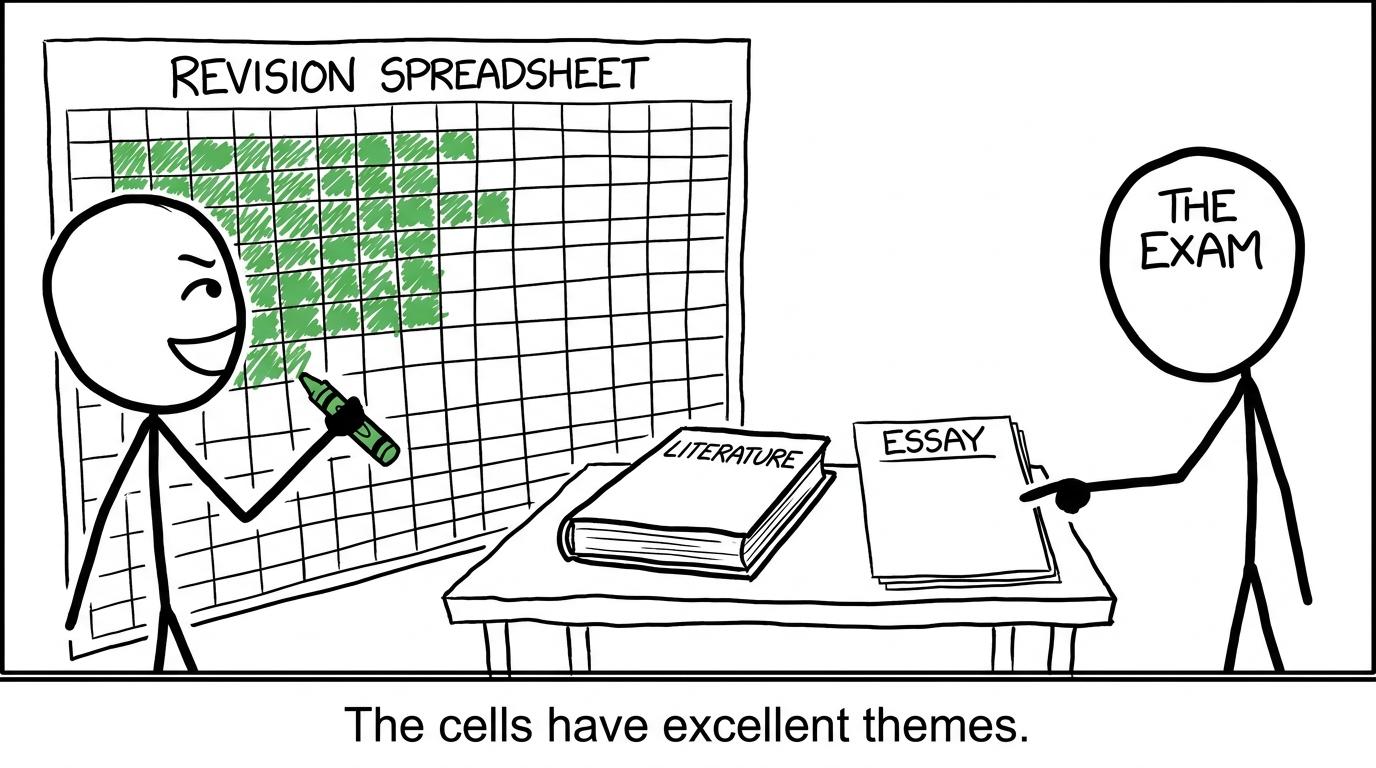 A student discovers that colourful spreadsheet cells cannot write the essay
What GCSE English Literature progress really means
English Literature is not a list of facts that becomes complete once every row is green. Students need knowledge, but they must also select and use it in response to a question.
Across GCSE English Literature specifications, assessment objectives broadly reward the ability to:
- respond thoughtfully to texts and support interpretations with references;
- analyse writers’ use of language, form and structure;
- understand relevant relationships between texts and contexts;
- write accurately where technical accuracy is assessed.
The exact papers, prescribed texts, question formats and weighting should always be checked against your exam board’s current specification. AQA, Edexcel, OCR and Eduqas do not necessarily organise their assessments in identical ways. Unlike GCSE maths, English Literature is not divided into foundation and higher tiers.
This means “read Act One” is weak evidence of progress. “Planned a response on responsibility and selected three relevant references from memory” is stronger. “Wrote a timed response, received feedback and improved the analysis of methods” is stronger still.
A good tracker records capability rather than exposure.
What to put in your revision spreadsheet
Keep the spreadsheet small enough to use. One row can represent a text, theme, character, poem, question type or specific weakness. Include only columns that influence a decision.
Text or component
Record the relevant area, such as a Shakespeare play, nineteenth-century novel, modern text, anthology poetry or unseen poetry. Use the component names from your own specification rather than copying somebody else’s template.
Precise revision task
Avoid vague entries such as “Macbeth revision”. Use actions that produce evidence:
- retrieve key events without notes;
- recall references for a theme;
- create an essay plan from an unseen question;
- compare two poems;
- write a timed paragraph;
- complete a full response;
- improve an answer using teacher feedback.
These tasks reveal what you can actually do.
Assessment focus
Add the relevant assessment objective or skill. You might discover that you know the text well but analyse methods superficially, or that contextual comments are replacing close analysis rather than supporting it.
Evidence and feedback
Record something observable: a mark where tasks are comparable, a teacher comment, a missed reference, an unclear argument or a repeated technical error. Do not turn every judgement into a false percentage. English responses are qualitative, and marks from different questions are not always directly comparable.
Next action and review date
Every weak result should create a next step. “Analysis poor” is a label. “Rewrite the second paragraph, explaining how the image develops the character’s conflict” is an action.
Add a later review date so that revision is spaced. The ideal interval is not fixed for every student or every topic. Review sooner when knowledge is fragile and extend the gap when recall becomes secure.
Track outputs, not revision hours
Time matters, but it is a poor measure on its own. An hour can contain focused essay practice or repeated rearranging of headings.
If you want one simple measure, track the proportion of planned active tasks completed:
Action rate=completed active tasksplanned active tasks×100%\text{Action rate} = \frac{\text{completed active tasks}}{\text{planned active tasks}} \times 100\%Action rate=planned active taskscompleted active tasks×100%An active task requires you to recall, select, explain, compare, plan or write. Reading notes may sometimes be necessary, but it should usually prepare you for an output rather than replace one.
This principle transfers directly to maths. Watching a method is not the same as solving an unfamiliar question. On the MathsGenie GCSE maths revision hub, revision lessons are paired with exam questions, worksheets and papers so that learning can become visible performance.
A tracker should capture that transition: lesson watched, questions attempted, errors identified and skill retested.
How a spreadsheet can improve revision decisions
The strongest benefit is not motivation or decoration. It is diagnosis.
Suppose your sheet shows plenty of quotation recall but very few timed plans. That imbalance tells you what to do next. If several responses receive feedback about unclear arguments, another set of flashcards will probably not solve the problem. You need planning and writing practice.
The same logic sits behind finding your weakest GCSE topics in maths: use performance evidence, isolate the recurring weakness, practise it and retest it. A total mark matters less than the pattern beneath it.
Tracking can also reduce decision fatigue. Instead of sitting down and wondering what to revise, you open the sheet and complete the next scheduled action. MathsGenie’s one-week GCSE maths revision plan follows the same practical idea: diagnose first, then let weaknesses shape the week.
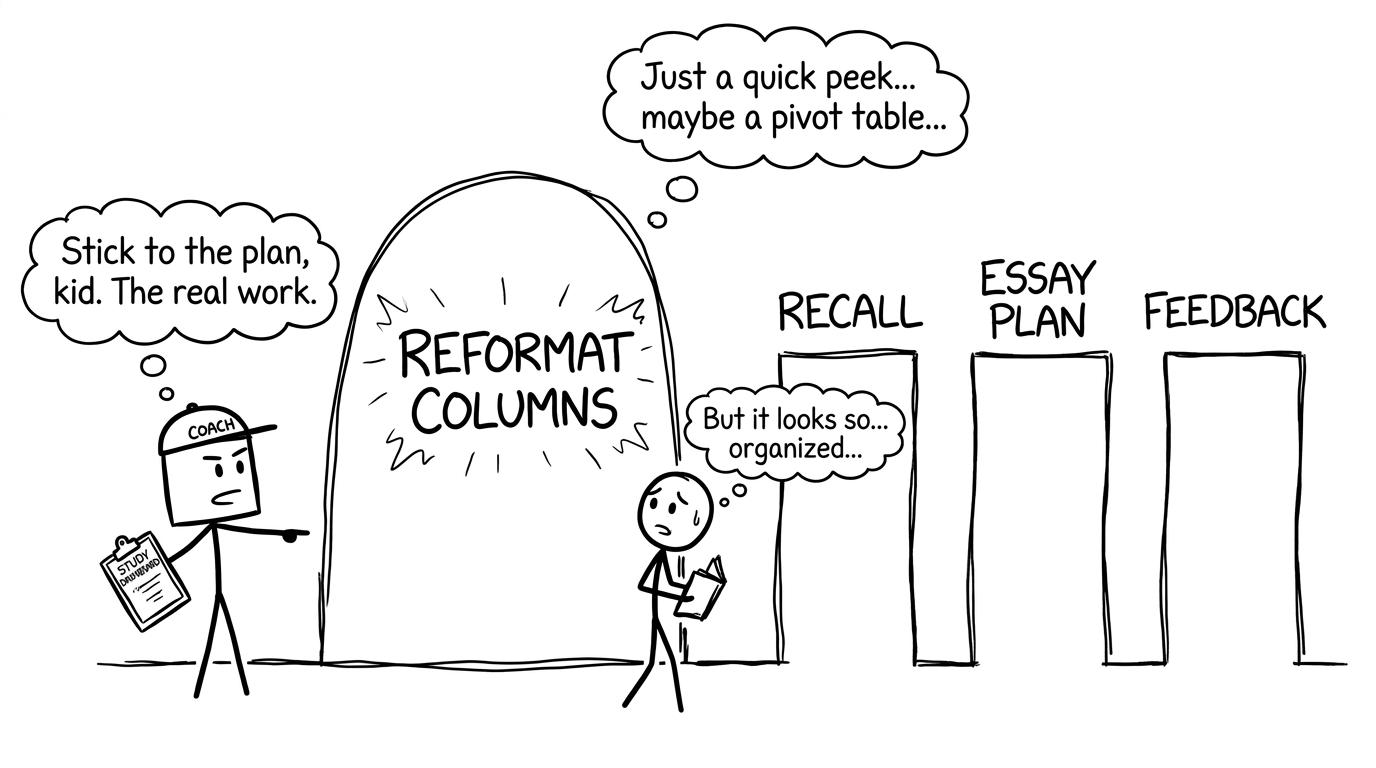 A tiny spreadsheet coaches a student towards recall, planning and feedback
Spreadsheet or revision app: which is better?
Neither format is automatically superior. Choose the least complicated tool that you will continue using.
A spreadsheet is useful when you want:
- a flexible overview of several texts and skills;
- sortable review dates;
- a simple record of feedback and recurring weaknesses;
- control without notifications or gamification.
An app may be useful when it provides:
- quick reminders;
- convenient flashcard scheduling;
- low-friction use on a phone;
- a clear daily queue.
The warning sign is the same for both: the tool begins asking for more attention than the subject. Custom dashboards, elaborate formulas and daily streaks can feel productive because they generate immediate completion. An essay plan offers less instant satisfaction, but it is much closer to what the exam demands.
Set a firm rule: tracking should occupy only a small fraction of the session. Most of the time should go towards retrieval, planning, writing, marking and correction.
A revision loop that makes tracking useful
Use a simple cycle:
- Choose: Select one weakness from recent work or feedback.
- Retrieve: Recall relevant knowledge without notes.
- Apply: Plan or write in response to an exam-style task.
- Check: Compare your work with the mark scheme, guidance or teacher feedback.
- Record: Write one precise strength and one weakness.
- Act: Schedule the smallest task capable of correcting that weakness.
- Retest: Return to the skill with a different question after a gap.
The record is only one step in the cycle. This is why using GCSE past papers properly matters in maths too: completing a paper provides information, but improvement happens when lost marks become targeted practice.
Near the exams, the loop can become shorter. The GCSE maths exam-week checklist uses immediate marking and a small fix list rather than an overwhelming catalogue of every possible topic. Apply the same restraint to English Literature. Choose the few weaknesses that repeatedly affect your responses.
Common mistakes when tracking revision progress
Colouring topics by confidence alone
Confidence is useful, but it is not proof. A familiar quotation can feel secure until you try to recall it without prompts. Record confidence before a task if you wish, then compare it with actual performance.
Counting reading as mastery
Rereading can support understanding, but familiarity is easily mistaken for recall. Close the book and produce something: a sequence of events, a thematic argument, an essay plan or a paragraph.
Tracking quotation quantity
Memorising more quotations is not automatically better. Examiners reward relevant textual support and developed interpretation, not a predetermined quotation count. Track whether you can select useful evidence for different questions.
Predicting a grade from unreliable data
Do not average unrelated task scores and treat the result as a secure predicted grade. Question demands and mark totals vary, while grade boundaries are set for complete examination series. Use marks to identify trends, then discuss grade judgements with your teacher.
Logging weaknesses without fixing them
A red cell that stays red is merely a warning light. Give every weakness a next action and review date.
Building a system too complicated to maintain
If updating your tracker requires a tutorial, simplify it. The best system is not the cleverest. It is the one that repeatedly sends you back to meaningful work. The same principle appears in MathsGenie’s guide to efficient GCSE revision for reluctant students: choose one focused task, practise, mark and repeat.
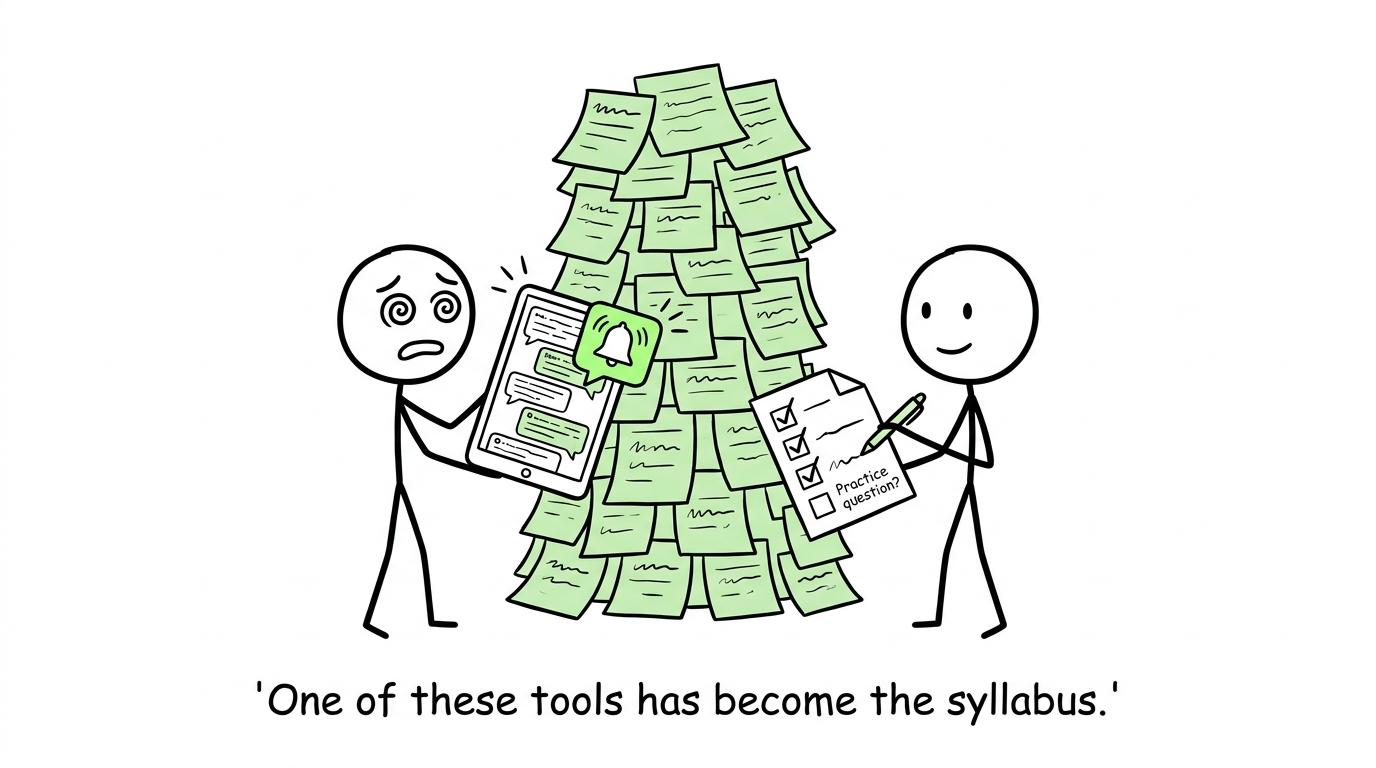 A simple checklist faces a revision monster while an overcomplicated app causes chaos
Use one tracking habit across English and maths
You do not need separate productivity philosophies for every GCSE. The content changes, but the useful questions remain stable:
- What can I do without help?
- Where did I lose marks or clarity?
- What is the smallest useful repair task?
- When will I test it again?
For English Literature, the evidence might be an essay plan, analytical paragraph or teacher comment. For maths, it might be an incorrect method, a missing unit or a question you could not start. MathsGenie’s guide to using Edexcel GCSE maths past papers shows how an error log can connect each mistake to a focused next action.
A shared spreadsheet can therefore work well, provided each subject uses meaningful evidence. Do not compare an English essay mark mechanically with a maths paper percentage. Compare whether your revision loop is closing gaps.
Make the tracker earn its place
A spreadsheet cannot remember a poem, construct an interpretation or solve an equation for you. Its value lies in making avoidance visible and the next action obvious.
Start with a plain sheet, a handful of useful columns and one honest task. After each session, record what the evidence says, not what you hoped the session achieved. Then act on it.
For maths, open the free MathsGenie GCSE revision hub and connect your tracker to real work: revision lessons, practice questions, mini tests, past papers, predicted papers, mark schemes and video solutions. Use the revision planner to decide when you will return to each weakness. The aim is not a perfect spreadsheet. It is better recall, stronger decisions and more marks when the notes are closed.











