Too Late to Revise GCSE Statistics? Start Here
Too late to revise GCSE Statistics? Learn what focused late revision can achieve, which topics to prioritise and how to use past papers effectively now.
The calendar can create a peculiar kind of panic. One moment the exam feels distant; the next, every untouched topic seems to be asking for attention at once.
So, is it too late to revise GCSE Statistics? Usually, no. Even close to the exam, focused revision can improve your recall, expose avoidable mistakes and make unfamiliar questions feel more manageable. What is no longer realistic is trying to relearn the entire course perfectly. Late revision works when you stop chasing completeness and start protecting the marks that are still within reach.
There is no honest promise that a few evenings will transform a grade. Your starting knowledge, available time and exam technique all matter. But there is almost always something useful you can do next.
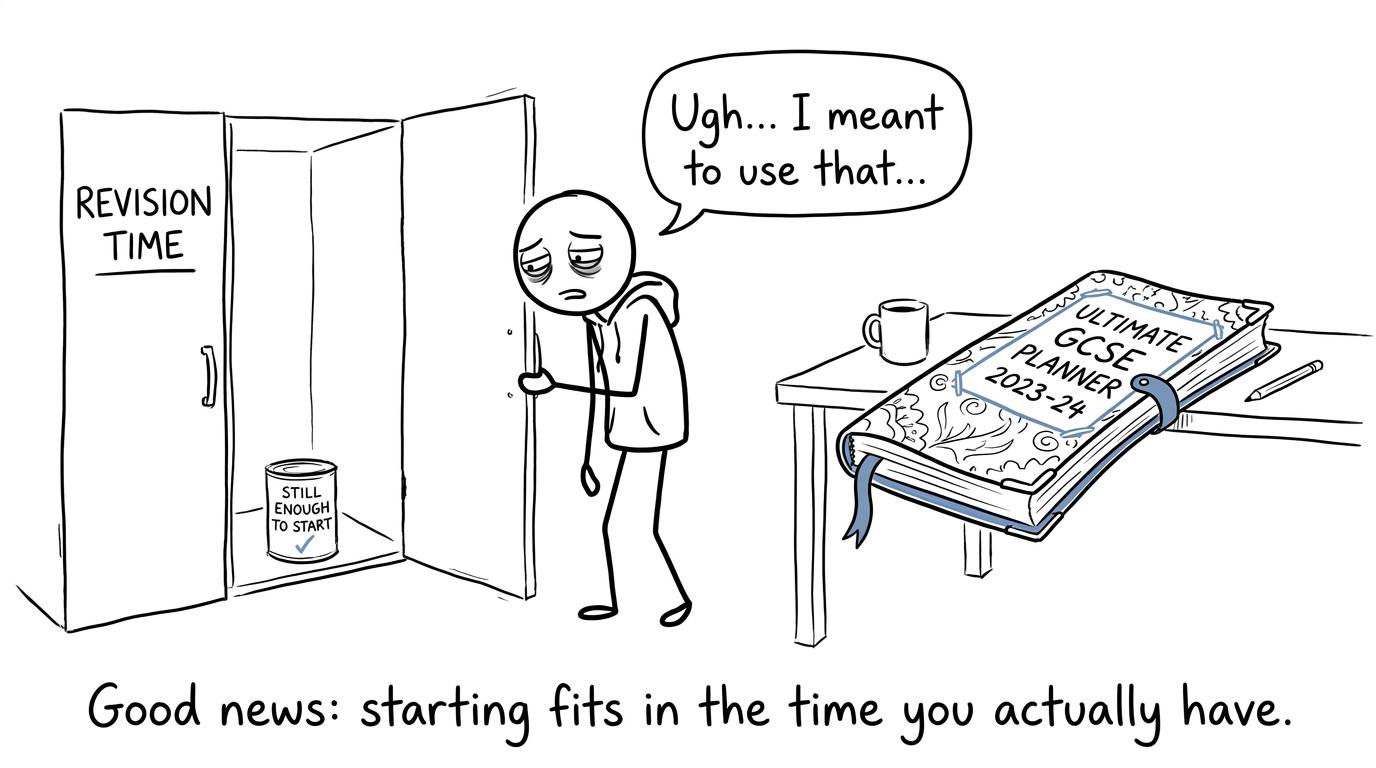 A student discovers that starting still fits into the time available
The late revision checklist
Before opening ten tabs or rewriting a textbook, make five decisions:
- Confirm whether you are sitting the separate GCSE Statistics qualification or revising statistics within GCSE Maths.
- Check your exam board, tier and specification with your school.
- Complete a short diagnostic set without notes.
- Identify the three topics responsible for the most lost marks.
- Alternate targeted practice with timed exam questions.
The GCSE Statistics revision hub is the natural starting point. It brings together free lessons, exam questions, worksheets, practice papers and past-paper resources for supported exam boards. If you are taking Pearson Edexcel, use the dedicated Edexcel GCSE Statistics revision page to keep your practice aligned with the qualification.
Do not assume that your GCSE Maths board must also be your Statistics board. Edexcel, AQA, OCR and Eduqas are familiar GCSE Maths boards, while the separate Statistics qualification has its own available specifications and entries. Ask your teacher if you are uncertain.
How much difference can late revision realistically make?
Late revision is best at recovering accessible marks. These are marks lost because you forgot a definition, selected the wrong diagram, misread a scale, failed to compare distributions in context or stopped before stating a conclusion.
It is less suited to building complete mastery of every difficult topic from the beginning. That distinction matters. If the exam is close, your aim should be to become reliably competent on a useful range of questions rather than briefly familiar with everything.
If you have several weeks
You have time for a proper learn-practise-test cycle. Diagnose gaps, revisit weak methods, complete topic questions and then test them inside mixed papers. A structured GCSE maths revision timetable can help you organise this, although your topic list must come from the Statistics specification if you are sitting the separate qualification.
If you have about one week
Prioritise breadth first, then depth. Make sure you can attempt something from data collection, representation, summary statistics, probability and interpretation. After that, concentrate on the areas where a short lesson is likely to unlock several question types.
The one-week GCSE revision plan provides a useful daily framework. Adapt it by replacing general maths topics with the Statistics topics identified by your diagnostic paper.
If you have only a few days
Do not spend most of the remaining time making beautiful notes. Use short revision lessons only when they solve a specific problem, then answer questions immediately. One carefully reviewed paper is more useful than several rushed papers that you never mark.
If the exam is tomorrow, the goal changes again. Use a short mixed set, correct a few recurring errors, check your equipment and stop early enough to rest. The GCSE maths night-before plan offers a calm structure that can be adapted for Statistics.
What to prioritise in GCSE Statistics
The national subject content is broader than calculations alone. GCSE Statistics develops the ability to collect and represent data, calculate summary statistics and probabilities, interpret results in context, and evaluate statistical methods through the statistical enquiry cycle.
Current assessment objectives give substantial weight to knowledge and standard techniques, but interpretation and evaluation matter too. In the regulated subject framework, approximately 55%55\%55% concerns knowledge and understanding of standard techniques, approximately 25%25\%25% concerns interpretation and statistical reasoning, and approximately 20%20\%20% concerns evaluating methods and conclusions. Exact paper design should always be checked against your board's current specification.
That balance carries an important message: memorising procedures is not enough. You also need to explain what results mean and judge whether a method was appropriate.
Data collection and the enquiry cycle
Revise populations, samples, sampling methods, questionnaires, bias, hypotheses and the stages of a statistical investigation. Be prepared to explain why a sample may be unrepresentative or why a question could influence responses.
These questions can be efficient revision targets because progress often comes from learning precise language and applying it to context, rather than performing long calculations.
Representing and interpreting data
Review the diagrams listed in your specification, including charts, cumulative frequency representations, box plots, scatter graphs and other displays relevant to your tier. Do not only practise drawing them. Ask what each representation reveals, what it hides and whether it is appropriate for the type of data.
Students revising overlapping GCSE Maths content can use MathsGenie's guide to GCSE Maths topics by exam board and tier to locate related statistics skills. Remember that the separate GCSE Statistics course goes beyond the statistics content inside GCSE Maths.
Summary statistics and comparisons
Secure the meaning and use of the mean, median, mode, range, quartiles and other measures named by your specification. For frequency tables, the general structure for the mean is:
mean=∑fx∑f\text{mean}=\frac{\sum fx}{\sum f}mean=∑f∑fxFor grouped data, using class midpoints produces an estimate rather than an exact mean. The averages from frequency tables revision guide is useful if this underlying skill is one of your gaps.
When comparing distributions, calculate accurately but finish the job. Compare a measure of location and a measure of spread, then write both statements in the context of the data.
Probability and uncertainty
Revise probability scales, relative frequency, expected outcomes, combined events and any distributions required by your specification. A basic probability model uses:
P(A)=number of outcomes in Atotal number of equally likely outcomesP(A)=\frac{\text{number of outcomes in }A}{\text{total number of equally likely outcomes}}P(A)=total number of equally likely outcomesnumber of outcomes in AMore importantly, recognise when outcomes are not equally likely and when experimental evidence should be used instead. Check that probabilities for all mutually exclusive, exhaustive outcomes sum to 111.
Use papers to diagnose, not merely to score
A past-paper mark is a measurement, not a verdict. Its most valuable information is hidden inside the questions you missed.
Use this cycle:
- Attempt a timed paper or section under suitable exam conditions.
- Mark it carefully with the official mark scheme.
- Classify each lost mark as a knowledge gap, execution error, misreading or timing problem.
- Revisit the relevant MathsGenie lesson or worksheet.
- Reattempt the question without copying the solution.
- Test the same skill later using a different question.
MathsGenie's guide to when to start GCSE past papers explains how paper practice can change as the exam approaches. If you are already late, begin now; but use shorter sections where a full paper would leave no time for correction.
Predicted papers can provide fresh practice, but they cannot tell you exactly what will appear. Treat them as supplements to specification coverage and official past papers, not as a reason to ignore whole topics.
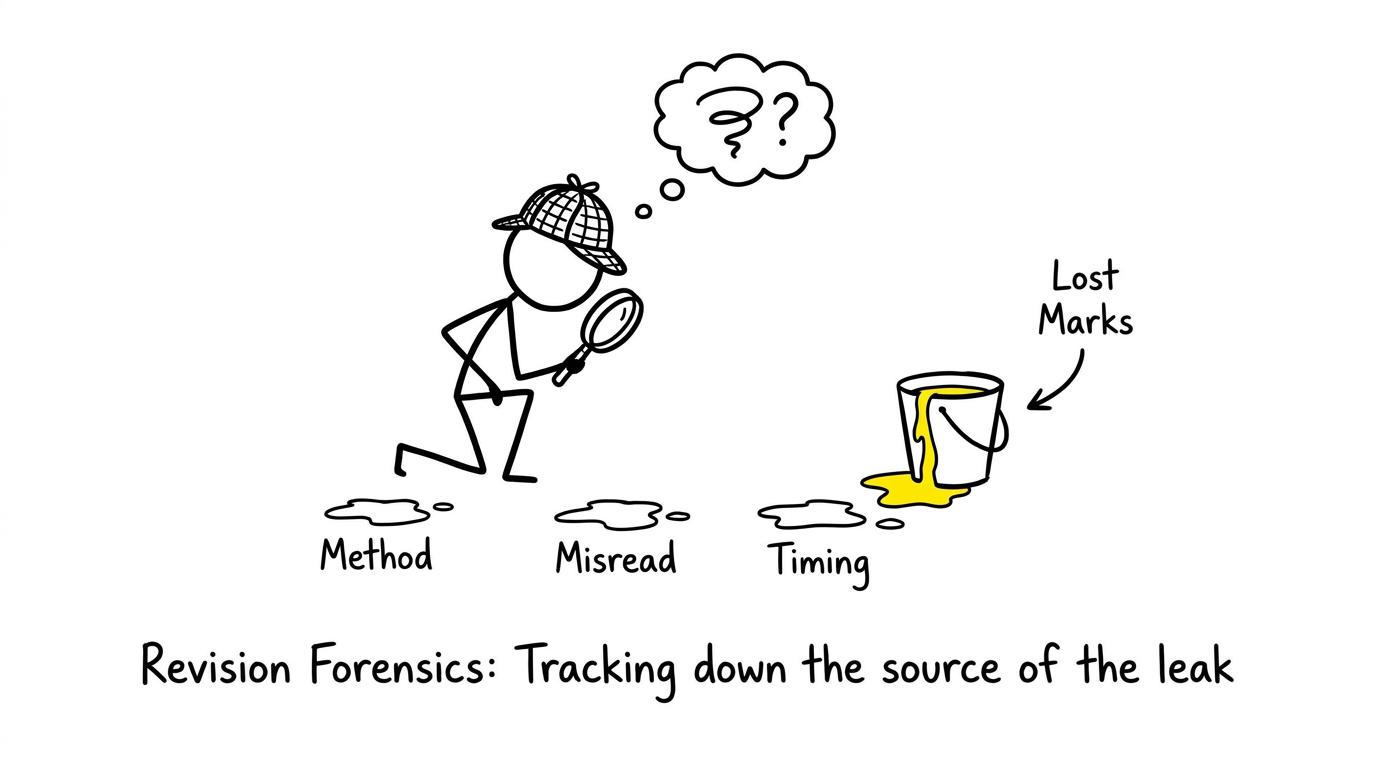 A student detective traces lost marks to method, misreading and timing
Build revision sessions around marks
A focused late-revision session can be simple:
- Begin with a short recall of terminology or formulae.
- Spend most of the session answering questions.
- Mark everything while your reasoning is still fresh.
- Write one specific correction for each repeated error.
- Finish by reattempting one question without help.
Keep a marks-leak list. Entries should be precise: “I compare medians but forget spread” is useful; “statistics is bad” is not. The first statement gives you an action. The second only gives anxiety a name.
If you are also preparing for GCSE Maths, protect Statistics time rather than allowing algebra or geometry to consume every session. Shared skills are helpful, but the separate Statistics qualification expects deeper statistical reasoning and evaluation.
Common mistakes in late GCSE Statistics revision
Revising every topic equally
Your weakest topic is not automatically your best investment. Prioritise topics that recur, support several question types or repeatedly cost you marks. Keep some mixed practice so that familiar areas do not fade.
Watching without practising
A video can make a method feel clear because someone else is doing the difficult thinking. Close the explanation and answer questions independently. Recognition is not the same as recall.
Ignoring context
A calculation without interpretation may leave marks behind. Use the variables, groups and units from the question. If you compare data sets, explain what the difference means in that situation.
Treating grouped data as exact
Calculations based on class midpoints are estimates. Use language such as “estimated mean” where appropriate and do not imply more precision than the grouped data provides.
Completing papers without reviewing them
Volume can feel productive while preserving the same errors. Mark schemes, corrections and reattempts are where much of the improvement happens.
Sacrificing rest for one more topic
A final exhausted hour is not automatically valuable. A sensible stopping point, prepared equipment and adequate rest are part of exam preparation, not evidence that you have given up.
 A stack of flashcards discovers that sleep is part of the revision plan
Start from where you are
It may be too late for the ideal revision plan. That does not make it too late for useful revision.
The realistic goal is to make the next available hour count: diagnose one weakness, learn the missing idea, practise it, mark it and return to it later. Repeat that process and you replace vague panic with evidence about what you can now do.
Start with the free MathsGenie GCSE Statistics resources. Use revision lessons and practice questions to repair specific gaps, mini tests to check recall, and past papers with mark schemes and video solutions to develop exam technique. Where suitable resources are available for your course, add predicted papers only after you have covered your priority topics.
You do not need to feel completely ready before beginning. Begin, and let each corrected question make you a little more ready than you were before.