Is It Too Late to Revise GCSE French?
Too late to revise GCSE French? Use a realistic plan for the final months, weeks or days, while keeping GCSE maths revision moving without panic.
The calendar can become frighteningly persuasive near exam season. A few missed weeks begin to feel like proof that the chance has gone. If you are wondering whether it is too late to revise GCSE French, the honest answer is no, but the amount of progress available depends on your remaining time, current knowledge and willingness to practise actively.
You cannot compress two years of teaching into a weekend. You can, however, improve vocabulary recall, repair common grammar errors, become more familiar with exam tasks and reduce avoidable lost marks. Even close to the exam, focused revision is better than surrender disguised as realism.
This matters particularly if you are also preparing for maths. French cannot be allowed to consume every revision hour, but it should not disappear from your timetable either. The aim is a small, repeatable system that protects both subjects.
Your late GCSE French revision checklist
Start with these actions:
- Confirm your exam board, tier and remaining assessment dates.
- Check which French papers or speaking tasks you have already completed.
- Identify weaknesses separately in listening, speaking, reading and writing.
- Learn useful vocabulary through retrieval rather than repeated reading.
- Practise short exam tasks and check them against available mark schemes.
- Keep French sessions frequent and contained so maths revision continues.
- Ask your teacher which areas offer the most realistic improvement for you.
For the maths side of your plan, the free GCSE maths revision hub brings together revision lessons, questions, papers and solutions for Edexcel, AQA, OCR, Eduqas, WJEC and CCEA.
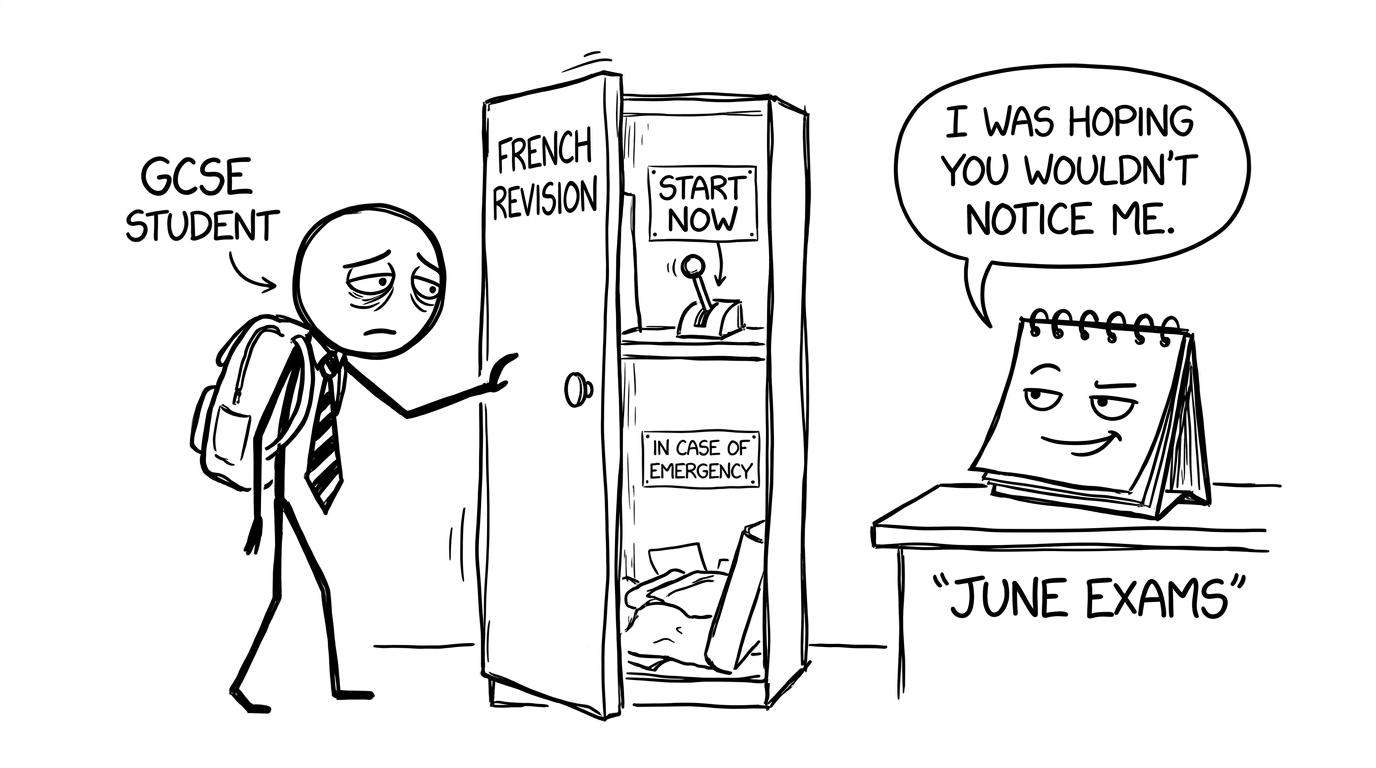 A student discovers the emergency start-now lever in the French revision cupboard
How much difference can late revision really make?
Late revision is most effective when it improves something specific. “Get better at French” is too broad. “Recognise common past-tense verbs in a listening task” is trainable.
The reformed GCSEs in French, German and Spanish were first taught from September 2024 and first assessed in summer 2026. Although exact task formats vary between Edexcel, AQA, OCR and Eduqas, students are assessed across listening, speaking, reading and writing. Current AQA and Eduqas specifications allocate 25%25\%25% of the qualification to each of those four components, with foundation and higher tiers available.
That structure explains why a balanced diagnosis matters. Revising only prepared speaking answers will not repair weak listening. Memorising isolated nouns will not automatically produce accurate writing. Begin by locating the skill that is leaking marks.
If you have several months
There is time to rebuild vocabulary and grammar systematically while completing regular exam practice. Work through specification themes, revisit difficult material at intervals and begin using timed tasks before the final weeks.
A realistic week could contain three short French sessions, one longer mixed-skills session and several protected maths blocks. MathsGenie’s GCSE maths revision timetable guide can help you distribute those blocks without turning every evening into an impossible list.
If you have four to six weeks
You still have enough time for meaningful improvement, but selection becomes important. Prioritise:
- high-frequency vocabulary from your board’s prescribed list;
- present, past and future time frames appropriate to your tier;
- question words, negatives, opinions and common connectives;
- short listening and dictation practice;
- translation in both directions;
- the exact speaking and writing formats used by your board.
Do not spend the first fortnight creating beautiful resources. Test yourself immediately. Every session should produce evidence: words recalled, sentences spoken, a task completed or an error corrected.
If the whole GCSE timetable feels crowded, adapt the structure in MathsGenie’s one-month GCSE revision plan. Use it for maths directly and borrow its diagnose-practise-check rhythm for French.
If you have one or two weeks
At this point, breadth is less useful than control. Choose a compact bank of vocabulary and structures that you can understand and use accurately. Complete short tasks under time pressure, then examine every mistake.
For reading and listening, distinguish between an unknown word and a misunderstood question. For writing and speaking, look for repeated weaknesses such as missing verb endings, disagreement or answers that do not address the prompt.
Keep a one-page error log. It should contain corrections you are likely to reuse, not a transcript of everything that went wrong.
If only a few days remain
You can still improve familiarity, accuracy and calmness. You are unlikely to transform your entire vocabulary, so stop chasing total coverage.
Review essential words, rehearse the relevant task formats and complete small amounts of listening, reading and translation. If your speaking assessment remains, practise answering aloud rather than silently planning answers.
Do not sacrifice the next day’s concentration to an exhausted overnight session. The GCSE night-before revision plan offers a calm model for maths: use a short task, fix recurring mistakes, prepare your equipment and stop at a sensible time. The same restraint helps before French assessments.
The most efficient way to revise GCSE French late
Diagnose before making a timetable
Complete a short task in each remaining skill without looking at notes. Mark what you can and ask your teacher to clarify errors where needed.
Classify each problem:
- Knowledge: you did not know the vocabulary or grammar.
- Recognition: you knew it on paper but missed it in speech or a longer text.
- Production: you recognised French but could not produce it yourself.
- Technique: you misunderstood instructions, omitted a bullet point or managed time poorly.
These categories require different responses. More vocabulary will not fix careless task reading; more past papers will not teach a tense you have never understood.
Use a short retrieval loop
A productive French session can fit into 202020 to 303030 minutes:
- recall vocabulary or structures without notes;
- check what you missed;
- use the material in speaking, writing or translation;
- complete a brief exam-style task;
- record one correction to revisit.
The consistency of the loop matters more than an occasional heroic evening. Maths students can use the matching 20-minute GCSE revision routine with MathsGenie’s topic questions and worked solutions.
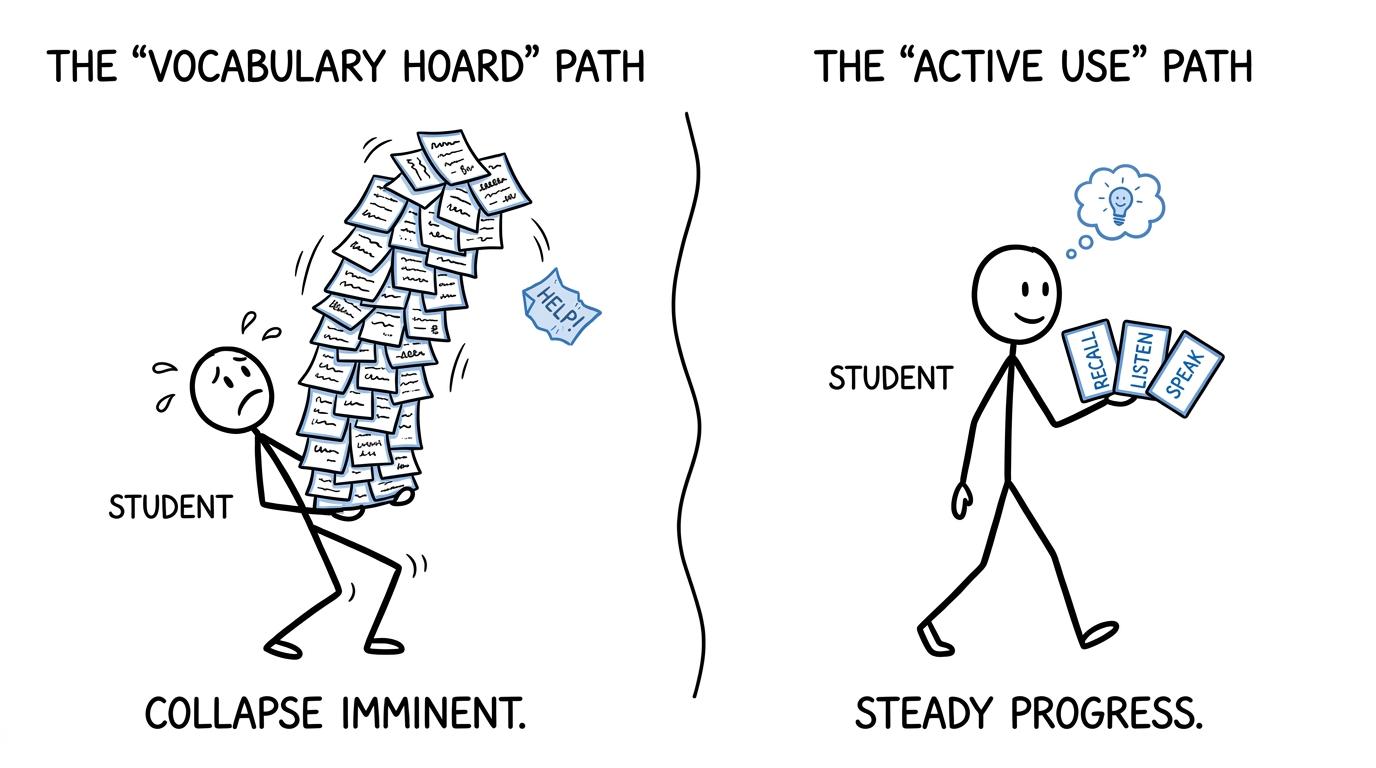 One student carries too many notes while another follows a small recall-listen-speak routine
Train all remaining exam skills
For listening, use short extracts and listen for time markers, negatives, opinions and changes of speaker. Check the transcript afterwards if one is supplied.
For speaking, say answers aloud. Practise pronunciation, spontaneous follow-up responses and recovery phrases rather than memorising one long script that may not fit the task.
For reading, identify the question before searching the text. Pay attention to synonyms and language that reverses an expected answer.
For writing, answer every required element, use language you can control and leave time to check verbs, agreements and spellings.
Your board’s exact format matters. AQA’s current specification, for example, includes dictation in listening, reading aloud within speaking and translation tasks. Eduqas also includes dictation, reading aloud and translation. Do not assume an older practice paper perfectly represents your current course; confirm suitable materials with your teacher.
How to balance French with GCSE maths revision
The danger of starting late is overcorrection. A worried student may devote an entire weekend to French, then discover that simultaneous equations, trigonometry and probability have quietly become less secure.
Protect fixed maths appointments in your timetable. Use French in shorter daily blocks and maths in sessions long enough to complete and mark meaningful question sets. A simple evening might contain one focused French retrieval session, a break and one maths topic session.
Maths revision should remain diagnostic. Choose your board and tier, use a revision lesson where understanding is weak, complete practice questions, mark them and revisit mistakes. The GCSE maths topics by exam board and tier guide can help you decide what belongs in your remaining plan.
As exams approach, introduce timed maths papers. MathsGenie’s guide to using Edexcel GCSE maths past papers properly explains the wider paper-mark-repair-retest cycle, which can also inform how you review French practice tasks.
Common mistakes when starting French revision late
Trying to learn everything
Late revision requires priorities. Attempting every theme, tense and obscure word usually produces shallow familiarity. Secure core vocabulary and adaptable structures first, then expand if time permits.
Reading notes instead of retrieving
Recognition can feel like knowledge. Close the book and recall the French, translate it, write it or say it. The gap between what feels familiar and what you can produce is the useful part of revision.
Ignoring listening and speaking
Silent revision is comfortable, but French is partly an audible subject. Regularly hear the language and produce it aloud, even when pronunciation feels imperfect.
Using the wrong specification materials
The current GCSE French specifications were introduced for first assessment in summer 2026. Check that sample assessments, vocabulary lists and task formats match your exam board and course.
Abandoning maths to rescue French
Panic creates false choices. A modest French routine can coexist with serious maths preparation. Keep using MathsGenie’s lessons, practice questions, mini tests, past papers and video solutions rather than leaving maths untouched for several days.
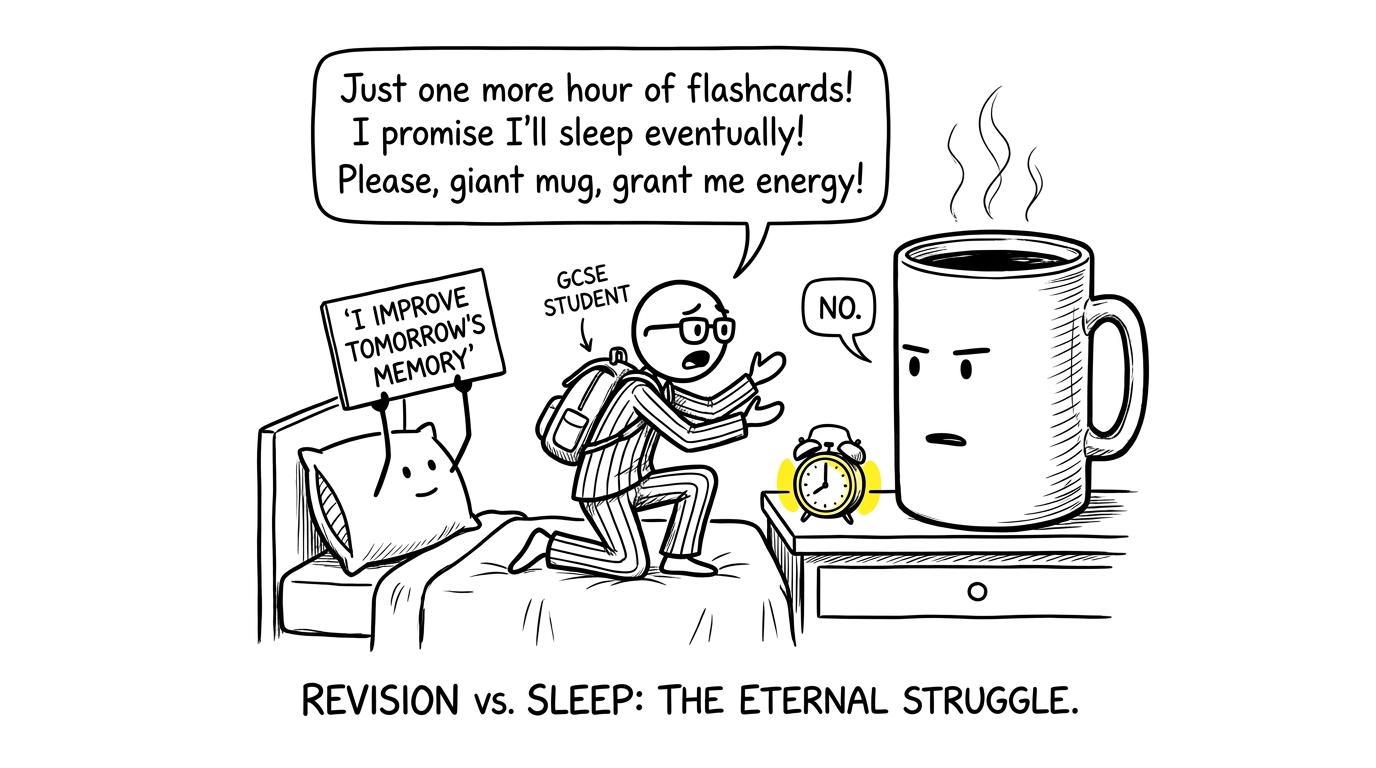 A pillow explains the value of sleep to a student negotiating with an enormous coffee mug
Start with the next useful session
It may be too late for the ideal revision plan. It is not too late for a useful one.
Confirm your French assessment details, diagnose one weak skill and complete one active session today. Then protect tomorrow’s maths block. Progress near an exam rarely looks dramatic; it looks like fewer repeated mistakes, faster recall and a clearer idea of what each question requires.
For maths, make MathsGenie’s free GCSE revision resources your starting point. Choose your exam board and tier, rebuild weak topics with revision lessons and practice questions, then test your progress using mini tests, past papers, predicted papers, mark schemes and video solutions. Start small, mark honestly and use every remaining day deliberately.