20-Minute GCSE Revision Routine for Busy School Days
GCSE revision routine for busy school days: a calm 20-minute plan using YesGenie lessons, practice questions, past papers and mark schemes.
The 20-minute routine that saves your GCSE revision
Most GCSE students don’t fail because they’re lazy. They fail because their days are already full.
It’s Tuesday. You’ve had double maths, a detention for missing a PE kit you swear you packed, and a bus ride home spent staring out of the window trying to remember what you were meant to revise. You open your bag and everything falls out: worksheets, a half-eaten cereal bar, a calculator with no lid, and that heavy feeling that proper GCSE revision needs hours you don’t have.
The truth is quieter: you don’t need a heroic session. You need a small routine you can keep.
This is a 20-minute GCSE maths routine designed for busy school days. It uses a simple pattern: recall, practise, check, and log. Over time, those twenty minutes compound into confidence.
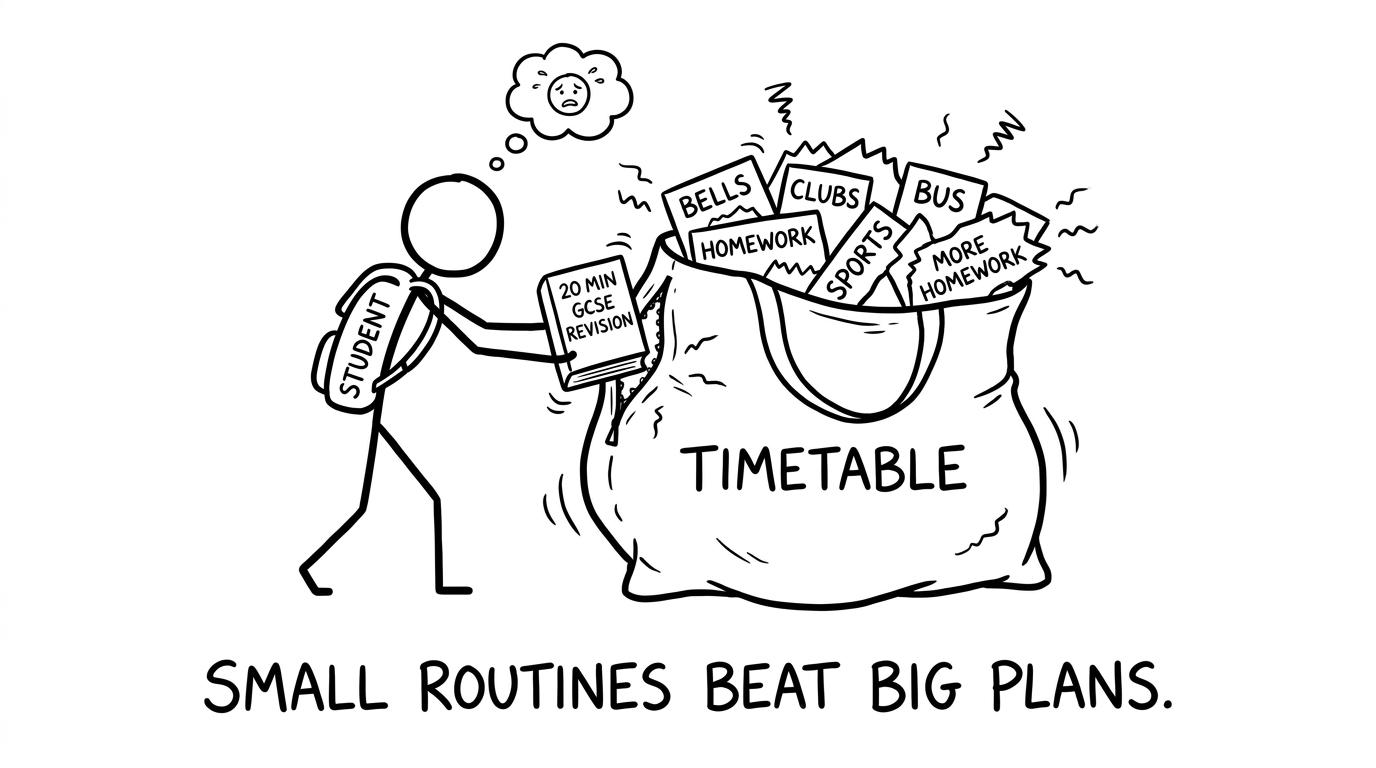 A student trying to squeeze 20 minutes of revision into a busy day
The 20-minute GCSE revision checklist
Keep the routine the same, even if the topic changes. Your brain likes predictability.
- 2 minutes: choose one topic (foundation or higher tier) and set a timer
- 5 minutes: active recall (no notes at first)
- 10 minutes: practise exam-style questions
- 2 minutes: mark and fix one mistake using a mark scheme or worked solution
- 1 minute: log the topic and the mistake you’ll avoid tomorrow
You’ll notice what’s missing: guilt, perfection, and the idea that you must “finish” a topic in one sitting.
Helpful starting points on YesGenie:
- Pick your board and home page: Edexcel GCSE Maths Revision
- Build your daily topic list: Edexcel GCSE Maths Lessons
- Use structured notes for quick review: Edexcel GCSE Maths Revision Guides
- Find quick paper-style practice: Resources (Mini Tests, Predicted Papers, more)
Why a 20-minute GCSE routine works (even when you’re tired)
A long GCSE revision plan is easy to admire and hard to live.
A short routine is the opposite: it looks almost too small to matter. But it has two advantages.
First, it fits inside the real shape of a school day. Twenty minutes is “before dinner” time. It’s “while my sibling is in the shower” time. It’s “I’m waiting for my lift” time.
Second, it gives you feedback quickly. And in maths, feedback is everything. You can’t improve a method you never check.
If you’re doing A Level maths as well, the same logic applies. Your brain still benefits from recall and correction, just with harder content. YesGenie has dedicated sections for that too, including Edexcel A Level Maths Past Papers.
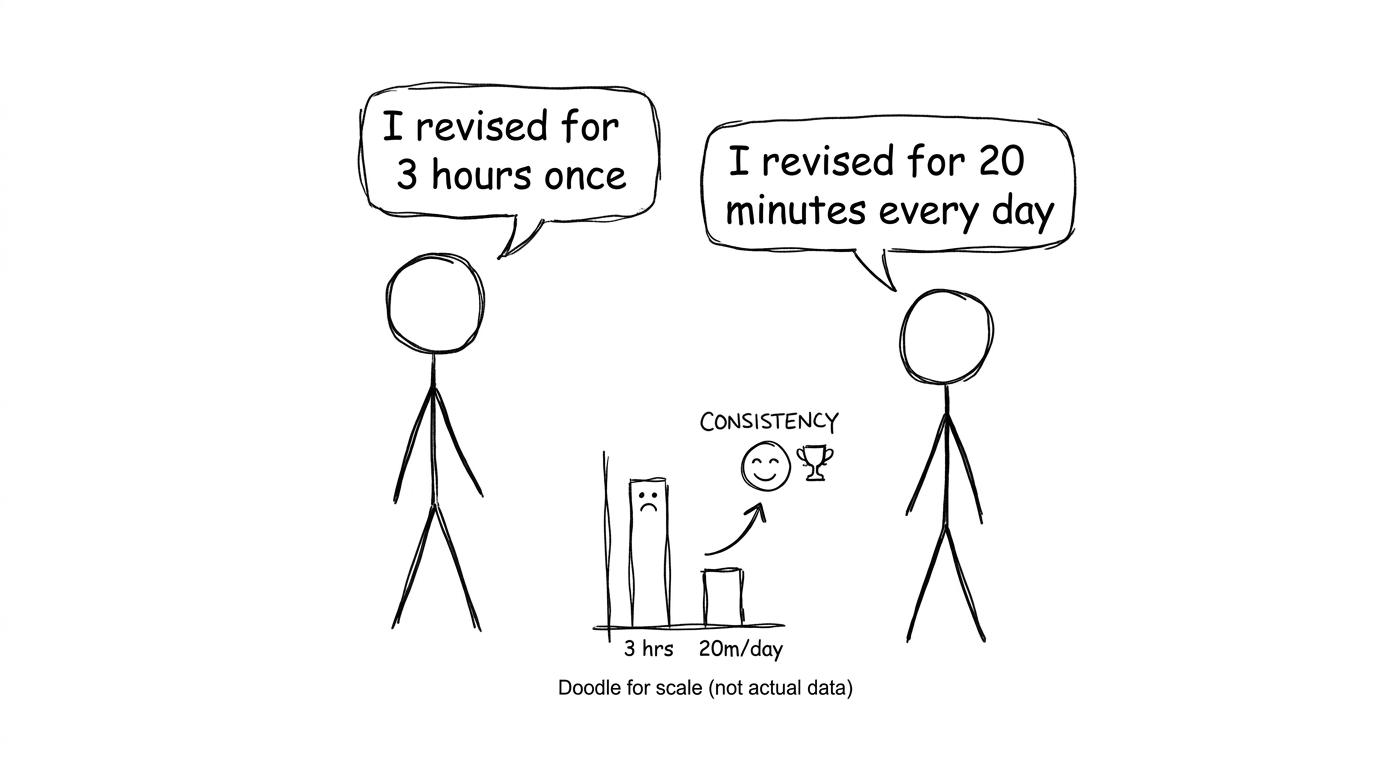 Consistency beats one-off marathon sessions
The 20-minute GCSE revision routine (minute-by-minute)
0:00 to 2:00: pick one precise target
Don’t write “algebra” or “geometry”. That’s too big.
Write something like:
- “Simplifying algebra expressions”
- “Probability tables add to 111”
- “Circle area and circumference”
If you’re not sure what to choose, use the topic lists inside Edexcel GCSE Maths Lessons and pick one that has come up in homework or a recent test.
A great “busy day” topic is something you can complete in small bites, like Simplifying Algebra.
2:00 to 7:00: active recall first (no notes)
Active recall means you try to retrieve the method from memory. That struggle is the point.
Take one sheet of paper. Write a micro-checklist for the topic.
Example: simplifying algebra.
- collect like terms
- watch the signs
- keep coefficients with variables
Now do one short recall task from memory:
Simplify 3x+5−2x+73x + 5 - 2x + 73x+5−2x+7.
3x−2x+5+7=x+123x - 2x + 5 + 7 = x + 123x−2x+5+7=x+12Then add one slightly more “exam-feeling” example:
Simplify 4a−3b+2a+5b4a - 3b + 2a + 5b4a−3b+2a+5b.
(4a+2a)+(−3b+5b)=6a+2b(4a + 2a) + (-3b + 5b) = 6a + 2b(4a+2a)+(−3b+5b)=6a+2bIf you got stuck, that’s not failure. That’s information. Now you know what to fix.
7:00 to 17:00: practise exam-style questions
This is where YesGenie is built to save you time. Use topic pages that give you practice questions and solutions in one place.
For example:
- Simplifying Algebra
- A quick probability unit: Probability (OCR topic page)
- Quick “best buy” problem-solving: Best Buy Questions (Revision Guide)
Aim for 3 to 6 questions depending on difficulty. You’re not chasing volume. You’re chasing clean methods.
Here’s a worked probability example you can do in this 10-minute block.
Worked example (GCSE probability table)
A bag contains only red, blue and green counters.
P(red)=0.35P(\text{red}) = 0.35P(red)=0.35 and P(blue)=0.41P(\text{blue}) = 0.41P(blue)=0.41.
Find P(green)P(\text{green})P(green).
Because these are the only outcomes:
P(red)+P(blue)+P(green)=1P(\text{red}) + P(\text{blue}) + P(\text{green}) = 1P(red)+P(blue)+P(green)=1So:
P(green)=1−0.35−0.41=0.24P(\text{green}) = 1 - 0.35 - 0.41 = 0.24P(green)=1−0.35−0.41=0.24That pattern (total 111, subtract what you know) comes up constantly in GCSE exams.
17:00 to 19:00: mark, then fix one thing properly
Marking is part of revision, not something you do “if you have time”.
If you’re doing past-paper questions, use the mark scheme. YesGenie makes this easy to access.
Example past papers area:
And here’s an example of a mark scheme page format (useful when you’re learning how examiners award method marks):
Your goal in these two minutes is specific: identify one mistake type and write a correction.
For instance:
- “I expanded 2(x−3)2(x-3)2(x−3) as 2x−32x-32x−3; correct is 2x−62x-62x−6.”
- “I rounded too early; keep full calculator value until the final step.”
19:00 to 20:00: log tomorrow’s starting point
Write one line:
- Topic
- Question type
- Mistake to avoid
Example:
- “Probability: missing probability in a table; remember total is 111.”
This tiny log is how you stop repeating the same errors for weeks.
A worked GCSE example you can use on any day: rearranging then solving
Busy days need methods that travel well across topics. Rearranging formulas and solving linear equations appear everywhere: from algebra to geometry to physics.
Worked example (GCSE rearranging and solving)
Make xxx the subject:
3x+7=253x + 7 = 253x+7=25Subtract 777 from both sides:
3x=183x = 183x=18Divide by 333:
x=6x = 6x=6Now add one “fraction step” version, because many GCSE mistakes happen when dividing:
Solve:
x5+2=9\frac{x}{5} + 2 = 95x+2=9Subtract 222:
x5=7\frac{x}{5} = 75x=7Multiply by 555:
x=35x = 35x=35This is the kind of small, complete win you can finish inside twenty minutes.
Using YesGenie past papers and predicted papers in 20 minutes
Past papers can feel like an all-or-nothing activity. But you can slice them.
- Do one question from a paper, not the whole paper.
- Mark it immediately.
- Watch a worked solution if needed.
For exam practice:
- Edexcel GCSE Maths Past Papers
- When exam season approaches, use: Edexcel GCSE Maths Predicted Papers
Predicted papers are especially useful when your GCSE revision time is tight, because they focus attention on realistic exam-style coverage.
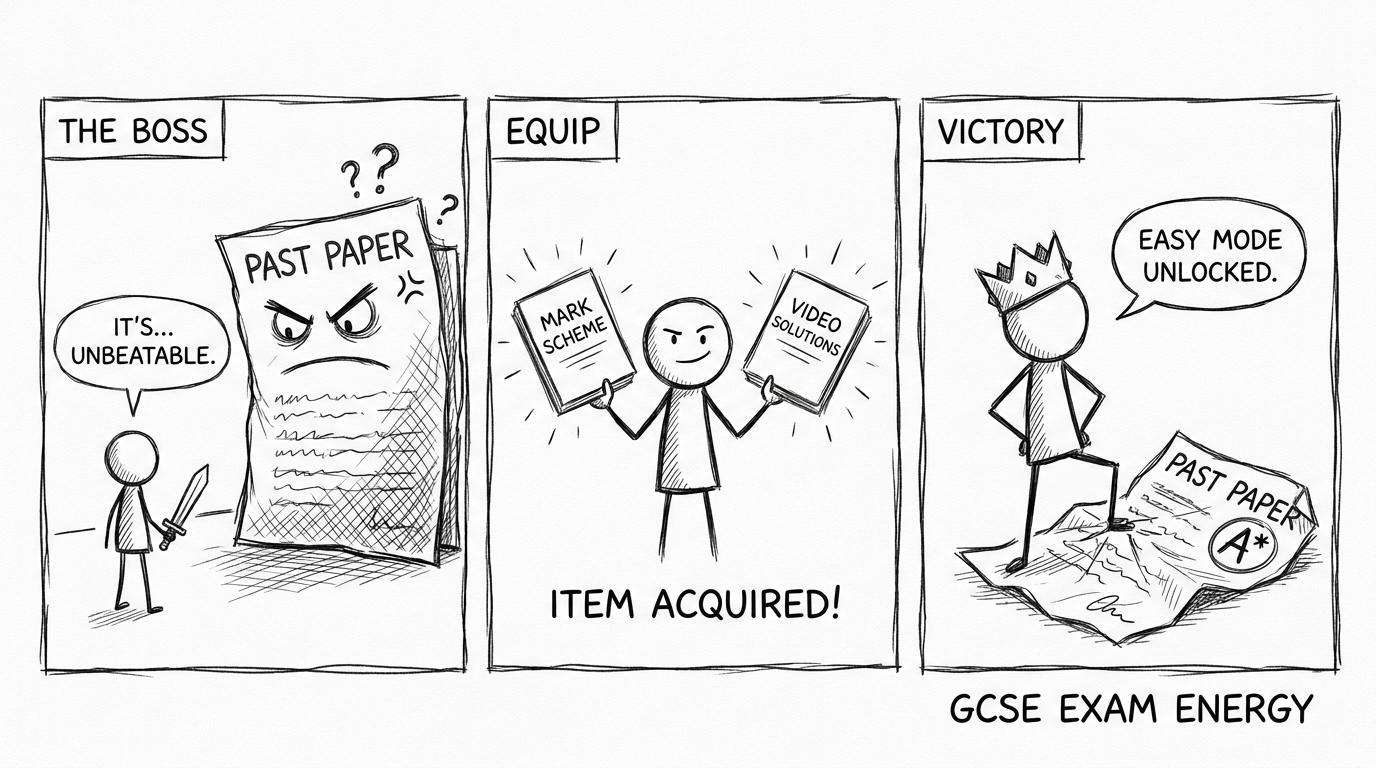 Past paper feels like a boss fight until you equip the mark scheme
Common mistakes that waste 20 minutes of GCSE revision
Treating revision as reading
Reading notes feels productive because it’s smooth. Maths progress is rougher than that. If your routine doesn’t include answers, it’s not GCSE revision; it’s browsing.
Picking topics that are too broad
“Trigonometry” is not a 20-minute target. “Use SOHCAHTOA to find a missing side” is.
Not checking with a mark scheme
You can do ten questions and still practise the wrong method if you never correct it. Use the mark scheme structure on YesGenie to see where method marks come from.
Repeating the same easy questions
Confidence is good, but it can be fake. If you always practise the first step of a topic, you never meet the real exam demand. Mix straightforward questions with one that makes you think.
Forgetting foundation vs higher tier priorities
Foundation tier needs secure basics and clean arithmetic. Higher tier needs fluency plus stretch topics. Your GCSE routine should match your tier and your mock feedback.
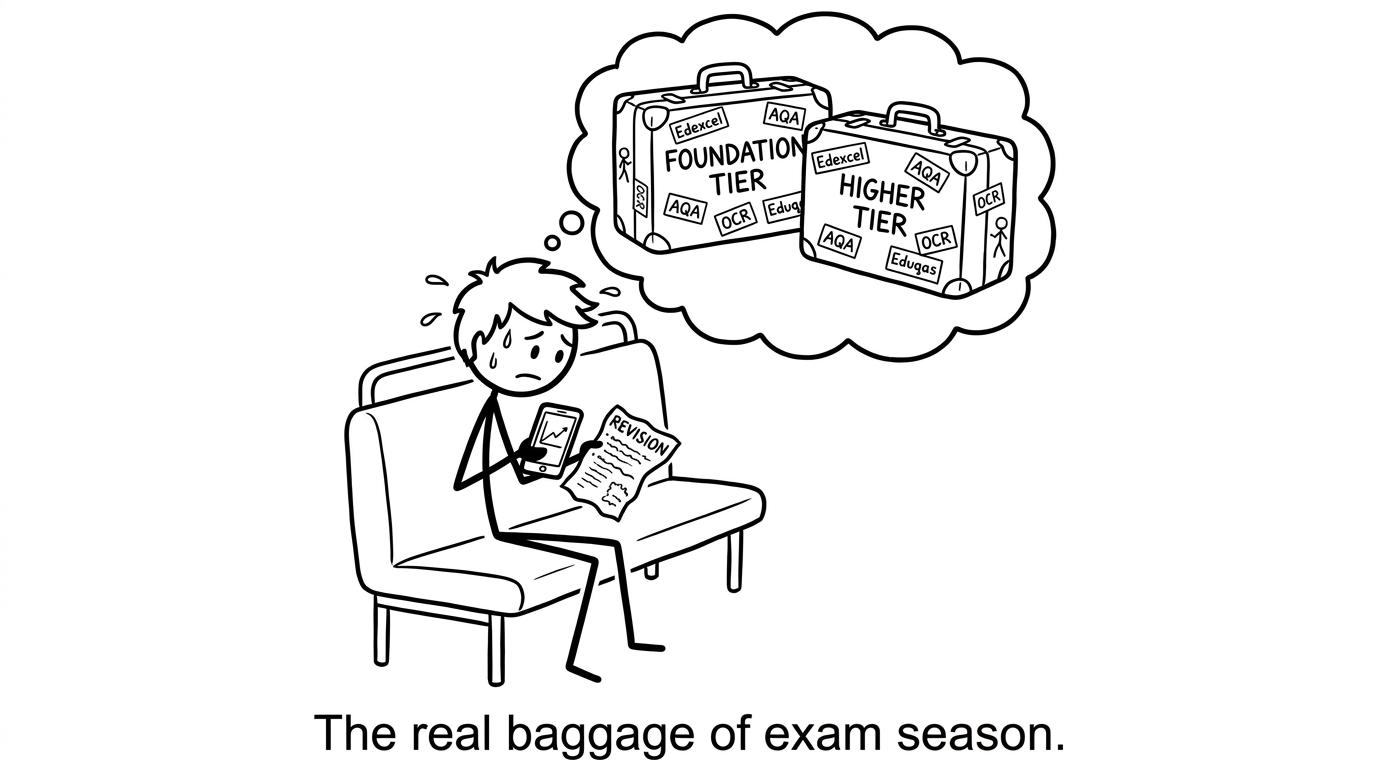 Revision on the move: the reality of busy school days
A calm way to finish your GCSE day
The best GCSE revision routine is one you can still do on a Wednesday in February, not just one you attempt during a burst of motivation.
Twenty minutes is small enough to be realistic and serious enough to matter. It’s long enough to retrieve a method, practise it, check it with a mark scheme, and leave a note for tomorrow. And when you repeat that pattern, your revision stops being a vague hope and becomes a quiet habit.
If you want this routine to feel even easier, use YesGenie as your default workspace:
- Start with your board hub: Edexcel GCSE Maths Revision
- Pick today’s topic from: Edexcel GCSE Maths Lessons
- Use clear notes and videos in: Edexcel GCSE Maths Revision Guides
- Add exam pressure gradually with: Edexcel GCSE Maths Past Papers
- Sharpen focus near exam season with: Edexcel GCSE Maths Predicted Papers
- When you want short bursts, open: Resources (Mini Tests and more)
Set a timer for tomorrow. Keep it small. Keep it honest. That’s how GCSE maths starts to feel manageable again.