Tell Teacher You're Struggling: GCSE Spanish Help
Tell teacher struggling GCSE Spanish? Learn why speaking up early helps, what to say, and how to protect time for focused GCSE maths revision too.
A difficult subject rarely announces itself with one dramatic moment. More often, the signs arrive quietly: vocabulary takes longer to remember, listening exercises become guesswork, and the homework you planned to finish in half an hour consumes the evening.
If your question is whether to tell your teacher you're struggling with GCSE Spanish, the short answer is yes. Say something early, be specific about what feels difficult, and ask for one or two practical next steps. Your teacher cannot remove every challenge, but they can help identify the gap before it becomes a larger one.
This matters particularly when you are also preparing for GCSE maths. Quietly spending extra hours on Spanish may seem responsible, but an unplanned catch-up effort can start taking time from maths, English and your other subjects. Asking for help is not giving up control. It is how you regain it.
A quick checklist before you speak to your teacher
You do not need a perfect explanation. Take five minutes and note:
- which skill is hardest: listening, speaking, reading or writing;
- one recent task that you could not complete confidently;
- whether the problem is vocabulary, grammar, speed, pronunciation or exam technique;
- what you have already tried;
- how much additional revision time Spanish is currently taking;
- one question you want your teacher to answer.
Then ask to speak briefly after the lesson, at lunch or at another suitable time. A simple opening is enough: “I am finding the listening tasks difficult and I am not sure how to practise them effectively. Could you help me decide what to work on first?”
That is clearer and more useful than saying only, “I am bad at Spanish.”
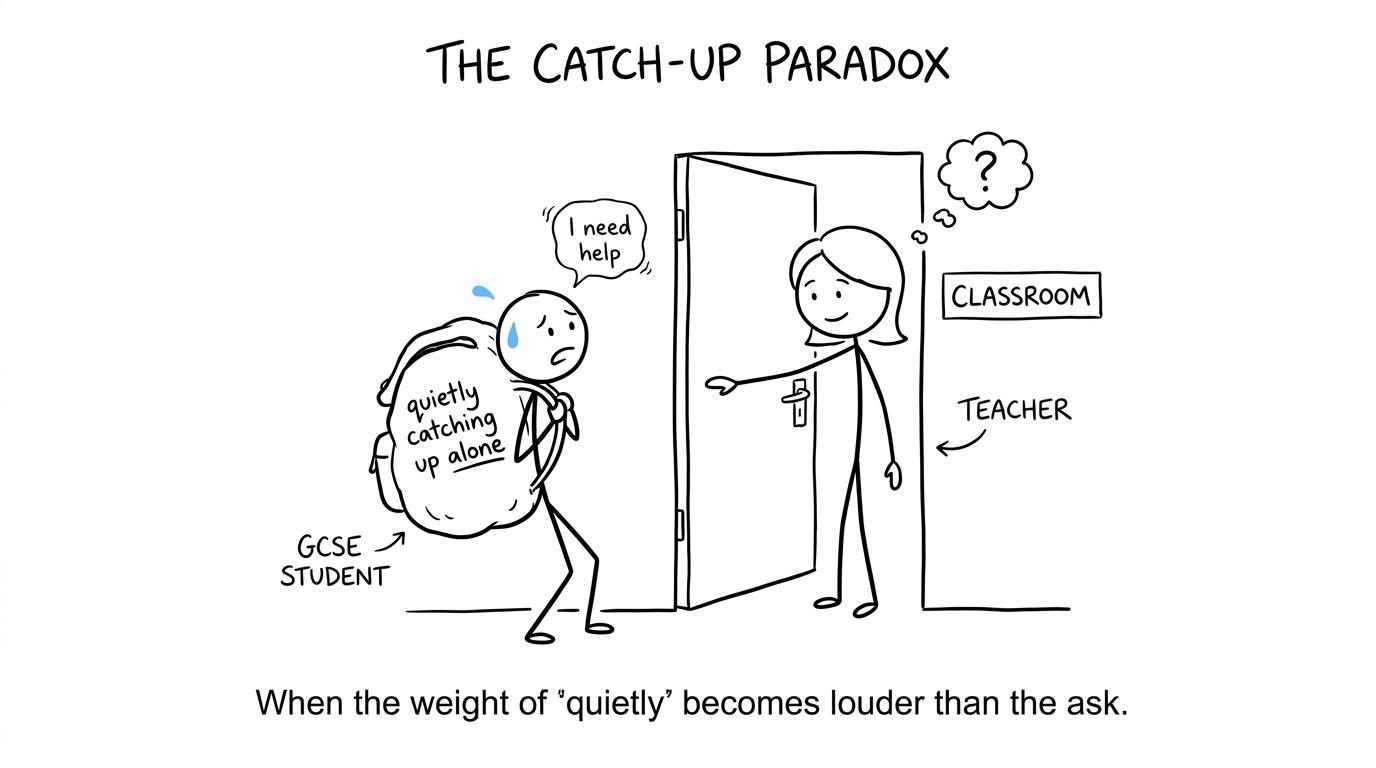 A student weighs up asking for help against carrying the burden alone
Why flagging the problem early tends to help
Your teacher can separate different kinds of difficulty
“Struggling with Spanish” can describe several different problems. You might understand written passages but lose track of recorded speech. You might know vocabulary when you see it yet be unable to retrieve it during a speaking task. Alternatively, your ideas may be strong while verb forms and agreements reduce the accuracy of your writing.
Those problems need different responses. More general revision is not automatically better revision.
A teacher can look at your classwork, assessments and recurring errors to help you identify the smallest useful target. That might be high-frequency vocabulary, sound-spelling relationships, a particular tense or a better way to prepare for a speaking task. Early feedback stops you repeatedly practising the wrong thing.
GCSE Spanish assesses several distinct skills
Current AQA and Pearson Edexcel GCSE Spanish specifications assess listening, speaking, reading and writing. In both specifications for first assessment in 2026, these four areas are equally weighted at 25%25\%25% each, although the precise tasks and timings depend on the exam board and tier.
This is why one disappointing listening score does not necessarily mean that you are failing across the whole subject. It does mean that the difficulty should be identified accurately. Ask your teacher which specification you follow, whether you are entered for foundation or higher tier, and which assessment skill requires the most attention.
Do not rely on revision advice designed for a different specification. Exam formats have changed, and your teacher is the best first source for what your class will actually face.
Small gaps become expensive when they stay hidden
A missing piece of core vocabulary affects more than a vocabulary test. It can slow down reading, make listening less secure and leave fewer phrases available in speaking and writing. Grammar gaps can spread in the same way.
There is a useful parallel with maths. If rearranging formulae is insecure, the difficulty may appear inside algebra, geometry and science calculations. The answer is not to complete random papers until the problem disappears. It is to identify the underlying skill, practise it directly and check that it has improved.
MathsGenie's guide to finding your weakest GCSE topics explains this diagnostic approach. Although the resources are for maths, the principle transfers: gather evidence, label the gap and fix the smallest skill that is holding you back.
What to tell your teacher
A productive conversation has three parts: evidence, impact and a request.
Give one piece of evidence
Mention something observable rather than judging your overall ability:
- “I cannot keep up with the recording after the first sentence.”
- “I recognise the vocabulary but cannot recall it when speaking.”
- “I do not understand how to improve my writing from the feedback.”
- “My Spanish revision is taking much longer than I planned.”
This gives your teacher a place to begin.
Explain the effect on your revision
Be honest if Spanish is affecting other subjects. You might say that catch-up work is taking time from maths practice or that you are avoiding speaking preparation because it makes you anxious.
This is not an attempt to escape work. It helps your teacher recommend an appropriate amount and type of practice. A focused fifteen-minute task may be more useful than another evening of rereading notes.
Ask for a concrete next step
Useful questions include:
- Which skill should I prioritise this week?
- Is there a model answer or mark scheme I should compare with my work?
- Can you show me what improvement would look like?
- Which vocabulary or grammar is essential for my tier?
- When should I check back with you?
The goal is to leave with a manageable action, not a vague instruction to “revise more”.
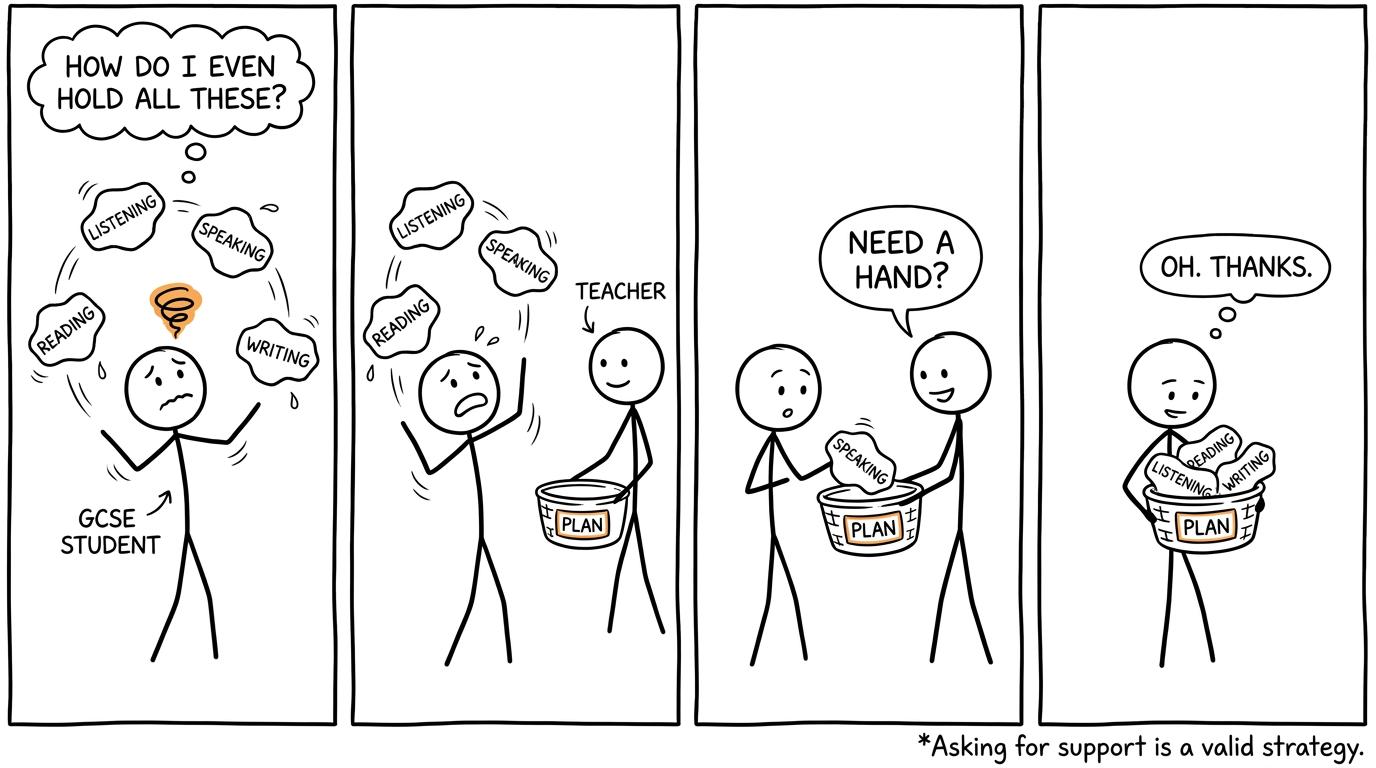 A student juggles four Spanish skills while a teacher brings a plan
What if speaking to your teacher feels awkward?
It is normal to worry that the conversation will sound like a complaint or reveal that you have fallen behind. But waiting does not make the information less true. It only reduces the time available to respond.
Write the first sentence down if you think you may freeze. You can also ask through your school's usual communication system whether there is a convenient time to talk. If approaching the subject teacher feels impossible, speak to your form tutor, head of year, pastoral lead or another trusted member of staff. They may help you plan the conversation.
If the difficulty is connected to anxiety, concentration, hearing, vision, literacy or another additional need, explain that too. Schools must follow formal rules and evidence requirements for any examination access arrangements, so no teacher can promise a particular arrangement immediately. Raising a concern early, however, gives the school time to consider appropriate support and explain the process.
Protecting your GCSE maths revision time
Asking for Spanish help should make your wider revision plan more efficient. It should not become a reason to abandon maths for a week.
Start by giving each subject a defined space. A short Spanish target set by your teacher can sit beside a focused maths session. The 20-minute GCSE maths revision routine is useful on crowded school days because it reduces the number of decisions you need to make.
For maths, choose the resources that match your stage:
- Begin with the GCSE maths revision hub to select your exam board, tier and topic.
- Use a revision lesson and practice questions when the method itself is unclear.
- Try short tests or paper sections when you need evidence of what you can do independently.
- Move to past papers once you are ready to practise choosing methods under time pressure.
- Use mark schemes and video solutions to understand why marks were lost.
If exams are still some distance away, topic practice should usually do most of the repair work. The guide to when to start GCSE past papers explains how to build from short sections towards timed papers rather than rushing into full papers too soon.
When time is tight, the one-month GCSE maths revision plan offers a clearer weekly rhythm. The important idea is balance: Spanish receives the targeted support it needs, while maths remains active through regular retrieval and exam-style practice.
Turn teacher feedback into a simple recovery plan
After the conversation, write down the agreed target in plain language. Keep it small enough to test.
A useful cycle is:
- identify one weak skill;
- learn or review the relevant material;
- practise without looking at the answer;
- check the work against feedback or a mark scheme;
- record the error;
- try a fresh task later;
- report back if the problem remains.
This is more effective than measuring revision only by time spent. Two hours of anxious rereading can create the feeling of work without producing reliable recall.
The same discipline strengthens maths. The article on using GCSE mark schemes as a revision coach shows how marking can reveal the precise step that cost you marks. If you use Edexcel, the Edexcel GCSE maths papers and mini tests provide structured opportunities to collect that evidence.
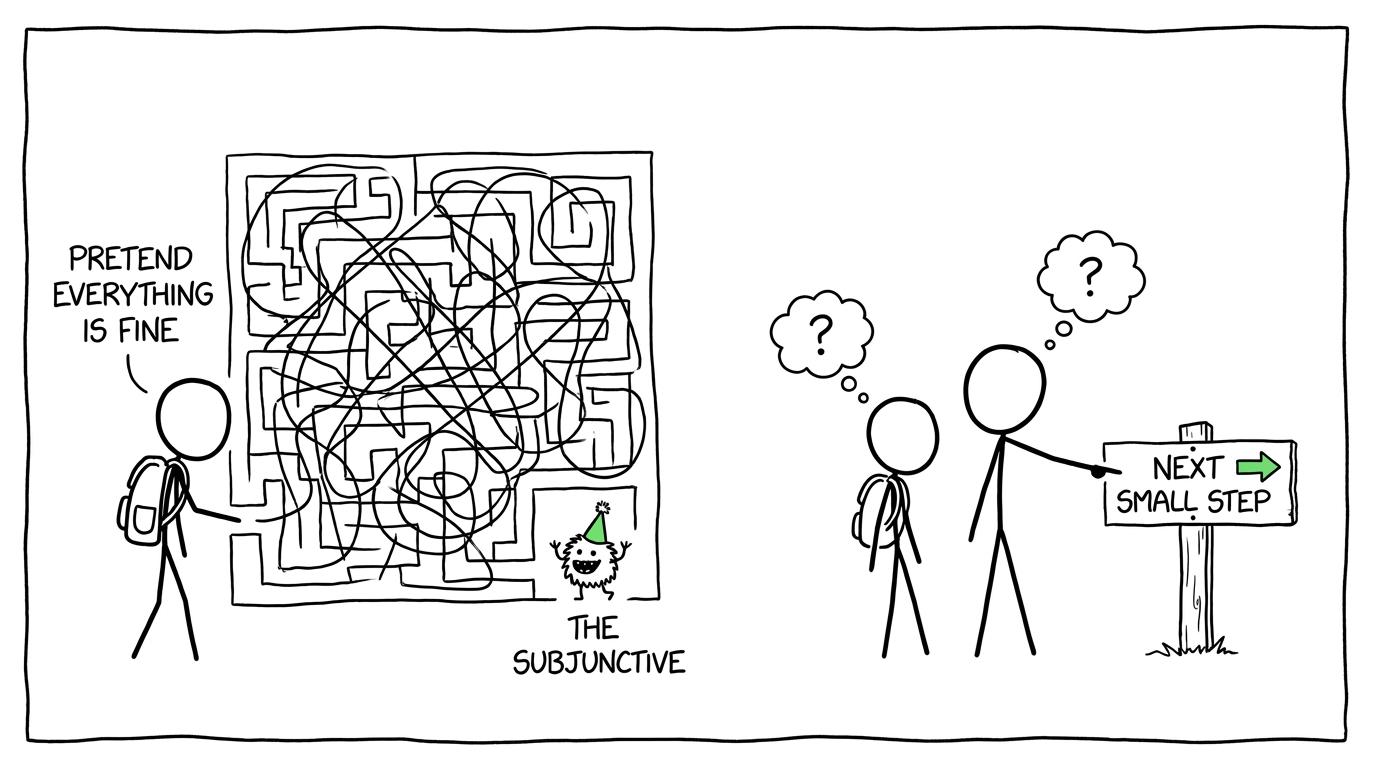 A clear next step looks less frightening than the maze of pretending everything is fine
Common mistakes when asking for help
Waiting until the final weeks
Late help is still worth requesting, but early help leaves more time to learn, practise and revisit the skill. Do not wait for a mock result to confirm something you already know from daily lessons.
Saying only that you are “terrible” at Spanish
A label gives your teacher little diagnostic information. Describe the task, what happened and where you became stuck.
Asking for more work without understanding the problem
Extra worksheets are useful only when they target the right gap. Ask what the activity is designed to improve and how you should check your progress.
Quietly sacrificing every other subject
One difficult subject can expand to fill all available revision time. Keep maths moving with short, regular sessions. Near an exam, a calm plan such as the GCSE maths night-before checklist is safer than trying to recover weeks of neglected practice at once.
Expecting one conversation to solve everything
The first conversation begins the process. Follow the advice, collect evidence and return with a specific update. Teachers can respond more effectively when they know what changed and what remains difficult.
Asking early is a revision strategy
Telling your teacher that you are struggling with GCSE Spanish is not a confession. It is a practical decision to replace uncertainty with information.
Be specific. Ask for one next step. Follow it, test it and check back. Done early, this can prevent Spanish from quietly consuming the time and confidence you need across the rest of your GCSEs.
Then give maths the same honest treatment. Open the MathsGenie GCSE revision hub, choose the topic that genuinely needs attention and use the free revision lessons, practice questions, mini tests, past papers, predicted papers, mark schemes and video solutions to close the gap. Improvement usually begins with a small sentence: “This is where I am stuck.”