

Can You Switch Exam Board for GCSE German?
Switch exam board GCSE German guidance: learn what your school controls, what changes between specifications and how to adjust your revision calmly.
A change of exam board can make a familiar course suddenly feel uncertain. The vocabulary you have learnt has not disappeared, but the papers, timings and question styles may no longer look quite the same. If your school plans to switch exam board for GCSE German, the short answer is that it is usually possible before final entries and assessments are completed. However, it is a decision for the school, not an individual student, and it needs careful planning.
Your first step is not to restart the subject. It is to confirm the new specification, identify the genuine gaps and practise the assessment formats you will actually face. If you are also preparing for GCSE maths, protect that revision time rather than allowing the German change to consume every evening.
Your immediate checklist
Ask your German teacher or exams officer to confirm:
- the old and new exam boards
- the exact specification and qualification code
- whether you are taking foundation or higher tier
- when the switch officially takes effect
- which topics, vocabulary and grammar remain relevant
- which new content or task types you must learn
- the dates and arrangements for the speaking assessment
- which specimen papers and official resources you should use
- whether any completed assessment could be affected
Write the answers down. A vague announcement creates anxiety; a precise list creates a revision plan.
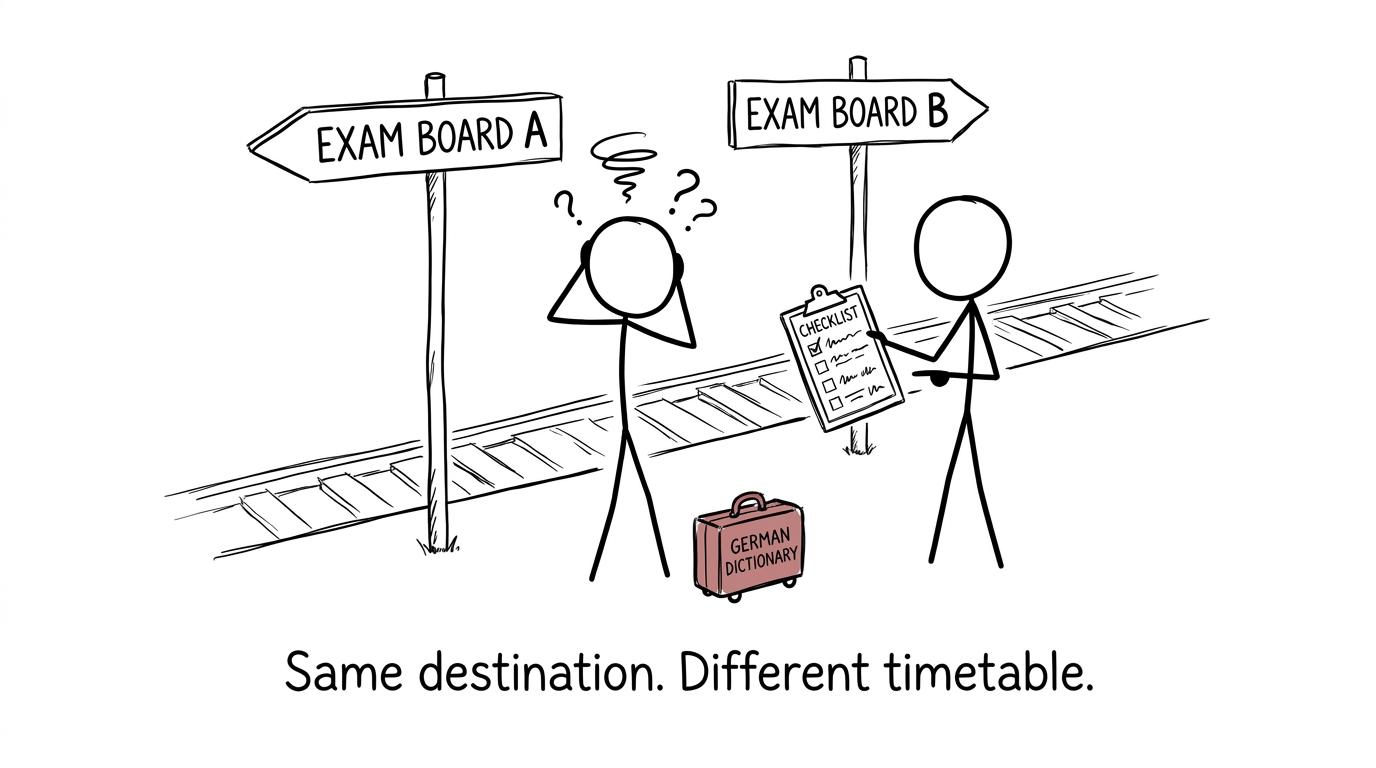 A student choosing between two exam-board routes
Can a school change GCSE German exam board mid-course?
Yes, a school can generally change the awarding organisation it intends to use, provided it meets the new board's entry, teaching and assessment requirements. In practice, the school or college chooses the specification, teaches it and submits the examination entries. A student cannot normally choose to sit a different board independently while remaining in the same class.
GCSE German is a linear qualification. The final assessments belong to one specification and are normally completed for the same awarding organisation in the relevant examination series. Your school cannot simply combine, for example, an AQA listening paper with a Pearson Edexcel writing paper to create one GCSE.
Timing matters. A change early in the course may require little more than remapping lessons. A change close to the speaking assessment or final entry deadlines is more complicated. If an assessment has already taken place, the exams officer should obtain board-specific guidance rather than assuming that a result can be transferred. Cross-board assessment marks should not be treated as automatically portable.
The current reformed GCSE German qualifications were introduced for first teaching from September 2024 and first assessed in summer 2026. They follow common national subject requirements, but each awarding organisation turns those requirements into its own papers, instructions and mark schemes. That shared core makes switching possible; the differences make preparation necessary.
What stays the same after the switch?
A new logo on a paper does not erase the German you already know. Much of your learning remains valuable, including:
- high-frequency vocabulary
- accurate use of present, past and future time frames
- opinions with reasons
- word order and verb placement
- adjective and case awareness
- listening for key details
- reading for gist and inference
- translation skills
- clear pronunciation and spontaneous speech
The regulated GCSE still assesses listening, speaking, reading and writing. It also remains a tiered qualification, so students take either foundation or higher assessments as required by the specification. Current rules require the same tier across the German assessments, rather than mixing foundation and higher papers.
This is an important psychological point. You are not beginning again. You are redirecting knowledge you already possess towards a different assessment design.
What might change between German exam boards?
The boards available for a particular qualification should be checked against current official specifications. For GCSE German in England, schools commonly consider specifications from AQA, Pearson Edexcel and Eduqas; do not assume that every board offering GCSE maths also offers the German qualification your school needs.
Paper structure and timings
The four language skills remain central, but paper order, duration, marks and section structure can differ. One board may place a task in a different paper or give more time for a particular component.
Do not rely on a comparison remembered from an older GCSE. Ask for the current specification that applies to your examination year.
Speaking tasks
Reformed language specifications include closely regulated speaking skills, but boards may organise preparation, role-based communication, reading aloud and conversation tasks differently. The precise teacher instructions and permitted preparation time matter.
This is one reason a late switch needs particular care. Speaking is not revised effectively by reading the specification once; students need repeated rehearsal under the new board's conditions.
Vocabulary and thematic organisation
There will be substantial overlap in useful vocabulary, yet the published vocabulary lists and the way content is organised may not be identical. Your teacher should produce a gap list rather than handing you an entire new list without explanation.
Divide vocabulary into three groups:
- already secure
- familiar but unreliable
- genuinely new
That distinction saves time. Revising every word equally is rarely sensible.
Question wording and mark schemes
Some questions require answers in English, some in German and others through non-verbal responses. Translation length, writing prompts and the balance between communication and accuracy may also vary.
Mark schemes reward what a specification asks for, not what a student hoped it asked for. New-board specimen materials therefore matter even when your underlying German is strong.
How to adjust without restarting the course
The most useful response is a specification audit. Your teacher will lead the curriculum mapping, but you can make the result practical.
Build a one-page difference list
Create four headings: content, vocabulary, task format and timing. Under each one, record only differences that affect your preparation.
A statement such as “the boards are different” is too broad to guide revision. “I need to rehearse the new reading-aloud format” leads directly to an action.
Use new-board materials from the start
Once the change is confirmed, use the correct specimen papers, sample assessments and teacher-approved resources. Older-board papers can still provide general language practice, but they should not be your main source of exam simulation.
Check the front of every paper for the awarding organisation, specification, tier and series. This simple habit is equally valuable in maths, where using the wrong tier or board can give you a misleading picture of your readiness.
Practise the unfamiliar format in small pieces
Do not begin with a full paper if you have not yet seen its structure. Start with one listening section, one speaking task or one writing prompt. Learn the instructions, complete it under appropriate conditions and review the mark scheme.
Then progress to complete papers. The principle mirrors MathsGenie's guidance on when to begin GCSE past papers: diagnose first, repair specific weaknesses and introduce full timed practice when it becomes useful.
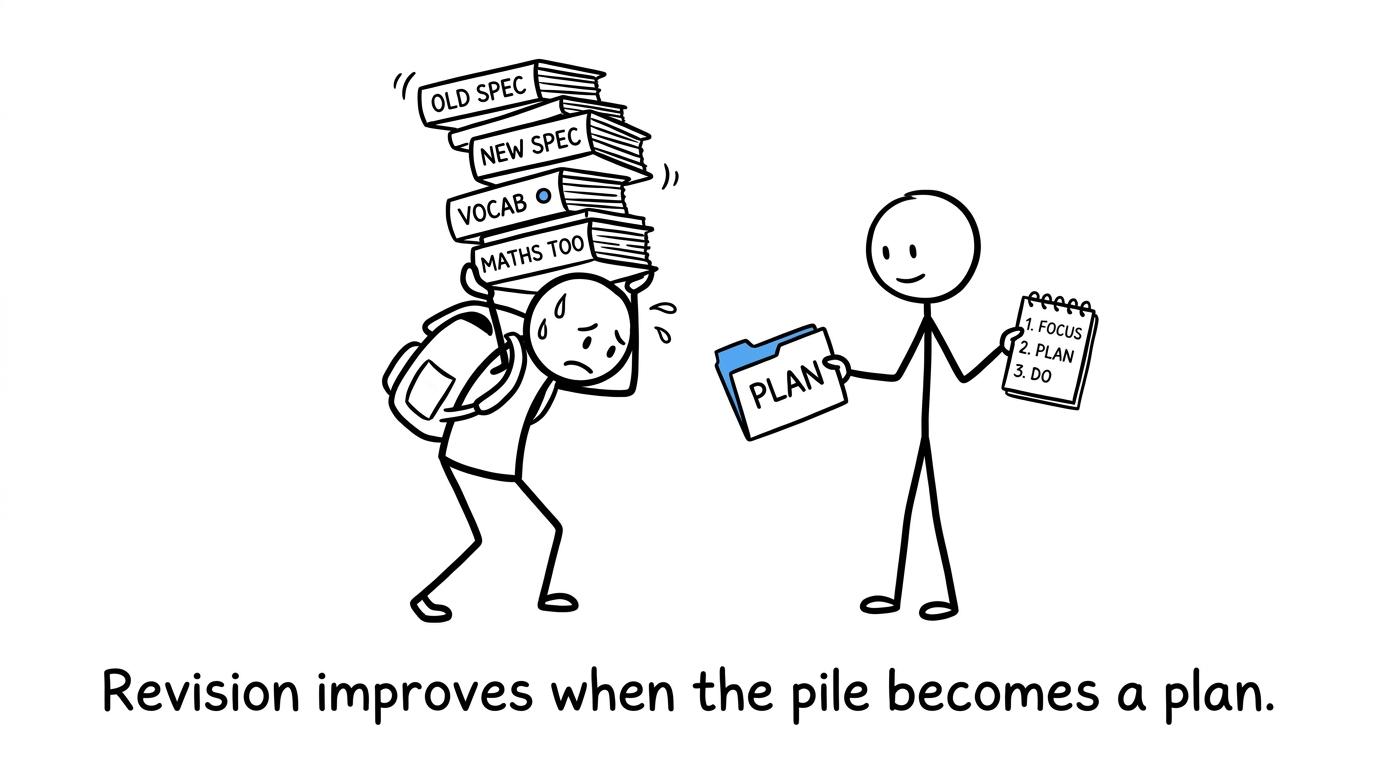 A large revision pile becoming a manageable checklist
Protecting your GCSE maths revision during the change
An unexpected specification switch creates extra work, but it should not silently take time from every other subject. Maths is cumulative: several missed weeks of practice can turn small gaps into larger ones.
Use two separate lists. Your German list should contain board-specific adjustments. Your maths list should contain the topics currently costing you marks. Keeping them separate prevents a change in one subject from making your entire revision plan feel unstable.
The GCSE maths revision hub lets you choose your exam board and work through free revision lessons, practice questions, mini tests and papers. If your weekly schedule needs rebuilding, use the GCSE maths revision timetable to assign realistic sessions instead of relying on whatever feels most urgent that evening.
A balanced week could include short German format sessions alongside regular maths topic practice. The exact time depends on your gaps and school guidance, but each session should have one purpose. “Revise German” is vague. “Practise the new speaking task instructions” is useful. “Do maths” is vague. “Complete and mark higher-tier ratio questions” is useful.
For a longer reset, the one-month GCSE maths revision plan provides a diagnose, practise, mark and retest structure. If the switch happens close to the examinations, the one-week maths revision plan helps you prioritise without attempting to relearn the whole course.
Questions to ask your school
Your teacher may already be preparing comparison documents, but students should understand the practical consequences. Ask:
- Why is the school changing board?
- Which classes and examination year are affected?
- Has the taught course been mapped against the new specification?
- Will additional lessons or speaking practice be provided?
- Which resources should no longer be used for exam simulation?
- Has the exams officer confirmed entries and assessment arrangements?
- How will foundation and higher tier decisions be made?
- What should students do if they have missed lessons during the transition?
These are requests for clarity, not challenges to the decision. If you receive conflicting information, ask for the final instructions in writing through the school's normal communication system.
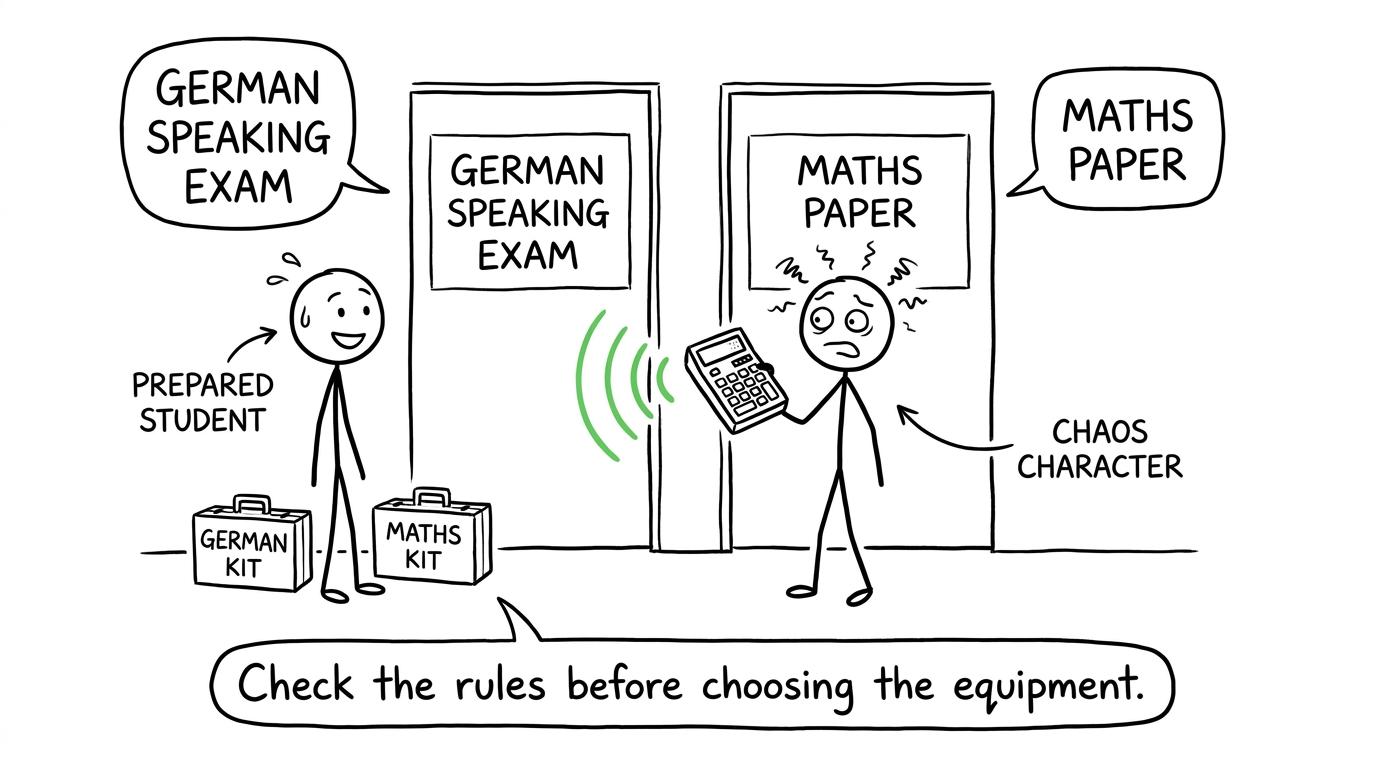 Separate toolkits for German and maths examinations
Common mistakes when the exam board changes
Throwing away all previous work
Most language knowledge transfers. Keep useful vocabulary, grammar notes and corrected writing. Replace outdated assessment assumptions, not everything you have learnt.
Using random papers from both boards
Mixed practice can help general fluency, but it can blur timings and instructions. Clearly label resources and reserve the new board's materials for realistic mock practice.
Assuming every specification is identical
National subject content creates common ground, not identical papers. Check task types, vocabulary expectations, timings and mark schemes.
Waiting for the final weeks
New speaking routines and question styles need repeated exposure. Begin short, focused practice as soon as the switch is confirmed.
Allowing German to displace maths completely
Urgency is not the same as importance. Maintain a minimum maths routine using MathsGenie's free GCSE resources even while you adjust. Near an examination, the GCSE maths night-before plan can help you avoid unfocused last-minute work.
Turn the change into a clear plan
A mid-course exam-board change is inconvenient, but it is manageable when the school handles the administration and students receive an accurate comparison of the specifications. Confirm the board, tier and assessment arrangements. Preserve transferable knowledge. Identify only the gaps that genuinely matter, then practise the new format until it feels ordinary.
At the same time, keep your maths preparation moving. Visit the MathsGenie GCSE hub for free revision lessons, practice questions, mini tests, past papers, predicted papers, mark schemes and video solutions. Choose the correct board and tier, find the next weakness on your list and start with one focused session today.










