

Switch Exam Board GCSE Astronomy: Is It Possible?
Switch exam board GCSE Astronomy: learn what a school change means, what happens to observations, and how to rebuild your revision plan calmly.
When a school announces an exam-board change halfway through a course, the first fear is usually simple: have months of revision just become useless? If you are trying to switch exam board GCSE Astronomy, the immediate answer is more reassuring than it sounds. At present, Pearson Edexcel provides the GCSE Astronomy qualification available in England, so a conventional move from Edexcel to AQA, OCR or Eduqas is not normally possible. Those boards offer GCSEs in other subjects, but not the equivalent GCSE Astronomy qualification.
If your school says that the board is changing, ask exactly what is changing. It may be the qualification, the teaching materials, the examination centre or the planned entry rather than the GCSE Astronomy exam board itself. Your completed learning will still matter, but the school must check the new assessment requirements and protect your mandatory observational work.
The short answer and your first checklist
Do not start revising a different collection of papers until the change has been confirmed in writing. Ask your teacher or examinations officer for:
- the full name of the qualification;
- the awarding organisation and specification code;
- the examination series and entry date;
- confirmation that it remains a regulated GCSE;
- details of the written papers and any practical or observational requirements;
- an explanation of how previous observations and records will be handled;
- a topic-by-topic comparison showing any gaps.
The current Pearson Edexcel specification code is 1AS0. It has two externally examined papers, both taken in the May/June series in the same year. Students must also undertake at least one unaided observation and at least one aided observation during the course.
That distinction matters. A resource pack can be replaced in an afternoon. A qualification entry, assessment structure and mandatory observation record cannot.
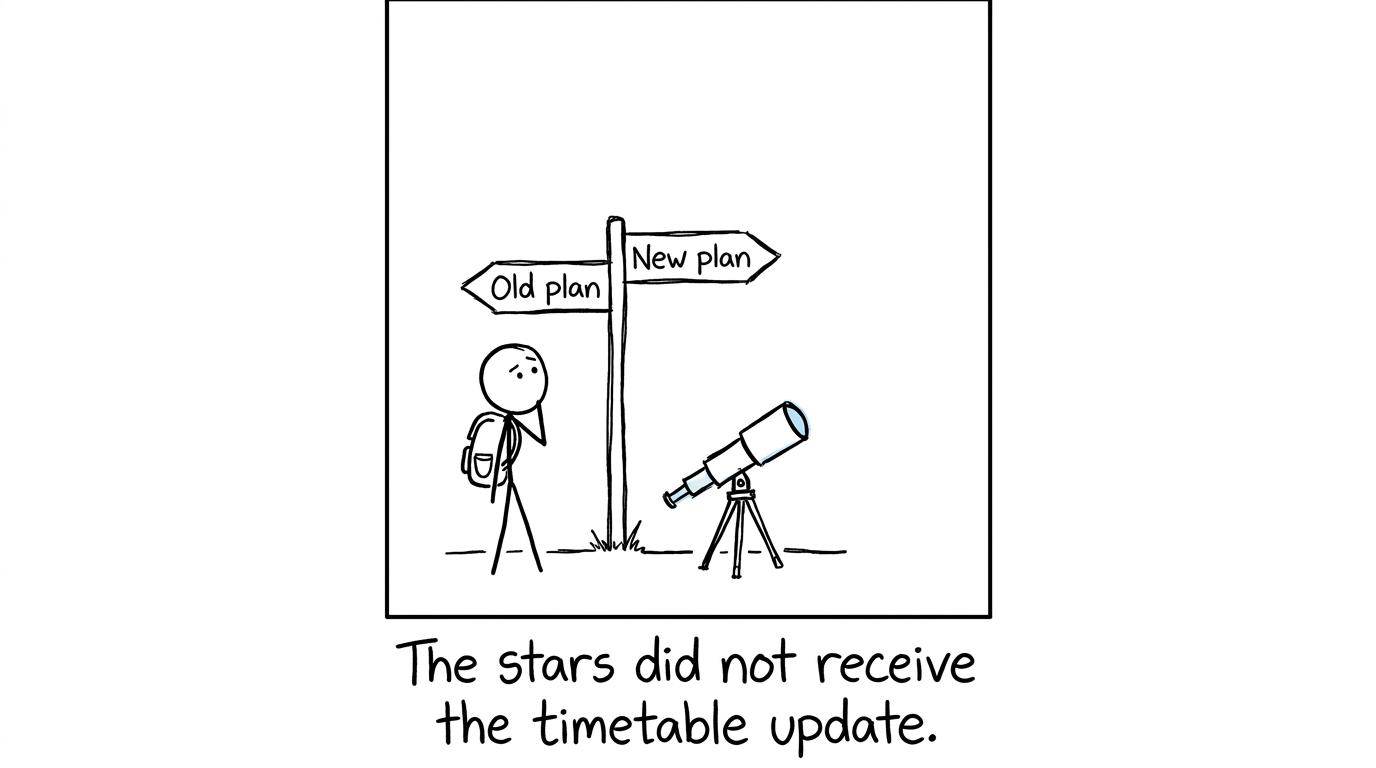 A student faces a changed course signpost while the telescope remains calmly pointed at the sky
Can a school actually switch GCSE Astronomy exam board?
A school can generally decide which awarding organisation it uses, provided that it enters students for an approved qualification and meets the relevant rules. Yet GCSE Astronomy is an unusual case because there is not currently a like-for-like choice among Edexcel, AQA, OCR and Eduqas.
Therefore, a supposed board change may really mean one of four things.
A change to another qualification
The school may be considering an alternative astronomy, space science or science-related course. That does not automatically make the new course equivalent to GCSE Astronomy. Its status, grading system, assessment method and recognition may differ.
Ask whether the replacement leads to a GCSE graded from 999 to 111, another regulated qualification, or an internal certificate. Students and parents should receive a clear answer before agreeing to the change.
A change of examination centre
Your teaching may remain based on Edexcel GCSE Astronomy while another approved centre handles the entry and examinations. This can occur where a school does not make the entry itself or where a private candidate needs a suitable centre.
That is an administrative change, not necessarily a specification change. However, responsibility for the Observation Statement and access arrangements must be made explicit.
A change of resources or teaching sequence
A new textbook, online platform or departmental scheme of work can feel like a board switch because the topic order suddenly changes. The deciding document is still the official specification, not the logo on a revision guide.
Confusion with another GCSE subject
Schools frequently use Edexcel, AQA, OCR or Eduqas across maths and science. A broad departmental announcement may apply to GCSE Maths or Physics but not Astronomy. Confirm the subject before rebuilding your revision plan.
For comparison, GCSE Maths topics by exam board and tier explains why genuine board differences matter in maths. GCSE Astronomy, by contrast, is untiered: there is no foundation or higher paper choice.
What happens to the work you have already completed?
Most astronomical knowledge does not disappear because an administrative plan changes. The Solar System does not reorganise itself around a specification. Concepts such as celestial coordinates, lunar phases, stellar evolution, telescope design and cosmology may remain useful wherever they appear in the replacement course.
The risk lies in three narrower areas:
- content present in one specification but absent from another;
- familiar content assessed with a different emphasis or command word;
- compulsory activities whose evidence must meet particular rules.
Your school should create a specification map. Every topic already taught can be labelled covered, partly covered or not yet covered. The same audit should be completed for mathematical skills, observational techniques and extended responses.
Avoid treating the entire course as new. Begin with the gaps. This is the same principle behind a useful GCSE maths revision timetable: revision becomes manageable when it is built around evidence rather than anxiety.
Protect your observational work
This is the most important practical issue in a mid-course change.
Under the current Edexcel GCSE Astronomy specification, students must complete at least one unaided and one aided observation. They should retain records showing what they planned, observed, analysed and evaluated. The centre must submit an Observation Statement to Pearson by 151515 April in the examination year, confirming that the requirement has been completed.
The observations are not simply optional enrichment. Knowledge and understanding developed through observational work are assessed in the written examinations. Failure by a centre to provide the required statement is treated seriously under the qualification rules.
Ask your school to confirm:
- where your observation records are stored;
- whether each task satisfies the current specification;
- whether both aided and unaided observations are complete;
- which centre will submit the Observation Statement;
- whether any activity must be repeated after the change.
Do not assume that photographs, rough notes or a telescope session automatically satisfy every requirement. Equally, do not repeat work unnecessarily. The examinations officer and subject teacher should first check the existing evidence against the specification.
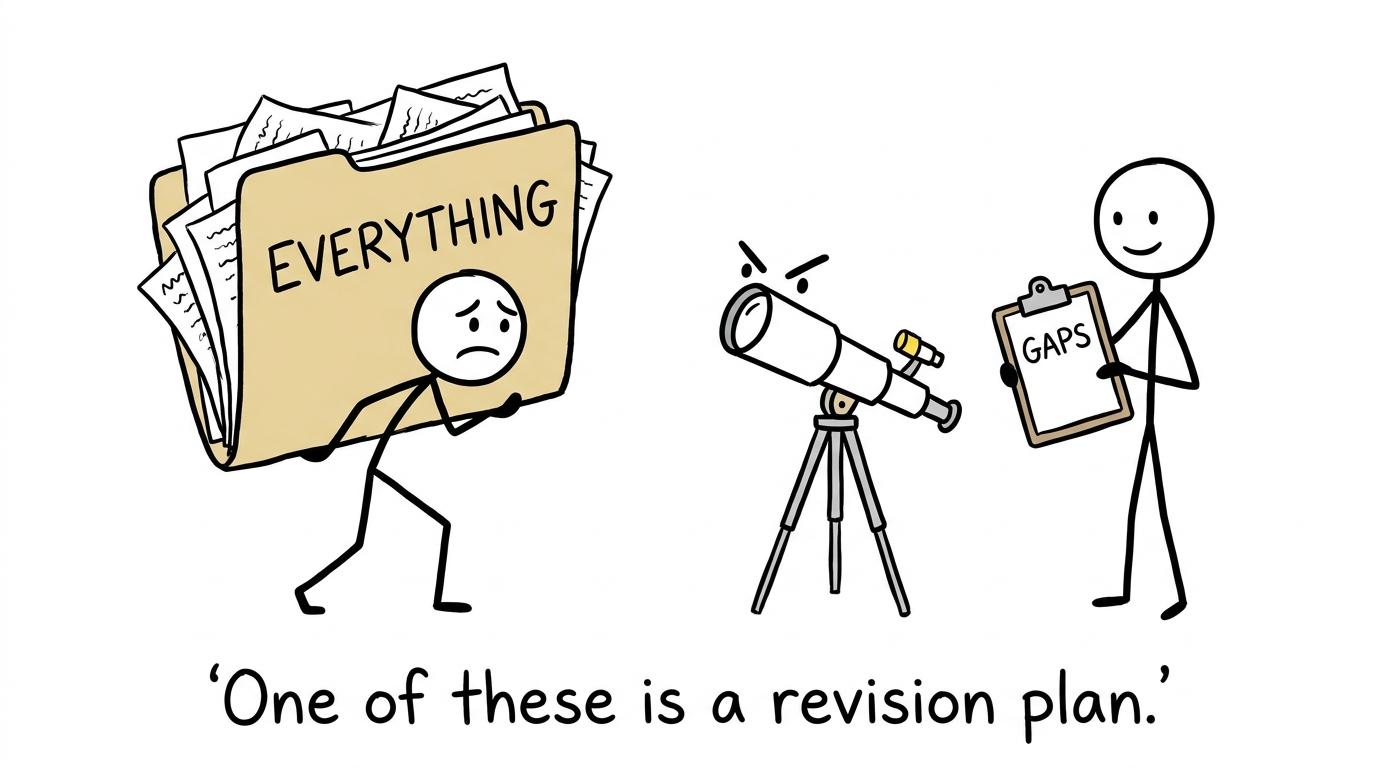 One student carries an enormous everything folder while another carries a focused gaps checklist
Understand the assessment you are preparing for
The current Edexcel GCSE Astronomy course has two equally weighted written examinations:
- Paper 1: Naked-eye Astronomy, covering Topics 111 to 888;
- Paper 2: Telescopic Astronomy, covering Topics 999 to 161616.
Each paper lasts 111 hour 454545 minutes, carries 100100100 marks and contributes 50%50\%50% of the qualification. Questions can include multiple-choice items, short answers, calculations, graphical work and extended open responses. A calculator is permitted, and Pearson supplies a formulae and data sheet.
Because both papers are sat at the end of the course, earlier class tests do not transfer as examination marks. Their value is diagnostic: they reveal what you know and what still needs attention.
If the school changes to a genuinely different qualification, obtain the equivalent assessment breakdown. Do not assume that its paper length, calculator rules, practical arrangements or grading system will match Edexcel.
Rebuild revision without starting again
A board or qualification change creates uncertainty, but the best response is a narrow, repeatable process.
Freeze the correct specification
Save the exact issue of the specification named by your school. Record the qualification code and examination series at the top of your revision plan. This prevents older resources from quietly directing your work.
Audit topics before revising them
Use the school’s comparison document to identify missing and partially covered material. If no comparison has been provided, request one rather than guessing from two textbooks.
Then divide your time between learning gaps, maintaining secure topics and practising the new assessment format. The GCSE one-month revision plan offers a useful structure for balancing targeted revision with timed practice.
Use the right papers
Past papers belong to a particular specification. Check the awarding organisation, code, series and paper title before starting. Older papers can still provide useful questions, but they should not be treated as a perfect model of the current assessment.
A productive paper routine is to sit suitable questions, mark them, classify each lost mark and revisit the underlying skill. MathsGenie’s guide to using Edexcel GCSE Maths past papers properly explains this feedback cycle clearly, even though your Astronomy papers must come from the correct Astronomy specification.
Strengthen the maths inside Astronomy
Astronomy questions often depend on transferable mathematical fluency: standard form, scale, ratio, angles, graphs, units, substitution and rearranging formulae. These skills remain valuable even if a course plan changes.
Use the free GCSE Maths revision hub to locate your board and practise weak methods through revision lessons, questions and video solutions. Astronomy itself is untiered, but your GCSE Maths tier still affects which maths resources are most suitable. If that distinction is unclear, read the guide to foundation and higher GCSE Maths.
Keep an evidence folder
Store observation plans, dated records, analysis, teacher feedback and official messages about the change. This is not about preparing an argument. It is about making responsibilities visible before a deadline becomes urgent.
Common mistakes after a mid-course change
Assuming AQA, OCR or Eduqas offers the same GCSE Astronomy course. At present, there is no straightforward like-for-like board switch. Verify the exact replacement qualification.
Throwing away previous revision. Much of the knowledge and mathematical skill may transfer. Audit it before deciding what must be relearned.
Ignoring the observations because they do not receive a separate coursework grade. The activities and centre declaration are mandatory, while observational understanding is assessed in the written papers.
Using papers from the wrong specification. A familiar subject title does not guarantee matching content or assessment.
Revising predicted topics instead of the full course. Predictions can focus final practice, but they cannot replace specification coverage. The same caution is explained in MathsGenie’s guide to GCSE predicted topics.
Trying to solve an administrative issue alone. Qualification entries and declarations belong with the school, examinations officer and awarding organisation. Your role is to ask precise questions, keep your records and continue revising confirmed content.
 Two exam papers wear different hats while a student discovers that careful reading still matters
A calmer way forward
A mid-course announcement can make the finish line seem as though it has moved. Usually, the first task is not to work harder. It is to name the change accurately.
Confirm the qualification, specification code, examination centre, assessment structure and observation arrangements. Then preserve what already transfers and make a focused plan for the genuine gaps. If the course remains Pearson Edexcel GCSE Astronomy, continue preparing for specification 1AS0 rather than searching for an equivalent AQA, OCR or Eduqas paper that does not exist.
For the mathematical skills supporting your Astronomy answers, make MathsGenie your free revision base. Use revision lessons and practice questions to repair individual methods, mini tests to check recall, and MathsGenie’s GCSE resources to move towards past papers, predicted papers, mark schemes and video solutions. A changed plan need not become a lost year. Once the facts are clear, progress becomes ordinary again: find the gap, practise it, check it and move forward.











