Extra Practice Material GCSE Arabic: How to Ask
Extra practice material GCSE Arabic: learn what to request, show your effort, and use teacher resources without neglecting your GCSE maths revision.

A teacher hands back a GCSE Arabic task. You recognise the vocabulary, yet the listening section moved too quickly, or your writing lost marks for accuracy. You want more practice, but one thought stops you: Will asking make it look as though I have not used the work already provided?
The short answer is no. Asking for extra practice material GCSE Arabic students can use is sensible when you show what you have attempted, identify a precise weakness and explain how you will use the new material. Teachers are far more able to help when the request is specific rather than simply, “Can I have more work?”
This matters especially if Arabic is competing with GCSE maths and several other subjects for your time. The goal is not to collect worksheets. It is to obtain the right practice, complete it carefully and learn from the feedback.
A quick checklist before asking your teacher
Before approaching your teacher, make sure you can answer these questions:
- Which GCSE Arabic exam board and tier are you taking?
- Which skill needs attention: listening, speaking, reading or writing?
- What material have you already completed?
- What exactly caused difficulty?
- Do you want questions, audio practice, a speaking prompt or feedback on a response?
- When will you complete the extra task?
- How will you protect the time needed for GCSE maths revision?
That final question matters. Extra material should strengthen your plan, not quietly overload it. If your week already feels crowded, use the MathsGenie revision planner to give each subject a realistic place.
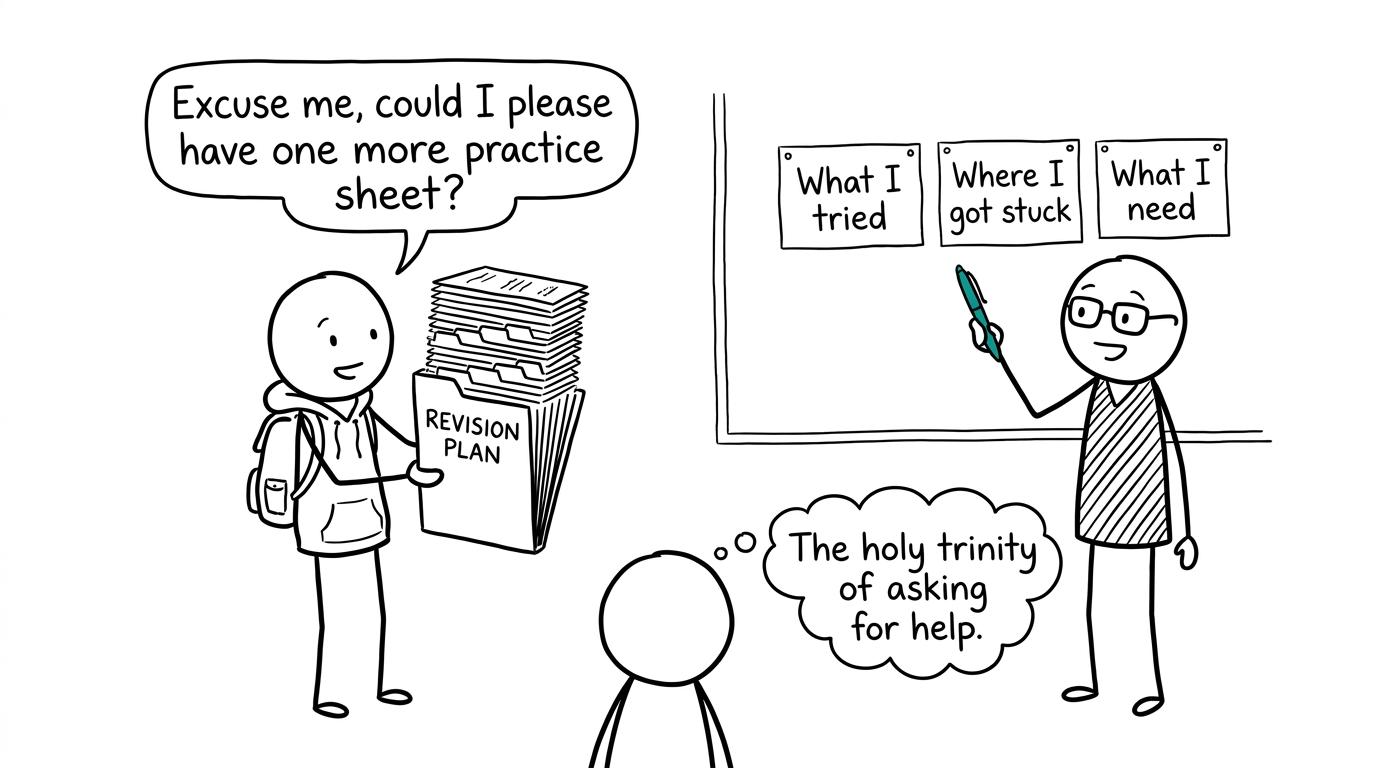 A prepared student asking a teacher for one targeted practice sheet
Why asking for extra GCSE Arabic practice is worthwhile
GCSE Arabic is not one single skill. For example, the current Pearson Edexcel GCSE Arabic qualification assesses listening, speaking, reading and writing in separate papers. Each contributes 25%25\%25% of the qualification, and students take the same tier across the papers. The exact format depends on your exam board and specification, so confirm those details with your teacher before choosing resources.
This structure explains why a general request for “more Arabic” is not especially useful. You may be confident when reading an article but hesitate during an unprepared speaking question. You may understand spoken Arabic yet lose writing marks because your grammar or word choice is not accurate enough.
Extra practice is most valuable when it matches the gap.
| If your difficulty is... | Ask whether your teacher can provide... |
|---|---|
| Following recorded Arabic | A specification-matched listening task with questions or a transcript for later review |
| Responding spontaneously | Role-play cards, picture prompts or short conversation questions |
| Understanding unfamiliar texts | Reading passages with exam-style questions and a mark scheme |
| Writing accurately | A short writing prompt focused on a particular theme or grammar point |
| Translating meaning precisely | Brief translation tasks at the correct tier |
| Managing exam time | A timed section from an approved past or sample paper |
This is the same principle that makes effective maths revision work. If algebra is the weakness, collecting an entire folder of unrelated geometry questions adds volume without solving the problem. MathsGenie’s GCSE maths revision hub organises lessons and practice by topic, board and level so that your effort can follow the evidence.
How to ask without sounding as though you are not trying
The tone of your request matters less than the evidence behind it. You do not need a perfect speech. You need to make three things visible: what you attempted, what you noticed and what you intend to do next.
Begin with the work you have completed
Instead of opening with “I need more sheets”, mention the task you have already tried. You might say:
“I completed the reading questions from this week and corrected them using my notes. I am still struggling to identify opinions when the wording is unfamiliar. Is there another short reading task I could attempt?”
That does not sound like avoidance. It sounds like reflection.
If possible, bring the completed work. A marked response, correction page or short error list gives your teacher something concrete to inspect. They may discover that you do not need another full paper at all. A smaller task on one question type could be more useful.
Name one specific weakness
“Arabic is difficult” is honest but too broad to guide a teacher. Narrow the problem:
- I miss details when the listening recording becomes faster.
- I need to practise answering unexpected speaking questions.
- I understand the reading passage but misinterpret the question instructions.
- My writing communicates the idea, but I repeat the same vocabulary.
- I need more practice translating accurately without relying on a dictionary.
Official GCSE modern foreign language requirements cover understanding and communication across different forms of language, alongside vocabulary, structures and grammar. Your teacher therefore needs to know which part of that process is breaking down.
The same diagnostic habit is powerful in maths. The guide to finding your weakest GCSE topics shows how to turn lost marks into specific revision priorities rather than revising everything equally.
Request a manageable amount
Ask for one focused task first. A request for every available worksheet can sound enthusiastic, but it may create a pile you never finish. One completed and reviewed task is worth more than ten downloaded papers.
Try:
“Could I have one higher-tier listening activity on school or future plans? I can complete it by Thursday and bring my corrections to the next lesson.”
Adjust the wording to your tier, topic and genuine deadline. Do not promise a date merely to impress your teacher. Choose one you can meet alongside homework and maths practice.
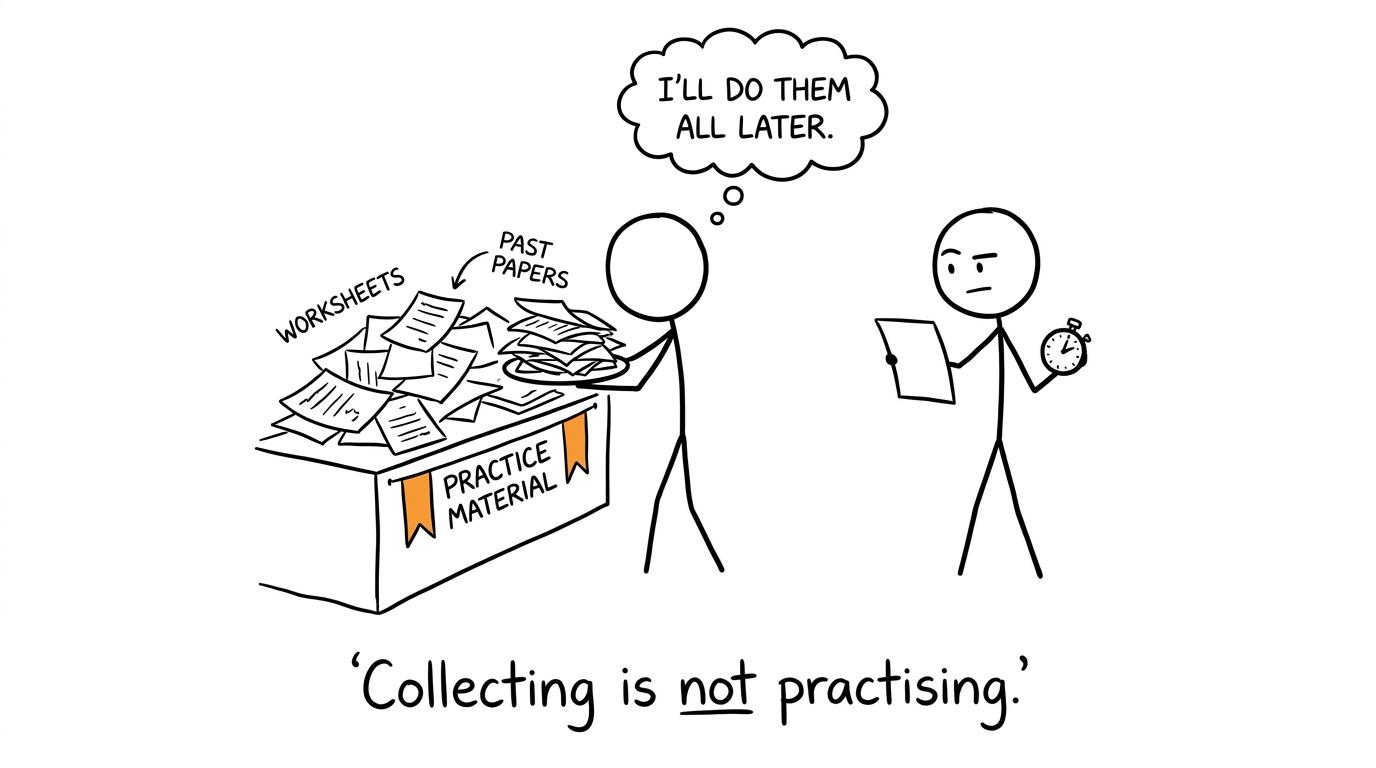 A student discovers that collecting worksheets is not the same as practising
What to request for each GCSE Arabic skill
Listening practice
Ask for audio that reflects your specification and tier. It may help to complete the questions once under timed conditions, then review the transcript or recording afterwards if your teacher permits it.
Tell your teacher whether the difficulty is vocabulary, speed, recognising different voices or holding details in memory. Those are different problems and may require different tasks.
Speaking practice
Speaking improves through active responses, not silent rereading. Ask for role-play prompts, picture-based questions or conversation topics that allow you to practise responding aloud.
Your teacher may also be able to suggest an appropriate way to record yourself, structure partner practice or evaluate pronunciation and spontaneity. Follow the assessment conditions explained by your school. Practice material should prepare you for the format without attempting to predict confidential live assessment content.
Reading and translation practice
Ask for texts that sit at the correct tier and include questions in the style used by your board. If translation is the issue, explain whether you struggle to preserve meaning, recognise vocabulary from context or produce natural English.
Do not treat every unknown word as a crisis. Reading questions often require you to find the relevant idea rather than translate every line perfectly. Your teacher can help you distinguish a vocabulary gap from an exam-technique problem.
Writing practice
A full extended response may not always be necessary. Your teacher might recommend a shorter task on tense control, opinions, justification, connectives or range of vocabulary.
Ask how the response should be checked. Feedback is more useful when you understand why a phrase was inaccurate and then rewrite it. Merely reading corrections can feel productive while leaving the underlying habit unchanged.
Use extra material as a feedback loop
The best revision has a simple rhythm:
- attempt a focused task without unnecessary support;
- mark it or obtain teacher feedback;
- classify each error;
- correct the response;
- revisit the same skill with fresh material;
- record whether the problem improved.
Keep an Arabic error log with headings such as vocabulary, grammar, misunderstood instruction, omitted detail and timing. For speaking, note where you paused, relied on memorised wording or failed to develop an answer.
This resembles the approach explained in how to use past papers properly. A paper is evidence. The learning happens when you mark it, repair the weakness and test it again.
Balance Arabic practice with GCSE maths revision
Students rarely revise one subject in isolation. An extra Arabic task has to fit beside maths, English, science and your other options. That makes selection more important than sheer effort.
A sensible short session might contain:
- a brief Arabic listening or reading task;
- immediate checking and one correction note;
- a separate maths topic session later in the week;
- one timed assessment block at the weekend.
For a compact maths structure, follow the twenty-minute GCSE maths revision routine. You can also use GCSE mini tests when you need quick evidence of a weak topic rather than another full paper.
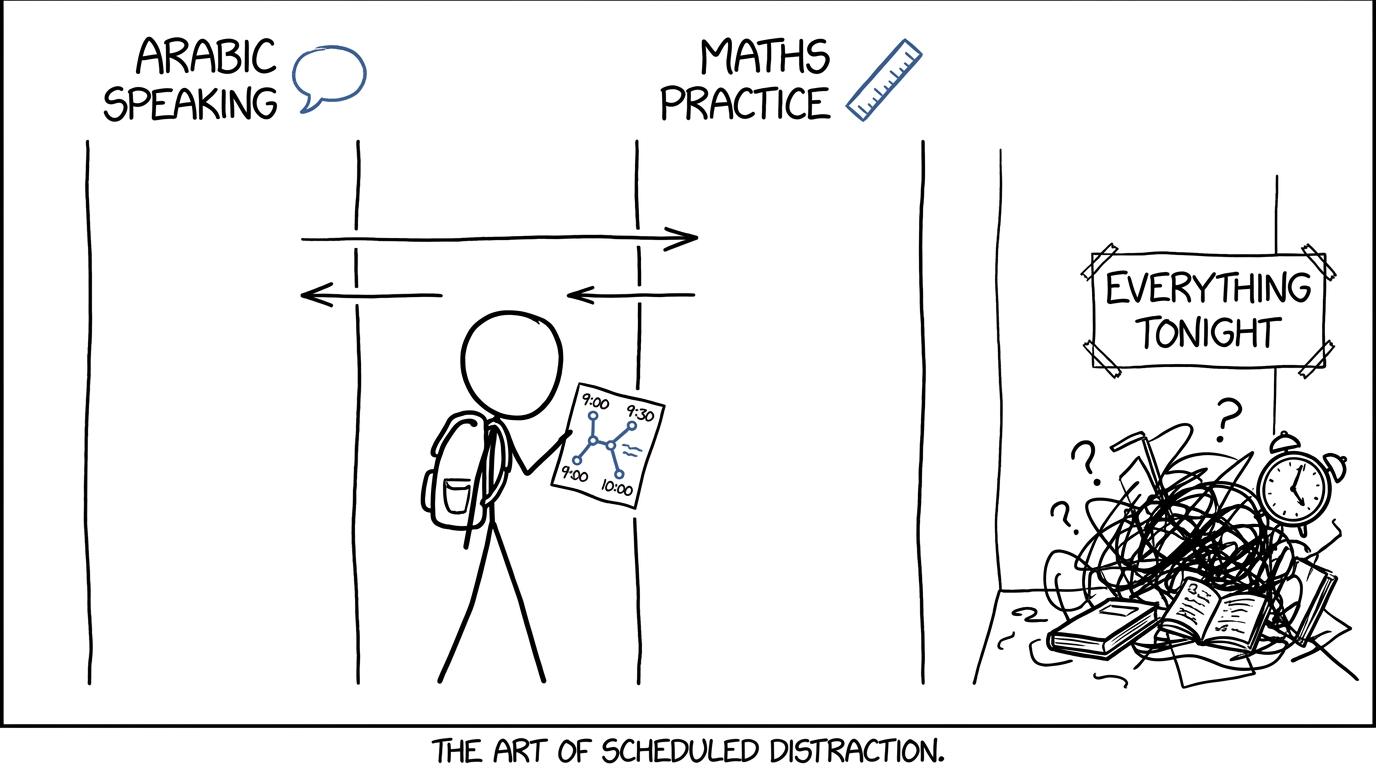 A student uses a timetable to switch calmly between Arabic and maths revision
The wider lesson is simple: do not let the subject shouting loudest consume the entire week. Give each session a purpose. Arabic may need speaking practice today; maths may need simultaneous equations tomorrow. A timetable turns both intentions into appointments.
Common mistakes when requesting extra material
Asking before using existing resources
Check your exercise book, school platform, specification materials and previous feedback first. If something suitable already exists, complete it and take your questions to the teacher.
Making the request too vague
“Can I have more revision?” gives your teacher little direction. State the paper, skill, tier and difficulty wherever possible.
Collecting more than you can complete
A large stack creates the appearance of preparation, but unfinished material produces no feedback. Start small and return with evidence.
Asking for a predicted live assessment
Request specification-matched practice, not confidential questions or promises about what will appear. Your teacher can help you prepare for skills and formats, but no responsible resource can guarantee future exam content. The same applies to maths: GCSE predicted papers are useful practice tools, not forecasts of the exact questions.
Ignoring corrections
Completing a task and immediately requesting another can repeat the same error. Correct the first task, explain what changed and then ask for a fresh check.
Forgetting your wider revision plan
Extra Arabic work should not erase maths practice or sleep. If the workload is becoming unmanageable, tell your teacher. Asking for a shorter, more focused activity is better than silently accepting work you cannot complete.
Ask clearly, then use the answer well
It is worth asking your teacher for extra GCSE Arabic practice material when your request is targeted and supported by visible effort. Bring what you have attempted. Name the precise difficulty. Ask for one manageable resource and agree how you will review it.
That approach does more than avoid the impression that you are not trying. It shows the most useful kind of effort: attention directed at a real weakness.
Then apply the same discipline to maths. Use MathsGenie’s free revision lessons and practice questions to rebuild weak topics, mini tests to check them, and past papers with mark schemes to develop exam confidence. When the exams draw closer, add predicted papers and video solutions to the cycle.
Ask for what you need. Complete it. Learn from it. Then return to the next weakness with better evidence than before.