GCSE Foundation vs Higher Maths: Which Is Better?
GCSE Foundation or Higher maths better? Learn grade limits, who each tier suits, and how to choose confidently with Maths Genie papers and topics.
When you’re revising for GCSE maths, the question “Is Foundation or Higher better?” can feel strangely personal. Not because of the maths itself, but because tiers sound like labels. A bit like being quietly sorted into a box you didn’t choose.
But the truth is simpler, and kinder: Foundation and Higher are just two different routes through the same landscape. One route is steadier and capped at a certain grade. The other goes further, but expects you to carry more tools. “Better” isn’t about status. It’s about outcomes: the grade you need, the confidence you can build, and the marks you can reliably secure under timed conditions.
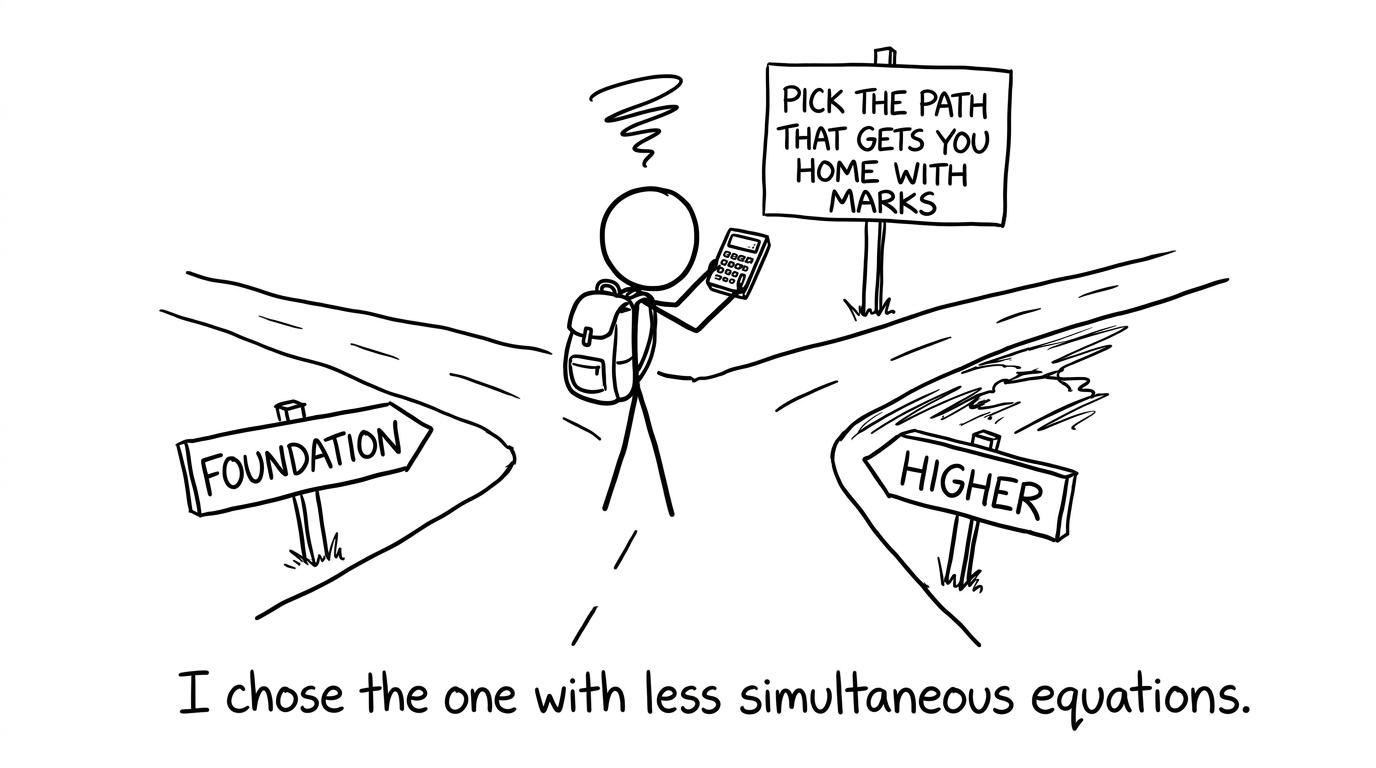 Student choosing between Foundation and Higher
Foundation vs Higher at a glance (the decision checklist)
Before you overthink it, run this checklist. It works across exam boards (Edexcel, AQA, OCR, Eduqas) even though the exact papers differ.
- Target grade for your next step: If you need grade 666+ (often for A Level maths or science pathways), Higher is usually required.
- Current performance under exam conditions: Not your best homework day: your repeatable paper score.
- Strength in core skills: fractions, percentages, algebra basics, and graph reading are the real gatekeepers.
- Attitude to risk: Higher has higher ceilings, but also a wider spread of question difficulty.
- Time left to improve: with a structured plan, jumps are possible, but you need evidence from practice papers.
If you want a structured route, Maths Genie’s scheme of learning is built exactly for this: stages 111 to 101010 cover Foundation content, and stages 111111 to 141414 are Higher-only. Start here: Edexcel GCSE Maths Scheme of Learning.
What “better” really means in GCSE tier choices
People say “Higher is better” because it reaches higher grades. People say “Foundation is better” because it feels safer. Both statements miss the point.
For GCSE maths, “better” means:
- You can access the grades you need for college, sixth form, apprenticeships, or entry requirements.
- You can convert your revision time into marks predictably.
- You can walk into Paper 1 knowing your methods are automatic, not fragile.
There’s a quiet trap here: students often pick Higher because they hope it will unlock a top grade. Hope is not a plan. But equally, some students stay on Foundation because they fear Higher topics they’ve never been taught properly. Fear is not a plan either.
A plan is evidence: topic-by-topic mastery, then timed papers, then targeted fixing.
Understanding the grade trade-off (without the myths)
The grade cap matters
Across most specifications, Foundation tier is capped at grade 555 (with grades 111 to 555 available). Higher tier typically covers grades 444 to 999.
So if your realistic best-case grade is 666 or above, Foundation literally cannot give you the outcome you want. That’s not a judgement. It’s just a rule.
The overlap is bigger than you think
A lot of the marks on Higher papers come from what feels like “Foundation maths done well”: accurate arithmetic, rearranging, interpreting graphs, and applying standard methods.
That means your decision isn’t “easy paper vs hard paper”. It’s more like:
- Foundation: fewer extreme questions, more emphasis on fluency.
- Higher: the same fluency still matters, plus extra content and harder problem-solving.
The fastest way to see this in real GCSE style is to use papers with solutions. For example:
The content difference: what Higher adds on top
If you’re choosing tiers, you need to know what you’re signing up for.
Higher-only content often includes topics like:
- more demanding algebra (e.g. iterative methods, harder simultaneous equations)
- circle theorems and more complex geometry
- advanced trigonometry and exact values
- harder quadratic and graph problems
- proof-style reasoning and multi-step problem solving
But remember: Higher students still drop marks on basics. It’s common to lose 333 to 555 marks on a paper simply through fraction slips or misreading scales.
If you’re unsure where your foundations are, use topic practice rather than only full papers. Maths Genie’s GCSE revision collections (videos, exam questions, and solutions) are ideal for this, particularly around exam season:
- GCSE Revision Summer 2024 (topic lists and questions)
- GCSE Revision Summer 2025 (topic lists and questions)
A worked example that shows the real difference
A good way to feel the tier gap is to compare two questions that share the same core skill.
Example 1 (Foundation-style): percentage change
A laptop costs £480480480 in a sale after a 20%20\%20% reduction. Find the original price.
Let the original price be xxx.
After a 20%20\%20% reduction, the price is 80%80\%80% of the original:
0.8x=480 0.8x = 480 0.8x=480Divide both sides by 0.80.80.8:
x=4800.8=600 x = \frac{480}{0.8} = 600 x=0.8480=600So the original price was £600600600.
The method is calm and direct: convert to a multiplier, form an equation, solve.
Example 2 (Higher-style): reverse percentages with algebraic structure
A value is increased by 15%15\%15% and then decreased by 15%15\%15%. The final value is £391391391. Find the original value.
Let the original value be xxx.
Increase by 15%15\%15% means multiply by 1.151.151.15:
After increase=1.15x \text{After increase} = 1.15x After increase=1.15xThen decrease that by 15%15\%15% means multiply by 0.850.850.85:
Final=0.85×1.15x=391 \text{Final} = 0.85 \times 1.15x = 391 Final=0.85×1.15x=391So:
0.9775x=391 0.9775x = 391 0.9775x=391 x=3910.9775=400 x = \frac{391}{0.9775} = 400 x=0.9775391=400So the original value was £400400400.
Notice what changed: not the underlying idea (multipliers), but the layering. Higher is often “Foundation methods with more steps and more traps”.
To practise these skills by topic, Maths Genie’s statistics and probability resources also help with exam interpretation and multi-step reasoning:
How to decide sensibly (with evidence, not vibes)
Use timed papers to find your “stable grade”
Do one full paper in exam conditions, then mark it honestly. Your stable grade is the one you can hit twice, not once.
If you’re working with Edexcel-style papers and want targeted exam practice, Maths Genie’s predicted papers are designed to focus revision when the exam window is close:
If a full paper feels too big, smaller timed sections can train stamina without the overwhelm:
Use the scheme of learning to plug gaps
If you’re on Higher but keep dropping marks on early questions, don’t “revise harder”. Revise lower. Return to the stage that matches your weakness and build up again.
Start here and move stage by stage:
Think about A Level readiness (if that’s your route)
If you want A Level maths, Higher tier is usually the practical choice because A Level assumes comfort with algebraic manipulation.
If you’re already looking ahead, browsing actual A Level paper styles can be motivating:
It’s not about rushing. It’s about seeing the direction of travel.
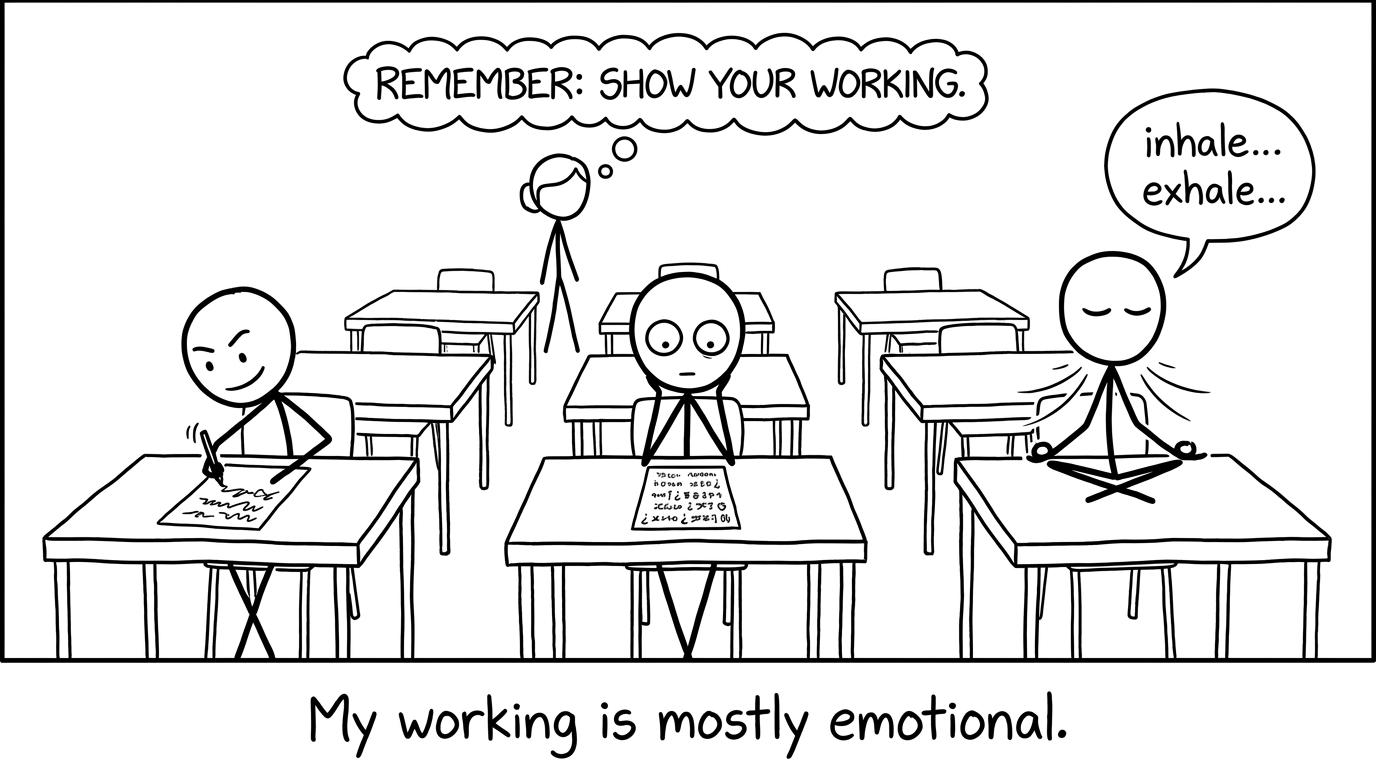 Exam hall nerves and “show your working”
Common mistakes when choosing Foundation or Higher
- Confusing potential with consistency: doing one brilliant Higher mini test doesn’t mean Higher is right if you collapse under full paper timing.
- Ignoring the grade cap: choosing Foundation while needing grade 666+ creates stress later when you realise the ceiling is fixed.
- Overvaluing “hard topics”: many Higher marks are earned through accurate basics. Losing marks on fractions can cost more than skipping a tough circle theorem question.
- Not using mark schemes properly: you should look for method marks (M marks) and accuracy marks (A marks). If you only check final answers, you miss the quickest improvements.
- Practising randomly: jumping between topics feels productive, but it often avoids the discomfort that creates progress. A structured sequence beats chaotic repetition.
Bringing it home: which is better for you?
For GCSE maths, Foundation or Higher is “better” only in the way a route home is better: the one that gets you there, safely, with time to spare.
If you need grades 666 to 999, Higher is the route. If you need a secure pass and your priority is consistency, Foundation can be the smarter route. Either way, your next step is the same: turn uncertainty into evidence.
Use Maths Genie to do that systematically:
- revise the exact topics you need with free lessons and exam questions
- practise with past papers and predicted papers
- mark with solutions and fix one weakness at a time
Start with the structured pathway here: Edexcel GCSE Maths Scheme of Learning, then build exam confidence using GCSE Predicted Papers and your exam board’s paper set (for example AQA GCSE Maths Past Papers).
Choose the tier that lets you collect marks reliably and then practise until the decision feels obvious.