GCSE Arabic Cross-Curricular Overlap: Does It Help?
GCSE Arabic cross curricular overlap explained: see where Arabic supports maths and other subjects, then revise shared themes once without missing key skills.
Revision can begin to feel like carrying the same idea between different rooms. You discuss environmental problems in Arabic, interpret environmental data in geography, calculate percentages in maths and evaluate evidence in science. The labels change, but part of the thinking remains familiar.
The idea behind GCSE Arabic cross curricular overlap is that you can reuse this shared knowledge and thinking instead of revising every context from the beginning. It genuinely helps, especially with vocabulary, data interpretation, concise reading and organising arguments. But it has limits. Arabic language accuracy cannot replace mathematical method, and knowing a topic in English does not mean you can discuss it fluently in Arabic.
The best strategy is therefore simple: revise shared content once, then practise the subject-specific response separately.
The quick overlap checklist
Before combining two revision sessions, ask:
- Does the same theme appear in both subjects?
- Does the same skill appear, such as extracting information or comparing evidence?
- Will the subjects require different vocabulary, notation or answer structures?
- Can one resource test both subjects without weakening either one?
- Have I still completed exam-style practice for each separate specification?
If the first two answers are yes, there is useful overlap. If you ignore the final three questions, efficient revision can quietly become incomplete revision.
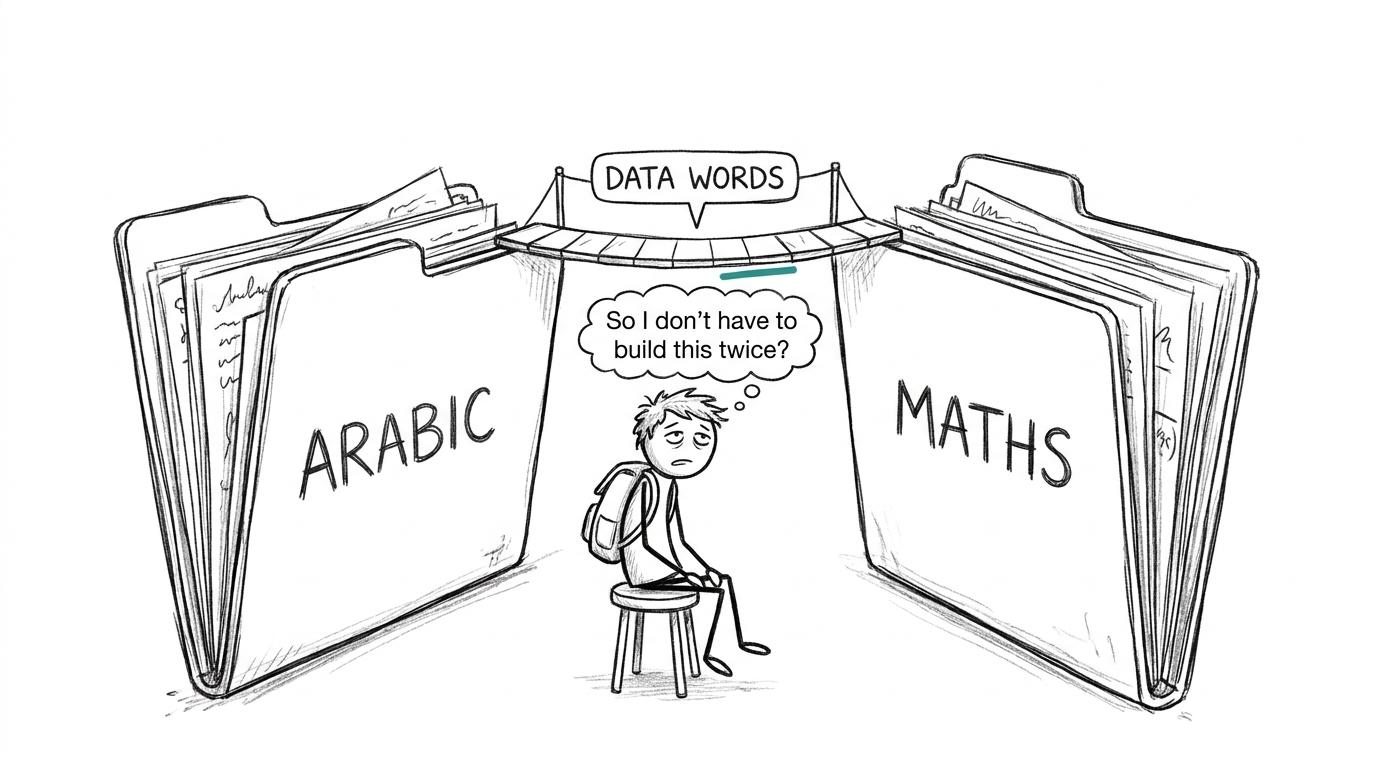 A student discovers a small bridge between Arabic and maths revision folders
What GCSE Arabic actually assesses
For students taking the current Pearson Edexcel GCSE Arabic qualification, the course assesses listening, speaking, reading and writing. Each skill contributes 25%25\%25% of the qualification, and students enter either foundation or higher tier across the papers.
The specification is organised around five broad themes:
- identity and culture
- local area, holidays and travel
- school
- future aspirations, study and work
- international and global issues
These themes create natural connections with other GCSE subjects. However, the marks remain language marks. In Arabic, you must understand or communicate meaning through appropriate vocabulary, grammar and structures. A strong understanding of climate change from geography may give you ideas, but it will not supply the Arabic words or accurate sentence forms needed to express them.
This distinction matters: topic overlap reduces the amount of content you must rediscover, while subject practice develops the form in which you must express it.
Where Arabic genuinely overlaps with maths
Arabic and maths do not share large sections of specification content. You will not revise algebra by learning travel vocabulary, and practising Arabic verb forms will not teach you circle theorems. Their most useful connection is found in transferable reading habits and numerical contexts.
Percentages, proportions and quantities
Arabic themes such as shopping, travel, technology, environmental resources and daily life can involve prices, quantities, comparisons or proportions. The underlying mathematical language may include ideas such as:
percentage=partwhole×100\text{percentage} = \frac{\text{part}}{\text{whole}} \times 100percentage=wholepart×100Understanding the relationship between a part and a whole helps you interpret claims involving discounts, survey results or resource use. You can strengthen the mathematical method with MathsGenie's percentages revision guide.
Ratios can also appear naturally when comparing groups, ingredients, spending or resources. The transferable idea is that order matters: a comparison of 2:32:32:3 is not interchangeable with 3:23:23:2. Use the ratio revision guide to secure the calculation, then learn how the relevant comparison is described in Arabic.
Do not force this connection. The Arabic exam is not testing whether you can perform a difficult percentage calculation. It is testing whether you can understand and communicate the message.
Reading numerical information carefully
Both subjects reward disciplined reading. In a maths question, one overlooked word can change the operation. In Arabic, a time marker, negative expression or comparative phrase can alter the whole meaning.
Useful shared habits include:
- identifying exactly what information is given
- separating essential details from distracting context
- noticing units, dates and quantities
- checking whether a statement describes an increase, decrease or comparison
- answering the question asked rather than the question expected
This is skill overlap rather than content overlap. It will not remove the need for separate practice, but it can make that practice more reliable.
Interpreting data and claims
Environmental and social themes may expose you to surveys, charts or statements containing numerical evidence. Maths teaches you to question what the figures actually show. Statistics asks whether a sample is representative, whether a graph is misleading and whether a relationship supports the claimed conclusion.
MathsGenie's GCSE Statistics revision hub is useful if your course includes statistics or if you want deeper practice interpreting data. The same sceptical mindset helps whenever an Arabic text presents a claim supported by quantities: understand the language first, then decide what the evidence means.
 A student detective investigates cross-curricular revision clues
The stronger overlaps with your other subjects
The most valuable cross-curricular connections often sit outside maths. These can still save time for maths revision because fewer duplicated sessions leave more room for focused question practice.
Geography and science
Environmental issues, natural resources, travel, weather and places connect closely with geography. Science may overlap through energy, pollution, health and evidence-based explanations, depending on the topics used in your Arabic lessons.
The efficient approach is to learn the underlying concept in the subject where it is assessed most deeply. Then build a compact Arabic vocabulary bank for describing causes, effects, advantages, disadvantages and possible solutions.
Geography also shares numerical skills with maths. The geography statistical skills guide covers averages, percentage change, scatter graphs and interpreting data. Revising these methods once can support geography and maths, while an Arabic follow-up can focus on language for trends and comparisons.
English and humanities
Arabic writing and speaking often require you to communicate opinions, reasons and experiences clearly. English, history, religious studies and citizenship also develop structured communication, although their assessment rules differ.
The reusable element is planning:
- state an idea
- support it with a relevant reason or detail
- introduce a contrasting perspective where appropriate
- reach a clear conclusion
What cannot be reused automatically is the final answer. An English literature paragraph, a history explanation and an Arabic response have different purposes and mark schemes. Borrow the structure of clear thinking, not the finished wording.
Business, computing and careers
Technology, social media, employment and future ambitions can overlap with business, computing and careers education. You might already understand online safety, workplace skills or the effects of technology. That prior knowledge gives you something meaningful to say in Arabic.
It also prevents a common revision problem: memorising impressive sentences without fully understanding them. Familiar content is easier to adapt when a question changes, but you must still practise the relevant Arabic vocabulary and grammar.
Psychology and research skills
Psychology and other social sciences frequently use quantitative and qualitative data, surveys, samples and conclusions. Those ideas reinforce the careful reading needed in maths and in any Arabic text discussing social behaviour or technology.
The analysing research revision guide can help you distinguish types of data, recognise bias and select appropriate charts. Again, the method belongs to the numerical subject; Arabic supplies a different communication layer.
How to revise shared material without revising it twice
The goal is not to merge your subjects into one vague session. It is to create a shared core followed by separate exam practice.
Build an overlap map
Take one sheet and create three columns:
- shared theme
- subjects connected to it
- separate exam outputs required
For an environmental theme, your shared core might contain definitions, causes, consequences and solutions. Your separate outputs might then include Arabic vocabulary recall, a geography case-study question and a maths data-interpretation task.
This makes the boundary visible. You are reusing understanding, not pretending the assessments are identical.
Use one stimulus in different ways
A short age-appropriate article, image or teacher-provided resource can support several tasks. You might identify the main message in Arabic, assess the evidence in geography and inspect any numerical claims using maths.
Keep each response aligned with its own mark scheme. In maths, show the method and include units. In Arabic, prioritise accurate communication and the requested tense or purpose. In geography, connect evidence to the command word.
Separate knowledge review from exam practice
A practical session can contain three stages:
- 151515 minutes reviewing a shared theme
- 202020 minutes completing subject-specific questions
- 101010 minutes marking and recording corrections
The exact timing can change. The important feature is separation. Shared revision saves preparation time; exam questions reveal whether you can apply the knowledge in the required form.
For maths, choose your exam board and tier through the GCSE Maths revision hub. Its revision lessons, practice questions, worksheets and video solutions allow you to repair the exact skill that a mixed session exposes.
 Two revision timetables discover an overlapping time slot
Protect your maths marks
Cross-curricular revision can release time, but that time should be used deliberately. Maths performance depends on practising methods, selecting strategies and showing working under exam conditions. Reading about a numerical issue is not the same as solving a question.
Use the saved time to:
- complete topic questions without notes
- mark every answer and classify the error
- revisit weak foundation or higher-tier content
- sit mini tests under light time pressure
- progress to full past papers and predicted papers
If you need a wider map of examinable content, the GCSE maths topics by board and tier guide covers Edexcel, AQA, OCR and Eduqas. For a longer timetable, adapt the one-month GCSE maths revision plan.
Common mistakes with cross-curricular revision
Treating a shared theme as a shared mark scheme
Knowing about renewable energy does not automatically earn marks in Arabic, science or geography. Each subject rewards a different form of knowledge and communication.
Counting passive reading as maths practice
Reading a chart or article can build context, but maths improvement requires calculations, reasoning and written working. Follow shared revision with proper exam questions.
Learning ideas without Arabic language
A sophisticated opinion is of limited use if you cannot express it accurately. Build small vocabulary groups around functions such as comparing, justifying, describing time and expressing consequences.
Forcing connections that do not exist
Some topics simply need independent revision. Algebra, trigonometry and probability techniques will usually require dedicated maths sessions. Arabic pronunciation, grammar and listening also need their own practice.
Using the wrong specification or tier
Check your Arabic qualification and your maths exam board before choosing resources. Maths specifications from Edexcel, AQA, OCR and Eduqas cover broadly comparable national content, but organisation and question style vary. Your foundation or higher tier also determines the level of practice you need.
Make overlap serve the timetable
Cross-curricular overlap helps when it removes repeated background learning while preserving subject-specific practice. It fails when it becomes an excuse to skip the difficult part: retrieving vocabulary, solving unfamiliar questions or writing under exam conditions.
Start with one genuinely shared theme. Build the common knowledge once. Then complete one Arabic task and one maths task, marking each by its own rules. That small boundary is what turns overlap from a revision shortcut into a sound strategy.
Use MathsGenie as your free maths base: begin with the GCSE Maths revision hub, strengthen weak topics through revision lessons and practice questions, and then test your progress with mark schemes, mini tests, video solutions, past papers and Edexcel GCSE Maths predicted papers. Save time where subjects genuinely meet; then spend it where your next maths marks will be won.