Read Answers Aloud GCSE Arabic: Does It Help?
Read answers aloud GCSE Arabic revision can expose missing links, awkward sentences and weak paragraph structure. Learn a focused checking routine.
A GCSE Arabic answer can look perfectly sensible when you have just written it. You know what you intended to say, so your eyes quietly supply the connections that never reached the page. Then you return later, read the same paragraph aloud, and hear the gap.
That is the strongest reason to read answers aloud GCSE Arabic students have written during revision: hearing the exact words can reveal missing links, overloaded sentences and abrupt changes of idea that silent reading overlooks. It is not a complete marking method, and it cannot replace feedback or a mark scheme. But as one stage of revision, it can make the structure of your writing easier to judge.
The same principle matters in maths. An answer may feel logical because the missing step exists in your head. Saying your reasoning slowly can reveal where the written solution stops explaining and starts hoping.
The short answer
Yes, reading your own GCSE Arabic writing aloud can help you improve it, particularly when checking:
- whether each sentence communicates one clear idea;
- whether ideas appear in a sensible order;
- whether a connector genuinely links the surrounding sentences;
- whether a sentence is too long or difficult to follow;
- whether you have omitted a word;
- whether the response sounds complete rather than like disconnected notes.
Research into proofreading has found that reading aloud can improve detection of typographical, grammatical and word-choice errors compared with silent reading. However, evidence involving second-language writers is more cautious: oral proofreading may help with some surface errors, but informed teacher feedback can find substantially more. Treat reading aloud as an extra checking lens, not proof that an answer is correct.
Your most useful revision cycle is:
Write, pause, read aloud, diagnose, edit, then compare with feedback or assessment criteria.
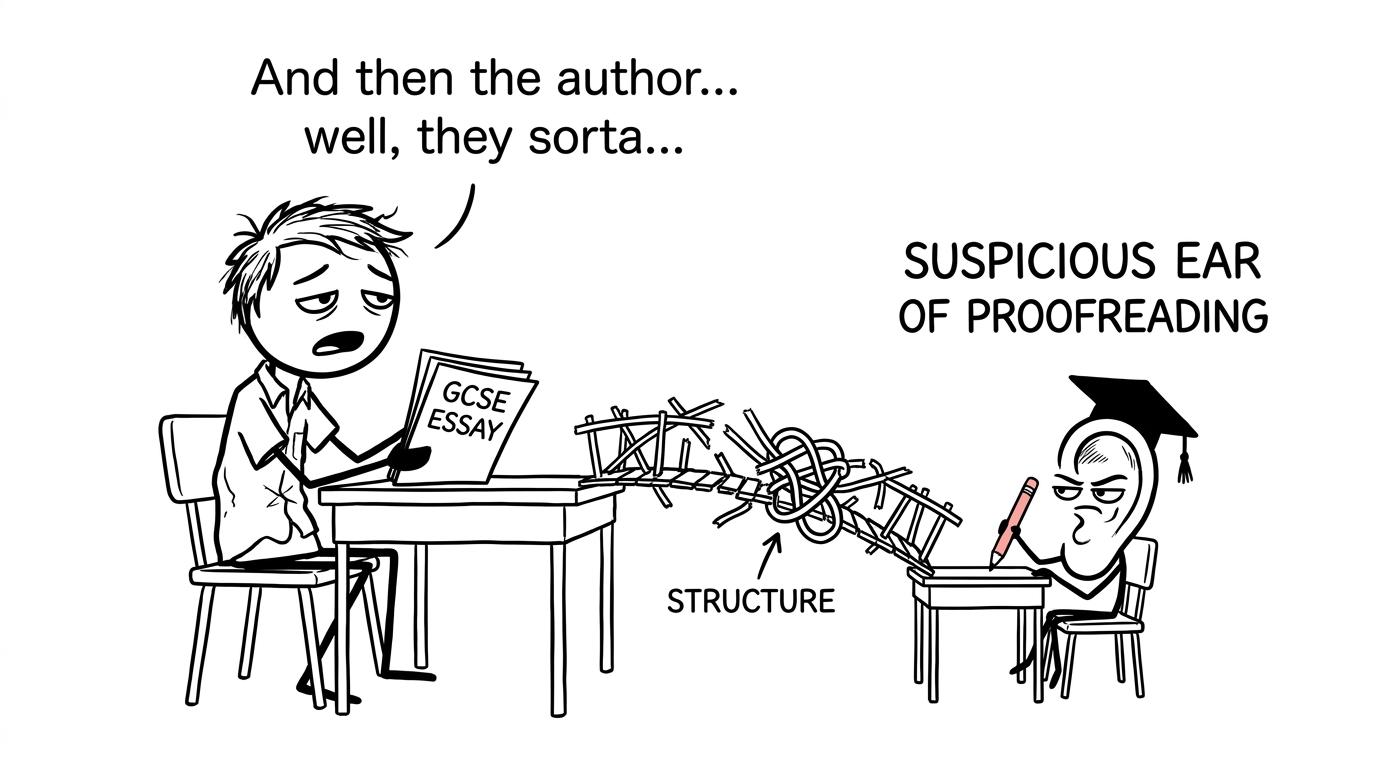 A suspicious proofreading ear inspects a tangled bridge of writing
Why silent reading misses structure problems
Silent reading is efficient. That is usually helpful, but it creates a problem when you proofread your own work: the answer is already familiar.
You remember the plan behind the paragraph. You know why the second idea follows the first. Your brain therefore reads the answer partly as written and partly as intended. A missing transition may not feel missing because the transition still exists in your memory.
Reading aloud changes the task. It slows you down and adds auditory and articulatory information. You must encounter the words in order rather than glancing across the shape of the paragraph. When a sentence contains too many competing ideas, your voice may run out of natural places to pause. When a new point appears without preparation, you can hear the jump.
A stumble is not automatic evidence of an error. Arabic may contain unfamiliar vocabulary or a construction you simply need to practise pronouncing. But a repeated stumble at the same place is useful evidence. Stop and ask:
- Is the sentence carrying more than one main message?
- Is a necessary word missing?
- Does the connector match the relationship between the ideas?
- Have I changed time, person or topic without making that change clear?
- Would two shorter sentences communicate more accurately?
The goal is not to make every sentence sound impressive. GCSE writing is rewarded for successful communication, accuracy, relevant content and an appropriate range of language. Clear control is worth more than complexity you cannot manage reliably.
What reading aloud can reveal in GCSE Arabic
Weak paragraph direction
After reading each paragraph, cover it and state its purpose briefly in English or Arabic. If you cannot identify that purpose, the examiner may also struggle to see where the paragraph is going.
A paragraph might describe an experience, explain an opinion, justify a preference or move from a past event towards a future intention. Those functions can sit together, but their relationship must be visible. Reading aloud helps you hear whether the paragraph develops or merely accumulates sentences.
Connectors that decorate rather than connect
Students sometimes learn an ambitious list of linking expressions and insert them because varied language sounds impressive. Yet a connector only works when the logic on both sides supports it.
As you read, pause before every linking word. Predict what relationship it promises: addition, contrast, reason, consequence, sequence or conclusion. Then check whether the next clause fulfils that promise. A sophisticated connector used inaccurately can make an answer less coherent, not more.
Sentences built beyond your control
Long sentences are not automatically better sentences. If you lose the subject, mix several time frames or reach the end without knowing how the sentence began, the structure is too ambitious in its current form.
Oral reading makes this visible because breath and intonation expose the sentence's architecture. Mark places where you naturally want to stop. Decide whether each needs punctuation, a connector or a new sentence.
Repetition and missing coverage
Hearing the response can make repeated openings, vocabulary and opinions more noticeable. It can also reveal that several sentences make essentially the same point while part of the task remains unanswered.
This matters because a polished paragraph cannot compensate for ignoring a required bullet point. Before improving style, return to the question and tick off every task demand.
A practical read-aloud revision routine
Use this routine on a completed practice response rather than trying to edit continuously while drafting.
Leave a short gap
Put the answer aside before proofreading it. Even a modest pause reduces familiarity and makes it easier to meet the writing as a reader rather than its author.
Re-read the task first
Underline the required content, audience, purpose and time references. Pearson Edexcel's GCSE Arabic materials require written communication in Arabic, and its writing tasks assess whether students communicate relevant information using appropriate vocabulary and grammatical structures. Always check the current specification and instructions for your qualification.
Read only what is on the page
Do not silently correct a missing word while saying the sentence. Read the written version exactly. If you automatically supply something that is absent, mark the location immediately.
Use a simple annotation code
Keep diagnosis separate from editing:
Sfor a structural jump;Cfor an unclear connector;Rfor repetition;Gfor grammar to verify;Tfor an incomplete task requirement;?for meaning that is difficult to follow.
These letters are revision annotations, not material to add to an exam response.
Reverse-outline the response
Write a short label beside each paragraph describing what it does. Then read only those labels in order. This creates a map of the response without becoming a worked example or rewriting the answer for you.
If the labels repeat, the writing may be circling one point. If a label does not relate to the task, you may have drifted. If the order feels arbitrary, rearrange the plan before polishing individual phrases.
Check accuracy separately
A sentence can sound fluent and still be grammatically or orthographically wrong. After the structural pass, make a quieter, focused check for matters such as agreement, verb forms, pronoun reference, negation, spelling and punctuation. Verify uncertain language with your teacher, trusted course materials and marked practice.
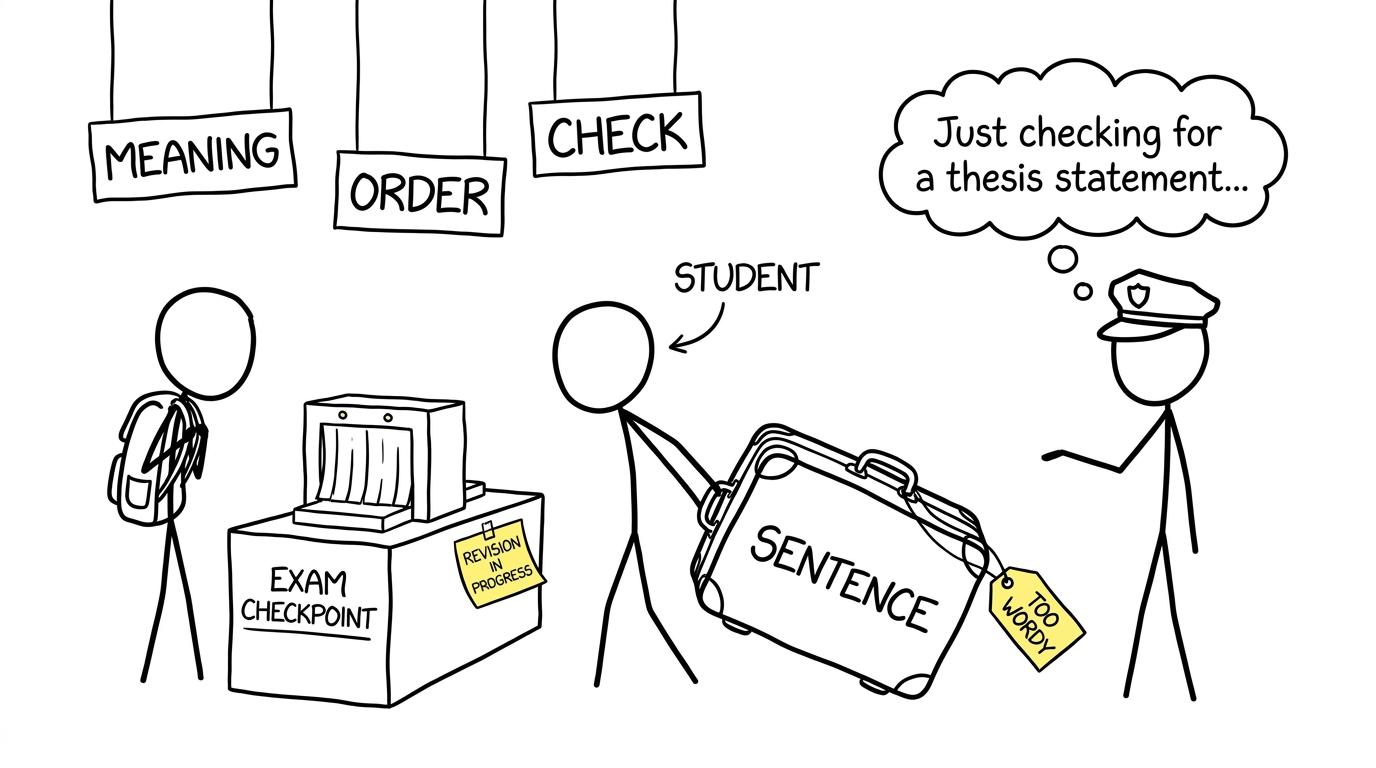 A tiny answer-security checkpoint checks meaning, order and clarity
When reading aloud is less useful
Reading aloud is not equally strong at every editing job.
It may not reveal a mistake if you habitually pronounce the intended form rather than the one written. It also cannot reliably tell you whether your answer meets an examiner's precise criteria, uses an appropriate register or contains enough grammatical variety. Because much written Arabic does not display every short vowel, fluent pronunciation should not be mistaken for complete written accuracy.
Nor should this become a performance exercise. Beautiful pronunciation does not repair irrelevant content. If you spend most of the session perfecting delivery, you have shifted from proofreading towards speaking practice.
Most importantly, this is primarily a revision-room strategy. A written examination is conducted under controlled, quiet conditions, so you should not expect to read your response audibly during the paper. In the exam, recreate the useful part by tracing each sentence slowly, pausing at connectors and checking paragraph purpose silently.
For realistic preparation, complete an answer under timed conditions and then use the Edexcel GCSE Arabic past papers with the available mark schemes and solutions. That separates exam performance from the deeper review that follows.
How this improves GCSE maths revision too
The method transfers surprisingly well to maths, although the object of the reading changes. You are not checking whether an equation sounds elegant. You are checking whether your written reasoning forms an unbroken chain.
After completing a question during revision, explain each line aloud without adding a step that is absent from the page. If you need to say, “I did something here”, identify exactly what operation or inference occurred and write it down where appropriate. Then check the numerical and algebraic work separately; hearing a line does not prove that its calculation is correct.
This routine is particularly useful after a timed paper. Start from the GCSE Maths revision hub, choose your board and tier, and use the mark scheme to distinguish a knowledge gap from unclear working. Students following Edexcel can use Edexcel GCSE Maths past papers, while the AQA GCSE Maths revision area and OCR GCSE Maths revision area provide board-specific lessons, questions and papers.
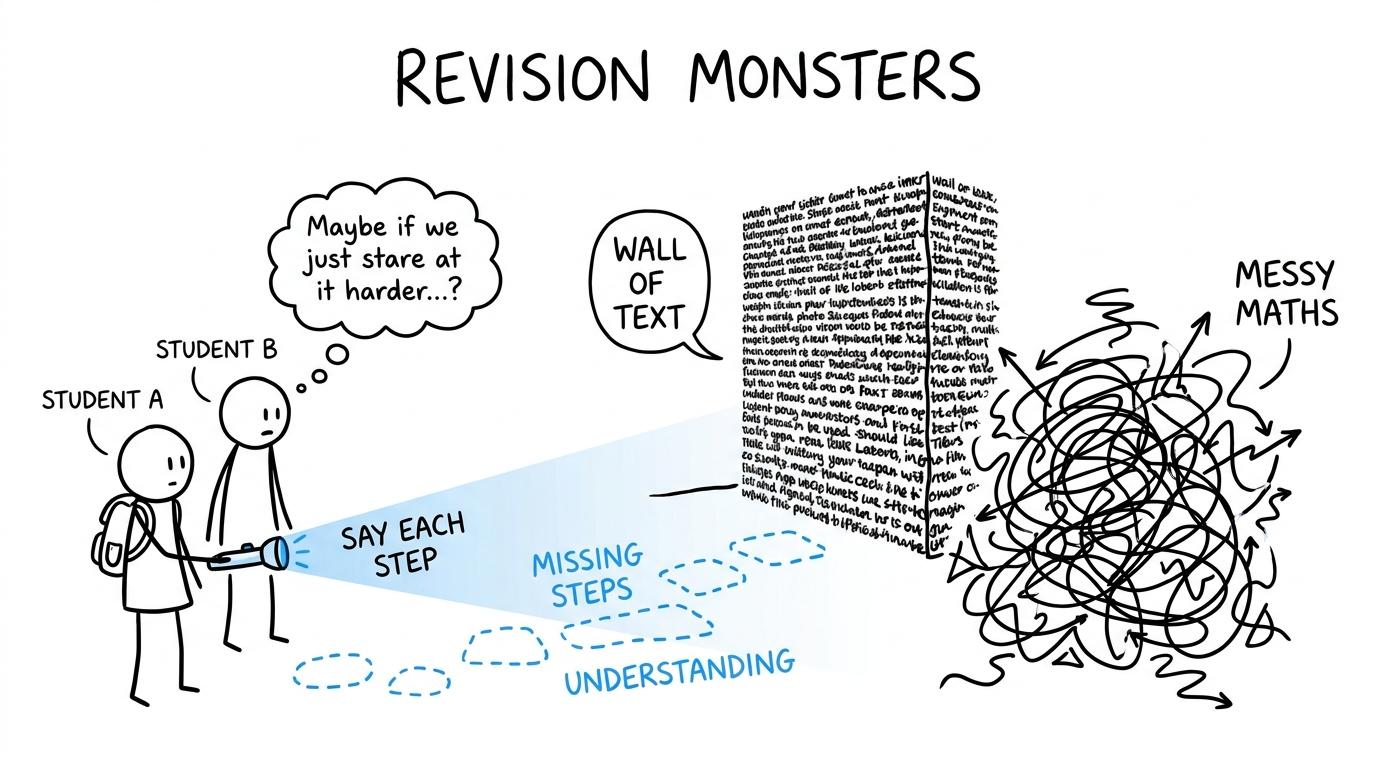 Students use a say-each-step torch to find missing stepping stones
The deeper habit is the same in both subjects: do not confuse recognising your intention with communicating it. MathsGenie's guide to using Edexcel past papers properly shows how marking, diagnosing and targeted reattempts turn a completed paper into useful revision. Nearer the exams, Edexcel GCSE Maths predicted papers can provide fresh questions rather than familiar answers you already remember.
Common mistakes when reading answers aloud
Correcting from memory
Students often say what they intended instead of what they wrote. Follow the page with a finger or ruler and stop whenever your spoken version departs from it.
Editing everything at once
Trying to judge content, structure, vocabulary, grammar and spelling simultaneously overloads the check. Use separate passes: task coverage, structure, then accuracy.
Assuming a smooth sentence is correct
Fluency is evidence about readability, not a guarantee of grammatical accuracy. Confirm uncertain forms using reliable feedback.
Treating every stumble as a fault
You may stumble because you are tired or because pronunciation is difficult. Re-read once. Investigate only if the difficulty remains or the meaning is genuinely unclear.
Ignoring the question
An answer can sound polished while missing a required detail. Keep the task beside the response and check coverage before style.
Replacing feedback with self-checking
Reading aloud is most valuable before teacher feedback, or after feedback when testing a revision. It should not replace assessment criteria, mark schemes or expert correction.
Hear the gap, then fix the cause
Reading your own GCSE Arabic answers aloud works best because it creates distance. For a moment, you stop being the writer who remembers the plan and become the reader who only has the words.
Use that moment to find abrupt transitions, overloaded sentences, repetition and missing task coverage. Then make a separate accuracy check and seek feedback. The voice reveals possible trouble; careful revision decides how to repair it.
Carry the same discipline into maths. Use MathsGenie's free revision lessons and practice questions to repair individual weaknesses, mini tests to check them, and past papers with mark schemes and video solutions to test performance. When the exams approach, add predicted papers and keep a short record of recurring errors. Start with one completed answer today: read the exact page, mark the first place where the logic breaks, and improve that place rather than rewriting everything.