Tell Your Teacher You're Struggling With GCSE Arabic?
Tell teacher struggling GCSE Arabic concerns early. Learn what to say, which support to request, and how to protect your GCSE maths revision time.

A difficult subject rarely announces itself with one dramatic moment. More often, the signs arrive quietly: vocabulary takes longer to recall, a listening task becomes guesswork, and unfinished revision begins competing with maths for the same evening.
Tell teacher struggling GCSE Arabic may be how you typed the problem into a search bar. The direct answer is yes: tell your Arabic teacher as early as you reasonably can. You do not need to wait until your mock result collapses or the exam feels uncomfortably close. An early conversation gives your teacher time to identify the precise gap, suggest manageable practice and monitor whether it is working.
That matters for your other GCSEs too. When Arabic becomes an unnamed worry, it can consume revision time without producing much progress. A clear plan protects both Arabic and maths.
The short answer and action checklist
If you are struggling with GCSE Arabic, take these steps:
- Tell your teacher what feels difficult rather than saying only, “I am bad at Arabic.”
- Bring one or two recent tasks that show the problem.
- Ask which skill should come first: listening, speaking, reading or writing.
- Agree on one small action and a date to review it.
- Check your exam board, specification and tier with your school.
- Tell a parent, carer, form tutor or pastoral lead if anxiety is affecting several subjects.
- Keep maths revision running through short, planned sessions rather than abandoning it while you catch up.
The point is not to create a bigger conversation than necessary. It is to replace a vague problem with a useful next step.
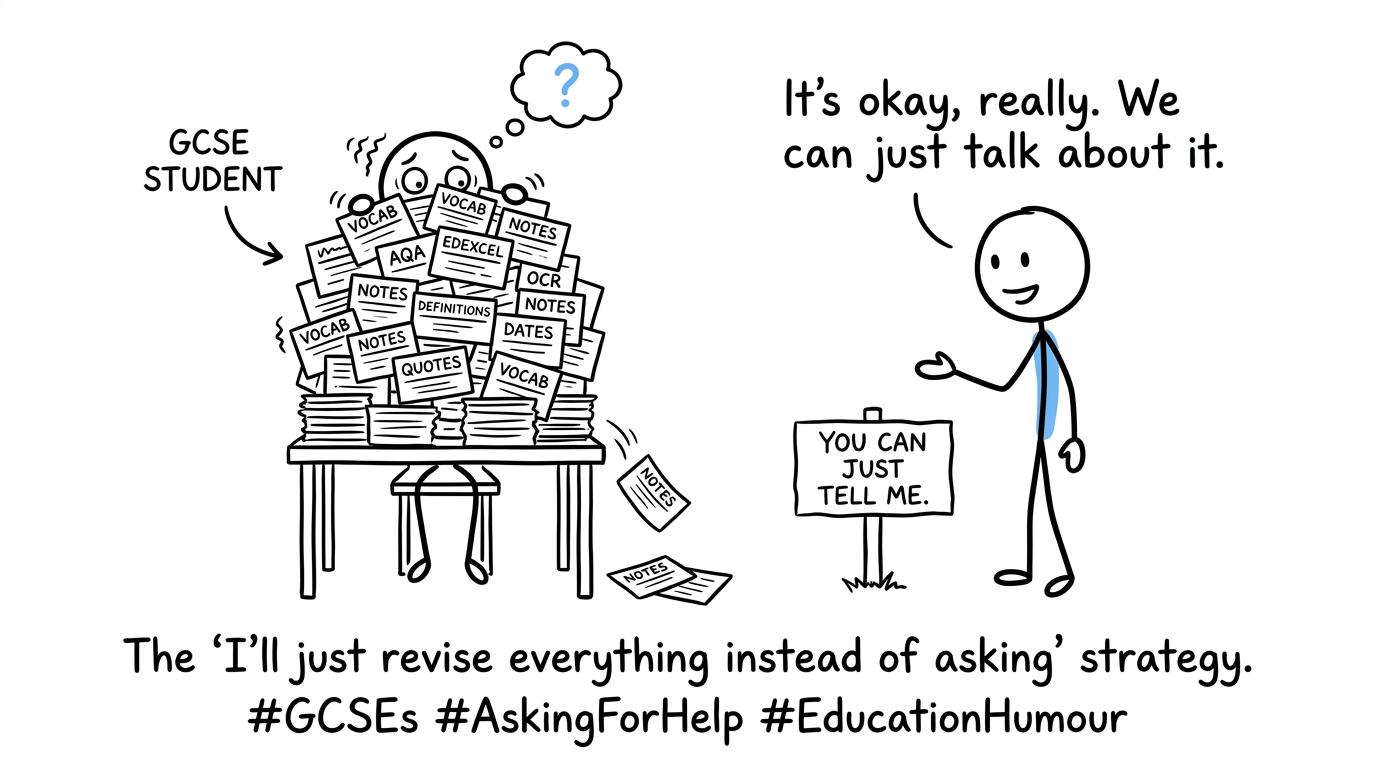 A student discovers that asking a teacher is easier than hiding behind revision cards
Why speaking up early usually helps
Silence feels safe because it postpones embarrassment. Unfortunately, it also postpones useful information.
Your teacher sees your classwork, assessments and participation across time. They may notice whether you understand a text but cannot write accurately, whether dialect and formal Arabic are becoming mixed, or whether your knowledge disappears mainly under timed conditions. Those are different problems and need different responses.
For example, more vocabulary practice will not automatically solve uncertainty about writing structures. Completing long written tasks may not be the best first move if listening is the real weakness. A teacher can help narrow the target before you spend hours revising the wrong thing.
Early disclosure also leaves time for support to become routine. That might mean a weekly vocabulary check, shorter speaking practice, a model planning structure, targeted feedback or referral to your school’s learning-support team. The exact provision depends on your needs and what your school offers, so ask rather than assuming.
If a disability, learning difficulty or persistent barrier may be affecting assessments, speak to the school’s SENCo or relevant support lead promptly. JCQ rules require access arrangements to be supported by evidence, approved before an assessment and normally reflect how the student works in school. Telling a teacher does not guarantee an arrangement, but waiting until the examination period can make proper investigation harder.
Know what GCSE Arabic is testing
Before deciding that you are “behind”, establish what qualification you are taking. Your school can confirm the awarding organisation, specification, tier and assessment dates.
For the current Pearson Edexcel GCSE Arabic qualification, assessment covers four skills: listening, speaking, reading and writing. Each contributes 25%25\%25% of the qualification. Foundation and Higher papers are available, and students are entered for the same tier across all four papers.
That structure gives you a better way to describe the difficulty. Instead of treating Arabic as one enormous subject, ask:
- Can I understand spoken Arabic at examination speed?
- Can I respond clearly during role-play and conversation tasks?
- Can I extract meaning from unfamiliar written passages?
- Can I write accurately and develop answers?
- Can I translate in the required direction?
- Is the problem knowledge, timing, confidence or examination technique?
Do not rely on a friend’s paper structure or an old online checklist. International GCSE qualifications can have different assessments, and specifications change. Use the exact information supplied by your school and awarding organisation.
What to say to your teacher
You do not need a polished speech. Specificity is more valuable than confidence.
You could say:
I am finding GCSE Arabic difficult, particularly listening and speaking. I have been revising, but I am not sure my method is working. Could we look at one recent task and decide what I should prioritise?
If speaking face to face feels difficult, send a short school email or ask to talk after the lesson. Include three pieces of information:
- The skill: what you cannot yet do reliably.
- The evidence: a task, mock paper or recurring mistake.
- The request: the next resource, practice task or feedback you need.
Avoid asking only, “How do I improve?” That question is so broad that the answer may also be broad. Asking, “Which two weaknesses cost me the most marks in this writing task?” gives your teacher something concrete to assess.
Useful questions to ask
Try one or two of these:
- Which skill is currently limiting my grade most?
- Is my difficulty mainly vocabulary, grammar or examination technique?
- Which practice should I complete this week?
- Can you show me how the mark scheme treats this type of response?
- When should I bring the work back for feedback?
- Am I working towards the appropriate tier?
Tier decisions belong in a discussion with your school. They should be based on evidence across the course, not one disappointing lesson or a comparison with someone else.
Turn the conversation into a catch-up plan
A helpful conversation should end with an action small enough to complete. “Revise Arabic” is not a plan. “Complete one listening task, record the unfamiliar vocabulary and review the errors on Thursday” is much clearer.
Use a simple cycle:
- Diagnose: identify the weakest skill from marked work.
- Practise: complete a focused task rather than revising everything.
- Check: use teacher feedback or an official mark scheme.
- Correct: explain why each error happened.
- Revisit: try a fresh task requiring the same skill.
This is also an effective model for maths. If Arabic has exposed a wider problem with feeling behind, MathsGenie’s guide to catching up on GCSE revision explains how to turn a large backlog into a repeatable paper / mistake / practice cycle.
In maths, use the GCSE maths revision hub to select your exam board and work at the correct Foundation or Higher tier. Edexcel, AQA, OCR and Eduqas specifications are not interchangeable, so match every paper and resource to the qualification you actually take.
Protect your GCSE maths revision time
When one subject becomes urgent, students often make one of two choices: ignore it or give it every available hour. Neither is especially stable.
A better approach is to assign each subject a defined next action. Arabic might receive a focused listening task and vocabulary review. Maths might receive one revision lesson followed by a short set of practice questions. You are no longer asking, “Which entire subject should I save tonight?”
The one-month GCSE maths revision plan can help you organise lessons, topic practice, mini tests and paper work without letting one difficult subject erase the rest of your timetable.
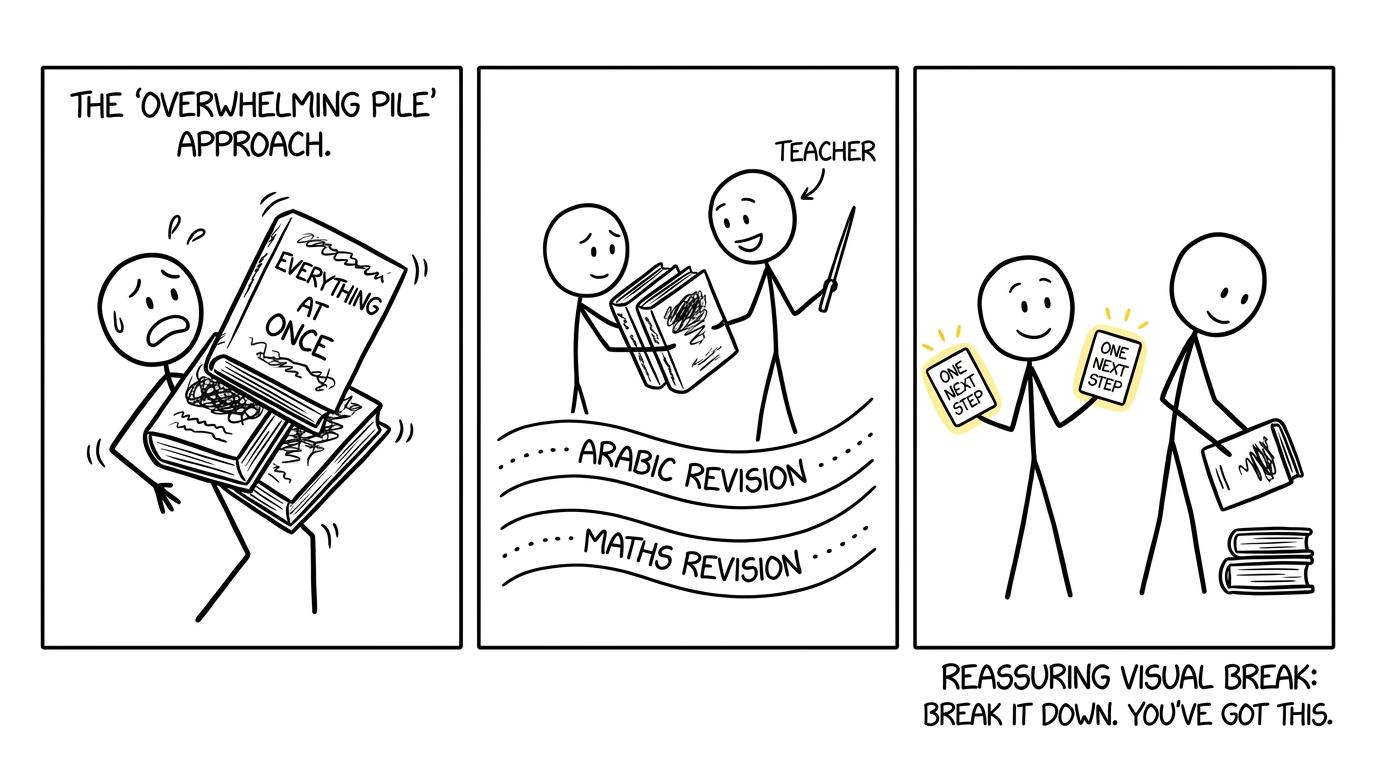 A student swaps impossible revision juggling for one manageable next step in each subject
Use evidence to decide where maths time goes. A short test or paper section can reveal whether the lost marks come from knowledge, method, accuracy or timing. The guide to finding your weakest GCSE topics shows how to diagnose gaps before revising them.
Then choose the appropriate MathsGenie revision lesson, complete the linked practice questions and check your work with the mark scheme or video solution. When the method is more secure, move to GCSE past-paper practice. Past papers should test your learning, not replace the learning stage.
If you take Edexcel maths, the Edexcel predicted papers offer fresh exam-style practice near the examination period. They are most useful after you have corrected topic gaps. For a more deliberate routine, follow the guide to using Edexcel GCSE maths past papers properly: sit the paper, mark it, diagnose the losses and return to targeted practice.
When struggling means more than subject knowledge
Sometimes the difficulty is not confined to Arabic. You may be unable to concentrate, feel persistently overwhelmed, avoid lessons or lose sleep because of examinations. In that situation, tell a trusted adult rather than treating it only as a revision problem.
A subject teacher can listen and help you reach the appropriate person, but teachers are not expected to diagnose mental health conditions. Depending on your school, support may involve a form tutor, pastoral lead, SENCo, safeguarding lead, school counsellor or mental health support team.
If you feel unsafe or need urgent help, tell a trusted adult immediately and use the urgent support arrangements available where you live. Revision advice is not a substitute for medical or safeguarding help.
Common mistakes when asking for help
Waiting for the next mock
A poor mock can provide evidence, but you do not need to manufacture a crisis before asking a question. Classwork and smaller assessments can already reveal a pattern.
Describing yourself instead of the problem
“I am terrible at languages” sounds permanent. “I lose track of the recording after the first question” identifies something that can be investigated and practised.
Asking for resources without a priority
More worksheets can create more unfinished work. Ask which skill and task should come first, then complete it before collecting another pile.
Expecting the teacher to do the practice
Telling your teacher opens the door; it does not remove the need to walk through it. Write down the agreed action and return with evidence of your attempt.
Dropping maths until Arabic is fixed
GCSE subjects do not wait politely for one another. Keep a minimum maths routine using revision lessons, practice questions and mini tests, even while Arabic receives extra attention.
Treating one result as your final grade
One assessment is information, not a verdict. Use it to locate the weakness, change the approach and gather fresh evidence.
Asking early is a revision skill
The strongest reason to tell your teacher you are struggling with GCSE Arabic is not simply that teachers can help. It is that early honesty creates options. There is time to identify the weak skill, practise it deliberately, review progress and involve wider support when appropriate.
That same habit improves maths revision. Do not hide from a topic because it produced a low mark. Name it, practise it and test it again.
Start at the MathsGenie GCSE maths hub, choose your exam board and tier, and build a calm cycle from revision lessons, practice questions and mini tests to past papers, predicted papers, mark schemes and video solutions. Asking for help is not evidence that revision has failed. Often, it is the moment revision becomes specific enough to work.