

Study Playlists for GCSE Music Focus: Do They Help?
Study playlists GCSE music focus explained: discover when background music helps maths revision, when it distracts, and how to test what works for you.
You sit down to revise. Before opening a single question, you choose your headphones, find the right playlist and adjust the volume. Ten minutes later, the atmosphere is perfect. The maths, however, remains untouched.
That is the tension behind the study playlists GCSE music focus debate. The short answer is that playlists do not reliably improve learning. Music with lyrics can disrupt reading, memory and language-heavy tasks, while instrumental music often has little measurable effect compared with silence. Yet a familiar, unobtrusive playlist may still help some students begin revising or tolerate a noisy environment.
The important question is not whether the playlist feels productive. It is whether you complete accurate, focused GCSE maths practice while it plays.
The quick verdict on study playlists
Use this checklist before pressing play:
- Choose silence for demanding work, unfamiliar methods and timed papers.
- Avoid lyrics when reading explanations, interpreting worded questions or memorising facts.
- Use quiet instrumental music cautiously for routine practice you already understand.
- Keep the playlist familiar so you are not waiting for favourite songs or exploring new ones.
- Remove your phone from reach once the music begins.
- Judge the habit using completed questions and marks, not mood alone.
- Practise some sessions in exam conditions, because headphones will not be part of the real paper.
A playlist can be a useful background. It cannot replace active revision.
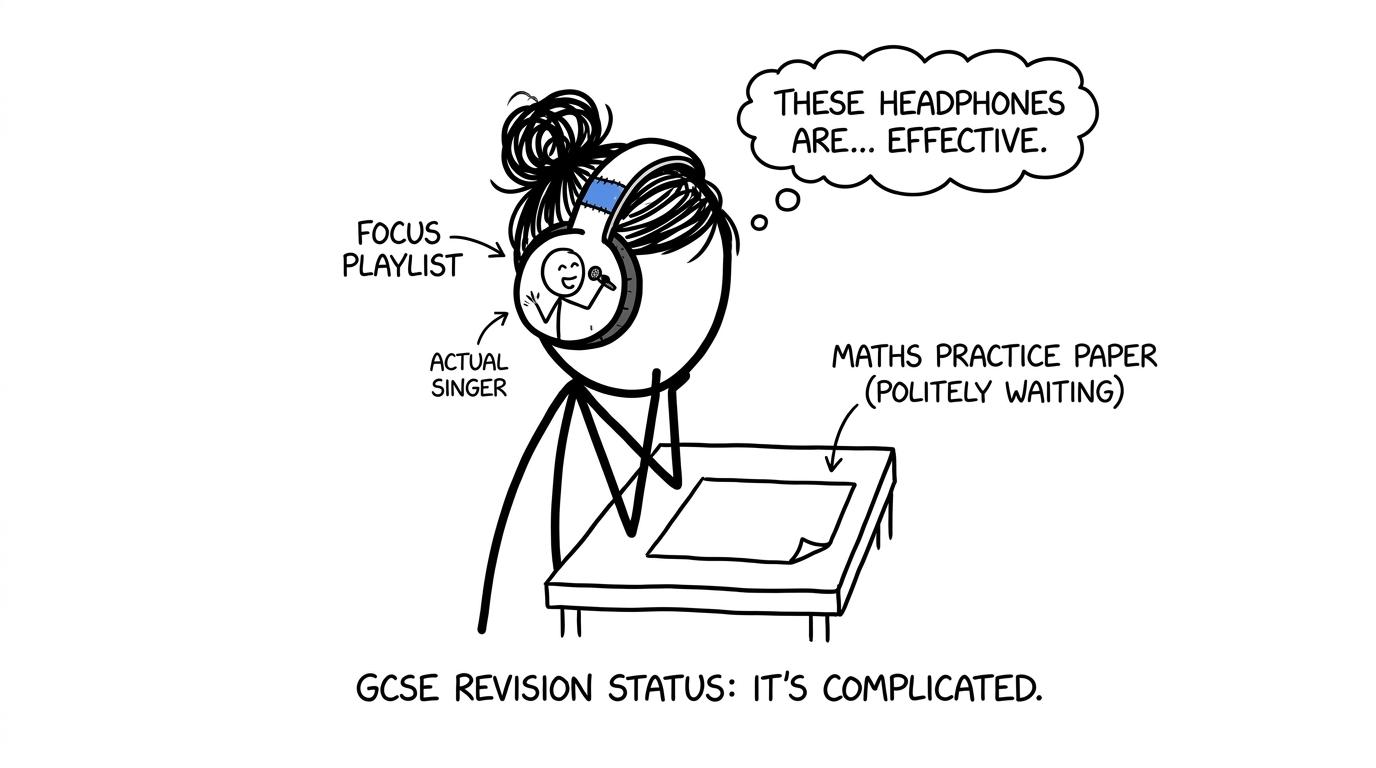 A student discovers that the focus playlist has its own distracting singer
What research says about music and concentration
Research into background music does not produce a simple claim that music is always helpful or always harmful. Effects vary with the task, the listener and the type of sound.
A systematic review published in 2022 examined 959595 articles containing 154154154 experiments. It found a general negative effect on memory and language-related tasks, with lyrical music tending to be more disruptive than instrumental music. Many experiments found no effect at all, while difficult tasks appeared more vulnerable to distraction than easy ones.
A controlled study published in 2023 compared silence, instrumental lo-fi music and music with lyrics. Lyrics impaired verbal memory, visual memory and reading comprehension. Instrumental music did not credibly improve or damage performance overall. Arithmetic performance was not credibly affected in that particular experiment.
More recent research into reading comprehension has also found that songs with lyrics can reduce performance, especially where the lyrics compete with the language being read. These studies largely involve university-age participants rather than GCSE pupils, so they should not be treated as a precise prediction for every teenager. Still, the pattern is relevant: words in your ears can compete with words in the task.
For GCSE maths, that distinction matters. A page of straightforward calculations is different from a multi-step probability problem or an explanation of algebraic proof. The latter tasks require you to hold information in mind, interpret language and decide what matters. A song may be quiet, but its lyrics are still another stream of information.
Why a playlist can feel helpful without improving learning
Revision has two separate problems: starting and thinking.
Music may help with the first. A familiar playlist can act as a cue that says, “This is revision time.” It can make an untidy room feel calmer, mask unpredictable household noise and make repetitive practice less unpleasant. Those are genuine benefits if they help you sit down and continue.
But feeling settled is not the same as learning more. You can enjoy an hour, remain at your desk and still avoid the questions that expose your weaknesses. Instrumental music is sometimes perceived as beneficial even when measured performance is no better than silence.
This is why the best evidence comes from your work. Open the GCSE Maths revision hub, choose one suitable topic and compare what happens under different listening conditions. Your measure is not whether time passed pleasantly. It is whether you attempted questions properly, retained the method and corrected errors.
When music is most likely to distract you
Learning an unfamiliar method
A new technique already places demands on attention. You must follow the explanation, connect each step and decide why it works. Adding lyrics or noticeable changes in sound gives your attention another place to go.
Use silence when watching a revision lesson, reading a revision guide or tackling a topic you currently find difficult. If you are unsure which topic should come first, the best order for learning GCSE maths topics provides a sensible route through number, algebra, graphs, geometry, probability and statistics.
Reading worded questions
Worded questions require more than calculation. You must identify relevant information, ignore distractions and translate language into mathematics. Lyrics are particularly unhelpful here because both the song and the question use verbal processing.
This applies to ratio problems, statistical interpretation and probability scenarios. Even a familiar chorus can occupy attention that should be checking whether events are independent or whether a quantity has been replaced. MathsGenie's OCR probability revision resources are useful material for testing whether your accuracy changes with and without music.
Completing timed papers
Your GCSE exam will not contain your headphones, favourite track or carefully controlled background noise. Some revision should therefore reproduce the conditions in which you must eventually perform.
Do timed sections and full papers in silence. This develops concentration without an external cue and helps you notice how you respond when a difficult question interrupts your rhythm. The guide to when to start GCSE past papers explains how to move from shorter diagnostic practice towards complete timed papers.
When a playlist may be reasonable
Music is less risky when the work is familiar and repetitive. Quiet instrumental tracks may be suitable while practising methods you already understand, checking routine calculations or organising an error log.
The key word is may. Instrumental music is not a concentration upgrade. The research more often suggests a neutral effect than a clear improvement. Its practical value may come from masking unpredictable noise or making it easier to begin.
Choose audio with:
- no lyrics or spoken samples;
- a steady volume;
- few abrupt changes;
- tracks you already know;
- no need to skip, search or select songs;
- notifications switched off.
If silence makes you notice every door, conversation or passing car, consistent background sound might be less distracting than an unpredictable environment. But keep the volume low enough that the music remains in the background rather than becoming the main event.
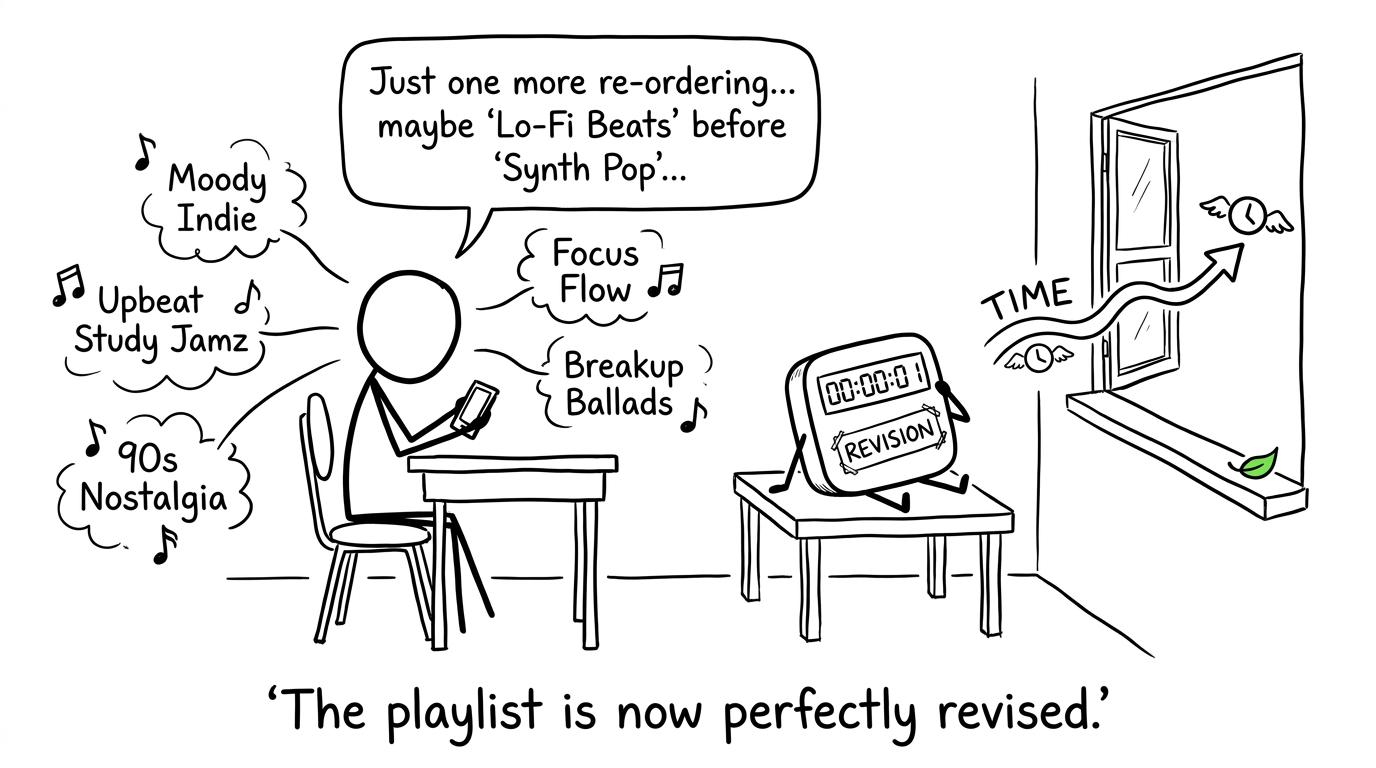 A perfectly revised playlist and a completely unrevised practice paper
Is the playlist helping, or is it just a ritual?
A ritual is not automatically bad. Opening the same resource, clearing the desk and beginning with a familiar sound can reduce the effort of starting. The problem begins when preparation expands to fill the revision session.
Creating artwork, rearranging tracks and searching for the perfect “brain frequency” are not maths revision. They produce a sense of control without testing any mathematical skill.
Use a simpler rule: the playlist must already exist, begin in one action and require no attention afterwards. Then follow a concrete revision loop:
- Select one weak topic.
- Use a revision lesson to restore the method.
- Complete practice questions without copying solutions.
- Mark the work honestly.
- Record why each mark was lost.
- Reattempt the skill after a short gap.
The guide to finding your weakest GCSE topics can help you choose work based on evidence rather than preference. That matters because music can make comfortable questions feel even more attractive. Good revision often means doing the question you would rather avoid.
Run your own fair focus test
Individual differences are real, so test your playlist rather than defending it. Choose two comparable sets of questions from the same topic and difficulty level.
Complete one in silence and one with your normal playlist. Keep the time limit, room, device access and resources as similar as possible. Record:
- questions attempted;
- marks earned;
- careless errors;
- times you paused or changed track;
- how much you remember the following day.
Swap the order on another day so tiredness does not always affect the second condition. Repeat the comparison across several sessions. One unusually good or bad set proves very little.
The useful measure is something such as
accuracy rate=marks earnedmarks available×100%.\text{accuracy rate}=\frac{\text{marks earned}}{\text{marks available}}\times 100\%.accuracy rate=marks availablemarks earned×100%.Also look beyond the percentage. If scores are similar but you take longer with music, the playlist is not helping efficiency. If instrumental music slightly improves persistence during routine practice but harms difficult questions, use it selectively rather than making one rule for every session.
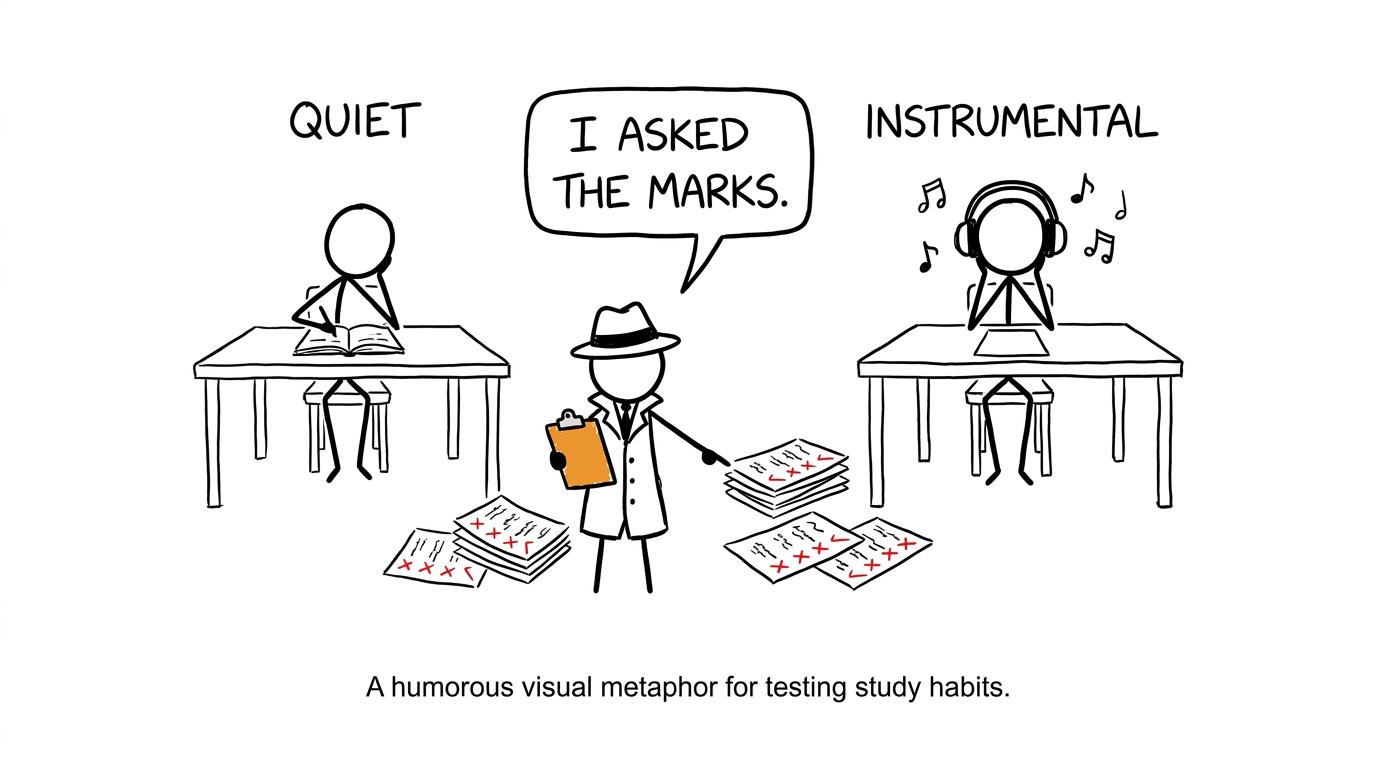 A student detective asks the marks whether music improved revision
Build a playlist-proof GCSE revision routine
Your revision system should work whether the room is silent or noisy. Begin with a specific task, not a vague promise to “do maths”. A one-month GCSE maths revision plan can provide the wider structure, while each session should have one visible outcome.
For example, decide that the session ends after a topic lesson, a set of practice questions and careful marking. Put your phone out of reach. If music comes from the phone, start the playlist first and use a focus mode that blocks notifications.
As examinations approach, increase silent practice. Use mini tests for short checks, past papers for realistic assessment and predicted papers for additional unseen combinations. Always use the mark scheme and video solutions to understand lost method marks rather than merely counting correct answers.
The same principle applies across Edexcel, AQA, OCR and Eduqas, and across foundation and higher tier: revision should become progressively closer to the task you will perform in the examination.
Common mistakes with study playlists
Choosing songs you actively want to hear
A playlist of favourites invites anticipation, singing and track skipping. Familiar, unremarkable instrumental audio is safer than emotionally engaging music.
Confusing duration with progress
Listening for two hours does not mean you revised for two hours. Count completed questions, corrected misconceptions and marks recovered.
Using music for every type of task
Routine fluency and unfamiliar problem-solving demand different levels of attention. Silence should be your default for complex learning and exam simulation.
Changing tracks whenever work becomes difficult
The urge to adjust the music may actually be an urge to escape the question. Mark the difficult item, attempt a first step and return to it after the set.
Never practising in exam conditions
A playlist can become a dependency if every session uses it. Include regular silent work so the examination room does not feel unfamiliar.
Let the work decide
Study playlists are neither a secret revision technique nor an automatic disaster. Lyrics are the clearest risk, particularly for reading, memory and language-heavy reasoning. Instrumental music is usually a cautious compromise, not a proven performance boost. Silence remains the strongest default for new learning, demanding problems and timed papers.
If a playlist helps you start, let it start you. Then let evidence decide whether it stays.
Open the MathsGenie GCSE maths topic guide, choose one genuine weakness and begin. Use free revision lessons to understand the method, practice questions to build fluency, mini tests to check recall, and past papers or predicted papers to develop exam technique. Mark every attempt carefully and use video solutions when the written method is not yet clear.
The playlist is optional. The practice is what changes your grade.










