Short Breaks vs Long Break: GCSE Further Maths
Short breaks vs long break GCSE Further Maths: see what research suggests, choose sensible timings, and build a focused revision routine for exam season.
There is a familiar moment in Further Maths revision when the symbols are still on the page, but your attention has quietly left the room. You read the same line twice. Then three times. The question has not become harder; your concentration has simply faded.
So, when comparing short breaks vs long break GCSE Further Maths revision, the practical answer is this: several planned short breaks will usually support concentration better than working continuously and saving all your rest for one long break. However, the evidence does not reveal one perfect timetable for every student. A sensible approach combines focused work blocks, brief breaks and an occasional longer reset.
That matters particularly for dense topics such as algebraic reasoning, functions, calculus and matrices. These demand more than recognition. You need enough mental energy to choose a method, carry it through accurately and check the result.
The quick break-planning checklist
Use this as a starting point rather than an unbreakable law:
- Revise for roughly 252525 to 404040 minutes before a short break.
- Take a break of around 555 to 101010 minutes.
- After two or three focused blocks, take a longer reset of around 151515 to 252525 minutes.
- Decide your return time before the break begins.
- Move away from the desk, drink water or stretch where possible.
- Use the next block for questions, retrieval or correction rather than passive rereading.
- Practise full papers under the actual continuous conditions required in the examination.
If 252525 minutes feels too short for a demanding proof or multi-stage algebra question, extend the focus block. The aim is not to obey a timer at the expense of the mathematics. It is to stop fatigue from turning revision into time that merely looks productive.
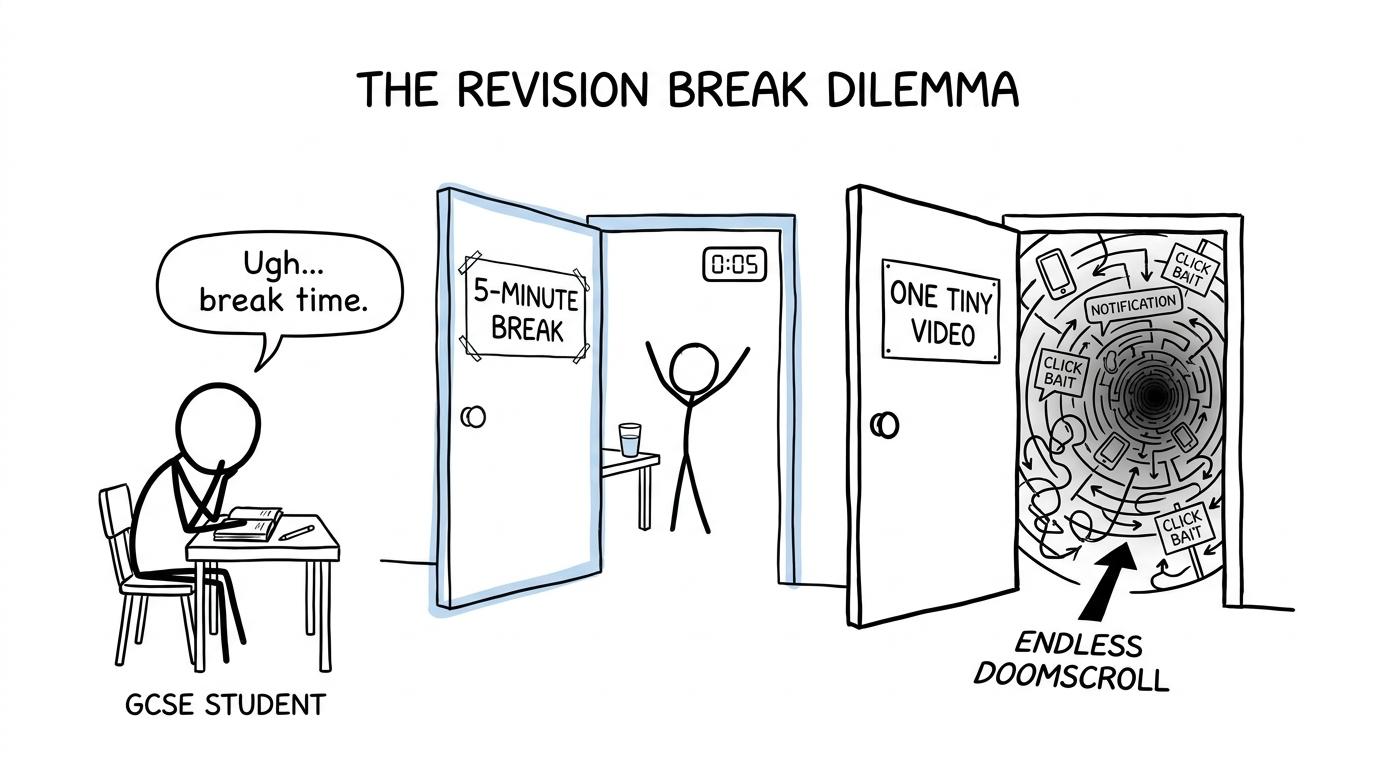 A student chooses between a useful short break and an endless maze of phone notifications
What does the evidence say about revision breaks?
Research on breaks is more nuanced than the familiar claim that one particular ratio is scientifically perfect. There has not been a definitive trial comparing break schedules specifically among UK students revising GCSE Further Maths. Most relevant studies involve university students, classrooms or cognitively demanding work more generally.
Even so, several findings are useful.
A 2022 systematic review and meta-analysis covering 222222 independent study samples found that micro-breaks of up to 101010 minutes produced small improvements in energy and reductions in fatigue. The overall improvement in task performance was not statistically significant, particularly for highly demanding cognitive tasks. Longer micro-breaks tended to be more helpful for performance, suggesting that a few seconds away from the page may not be enough after sustained difficult work.
A 2023 study of real-life student revision compared self-chosen breaks with planned schedules. The systematic groups used either 242424 minutes of work followed by 666 minutes of rest, or 121212 minutes followed by 333 minutes. Students choosing their own breaks tended to revise and rest for longer, while reporting greater fatigue and distraction and lower concentration. Task completion did not differ significantly, so the planned schedules appeared to achieve similar work in less time.
More recent classroom research has also found promising results for frequent micro-breaks, but much of this evidence comes from undergraduates rather than GCSE students completing independent problem-solving. It should inform your routine, not be treated as proof that one timer setting guarantees more marks.
The careful conclusion is straightforward: planned short breaks are useful for managing fatigue and concentration, but break length alone does not create learning. What you do during each revision block remains more important.
Why Further Maths makes break quality important
Further Maths is unusually unforgiving of half-attention. A small sign error can travel through several lines. A question on functions may require you to interpret notation before you perform any manipulation. Calculus and matrix transformations introduce ideas that may be unfamiliar alongside ordinary GCSE Maths.
The current AQA Level 2 Certificate in Further Mathematics, often described informally as GCSE Further Maths, includes number, algebra, coordinate geometry, calculus, matrix transformations and geometry. It emphasises higher-order reasoning and problem solving. Students can explore the relevant lessons, questions and papers through the AQA GCSE Further Maths revision hub.
This density creates two different kinds of tiredness:
- Mechanical fatigue: you begin making slips in expansion, signs or arithmetic.
- Strategic fatigue: you can still calculate, but struggle to decide how to begin.
A short break can interrupt both patterns. It cannot replace missing knowledge, but it can help you return with enough attention to notice what the question is asking.
Several short breaks or one long break?
Short breaks usually win within a revision session
Imagine a 909090-minute evening session. If you work without stopping and rest only at the end, the break arrives after the concentration was needed. You may have spent the final part of the session rereading solutions, checking your phone between lines or repeating avoidable errors.
Several short breaks place recovery before the largest decline in attention. They also create natural boundaries between tasks. One block might be used to review a revision lesson, the next for unsupported questions and the final block for marking and corrections.
This structure is particularly useful when revisiting forgotten material. MathsGenie’s guide to stopping GCSE Maths content from being forgotten explains how spaced practice, retrieval and mark-scheme feedback can work together.
One longer break still has a role
A longer break is valuable after several blocks, between subjects or following a timed paper. Highly demanding work may require more recovery than a micro-break can provide. Eating, walking outside or having a proper conversation can restore you in a way that remaining beside the desk cannot.
The mistake is not taking a long break. It is expecting one large break at the end to repair an unfocused session.
A good routine therefore uses both: brief interruptions to protect attention and a longer reset to prevent the whole evening becoming one extended mental slog.
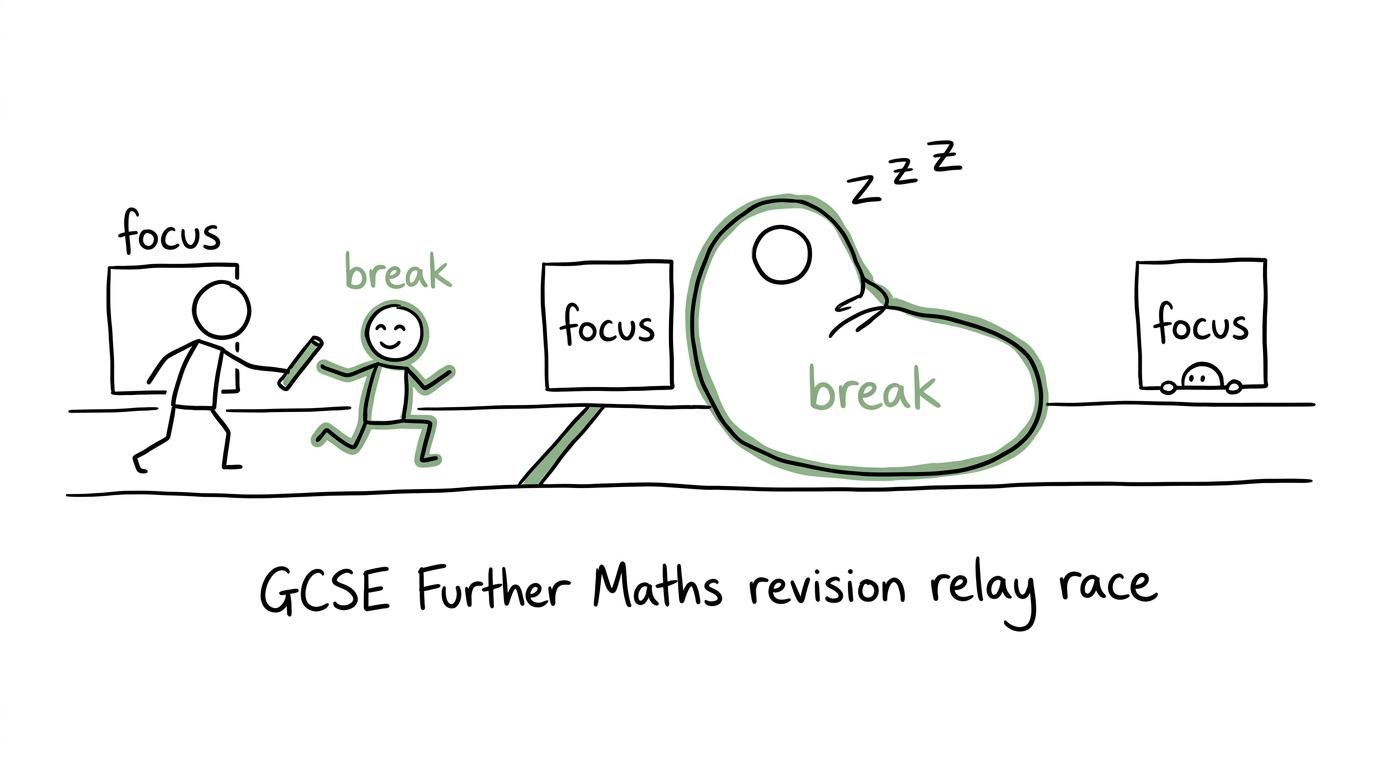 Several small breaks run a revision relay while one enormous break blocks the track
A practical GCSE Further Maths break schedule
Different revision tasks need different rhythms.
| Revision task | Focus block | Suggested break |
|---|---|---|
| Learning or reviewing one method | 202020 to 303030 minutes | 555 minutes |
| Focused topic questions | 303030 to 404040 minutes | 555 to 101010 minutes |
| Difficult mixed problem solving | 404040 to 555555 minutes | 101010 minutes |
| Marking and correcting errors | 202020 to 303030 minutes | Finish or change task |
| Full timed paper | Follow official exam timing | Break afterwards |
These ranges are starting points. If you are working well when the timer sounds, finish the current question or a natural step. Do not abandon a coherent argument halfway through simply because an alarm has rung.
On a busy school day, a smaller routine may be more realistic. The 20-minute GCSE Maths revision routine shows how a brief session can still include recall, questions and marking. For broader planning across several weeks, use the GCSE one-month revision plan.
What should you do during a short break?
A useful break changes your mental state without making the return unnecessarily difficult.
Good options include:
- standing up and stretching;
- walking to another room;
- drinking water;
- looking into the distance to rest your eyes;
- taking several calm breaths;
- preparing a simple snack;
- briefly speaking to someone nearby.
The NHS advises students to take regular short breaks rather than revising for hours without stopping. It also recommends physical activity, realistic schedules and sufficient sleep during exam preparation. A break should support those habits rather than compete with them.
Phone use is not automatically disastrous, but highly engaging feeds and videos remove your control over the stopping point. A planned 555-minute break can easily become 252525 minutes. If that regularly happens, leave the phone outside the room or set an alarm on a separate clock.
Before standing up, write the exact first action for your return: “Complete the next matrix question” is better than “Do more revision”. The smaller the decision awaiting you, the easier it is to restart.
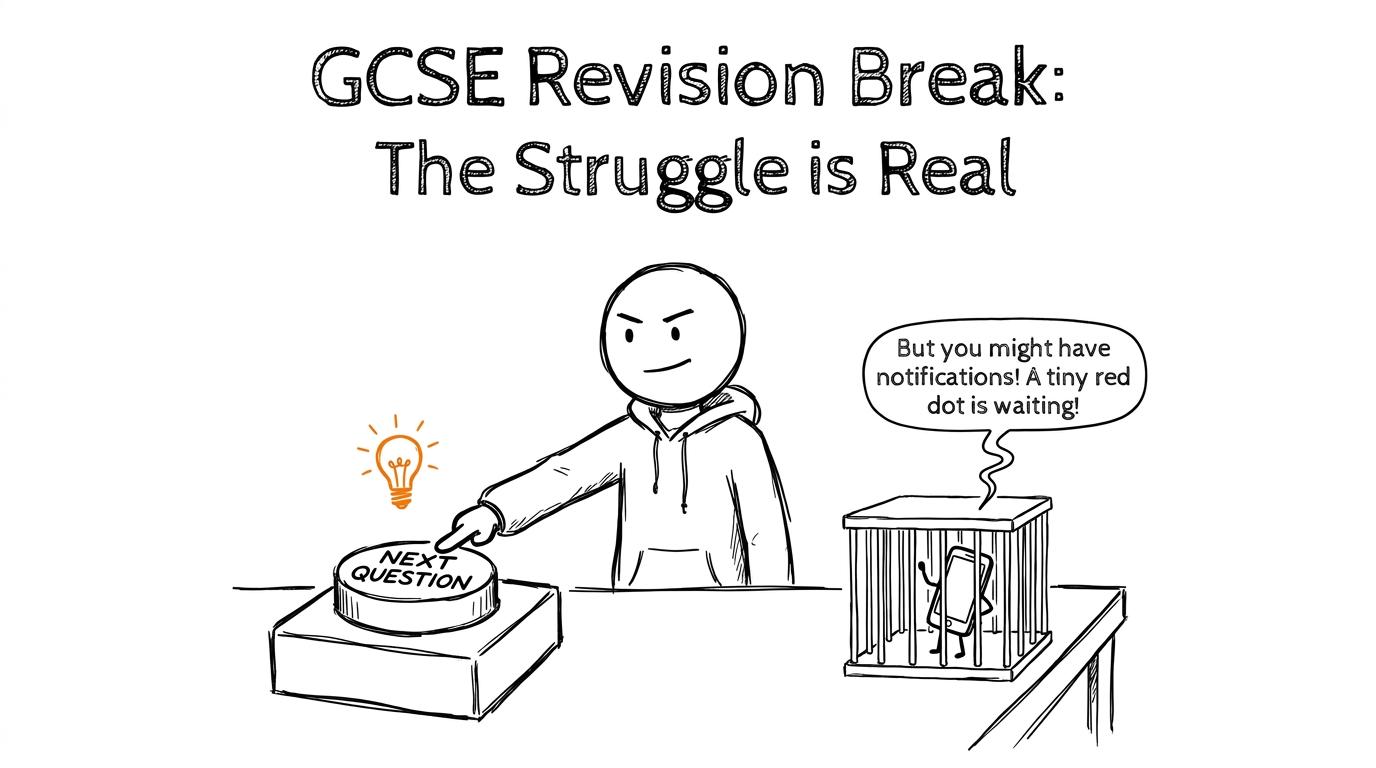 A student returns to the next question while a phone complains from cartoon jail
Make each focus block produce learning
Breaks protect attention. They do not decide how that attention is used.
An effective Further Maths block should normally contain active work. Try a question before opening the solution. Retrieve a formula or method from memory. Mark the attempt honestly, identify the precise lost step and return to that skill on another day.
MathsGenie makes this cycle easier because the learning and testing resources are connected. Start with the free GCSE and A Level Maths revision lessons, move to topic practice, and then use GCSE Maths mini tests to check whether methods can be recalled under time pressure.
Across a week, spacing matters too. Evidence for learning consistently favours distributing practice over separate sessions rather than compressing the same total time into one sitting. Recent research focused specifically on mathematics also supports a modest benefit from spaced rather than massed practice.
That means breaks operate on two scales:
- short pauses within today’s session help manage fatigue;
- gaps between sessions help you revisit and retrieve knowledge later.
For sequencing prerequisite GCSE content before harder material, the best order for learning GCSE Maths topics provides a useful map.
When not to interrupt your revision
Timers are tools, not supervisors. There are occasions when an interruption may do more harm than good.
If you have just recognised a route through a difficult question, finish the logical section. If a proof is unfolding clearly, preserve that thread. You can take the break a few minutes late.
You should also complete some full papers without revision breaks. AQA Level 2 Further Mathematics currently uses two written papers, each lasting 111 hour 454545 minutes, with one non-calculator paper and one calculator paper. Check your own qualification and current specification, because arrangements differ between awarding organisations and courses.
Timed papers train sustained concentration as well as mathematical knowledge. Use short-break sessions to build the skills, then uninterrupted papers to test whether those skills survive examination conditions. The GCSE Maths exam-week checklist can help you balance final practice with recovery and sleep.
Common mistakes with revision breaks
Taking breaks only after concentration has collapsed
Plan breaks before the session. Waiting until you feel completely exhausted often means the least productive part has already happened.
Treating the schedule as more important than the question
Do not stop in the middle of a productive mathematical thought. Finish a natural step, note where you are and then rest.
Turning every break into screen time
Fast-moving content keeps attention occupied and often makes returning harder. Choose at least some breaks that involve movement, water or distance from a screen.
Restarting without a defined task
A vague return invites procrastination. Leave one specific instruction on the page before you stand up.
Using frequent breaks to avoid difficult questions
A break should follow focused effort, not the first feeling of discomfort. Further Maths often feels difficult precisely when useful thinking is beginning.
Never practising full exam conditions
Fragmented practice can improve daily concentration, but the examination will not pause every 303030 minutes. Build towards complete timed papers and use mark schemes to identify where method marks were lost.
A balanced answer for better revision
Several short, planned breaks generally beat one delayed long break for maintaining energy and concentration during dense GCSE Further Maths revision. But the strongest routine is not an argument between the two. Use short breaks within sessions, a longer reset after several blocks and uninterrupted practice when training for the real paper.
Most importantly, make the work between breaks count. Choose one topic, attempt questions without immediate help, mark them carefully and revisit mistakes after a gap.
Start with MathsGenie’s AQA Further Maths revision resources, then build towards past papers using revision lessons, practice questions, mark schemes and video solutions. Alongside your main GCSE preparation, mini tests and predicted papers can reveal the gaps that deserve your next focused block. Set the timer, choose the first question and let consistency do what cramming rarely can.