

How to Send GCSE Business Result to Sixth Form
Send GCSE Business result to sixth form confidently: learn how results arrive, what evidence colleges need and how to resolve delays on results day.
Results day can feel strangely unfinished. You have the grade in your hand, but your next school is somewhere else, waiting to decide whether you can enrol. The practical answer is simple: to send GCSE Business result to sixth form, follow the admissions instructions from that sixth form or college. You will usually upload, email or show your official results slip during enrolment. Do not assume it has arrived automatically.
Your GCSE Business grade normally appears alongside your other GCSE results on the provisional results statement issued by your school or exam centre. The receiving sixth form may already have access to some information, particularly if it is attached to your current school, but arrangements vary. Your offer email, applicant portal and enrolment instructions are therefore the final authority.
Your results-day checklist
Keep this short list ready before results day:
- Read your sixth form or college enrolment instructions again.
- Check the deadline and whether enrolment is online or in person.
- Collect or download your official results statement.
- Keep clear evidence of every grade, not only GCSE Business.
- Upload, email or present the results using the requested method.
- Include your applicant number and full name where required.
- Save confirmation that the information was submitted.
- Contact admissions promptly if your result or application is missing.
For summer 2026, GCSE results day in England, Wales and Northern Ireland is Thursday 20 August. Your own school or exam centre should tell you when and how it will release results.
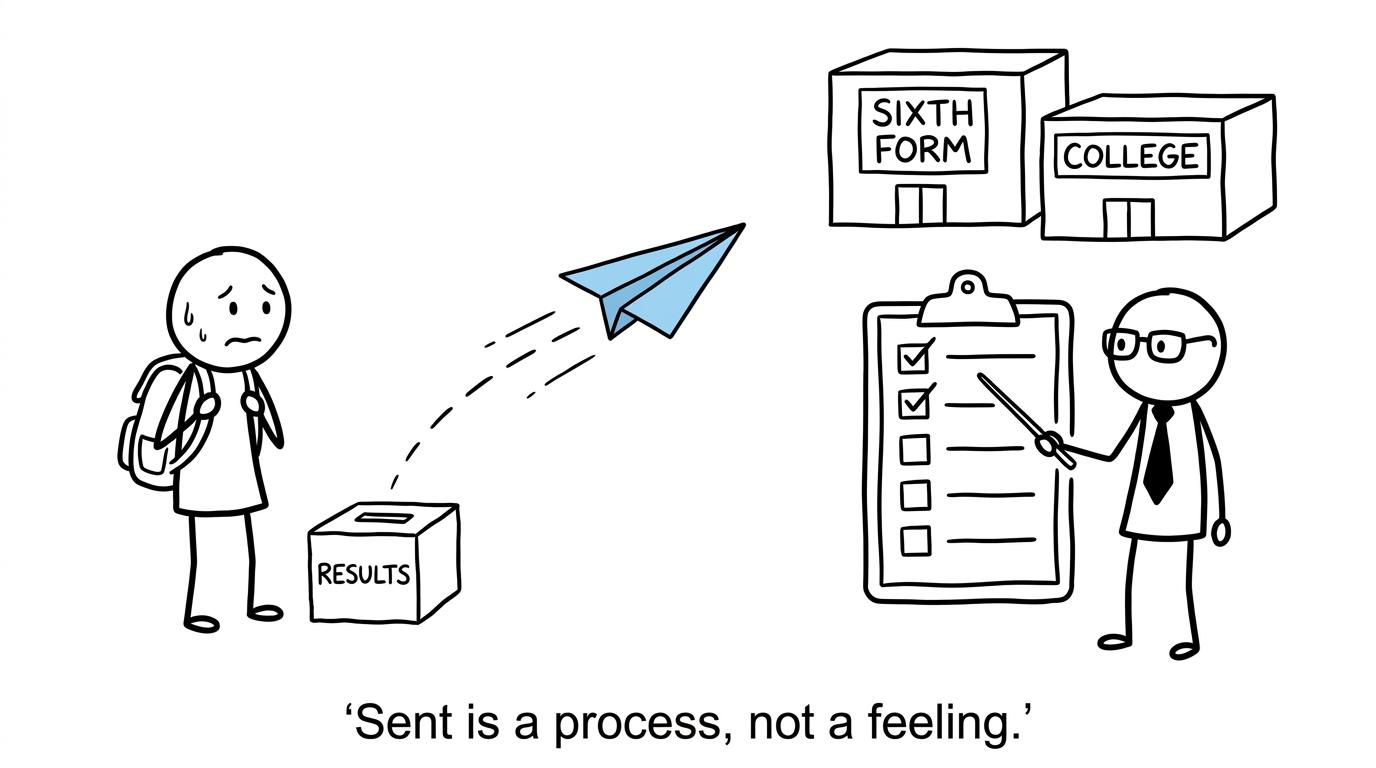 A GCSE result travelling towards sixth form and college
How GCSE Business results actually reach sixth forms
There is no single admissions system used by every school sixth form and further education college. That is why two friends applying to different places may receive different instructions.
Your exam board sends the result to your exam centre
Your exam board, such as AQA, Edexcel, OCR or Eduqas, marks the qualification and supplies the result to the school or centre through which you were entered. On results day, the centre gives you a statement of provisional results, sometimes called a Candidate Statement of Provisional Results.
GCSE Business is not normally delivered as a special standalone document. It appears as one qualification within your overall GCSE record. Check that the subject title, exam board and grade are shown correctly.
The statement is described as provisional because enquiries and reviews can lead to later changes. Your final certificate arrives afterwards. For example, AQA says certificates are sent to exam centres around eight weeks after results day. You should ask your own centre when and how certificates will be available, as arrangements differ.
Your school may share information through a local process
If you are moving into your current school's sixth form, its admissions team may already be able to view your results. Schools and local application services may also have secure information-sharing arrangements.
That does not remove your responsibility to complete enrolment. A place can still depend on confirming grades, accepting the offer and choosing courses by the stated deadline.
Data protection rules require schools to share personal information lawfully and securely. This helps explain why staff may not simply forward your result to any email address supplied in an informal message.
You may need to provide the evidence yourself
Many external sixth forms and colleges ask applicants to provide their own results. Their instructions may tell you to:
- upload a scan or photograph to an applicant portal;
- email a copy to a named admissions address;
- bring the original results statement to enrolment;
- enter grades in an online form and provide evidence later; or
- share a digital education record where that service is supported.
The Department for Education has developed digital education records that can include official GCSE results and be shared by a learner with participating providers. Availability depends on whether your school and receiving provider use the service, so do not assume an app has replaced the college's published process.
UCAS mainly handles applications to higher education. Its results service should not be treated as the standard route for sending a Year 11 GCSE Business result to a local sixth form. Even for university applications, UCAS advises applicants to supply evidence themselves when a required GCSE result is not passed on through its results service.
How to send your result correctly
The safest approach is not clever. It is careful.
Follow the offer and enrolment instructions
Search your inbox for messages containing words such as “offer”, “enrolment”, “results” and “applicant portal”. Check spam and junk folders too. The provider may have set a narrow enrolment window or asked you to attend at a particular time.
Use the method it names. If the instruction says to upload the full statement, do not crop the image to show only Business. Admissions staff may need to check GCSE Maths, English and other entry requirements at the same time.
Prepare clear evidence
If you are submitting a digital copy, make sure:
- all four corners of the document are visible;
- your name, candidate details, subjects and grades can be read;
- the image is upright and not blurred;
- no grade has been obscured or edited; and
- the file format and size meet the portal's rules.
Never alter a results document. If something appears incorrect, contact your school's exams officer rather than trying to make the evidence look right.
When emailing admissions, use the address given in your offer information. Put your full name and applicant reference in the subject line, attach the evidence and state briefly that you are confirming your GCSE results for enrolment. Avoid sending sensitive information to personal addresses or through social media.
Keep proof that you submitted it
Take a screenshot of the portal confirmation or retain your sent email. Record when you submitted the result and which address or account you used.
This is not about expecting something to go wrong. It simply turns an uncertain memory into useful evidence if an admissions team cannot immediately find the file.
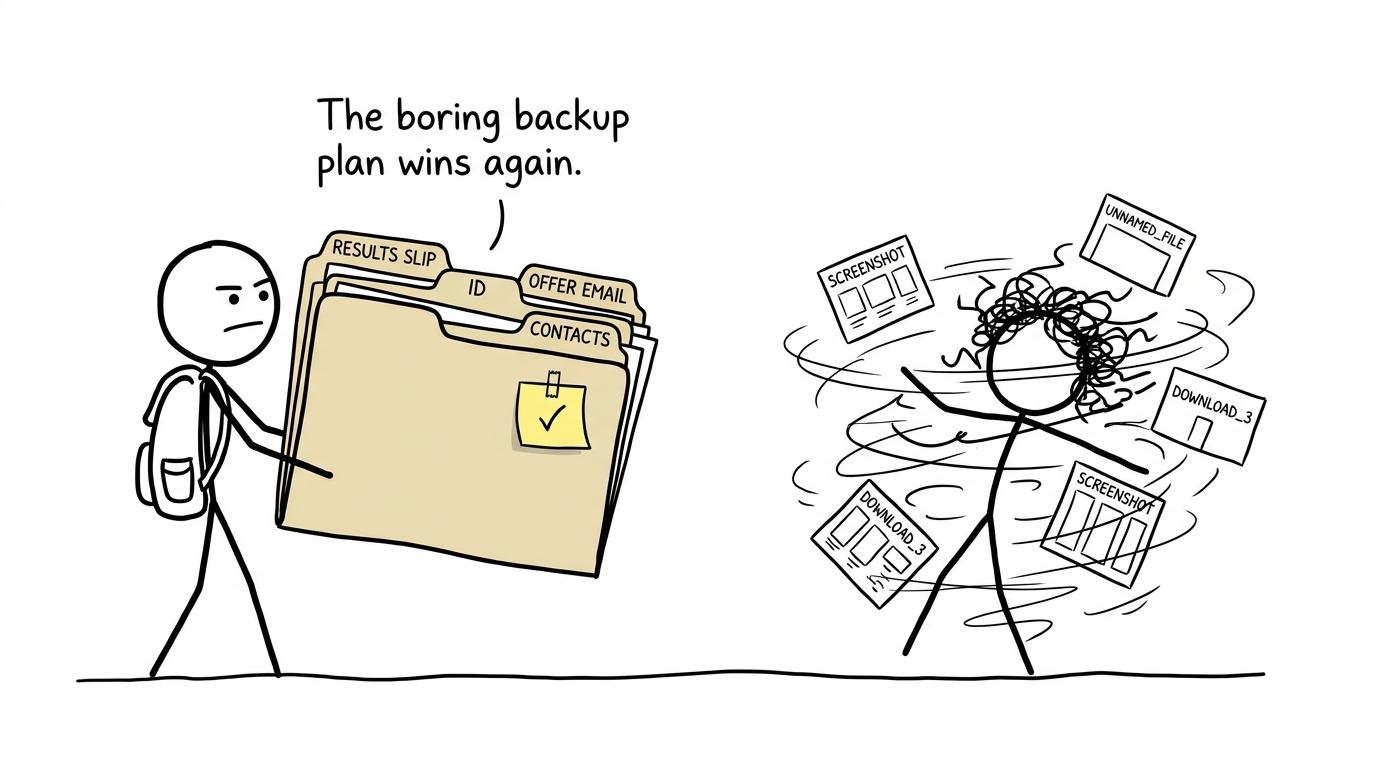 An organised results-day folder beats loose screenshots
What to do if your GCSE Business result is delayed
A delay is inconvenient, but it does not automatically mean you have lost your place. Act quickly and keep both institutions informed.
First, contact your school or exam centre. If you are a private candidate, contact the centre where you sat the examination. Ask whether the result is genuinely missing, being investigated or unavailable because of an administrative issue.
Next, contact the sixth form or college admissions team before its deadline. Explain that the result has not been released, give your applicant reference and ask what temporary evidence it will accept. Do not invent or estimate a grade.
The provider might ask for confirmation from your exam centre, allow more time or enrol you conditionally while the issue is resolved. This is a decision for the provider, so obtain its instructions in writing where possible.
If all your results are available but the portal does not show them, try the basic checks first:
- confirm that you used the correct applicant account;
- check that the upload completed successfully;
- verify that your name and date of birth match the application;
- resend the document only if admissions asks you to; and
- telephone admissions if an imminent deadline is at risk.
Repeatedly sending the same attachment to several addresses can make the trail harder to follow. One clear submission followed by one calm enquiry is usually more useful.
What if the grade does not meet your offer?
Read the exact conditions before assuming the answer is no. A sixth form may consider your overall GCSE profile, specific subject grades, available places and the requirements for your chosen course. Entry rules belong to the individual provider.
GCSE Business may be a condition for one course but irrelevant to another. A provider may place greater emphasis on GCSE Maths or English, while another may set a particular requirement for A Level Business. Check the published course information and ask admissions rather than relying on what happened to another student.
If you narrowly miss a requirement:
- attend enrolment or contact admissions as instructed;
- ask whether the course decision can be reviewed;
- discuss suitable alternative subjects or pathways;
- avoid waiting for a possible grade review before communicating; and
- keep a note of any revised offer you receive.
A review of marking must normally be requested through your school or exam centre, which can explain the available post-results services, deadlines, fees and the fact that a grade can stay the same, rise or fall. If a result changes, ask the sixth form what updated evidence it requires.
Students considering a GCSE Maths resit can use the GCSE Maths resit results-day plan to turn the result into a practical next step.
Common mistakes when sending GCSE results
Assuming the result transfers automatically
Some information may be shared securely, but the process is not universal. Always complete the receiving provider's enrolment steps.
Sending only the Business grade
The sixth form may need your complete GCSE results statement to verify all offer conditions. Send the full document unless it specifically requests otherwise.
Using predicted grades as final evidence
Predicted grades support applications before examinations. They do not replace the official provisional results statement on results day.
Waiting for the certificate
Final certificates usually arrive later than results day. Use the provisional results evidence requested by the provider rather than missing enrolment while waiting for a certificate.
Contacting the exam board before the centre
Your school or exam centre is normally the first contact for a missing result, clerical check or review of marking. It holds the entry details and can access the relevant post-results process.
Forgetting to save confirmation
A successful upload screen or sent email takes seconds to keep. It can save a much longer conversation later.
Keep admissions admin separate from revision
Results administration deserves attention, but it should not consume the weeks before your exams. Prepare the contact details and document checklist once, then return to the work that can still improve your grades.
MathsGenie's GCSE Maths revision hub brings together free lessons, exam questions, worksheets, mini tests and papers for Edexcel, AQA, OCR, Eduqas, WJEC and CCEA. If you are unsure what belongs on your tier, use the GCSE topics by exam board and tier guide.
A structured plan reduces the temptation to revise only comfortable topics. The GCSE one-month maths revision plan provides a repeatable schedule, while the GCSE revision timetable guide helps you build a longer revision planner around your own week.
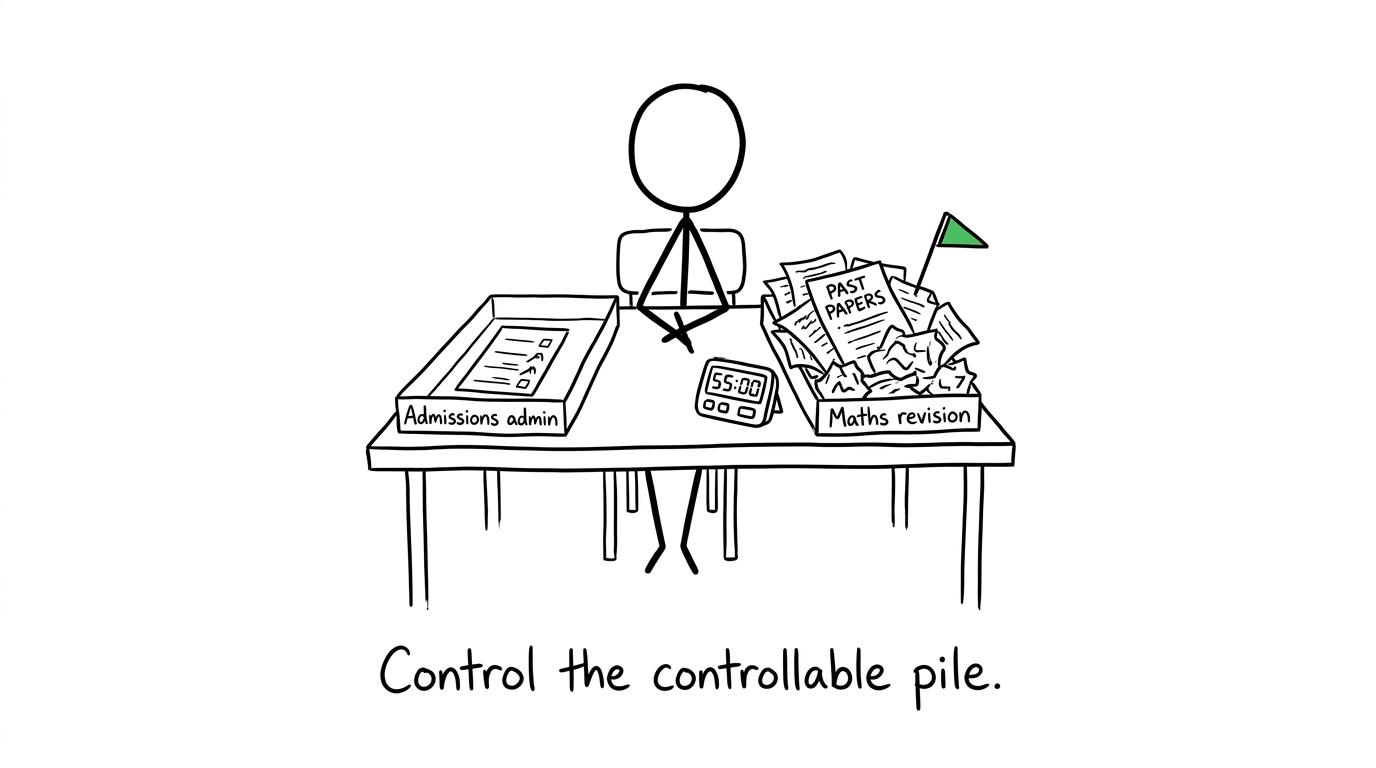 A student separates admissions admin from maths revision
Once your methods are secure, move into timed practice. The guide to when to start GCSE past papers explains how to progress from targeted questions to complete papers. Near the examination, Edexcel GCSE Maths predicted papers can provide fresh practice alongside official past papers, mark schemes and video solutions.
Make the next step boringly reliable
Sending a GCSE result is mostly an exercise in following instructions: obtain the official statement, use the named submission route, keep proof and contact admissions quickly if anything is delayed. The exact route varies, which is why your sixth form or college's own instructions matter more than assumptions about automatic transfer.
Prepare that small piece of administration early. Then put your attention back where it can earn marks. Open the MathsGenie GCSE Maths revision resources, choose your board and tier, and build a steady cycle of revision lessons, practice questions, mini tests, past papers, predicted papers, mark schemes and video solutions. Calm preparation works because it leaves fewer important things to chance.










