Revision Order for GCSE French: Does It Matter?
Revision order GCSE French advice: learn when subject order matters, how to balance French with maths, and how to build a practical weekly timetable.
Revision timetables often look beautifully certain. French on Monday, maths on Tuesday, science on Wednesday. Then a difficult maths paper or an approaching speaking assessment changes everything, and the carefully planned order begins to feel wrong.
Here is the useful answer: revision order for GCSE French matters, but not because French must always come before or after another subject. What matters more is how often you return to French, whether you prioritise your weakest skills and how close each assessment is. A flexible sequence of short, active sessions usually serves you better than one perfect subject order.
For students balancing French with GCSE maths, the goal is not to decide which subject permanently comes first. It is to give each subject the kind of attention it needs.
The quick revision-order checklist
Use these principles when arranging your week:
- Put the most urgent assessment first when speaking tests, mocks or written papers are approaching.
- Revise a weak skill while your concentration is strongest.
- Return to French vocabulary, grammar and listening several times rather than completing one large weekly block.
- Give maths regular written practice rather than leaving it until one long weekend session.
- Alternate demanding and lighter tasks when that helps you maintain attention.
- Use test results to change the order instead of following an outdated timetable.
- Protect sleep and breaks; tired revision is rarely efficient revision.
A timetable is a decision-making tool, not a contract.
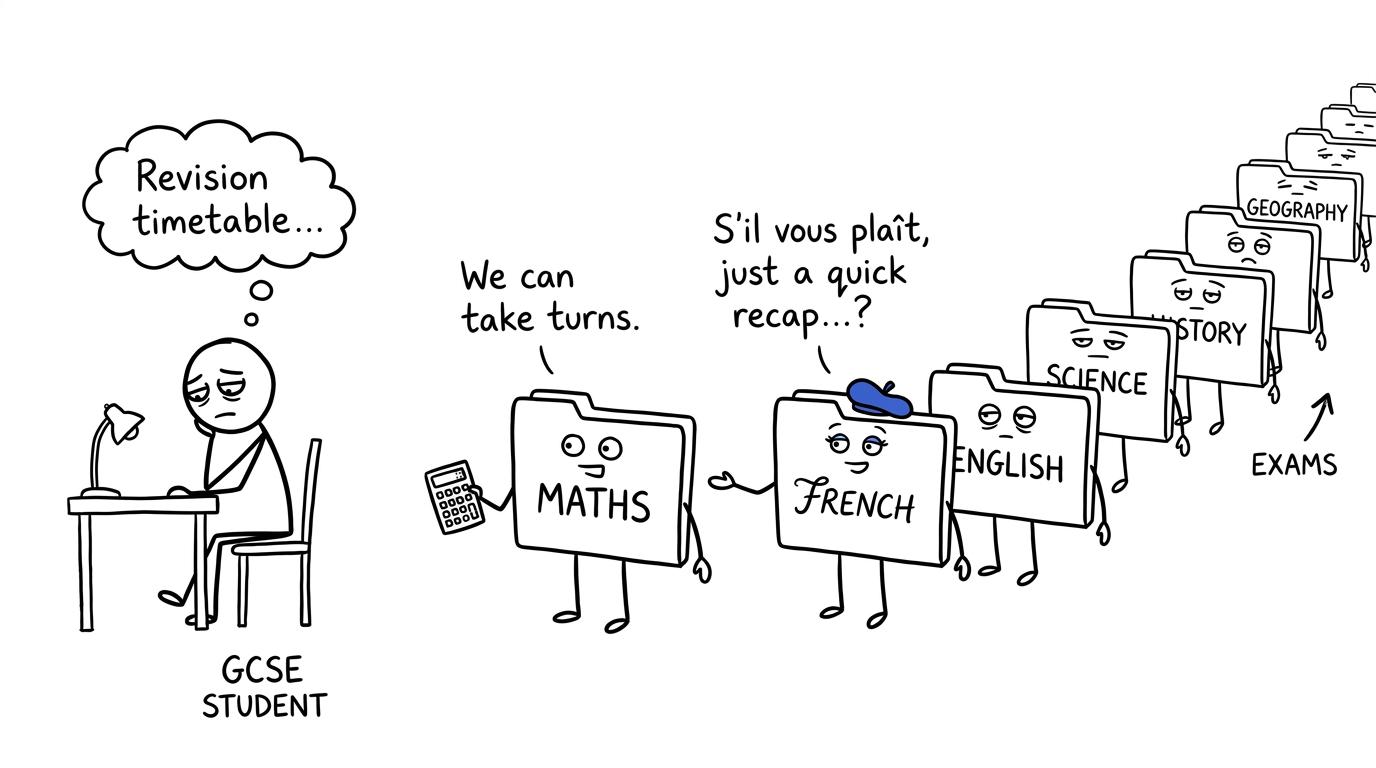 A student negotiates the revision queue with French and maths
Does revision order for GCSE French really affect results?
Order has a small practical effect, while selection, frequency and revision method have a much larger one.
If French is consistently placed at the end of the evening, when you are too tired to listen carefully or form accurate sentences, its position is hurting your revision. If it comes first every day simply because you enjoy it, while a major maths weakness remains untouched, that order is unhelpful too.
The strongest order is therefore personal and changeable. It reflects:
- your current weaknesses;
- your energy at different times;
- the dates of your assessments;
- the type of task being completed;
- what your latest practice revealed.
This fits the wider principle of planning, monitoring and evaluating revision. You choose a strategy, check whether it is working and then adjust it. MathsGenie's guide to building a GCSE maths revision timetable uses the same idea: evidence from questions should shape what comes next.
There is no reliable rule saying that French should always be revised before maths, or that calculation-based subjects must come first. Your timetable should respond to need rather than folklore.
Why French benefits from frequent returns
GCSE French is not one task. It combines listening, speaking, reading, writing, vocabulary, grammar, pronunciation and translation. Under the revised GCSE qualifications first assessed in summer 202620262026, specifications continue to assess listening, speaking, reading and writing. For example, the current AQA and Pearson Edexcel specifications give each component 25%25\%25% of the qualification.
Always check your own exam board and qualification because tasks and paper order can differ between AQA, Pearson Edexcel and Eduqas, and arrangements may be different for resits or other qualifications.
The broad lesson is simple: revising only writing for three hours does not prepare every skill. French knowledge needs to be encountered and retrieved in different forms.
A useful pattern might include:
- vocabulary retrieval on one day;
- listening and dictation on another;
- a speaking rehearsal later in the week;
- reading or translation at the weekend;
- short grammar checks woven through several sessions.
The exact weekday order is less important than returning before too much has been forgotten. Evidence on revision routines supports active retrieval and spacing learning over time rather than relying on repeated rereading.
This principle is equally valuable in maths. The MathsGenie guide to stopping forgotten maths content explains how retrieval, spaced practice and exam questions work together.
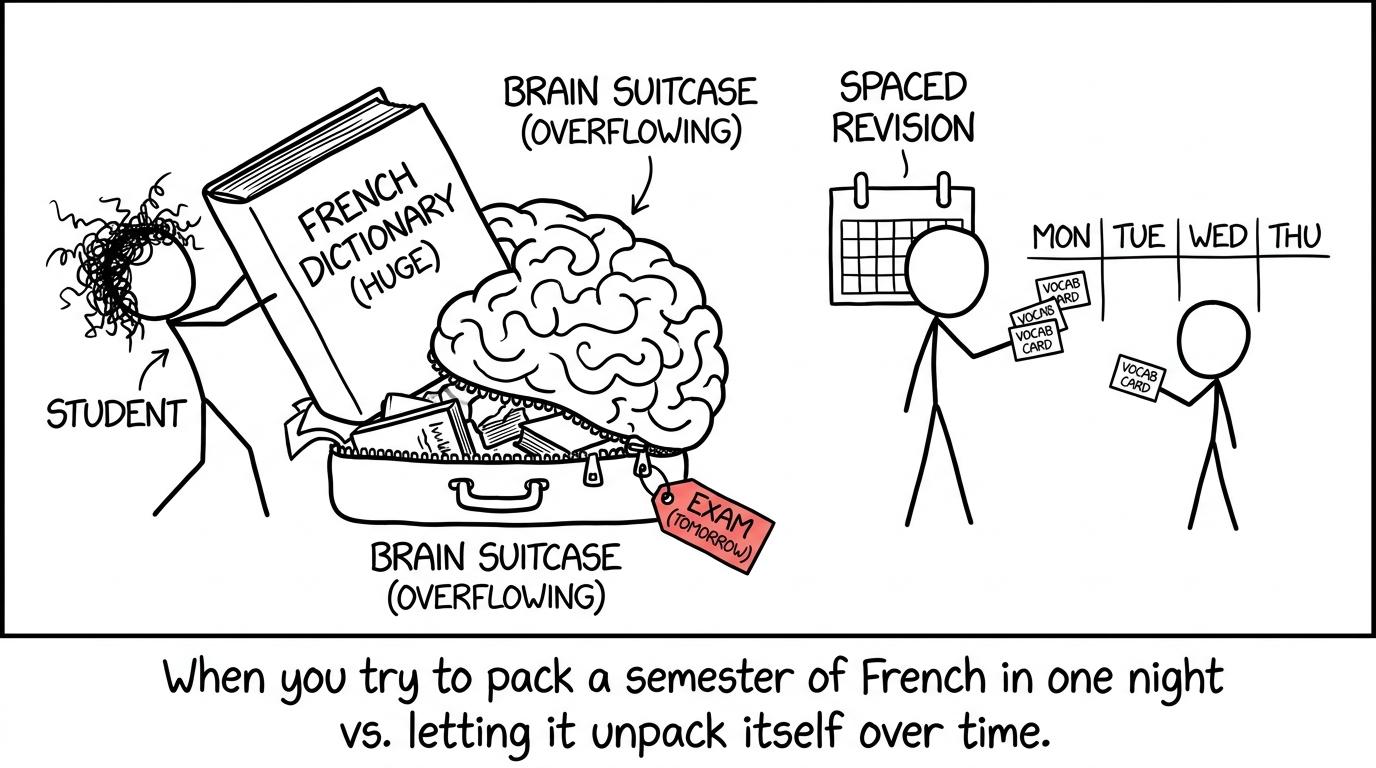 A calendar offers small vocabulary cards to an overflowing suitcase
When GCSE French should come first
French deserves the first revision slot when placing it there solves a real problem.
When your speaking assessment is approaching
Speaking is assessed separately and may take place before your written papers. Your school will give you the relevant arrangements and date. As it approaches, move speaking practice towards the front of your timetable.
This does not mean abandoning maths. It means temporarily increasing the frequency of pronunciation, read-aloud practice where relevant to your specification, role-play preparation and spontaneous answers.
Speaking also benefits from alertness. If forming sentences aloud feels much harder late at night, schedule it earlier and leave a more contained task for later.
When listening is your weakest component
Listening cannot be improved effectively through vocabulary lists alone. You need regular contact with spoken French, including practice at an appropriate speed and tasks matching your specification.
If listening scores are consistently lower than reading or writing scores, place it early in selected sessions. That prevents an uncomfortable skill from being postponed whenever time runs short.
When you keep avoiding French
Students naturally prefer tasks that feel successful. A familiar maths topic can therefore displace a French task that feels uncertain, or the reverse.
If French is repeatedly missed, put a short French block first. Even 151515 to 202020 focused minutes of retrieval or listening can remove the risk that the subject disappears from the day altogether.
When maths should come first
Maths should lead when it is the more urgent or mentally demanding priority.
If a maths mock is tomorrow, a paper has exposed major gaps or you need sustained concentration for higher-tier problem-solving, begin there. The GCSE maths revision hub provides free revision lessons, practice questions, papers and solutions across boards including Edexcel, AQA, OCR and Eduqas.
Maths often requires uninterrupted written work. You may need time to select a method, show each stage, check the answer and learn from the mark scheme. Starting while fresh can improve the quality of that practice.
A productive sequence could be:
- demanding maths questions while concentration is high;
- a proper break;
- short French vocabulary retrieval;
- French listening or speaking;
- a brief review of errors from both subjects.
That is not evidence that maths is universally more important. It simply matches each task to your available attention.
To identify where maths genuinely needs priority, use a diagnostic approach rather than guessing. The guide to finding your weakest GCSE topics shows how mistakes can be turned into specific next actions.
Build a weekly rhythm instead of a rigid ranking
The idea of one permanent subject order is attractive because it removes decisions. But it also ignores changing deadlines and weaknesses.
A better timetable has three layers.
Fixed commitments
Add school, homework, meals, activities, sleep and known assessment dates first. Your plan must fit your real week, not an imaginary week with unlimited evenings.
Priority sessions
Choose the subjects and skills that currently need your best concentration. A French speaking assessment may dominate one week; a maths mock may lead the next.
Use evidence. French practice scores can reveal whether listening, reading, speaking or writing needs attention. In maths, mini tests and papers expose precise gaps. For short diagnostic work, Edexcel GCSE maths mini tests provide focused timed practice with answers and supporting solutions where available.
Maintenance sessions
Keep subjects alive even when they are not the main priority. A short French recall task or a handful of maths questions prevents the return from feeling like a complete restart.
On busy days, a compact routine is often more realistic than skipping revision. MathsGenie's 20-minute maths revision routine offers a useful structure for brief, active sessions.
Match the order to your energy
“Do the hardest subject first” is useful advice only when you know what hardest means.
For one student, French listening demands the most attention. For another, it is algebraic reasoning. Some students work best immediately after school; others need food, movement and a proper pause first.
Track this for a week. After each session, record whether you completed the planned task and whether the work was accurate. Then ask:
- Which tasks were repeatedly postponed?
- When was concentration strongest?
- Did the first subject receive much better work than the second?
- Was the block too long?
- What did marking reveal?
The purpose is not to score your motivation. It is to improve the design of the timetable.
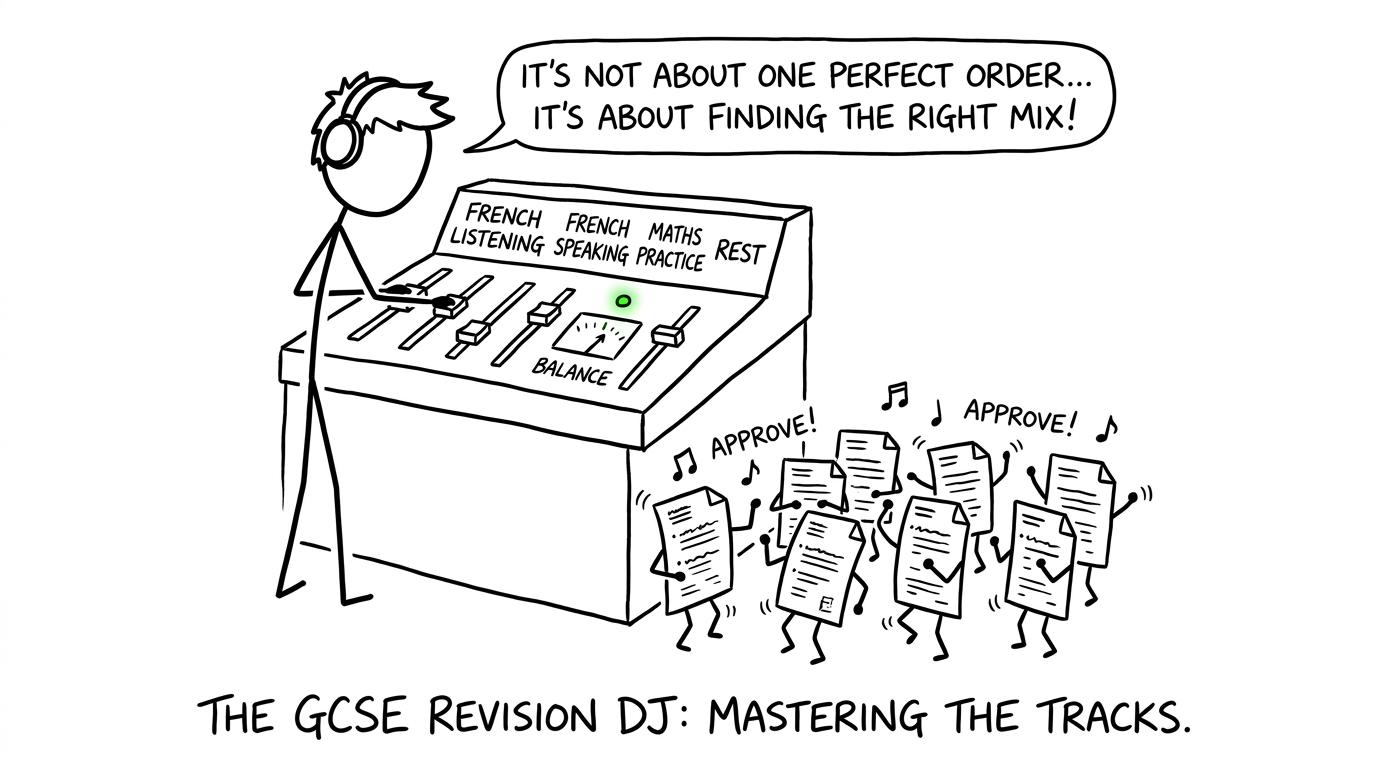 A student mixes French, maths and rest at a revision DJ desk
Change the order as exams approach
Early revision should usually emphasise coverage, weak skills and repeated retrieval. Closer to exams, assessment dates become more influential.
Bring French speaking forward before the speaking assessment, while continuing short maintenance in maths. Before a maths paper, increase timed questions and paper review without allowing French to vanish completely.
Past papers should also enter gradually. They are most useful when you mark them, identify gaps and repair those gaps rather than simply collecting scores. The MathsGenie guide on when to start GCSE past papers explains how to move from shorter diagnostic work towards timed papers.
Remember that a predicted paper is practice, not a promise about the real examination. Use predicted papers to rehearse decisions and timing, then use the resulting errors to choose the next revision session.
Common revision-order mistakes
Searching for one perfect sequence
No universal order can account for your assessment dates, weaknesses and energy. Build a repeatable starting structure, then revise it weekly.
Putting the favourite subject first every day
Confidence is useful, but comfort can consume the timetable. Begin with a weaker subject on some days and use the favourite as the second block.
Leaving French for one weekly marathon
A long session may feel productive, yet it gives too few opportunities to retrieve language across time. Several shorter encounters usually create a more useful rhythm.
Treating all French revision as vocabulary revision
Vocabulary matters, but GCSE assessment also requires you to understand and produce language through different skills. Include listening, speaking, reading, writing, grammar and translation as required by your specification.
Doing maths without marking it
The order cannot help if practice produces no feedback. Check answers, study the mark scheme or video solution, label the error and revisit it. MathsGenie's free resources make that attempt, mark, fix cycle straightforward.
Sacrificing sleep to preserve the timetable
A timetable that repeatedly pushes revision late into the night is not disciplined; it is overloaded. Shorten or move sessions rather than treating exhaustion as evidence of commitment.
A flexible order beats a perfect order
The order of GCSE French revision matters when it affects attention, urgency or whether the subject gets revised at all. Beyond that, there is no magical position in the week. Frequency, active practice, feedback and sensible prioritisation matter more.
Give French regular contact across its different skills. Give maths enough uninterrupted time for written questions and correction. Move either subject forward when an assessment or weakness justifies it.
Then let evidence guide the next decision. Open the MathsGenie GCSE maths revision area, choose your board and tier, and use free revision lessons and practice questions to repair gaps. Build towards mini tests, past papers and predicted papers, checking mark schemes and video solutions as you go. Your timetable does not need to look perfect. It needs to keep helping you take the next useful step.