

Revise Weakest Topic First: GCSE Engineering Guide
Revise weakest topic first GCSE engineering? Learn when to tackle weak maths, structure each session and use practice evidence to improve exam marks calmly.
A revision session often begins with a quiet negotiation. You know which topic needs attention, but another topic feels easier, quicker and far more inviting. So, should you revise weakest topic first GCSE engineering, or save it until you have built some confidence?
The best answer is to tackle it near the start, but not necessarily in the first minute. Use a short warm-up, work on the weak area while your concentration is strongest, then finish by testing it again. Leaving the hardest topic until the very end often means meeting it when your attention and patience are already fading.
This matters because engineering calculations draw on several GCSE maths skills at once. A question about density, stress, pressure, gears or electrical systems may also test substitution, rearranging formulae, unit conversion and rounding. Sometimes the apparent engineering weakness is really a smaller maths gap hiding underneath.
The short answer: first, last or somewhere between?
Use this order as your default:
- Begin with a 555 to 101010 minute warm-up on a familiar but relevant skill.
- Spend the main part of the session on your weakest engineering or mathematical area.
- Check your work using answers, solutions or a mark scheme.
- Finish with a short independent re-test or mixed question set.
- Return to the same weakness on another day rather than declaring it finished.
In other words, the weakest topic should usually come first in the serious part of the session and last in the checking part.
That balance avoids two problems. Starting cold with something intimidating can create unnecessary resistance. Saving it until last can turn a good intention into a permanent delay.
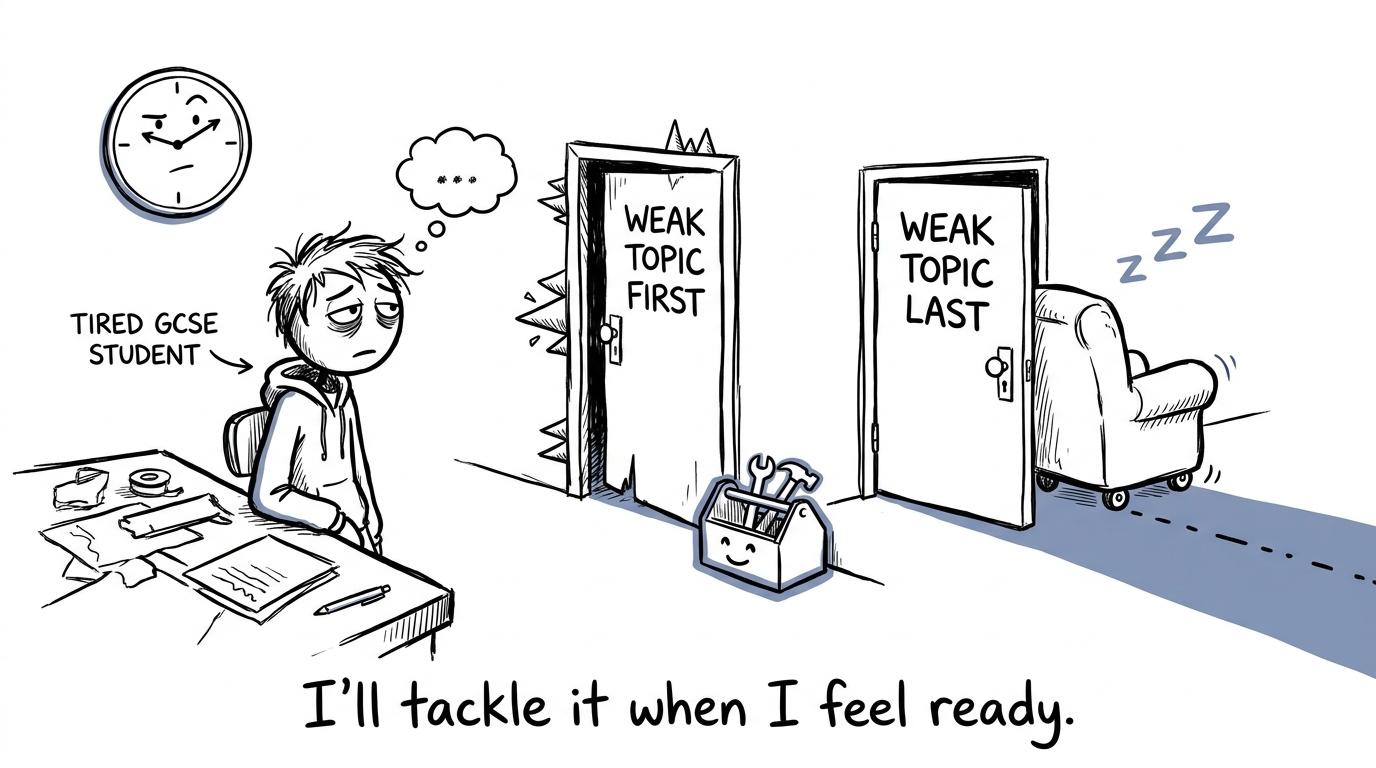 A student choosing between a difficult topic and a suspiciously comfortable sofa
Why your weakest topic deserves your best attention
Weak topics are expensive because they rarely stay in one box. Suppose you struggle with pressure. The relevant relationship is
P=FA.P=\frac{F}{A}.P=AF.Understanding the engineering idea is only one part of the task. You may also need to identify the correct area, convert units, substitute accurately, rearrange the equation and state an appropriate unit.
The same is true of density:
ρ=mV.\rho=\frac{m}{V}.ρ=Vm.A weakness labelled “density” might actually be a difficulty with volume, converting cubic units or deciding whether to multiply or divide. That is why targeted maths revision can improve performance in engineering contexts.
The current GCSE Engineering subject content requires mathematical understanding to be applied in engineering situations. In AQA GCSE Engineering, for example, the specification includes arithmetic, ratio, percentages, trigonometry, Pythagoras, algebra, graphs, units and engineering equations. At least 15%15\%15% of marks must be allocated to mathematical knowledge and understanding under the GCSE Engineering subject requirements.
Your exact course may differ. Some schools offer GCSE Engineering, while others use vocational engineering design or manufacture qualifications. Check your qualification title, exam board and specification before building a topic list. The underlying maths, however, remains highly transferable.
MathsGenie’s GCSE maths revision hub lets you select your exam board and work through lessons, questions and papers for the mathematical skills behind these calculations.
Start with evidence, not a feeling
Students often call a topic weak because it feels unpleasant. That is useful information, but it is not enough. A topic can feel difficult because it is unfamiliar, because the questions contain technical language, or because one prerequisite skill is missing.
Use a short diagnostic before deciding what comes first. Complete a few relevant questions without notes, mark them carefully and record why each mark was lost. The MathsGenie guide to finding your weakest topics gives you a practical process for turning mistakes into specific revision targets.
Separate errors into categories such as:
- engineering knowledge;
- choosing an equation;
- rearranging a formula;
- substitution or calculator use;
- unit conversion;
- rounding or significant figures;
- interpreting a graph;
- reading the command word incorrectly.
This changes the target from “revise forces” into something useful, such as “practise converting area units before using the pressure equation”. Smaller targets are easier to teach, practise and re-test.
A better structure for each revision session
Warm up without hiding
A brief warm-up can help you settle into the session, especially after a long school day. Choose something connected to the main weakness: a unit conversion, a formula recall prompt or a straightforward substitution.
Keep it brief. The warm-up is a runway, not a new destination. If you spend half the session doing comfortable questions, you have not prepared for the difficult topic; you have avoided it politely.
Work on the weakness while you are fresh
Now give the weak area the largest focused block. Use a revision lesson or guide to repair the method, then move into questions without keeping the explanation open beside you.
For common engineering calculations, MathsGenie’s speed and density revision guide covers compound measures, while the conversions and units guide explains length, area, volume and compound-unit conversions.
If the equation itself causes trouble, use the rearranging harder formulae resources. Although this page is organised for Edexcel GCSE Maths, the algebraic skill transfers directly to engineering equations. Students following AQA, OCR or Eduqas maths can use the relevant board materials from the main hub.
Mark immediately and name the fault
Feedback is where practice becomes revision. Do not simply write a score. Compare each response with the solution or mark scheme and write one short correction:
- “Converted length but not area.”
- “Rearranged before identifying the required quantity.”
- “Rounded during the calculation rather than at the end.”
- “Used diameter where the formula required radius.”
A useful engineering mindset is to treat the wrong answer as test data. You are not judging the whole machine; you are finding the loose component.
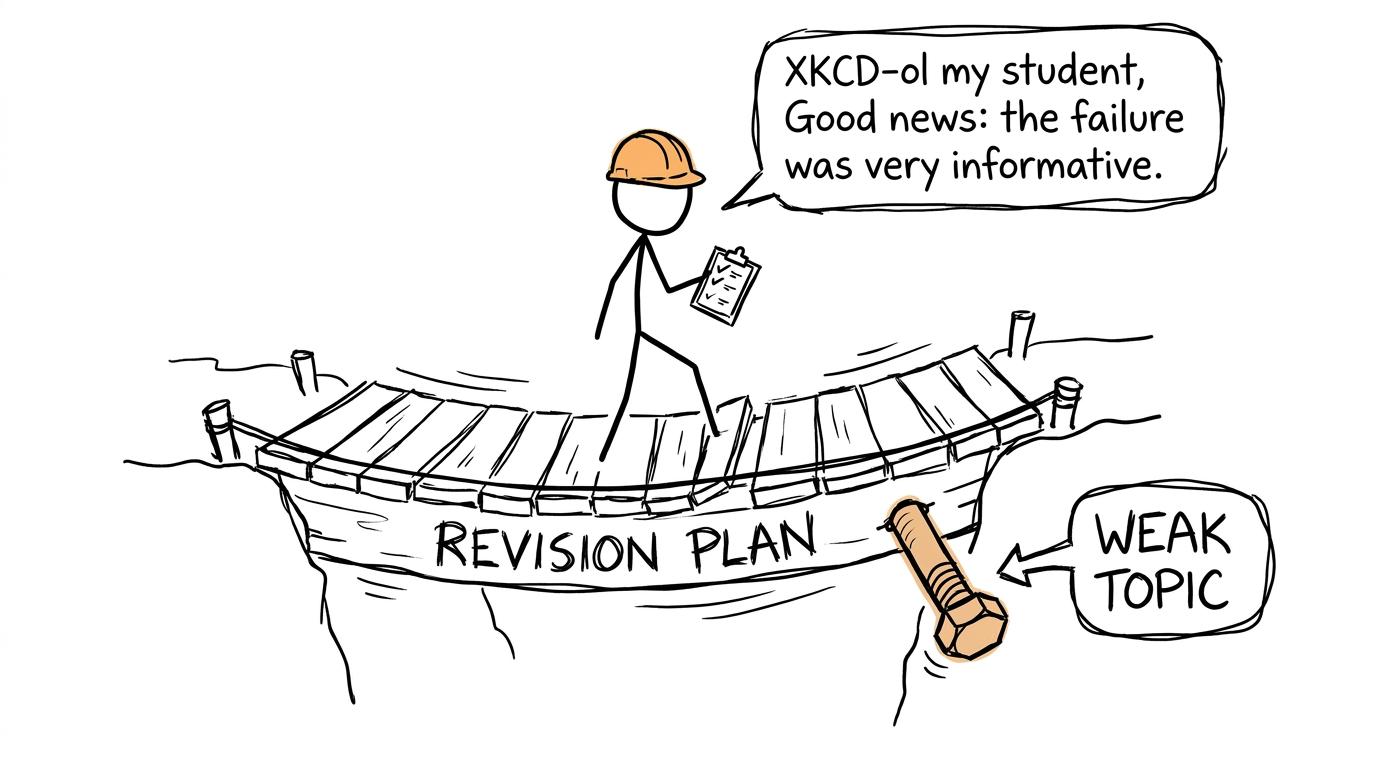 A student engineer discovering that a failed revision bridge has one informative loose bolt
End by retrieving, not rereading
Research reviews in learning science consistently support spacing and active retrieval over repeatedly rereading material. There are limits to how directly any single study transfers to complex GCSE problem-solving, but the practical principle is sound: attempt to recall and apply the method, then check whether you were right.
End with a closed-book question, a formula recall check or a short mixed test. MathsGenie’s GCSE maths mini tests can provide quick evidence without requiring a full paper.
Your final task should answer one question: Can I now do this without support?
When should the weakest topic come last?
There are situations where moving it later is sensible.
If you are so anxious that you cannot begin, complete one short, achievable task first. Then move directly to the weak topic. This is a deliberate entry strategy, not permission to spend the session collecting easy marks.
You should also delay a topic when it depends on a missing prerequisite. There is little value in repeatedly attempting engineering stress calculations if area conversion is the actual barrier. Repair the prerequisite first, then return to the engineering application in the same session or the next one.
Finally, the night before an exam is not the ideal time to rebuild a large topic from nothing. Focus on high-value errors you can realistically correct, key equations, units and calm exam practice. A weak area requiring several lessons belongs earlier in the revision plan.
For a longer structure, the GCSE one-month maths revision plan combines diagnosis, focused practice and spaced review. MathsGenie’s revision planner can also help you give difficult topics more than one appointment.
Spacing matters more than a perfect position
Whether a topic appears first or last in one session matters less than whether you revisit it. One long evening can create familiarity, but familiarity is not the same as durable recall.
A stronger cycle is:
- diagnose the specific weakness;
- learn or repair the method;
- practise without support;
- mark and correct;
- re-test after a gap;
- apply the skill inside a mixed or timed paper.
Past papers are valuable here because they remove the topic label. In an exam, nobody tells you that a question requires ratio, area and rearranging. You must recognise the structure yourself. The guide on when to start GCSE past papers explains how to move from mini tests and targeted sections towards full timed papers.
MathsGenie predicted papers can help you practise GCSE maths under realistic conditions, but they should support rather than replace specification-wide revision. They are designed for maths preparation, not as predictions of the content of a separate Engineering assessment.
Common mistakes when prioritising weak topics
Choosing the broadest possible label
“Graphs” or “materials calculations” is too vague. Identify the exact action that fails: finding a gradient, selecting scales, reading coordinates or converting graphical information into numerical form.
Spending the whole session relearning
Watching videos and reading notes can restore understanding, but you need independent questions to reveal whether the method is available from memory. Learning should move into practice quickly.
Mistaking one correct answer for mastery
A familiar question may test imitation rather than understanding. Use a second question with different wording, then return after a gap.
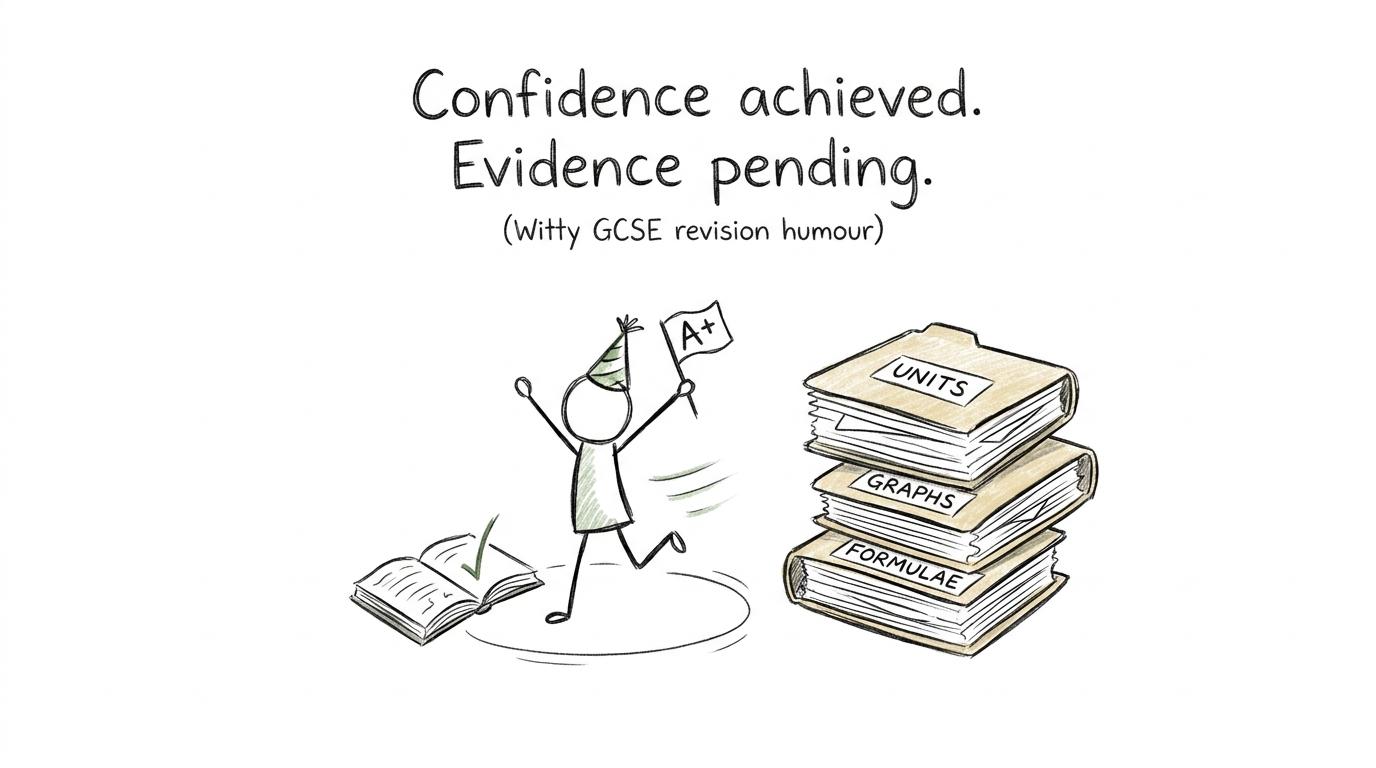 A student celebrates one easy answer while unopened revision folders wait nearby
Ignoring units and presentation
Engineering calculations are attached to physical quantities. Record units during working, check whether area or volume units are required, and round only as instructed. A correct calculator display is not automatically a complete exam answer.
Revising only weak topics
Your strongest areas still need maintenance. A sensible plan gives most focused time to weaknesses while using short mixed retrieval to protect secure knowledge. Revision is not about making every topic equally comfortable; it is about improving the marks available across the paper.
Build a revision loop that produces evidence
The useful question is not simply whether to begin or end with your weakest area. It is whether your session gives that area enough attention, feedback and another chance to succeed.
Start with a short warm-up. Tackle the weakness while your attention is fresh. Mark it honestly. Finish with retrieval, then schedule a later re-test. That sequence turns avoidance into a manageable process and turns mistakes into engineering-style evidence.
MathsGenie gives you the free tools to run the whole loop: revision lessons and guides to rebuild understanding, practice questions and mini tests to develop accuracy, and past papers, predicted papers, mark schemes and video solutions to test performance. Open the GCSE maths revision hub, choose the smallest skill behind your weakest Engineering topic, and make it the first serious task in your next session.










