Speed and Density
What you'll learn
- Choose and use formulas for speed, density and pressure.
- Rearrange formulas to find missing quantities.
- Convert time units for mph and m/s questions.
- Combine masses and volumes in liquid-mixture problems.
The basic idea: “per” means divide
A unit is the label on a measurement, such as metres, seconds, grams or cm³.
You will meet these quantities:
- Distance: how far something travels.
- Time: how long something takes.
- Mass: how much matter there is, often measured in grams or kilograms.
- Volume: how much 3D space something takes up, often measured in cm³ or ml.
- Force: a push or pull, measured in newtons (N).
- Area: the size of a surface, such as the bottom of a box.
The word per means “for each one”. So miles per hour means miles divided by hours.
The three rates
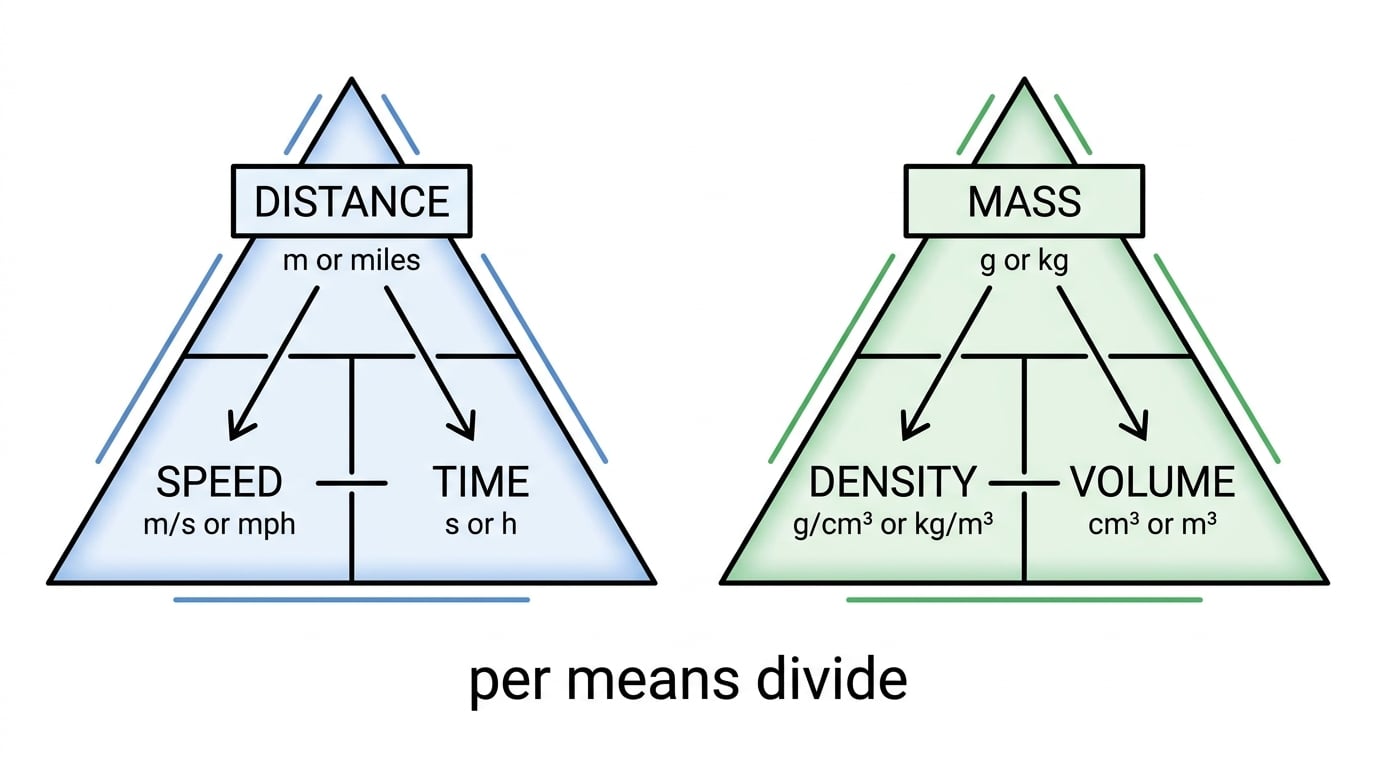
- Average speed is distance per unit time.
- Density is mass per unit volume.
- Pressure is force per unit area.
The three main formulae are:

One pattern
Each formula compares one quantity with another by dividing. If you know two quantities, you can usually find the third.
Worked example: average speed
Finding average speed
A runner covers 240 metres in 30 seconds. Find the average speed.

-
Write the formula.
average speed=distancetime\text{average speed} = \frac{\text{distance}}{\text{time}}average speed=timedistance -
Substitute the distance and time.
average speed=24030=8\text{average speed} = \frac{240}{30} = 8average speed=30240=8 -
Add the correct units: the average speed is 8 m/s.
Density and pressure: same pattern
To substitute means to replace the words in a formula with the numbers from the question.
For density, divide mass by volume.
For pressure, divide force by area.
Quick density and pressure questions
- A metal object has mass 630 g and volume 35 cm³. Use the density formula.

$$
\text{density} = \frac{630}{35} = 18
$$
2. The density is 18 g/cm³.
- A crate exerts a force of 150 N over an area of 6 m². Use the pressure formula.

$$
\text{pressure} = \frac{150}{6} = 25
$$
4. The pressure is 25 N/m².
Rearranging when the missing value is not on top
Sometimes the question asks for distance, time, mass, volume, force or area instead.
For a formula like a=bca=\frac{b}{c}a=cb:
- The top quantity is found by multiplying: b=a×cb=a \times cb=a×c.
- The bottom quantity is found by dividing: c=bac=\frac{b}{a}c=ab.
Cover-up method
In formulas shaped like “top divided by bottom”, cover the missing quantity. If the missing quantity is on top, multiply. If it is on the bottom, divide.
Finding volume and area
- A stone has mass 84 g and density 3.5 g/cm³. Volume is the bottom quantity, so divide mass by density.

$$
\text{volume} = \frac{84}{3.5} = 24
$$
2. The volume is 24 cm³.
-
A block has force 108 N and pressure 36 N/m². Area is the bottom quantity, so divide force by pressure.
area=10836=3\text{area} = \frac{108}{36} = 3area=36108=3 -
The area is 3 m².
Time units in speed questions
For a speed in miles per hour, the time must be in hours.
For a speed in metres per second, the time must be in seconds.
To convert minutes to hours, divide by 60.
To convert seconds to minutes, divide by 60.
Writing minutes as decimals incorrectly
Do not write 4 hours 15 minutes as 4.15 hours. Since 15 minutes is 1560=0.25\frac{15}{60}=0.256015=0.25 hours, the correct time is 4.25 hours.
Speed in mph and arrival time
- A car travels 310 miles in 5 hours 40 minutes. Convert the time into hours.

$$
5+\frac{40}{60}=5.666\ldots
$$
2. Use average speed equals distance divided by time.
$$
\text{average speed}=\frac{310}{5.666\ldots}=54.705\ldots
$$
3. To 1 decimal place, the average speed is 54.7 mph.
-
For a separate journey, a driver travels 81 miles at 36 mph. Find the time.
time=8136=2.25\text{time}=\frac{81}{36}=2.25time=3681=2.25 -
2.25 hours is 2 hours 15 minutes, so if the driver leaves at 08:20, they arrive at 10:35.
Average speed for a whole journey
For a whole journey, use:
average speed=total distancetotal time\text{average speed}=\frac{\text{total distance}}{\text{total time}}average speed=total timetotal distanceThis is true even if the speed changes during the journey.
Averaging the speeds
If a journey has two parts, do not usually add the two speeds and divide by 2. Use total distance divided by total time instead.
Average speed over two parts
A van travels 150 miles at 60 mph. It then travels another 90 miles in 2 hours 15 minutes. Find the average speed for the whole journey.

-
Find the time for the first part.
time=15060=2.5\text{time}=\frac{150}{60}=2.5time=60150=2.5 -
Convert the second time into hours.
2+1560=2.252+\frac{15}{60}=2.252+6015=2.25 -
Add the distances and times.
total distance=150+90=240total time=2.5+2.25=4.75\begin{aligned} \text{total distance} &= 150+90=240 \\ \text{total time} &= 2.5+2.25=4.75 \end{aligned}total distancetotal time=150+90=240=2.5+2.25=4.75 -
Find the average speed.
average speed=2404.75=50.526…\text{average speed}=\frac{240}{4.75}=50.526\ldotsaverage speed=4.75240=50.526… -
The average speed is about 50.5 mph.
Different routes
If two people take different roads, the distance may be different. You can only use the same distance if the question makes it clear they travelled the same journey.
Mixing liquids and density
A mixture is made by combining substances. In these questions, work with mass and volume separately.
Do not add densities directly. Density is found after you know the total mass and total volume.
Mixtures
For mixed liquids: find masses, find volumes, then use density equals total mass divided by total volume.
Finding the density of an unknown liquid
120 cm³ of Liquid A has density 1.25 g/cm³. It is mixed with some Liquid B to make Liquid C. Liquid C has mass 240 g and density 1.2 g/cm³. Find the density of Liquid B.

-
Find the total volume of Liquid C.
volume of C=2401.2=200\text{volume of C}=\frac{240}{1.2}=200volume of C=1.2240=200 -
Find the mass of Liquid A.
mass of A=1.25×120=150\text{mass of A}=1.25 \times 120=150mass of A=1.25×120=150 -
Subtract to find the volume and mass of Liquid B.
volume of B=200−120=80mass of B=240−150=90\begin{aligned} \text{volume of B} &= 200-120=80 \\ \text{mass of B} &= 240-150=90 \end{aligned}volume of Bmass of B=200−120=80=240−150=90 -
Find the density of Liquid B.
density of B=9080=1.125\text{density of B}=\frac{90}{80}=1.125density of B=8090=1.125 -
The density of Liquid B is 1.125 g/cm³.
In the exam
- Write the formula first, then substitute the numbers.
- Check the units before calculating, especially hours, minutes and seconds.
- For whole journeys and mixtures, use totals: total distance, total time, total mass and total volume.
Check yourself
- If a car travels 150 miles in 2.5 hours, what calculation gives its average speed?
- Why is 3 hours 20 minutes not the same as 3.20 hours?
- In a liquid mixture question, why should you avoid adding the densities directly?