Revise Weakest Topic First GCSE Biology: Best Order
Revise weakest topic first GCSE Biology? Usually, yes. Learn when to tackle it, when to delay it, and how to turn weak areas into exam marks calmly.

There is a familiar revision trap: you sit down intending to tackle genetics, homeostasis or another topic you find difficult, then spend the session reviewing cell structure because it feels reassuringly familiar. You have worked, but the gap remains.
So, should you revise weakest topic first GCSE Biology? Usually, yes. Tackle it near the beginning of the session, when your attention is strongest, but not necessarily in the first minute. A short retrieval warm-up can help you settle before you give the main block of time to the difficult material. Then revisit it briefly at the end or on another day.
The order makes a difference because energy, avoidance and feedback all shape what you learn. Yet order alone is not magic. Active recall, exam questions, marking and spaced revisits matter more than whether a topic appears first or last on one evening.
The quick answer and revision checklist
Use this as your default approach:
- Identify weakness from questions and feedback, not simply from how a topic feels.
- Begin with a short warm-up on familiar material.
- Put your weakest Biology topic in the first substantial revision block.
- Narrow a large topic to one precise gap.
- Retrieve knowledge before reopening your notes.
- Answer exam-style questions and check the mark scheme.
- Record the exact reason for each lost mark.
- Revisit the topic after a gap rather than trying to finish it forever.
- End with a short success you can complete accurately.
This is a hybrid strategy: warm up, tackle the weakness, then finish by consolidating. It avoids both extremes of beginning cold with something overwhelming and leaving the hardest work until your concentration has disappeared.
 A student choosing between a comfortable easy topic and a useful difficult topic
Why revising your weakest Biology topic early usually works
The weakest topic is often the one most likely to be postponed. Putting it early removes that daily negotiation. You do not need to wonder whether there will be time later because the decision has already been made.
Earlier work also tends to receive better attention. A difficult process such as hormonal control, inheritance or interpreting an ecological investigation may require you to connect facts, apply them in an unfamiliar context and explain a chain of reasoning. Those tasks are harder to complete when you are tired.
Official GCSE Biology specifications from AQA, Edexcel and OCR make an important distinction between knowing scientific ideas, applying knowledge and analysing information. Eduqas assessments likewise require more than memorising isolated facts. Therefore, “I am weak at homeostasis” is not a sufficiently precise diagnosis. You might know the key terms but struggle to apply negative feedback to a new situation. Alternatively, the science may be secure while your interpretation of graphs or practical methods is costing marks.
Starting early gives you time to discover which problem you actually have.
Difficulty can be useful information
Students sometimes treat difficulty as proof that revision is failing. Often, it means the task is exposing a genuine gap.
Retrieval practice asks you to bring information to mind without immediately looking at notes. Evidence reviewed by the Education Endowment Foundation suggests that low-stakes quizzes and retrieval activities can strengthen memory, although their success depends on how they are implemented. Spacing learning across different days also shows promise compared with concentrating every encounter into one sitting.
That means the uncomfortable moment when you cannot recall the stages of a process is useful. It tells you where to look next. Quiet rereading can hide the same gap because every sentence feels familiar while it is visible.
This principle transfers directly to maths revision. The MathsGenie GCSE Maths revision hub combines topic resources, practice questions and papers so that weaknesses become visible through performance rather than guesswork.
When should you leave the weakest topic until later?
“Weakest first” is a sensible default, not an unbreakable rule. There are circumstances in which delaying the topic briefly is more productive.
You need prerequisite knowledge first
Biology topics are connected. If your understanding of enzymes is insecure, parts of digestion may remain confusing. If cell division is unclear, inheritance can become harder to organise. In this situation, revise the missing prerequisite first. That is not avoidance; it is repairing the foundation.
The same logic applies in maths, where the best order for learning GCSE Maths topics places dependent skills in a sequence rather than treating every topic as separate.
You are too anxious to begin productively
If opening the weakest topic causes you to freeze, use a short, controlled warm-up. Retrieve a few secure facts, organise your materials or answer one manageable question. Then switch to the planned weakness while you still have most of your energy.
The warm-up must have a boundary. Otherwise, it becomes a comfortable topic wearing the costume of preparation.
The exam is extremely close
The evening before an examination is rarely the right time to rebuild an enormous topic from the beginning. Prioritise concise retrieval, common errors, required practical knowledge and a small number of questions. Protect sleep and stop at a planned time.
Government exam guidance recommends manageable targets, regular revision, breaks and testing yourself rather than relying only on passive review. For a similarly restrained approach to another subject, the MathsGenie night-before GCSE Maths plan shows how to focus on a few useful actions instead of attempting everything.
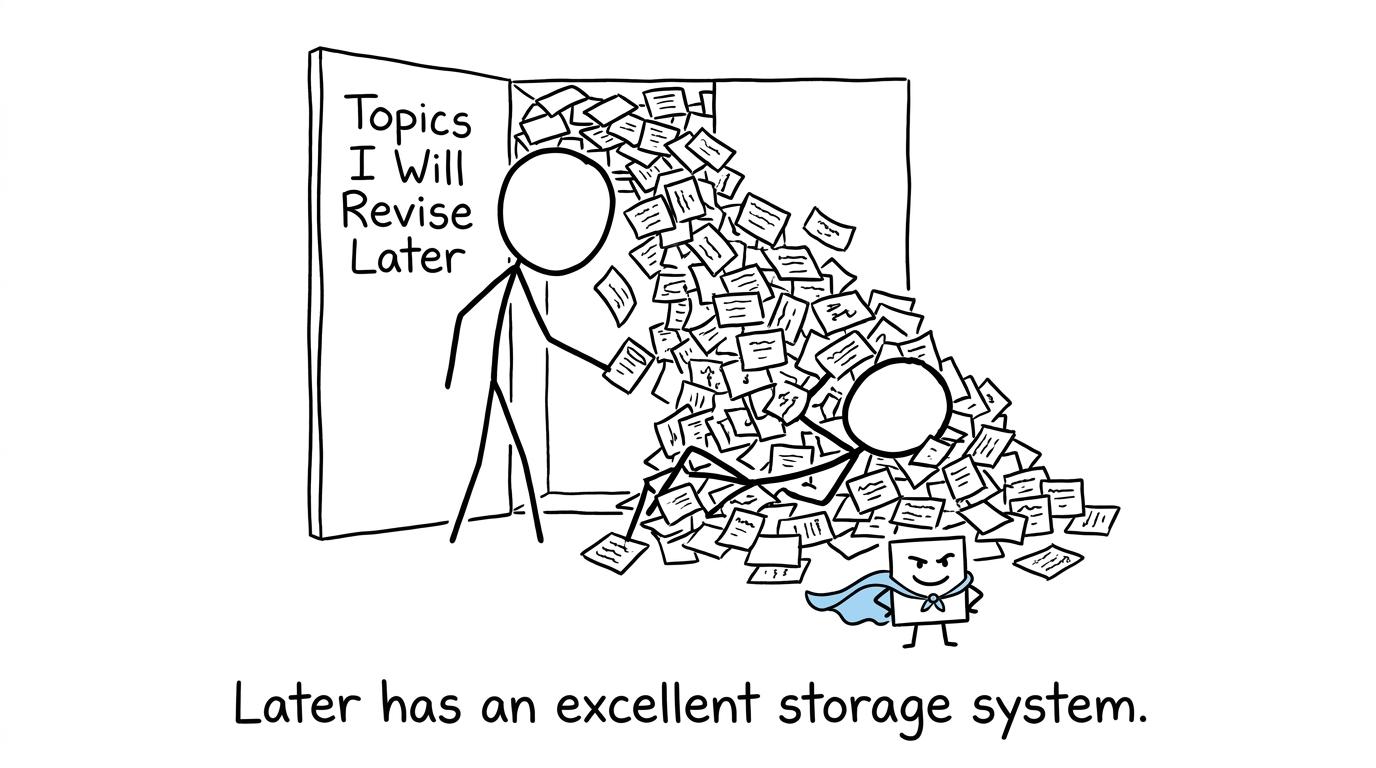 A cupboard full of topics saved for later collapsing onto a student
How to identify your real weakest topic
The topic you dislike most is not automatically the topic losing the most marks. Use evidence from several places:
- marked class assessments and mock examinations;
- questions you could not begin without notes;
- repeated errors across more than one paper;
- practical-method questions where variables or improvements are unclear;
- command words such as “explain”, “evaluate” and “compare”;
- calculations, graphs and data interpretation;
- the specification for your exam board.
Check the exact AQA, Edexcel, OCR or Eduqas specification followed by your school. Topic names and paper organisation vary, and separate Biology is not identical to Combined Science.
Create a short weakness statement. “Ecology” is too broad. “Explaining how a quadrat sample supports an estimate” or “evaluating limitations in fieldwork data” gives you something you can act on.
Maths students can use the same diagnostic habit. A timed paper followed by careful marking is more reliable than confidence alone. The guide to when to start GCSE past papers explains why papers are most valuable while there is still time to respond to what they reveal.
A productive order for one revision session
Begin with brief retrieval from an older topic. Keep your notes closed and write what you can remember, sketch a process from memory or answer a few short questions. This is a starting routine, not the main event.
Next, spend the largest focused block on one part of the weak topic. Check the relevant specification statement, repair the missing understanding and move promptly into questions. Do not spend the whole block making notes look complete.
Then mark your answers. Separate errors into categories:
- missing scientific knowledge;
- incorrect application to the question;
- weak analysis or evaluation;
- imprecise terminology;
- misread command word;
- calculation or graph error.
Finally, finish with a short independent retest or a secure topic. Ending with something achievable can preserve confidence, but it should follow the difficult work rather than replace it.
A repeatable plan matters more than one heroic session. The GCSE Maths revision timetable guide demonstrates the same rhythm: targeted topic work, active questions, marking and later paper practice.
Why the end of the session still matters
Leaving all weak-topic revision until the end is risky because “the end” is where plans shrink. You may be tired, short of time or tempted to stop after completing easier tasks.
However, the final minutes are useful for consolidation. Close your materials and retrieve the central idea again. Write down the question you can now answer and the point that remains uncertain. This produces a clear starting place for the next session.
The strongest plan therefore uses both positions differently:
- early in the session for substantial repair;
- late in the session for retrieval and diagnosis;
- later in the week for spaced practice.
This is also how good paper practice works. Completing a paper is only the diagnostic stage; the learning comes from marking, repairing and retesting. MathsGenie’s guide to using Edexcel GCSE Maths past papers properly explains that cycle, while the free Edexcel GCSE Maths past papers provide papers, mark schemes and solutions.
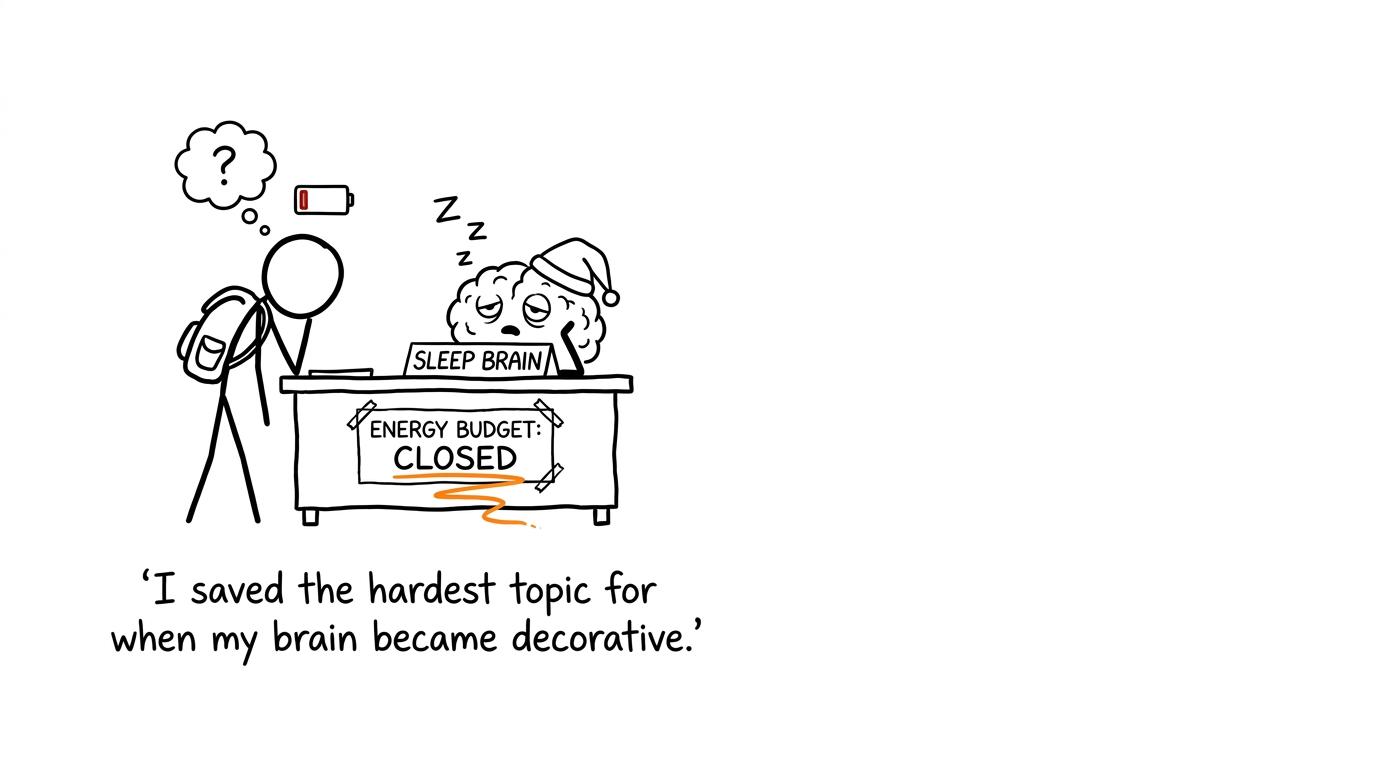 A student trying to negotiate revision time with a sleepy brain
Common mistakes when prioritising weak topics
Choosing by emotion rather than evidence
A topic can feel difficult because it is detailed, yet still produce reasonable marks. Diagnose weakness using questions, teacher feedback and mark schemes.
Trying to repair an entire unit at once
“Revise genetics” is too large for one focused block. Choose a process, skill or question type. Small targets make progress visible and make later retesting possible.
Reading before attempting retrieval
Opening notes immediately removes the chance to discover what you genuinely remember. Try first, check second, then correct.
Spending every session on weaknesses
Secure topics can fade if ignored. Keep some mixed retrieval and occasional paper practice in your plan. Weak-topic work should receive priority, not complete ownership of your timetable.
Revising once and declaring the topic finished
A successful session can create temporary fluency. Revisit the material after a gap and test it in a mixed context. The MathsGenie one-month revision plan uses the same principle of diagnosis, retrieval, practice and repeated review.
Confusing activity with improvement
Colourful notes, long videos and completed flashcards can all feel productive. Improvement is shown when you can recall, apply and explain the content without support.
The best answer is first, then later
For most students, the best time to revise the weakest GCSE Biology topic is near the start of a session, after a brief warm-up. That is when you are most likely to give it proper attention rather than postponing it. But the topic should not stay confined to that one block. Retrieve it again at the end and revisit it on another day.
The deeper lesson is that revision order should follow evidence. Find the precise gap, practise actively, mark honestly and return before the learning fades.
And when Biology revision is finished for the day, use the same disciplined cycle for maths. Start at the MathsGenie GCSE revision hub, choose your board and tier, then combine free revision lessons, practice questions, mini tests, past papers, predicted papers, mark schemes and video solutions. Your weakest topic does not need to remain your weakest topic. It simply needs an honest place in the plan.