Revise GCSE Russian When You Can't Sit Still
Revise GCSE Russian if you can't sit still with short, active sessions for listening, speaking, reading and writing, plus a realistic weekly plan.
You sit down with a Russian vocabulary list. Two minutes later, you are tapping your pen, checking the window and inventing reasons to leave the room. The problem may not be laziness. Long, silent revision sessions may simply be the wrong tool for you.
If you searched for “revise gcse russian cant sit still”, the practical answer is this: stop making sitting still a condition of learning. Revise while walking, speaking, sorting cards, changing stations and completing short timed tasks. Movement can become part of your revision system rather than something you must suppress.
The aim is not to avoid focused work altogether. GCSE Russian includes written examinations, so you eventually need to practise sitting and writing under exam conditions. But you can build the knowledge needed for those papers through far more active methods.
Your active GCSE Russian revision checklist
Use this as your starting point:
- Choose one precise task rather than “revise Russian”.
- Work in short blocks with a visible finish line.
- Walk while retrieving vocabulary or rehearsing speaking answers.
- Turn reading and grammar into sorting, matching and station activities.
- Practise listening away from your desk when it is safe to do so.
- Include brief seated writing bursts, then increase their length gradually.
- Mark or check every task so that revision produces feedback.
- Return to difficult material on later days rather than cramming it once.
- Confirm your specification, tier and assessment arrangements with your teacher.
The same principle helps when Russian must fit beside maths and other subjects. MathsGenie's twenty-minute GCSE revision routine provides a useful structure: recall, practise, check and record the next step. The subject changes, but the habit remains valuable.
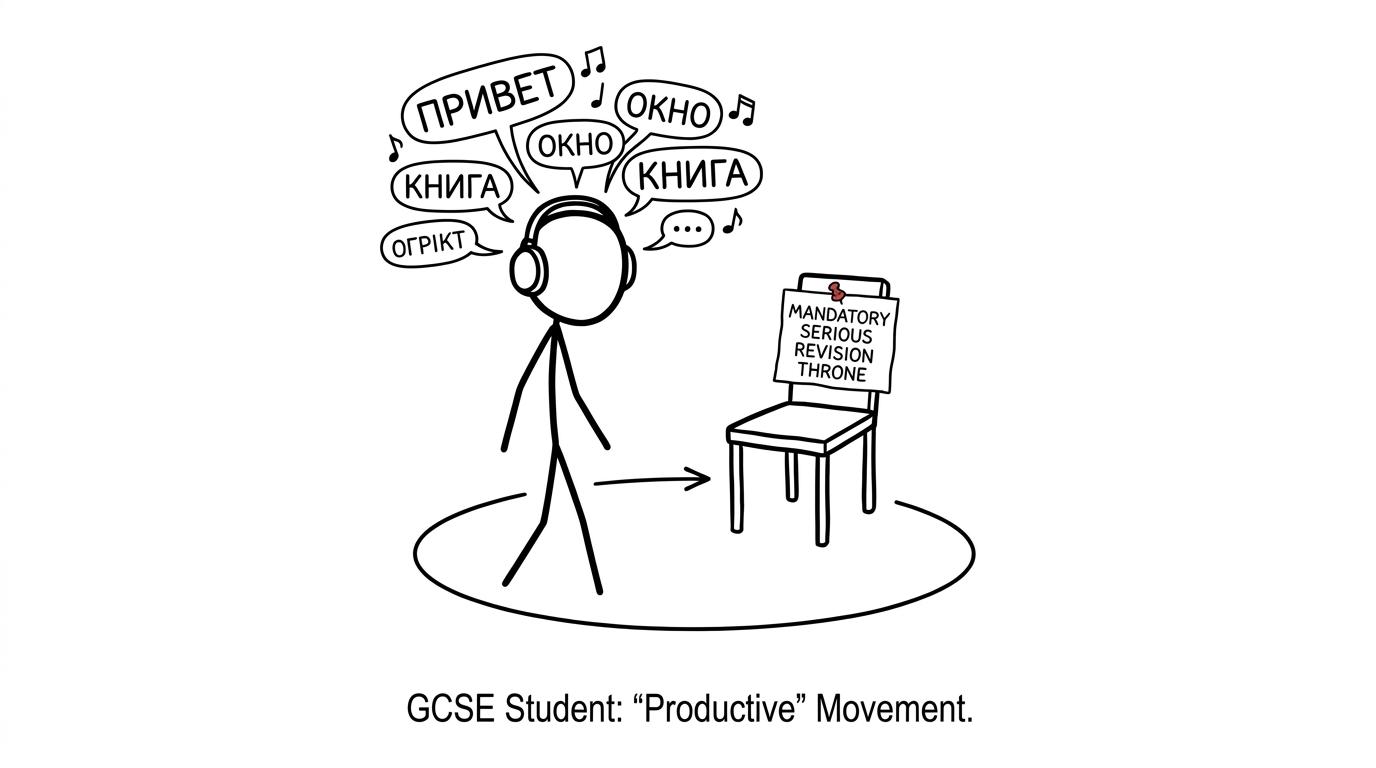 A student walking while practising Russian as an empty chair waits for serious revision
Know what your Russian examination requires
Before choosing activities, check the qualification you are actually taking. The current Pearson Edexcel GCSE Russian specification, code 1RU01\text{RU}01RU0, assesses four skills: listening, speaking, reading and writing. Each contributes 25%25\%25% of the qualification.
Foundation and Higher tiers are available, and candidates enter the same tier across all four papers. Dictionaries are not permitted, including during preparation for the speaking assessment. That makes independent vocabulary recall especially important.
Your teacher should be the final source for your tier, examination dates and speaking arrangements. Do not assume that advice written for French, German or Spanish automatically matches Russian. Likewise, AQA, OCR and Eduqas are familiar names in GCSE maths, but you should follow the exact board and specification listed by your school for every subject.
A useful revision plan therefore needs four separate strands:
| Skill | Active revision approach |
|---|---|
| Listening | Walk while completing short audio tasks, then stop to check details |
| Speaking | Rehearse aloud while pacing, using prompts rather than full scripts |
| Reading | Place short texts or questions at different stations around the room |
| Writing | Use brief seated sprints, followed by standing correction and recall |
This prevents an easy mistake: spending most of your time learning vocabulary while barely practising the form in which the examination will test it.
How to revise GCSE Russian when you cannot sit still
Replace long sessions with short missions
An hour labelled “Russian revision” has no clear edge. A task such as “retrieve fifteen travel words, check them and repeat the missed five” does.
Set a short timer and give each block one outcome. Suitable missions include:
- recalling vocabulary from one specification theme;
- identifying key information in one listening extract;
- rehearsing one speaking prompt without a script;
- reading one short passage and checking your interpretation;
- writing one paragraph before correcting its verbs and endings.
Stop when the mission is complete. Take a movement break, switch skill or move to another subject. If you also need a sustainable maths plan, the GCSE maths revision timetable guide shows how to organise focused tasks around school, rest and other commitments.
Make vocabulary retrieval physical
Copying a word repeatedly can feel productive because your hand is moving. Unfortunately, the word remains visible, so you are often recognising rather than recalling it.
Instead, put English prompts on cards around the room. Walk to a card, say or write the Russian equivalent, turn it over and check. Put incorrect cards in a separate pile and revisit them after a gap.
You can also assign areas of a room to themes such as school, travel, family, work and the environment. Moving to the appropriate area creates an extra cue, but the important action is still retrieval: attempt the word before looking.
Keep the cards selective. A mountain of untested vocabulary is less useful than a smaller set you can recall accurately in both directions.
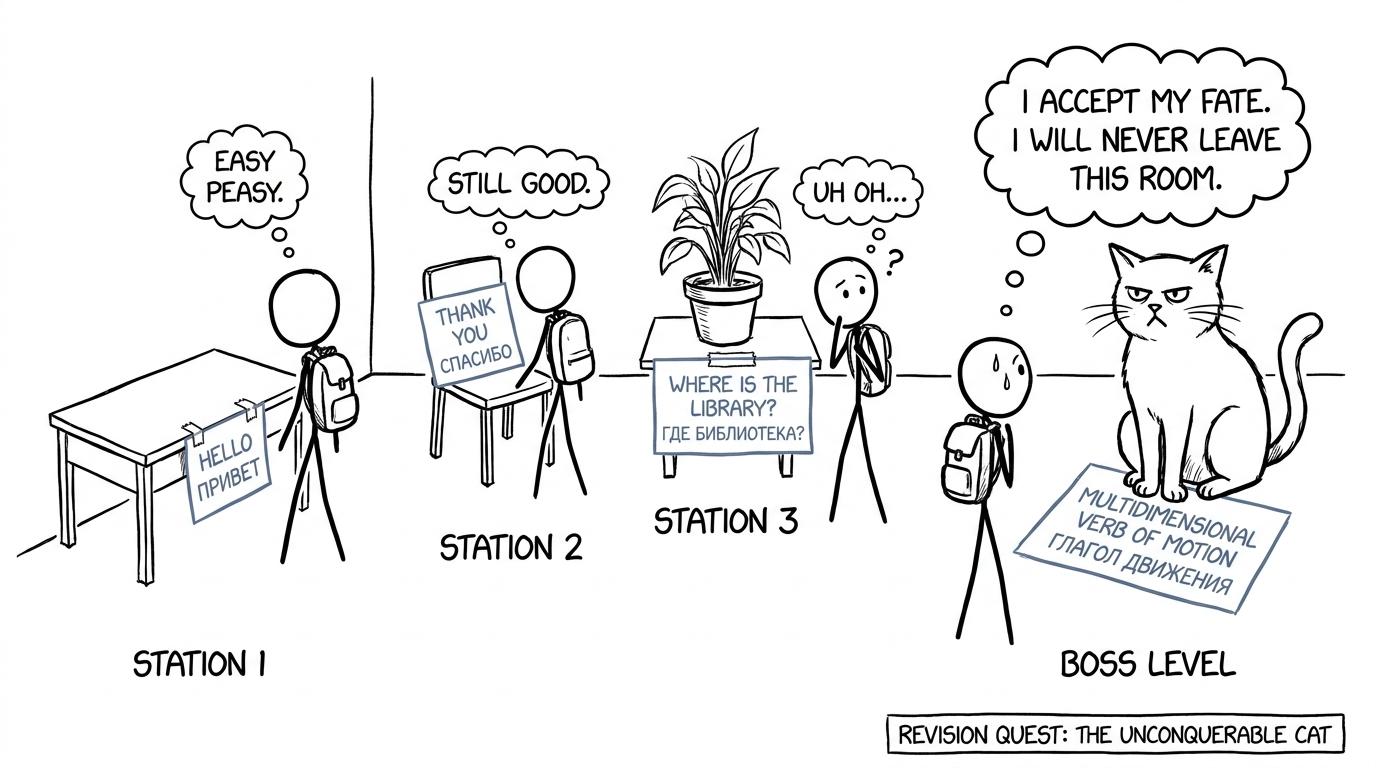 Russian vocabulary cards become a treasure hunt with a cat guarding the final card
Walk and talk for the speaking paper
Speaking revision naturally suits movement. Put brief prompts on your phone or cards, then walk slowly while answering aloud. Use this only somewhere safe, and keep your attention on your surroundings.
Avoid memorising one enormous script. The speaking assessment rewards communication and interaction, so practise adapting familiar language to different prompts. Begin with cue words, then reduce your support. Record selected answers and listen back for clarity, hesitation, verb forms and whether you answered the question actually asked.
A helpful sequence is:
- read the prompt;
- pause before speaking;
- answer from memory;
- listen back or ask a teacher to review it;
- record one specific correction;
- attempt the prompt again on another day.
Movement supplies energy, but feedback supplies improvement.
Turn listening into an active search
Listening revision does not require a desk. You might stand, stretch gently or walk indoors while hearing an extract. Give each listen a different purpose rather than replaying it vaguely.
On the first listen, identify the setting and overall message. On another, listen for details such as opinions, reasons, time references or changes of tense. Then check against the available transcript, answers or teacher guidance.
Do not use audio as passive background noise and count the whole period as revision. Decide beforehand what information you are trying to retrieve. A five-minute extract followed by an honest check is more useful than a long playlist you barely notice.
Use stations for reading and grammar
Place a short Russian text at one station, questions at another and your checking material at a third. Read the text, move away, answer from memory and return only when necessary. This makes rereading slightly inconvenient, which encourages genuine recall.
Grammar can be organised in the same way. Sort cards by tense, case, gender, ending or sentence function. Reassemble sentences physically, then explain aloud why each form belongs there. Keep the language aligned with the vocabulary and structures required by your own specification.
Train seated writing gradually
Writing is the point where “I cannot sit still” meets an unavoidable reality: the examination is seated and timed. The answer is gradual exposure, not an immediate full paper.
Start with a short writing sprint. Stand up to check vocabulary from memory, stretch or review your correction list, then complete another sprint. Over several weeks, lengthen some seated blocks and reduce the breaks until you can manage a realistic section.
The NHS advises students to take regular short breaks and make revision schedules manageable. It also recommends physical activity away from revision, while national guidance encourages young people to break up long periods of inactivity. Movement is not a failure of discipline. Used deliberately, it can support a sustainable routine.
Build a weekly plan that includes movement
A workable week should cover every Russian skill without demanding a heroic evening. Try this pattern:
- Monday: walking vocabulary retrieval and a short writing burst;
- Tuesday: active listening followed by immediate checking;
- Wednesday: speaking prompts while pacing, then one recorded answer;
- Thursday: reading stations and a grammar-card sort;
- Friday: revisit the week's mistakes without notes;
- Weekend: complete a timed paper section and review it carefully.
Leave room for maths. Start at the GCSE maths revision hub, choose your exam board and use short topic sessions when concentration is limited. MathsGenie's guide to finding your weakest GCSE topics can stop you spending scarce attention on material you already know.
As examinations approach, both subjects need longer periods under realistic conditions. Learn how to use GCSE past papers properly, but build towards them through sections, mini tests and timed bursts. Stamina is trained progressively, just like any other skill.
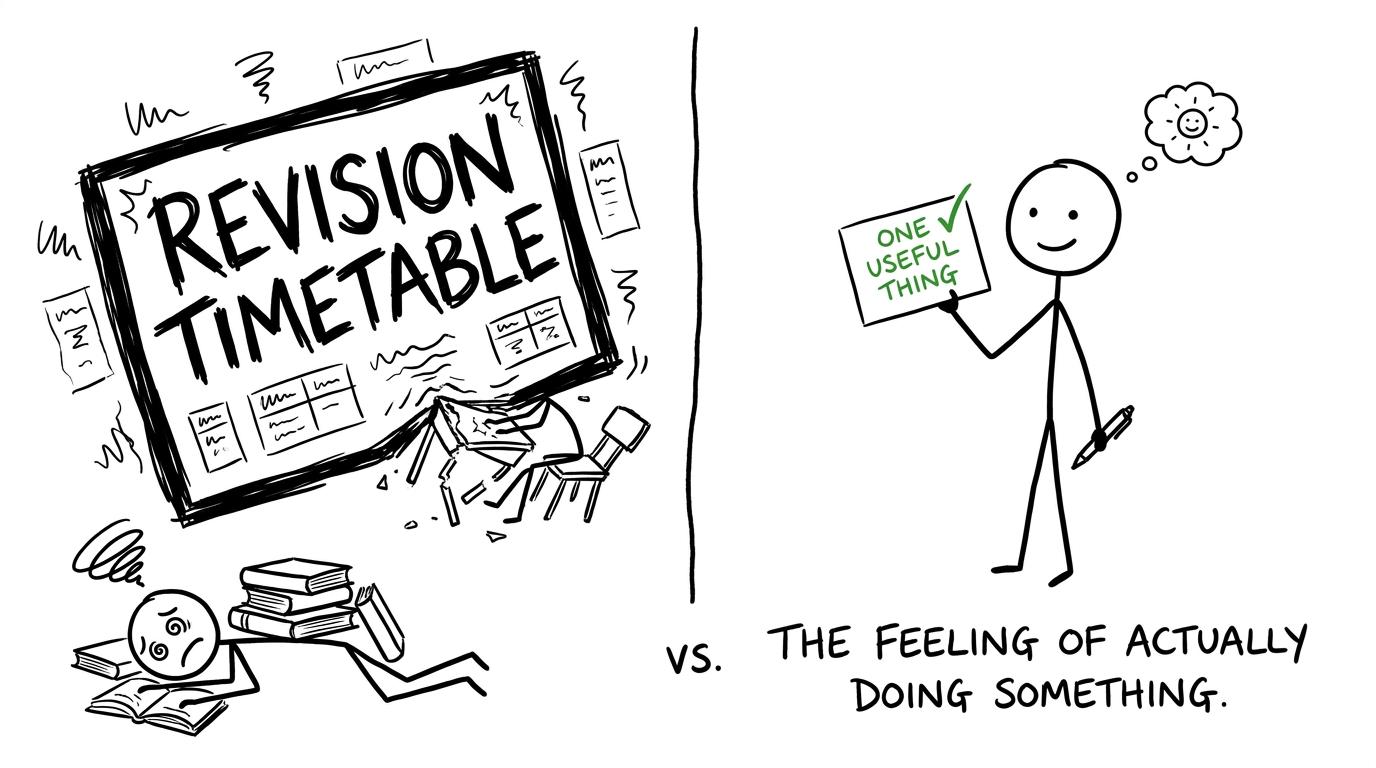 A giant revision timetable loses to one small useful task
Make each session leave evidence
A revision session should leave something behind: checked cards, a corrected paragraph, a recorded speaking answer or a list of missed details. Without evidence, movement can quietly become avoidance.
Keep a simple error log with four headings:
- skill;
- exact mistake;
- correct form or strategy;
- date to retest it.
Return to the mistake after a gap. The guide to stopping forgotten GCSE maths content explains the same useful cycle for maths: retrieve, check, space the practice and test it in examination-style questions.
Common mistakes when using active revision
Moving without retrieving
Walking while reading notes is still mostly reading. Close the notes, answer first and check afterwards.
Changing activities too quickly
Variety helps attention, but constant switching prevents depth. Finish one small mission before moving to the next.
Avoiding writing completely
Active revision should make written practice easier to approach, not remove it. Include seated, timed writing every week and extend it gradually.
Memorising scripts without flexibility
A polished script can collapse when the prompt changes. Learn reusable vocabulary and structures, then practise responding to varied questions.
Completing work without checking it
Uncorrected practice can reinforce errors. Use answers, transcripts, mark schemes and teacher feedback wherever available.
Treating every restless day as a crisis
Your minimum task should be small enough to complete on a difficult day. One checked listening extract or one corrected paragraph keeps the chain intact. The one-month GCSE revision plan applies this idea to maths through measurable daily work and regular feedback.
Revision does not have to look quiet
Good revision is not defined by how long you remain in a chair. It is defined by what you can retrieve, apply and correct afterwards.
For Russian, walk while learning vocabulary, rehearse speaking aloud, turn reading into stations and build written stamina in stages. Keep every activity tied to listening, speaking, reading or writing, and use your specification to decide what belongs in the plan.
Then protect time for your other GCSEs. MathsGenie gives you free maths revision lessons, practice questions, mini tests, past papers, predicted papers, mark schemes and video solutions in one structured place. Choose one small task from the GCSE maths revision area, complete it honestly and let movement happen between focused attempts. You do not need to become a different kind of student. You need a revision system that helps the student you are do useful work.