Revise GCSE Citizenship Studies if You Can't Sit Still
Revise GCSE Citizenship Studies if you can't sit still with short active-recall sessions, movement breaks, exam practice and a realistic revision plan.
There is a familiar version of revision: sit at a desk, open a textbook and remain perfectly still for an hour. If that makes you restless within minutes, the problem may not be your commitment. The method may simply be a poor fit.
If you searched revise GCSE Citizenship Studies cant sit still, the practical answer is this: use brief retrieval tasks, revise while moving, alternate knowledge with exam questions, and stop each session before your attention disappears. You still need accurate knowledge and structured arguments, but you do not need to learn them through long, silent reading sessions.
GCSE Citizenship Studies rewards what you can recall, apply, analyse and evaluate. Your revision should rehearse those actions, not your ability to occupy a chair.
Your active revision checklist
Use this as a starting point:
- Break each topic into tasks lasting roughly five to fifteen minutes.
- Recall information before looking at your notes.
- Walk, stand or use safe movement while answering orally.
- Practise knowledge, application and evaluation separately.
- Turn source questions into short annotation sprints.
- Record arguments as voice notes, then check their accuracy.
- Mark exam questions and keep a brief error log.
- Revisit weak material on another day.
- Build sitting stamina gradually before the real examination.
The aim is not constant motion. It is purposeful switching between movement, retrieval, writing and feedback.
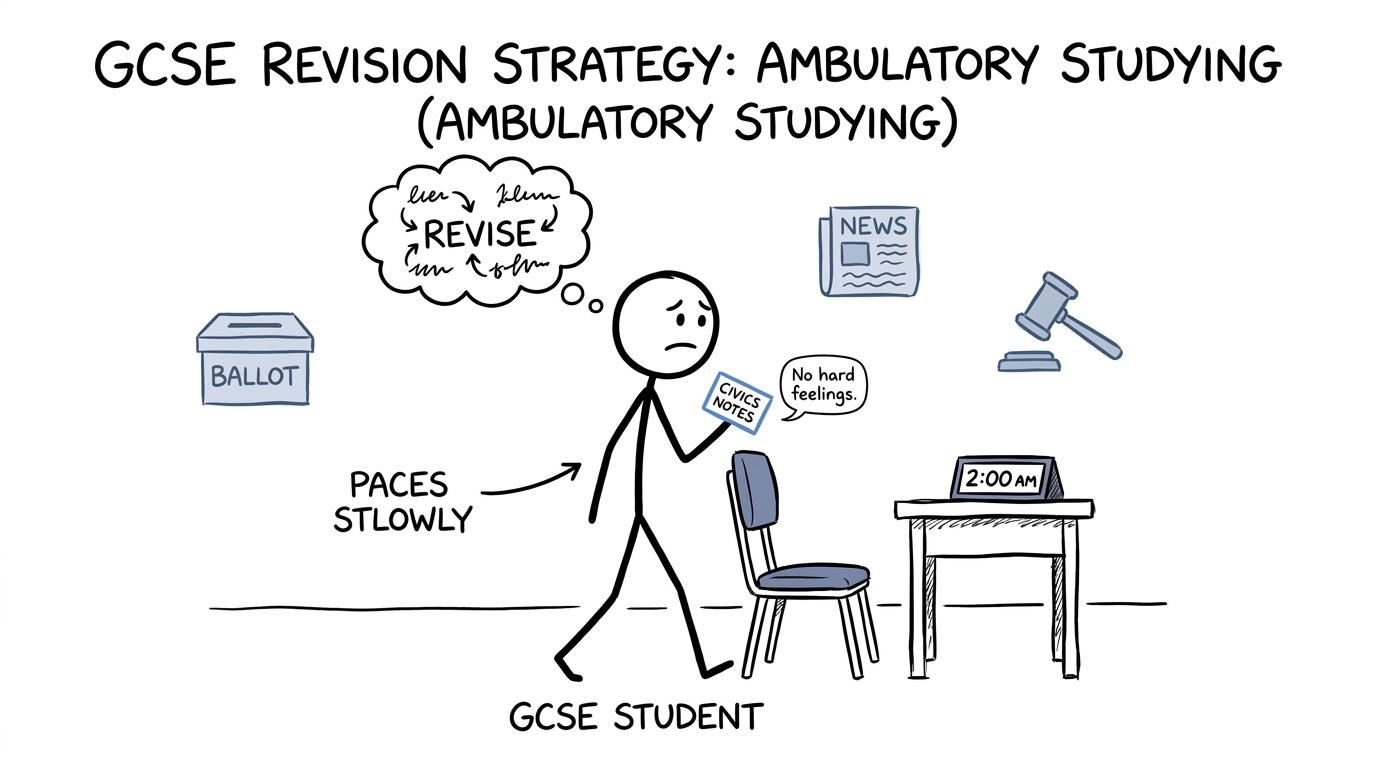 A restless student revising while walking as an abandoned chair watches without resentment
Know what Citizenship Studies actually tests
Revision becomes easier when the target is precise. Across GCSE Citizenship Studies specifications, the assessment objectives cover three broad demands:
- AO1: knowledge and understanding of citizenship concepts, terms and issues.
- AO2: applying that knowledge to contexts and citizenship actions.
- AO3: analysing and evaluating evidence, viewpoints, debates and actions to form reasoned arguments and supported judgements.
Ofqual sets these objectives across the qualification. The current weighting is approximately 30% for AO1, 30% for AO2 and 40% for AO3. That means memorising definitions matters, but it is not the whole course. A substantial part of your marks depends on using knowledge intelligently.
The Department for Education's subject content includes democracy and government, law and justice, rights and responsibilities, participation, identity and diversity, public finance, and the UK's wider international role. Students must also undertake an in-depth investigation leading to informed citizenship action. Knowledge and understanding gained from taking action are assessed in the written examinations.
AQA, Pearson Edexcel and OCR organise this material differently. Their paper structures also differ, so check your specification and ask your teacher which papers you will sit. Do not use an attractive revision timetable built around the wrong exam board.
Replace long sessions with revision circuits
A revision circuit gives each burst one clear job. It can be completed standing at a desk or by moving between safe stations in a room.
Retrieval station
Choose one small area, such as electoral systems, the role of Parliament or civil and criminal law. Close your notes and say or write everything you remember. Then check the specification or class material and add what was missing in a different colour.
This is more demanding than rereading because it exposes the gap between recognition and recall. A page can look familiar without being available in an examination.
Application station
Take a short source, scenario or citizenship action. Identify which concepts apply and explain the connection aloud. Ask yourself:
- What is the citizenship issue?
- Which institution, right or process is relevant?
- Who holds power here?
- What action could citizens take?
- What evidence would help assess its effect?
You are now practising AO2 rather than simply repeating facts.
Evaluation station
Move to another place and build both sides of a debate. Give one reason supporting a viewpoint, one challenge, relevant evidence and a provisional judgement. Walk back to your notes and check whether the argument uses specific citizenship knowledge.
This circuit can be short. Completion matters more than remaining seated for an impressive-looking block of time.
Use movement without losing academic focus
Physical activity is associated with health and learning benefits for young people, and official UK guidance recommends breaking up long sedentary periods where physically possible. Research into active classroom breaks is more cautious: findings on attention and academic performance are mixed, although movement breaks generally do not appear to damage attention and may help some aspects of concentration or classroom behaviour.
So movement is not a guaranteed memory trick. Treat it as a practical way to manage restlessness and return to the work.
Useful options include:
- pacing while recalling definitions;
- placing question cards around the room;
- standing while annotating a source;
- walking during a voice-note explanation;
- taking a brief movement break between written answers;
- switching location when you switch assessment objective.
Keep the task safe and simple. Revision while cycling on roads, crossing streets or doing anything requiring full attention is not sensible. Movement should support concentration, not compete with it.
Build knowledge with active recall
Citizenship contains many connected terms: representative democracy, parliamentary sovereignty, devolution, pressure groups, judicial independence, human rights and the rule of law, among others. Flashcards can help, but only when they demand retrieval.
Put a precise prompt on the front. On the back, include the definition, one related institution or process, and one distinction that prevents confusion. Sort cards into three piles: secure, uncertain and weak. Revisit the uncertain and weak piles rather than repeatedly celebrating the secure one.
You can also use a spoken recall route. Assign topics to familiar places in your room, then walk between them and retrieve the linked facts. Afterwards, verify every statement against reliable course material. Memory devices help you retrieve content; they do not make inaccurate content correct.
Maths students can use the same principle. The MathsGenie guide to stopping forgotten GCSE content explains how retrieval, spacing and retesting work in maths revision too.
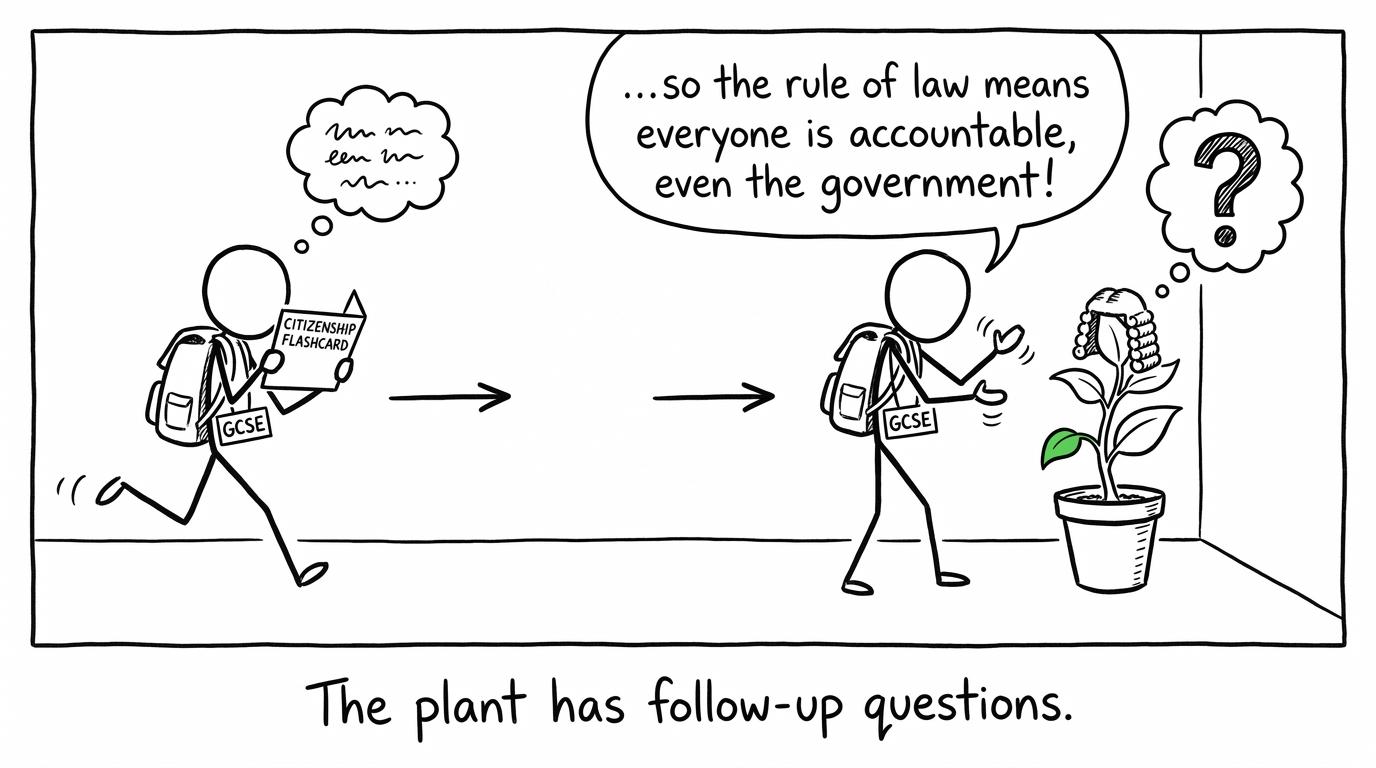 A student explains citizenship to a houseplant which has unexpected follow-up questions
Practise extended answers in layers
You will eventually need to sit and write. Avoiding every written task may feel comfortable now but leave the examination format unfamiliar later. The solution is to build writing stamina gradually.
Begin by planning an answer on separate cards: claim, evidence, alternative viewpoint and judgement. Arrange the cards while standing. Next, write one paragraph. After a short break, add another. Later in your revision, combine the stages into a complete timed response.
For an evaluative question, check that your plan contains:
- accurate knowledge relevant to the question;
- an explained argument rather than an unsupported assertion;
- another viewpoint or limitation where appropriate;
- evidence or examples used for a clear purpose;
- a judgement that answers the exact question.
Do not memorise one universal essay and force it onto every debate. Learn a flexible structure, then select knowledge that fits the wording and source.
Make active citizenship concrete
Your citizenship action is easier to remember as a sequence of decisions than as a large folder of paperwork. Create cards or voice prompts for:
- the issue and why it mattered;
- the aims of the action;
- primary and secondary research;
- alternative actions considered;
- the action taken;
- people or organisations involved;
- evidence of impact;
- limitations and improvements;
- what the process taught you about participation.
Walk through the sequence and explain why each decision was made. Evaluation is particularly important: activity is not automatically impact. A campaign may produce leaflets, meetings or online responses, but you still need evidence showing whether it moved towards its intended aim.
Keep your account truthful and specific to the action you actually undertook. Do not borrow another student's experience or invent evidence because it sounds more impressive.
Create a weekly plan that allows movement
A useful plan alternates short tasks rather than scheduling several hours of vague revision.
On one day, retrieve core knowledge and correct it. On another, apply that material to sources. Later, plan or write an evaluative answer. End the week with a mixed quiz and revisit the weakest area.
Record completed tasks, not merely time spent. “Recalled the functions of Parliament and corrected three omissions” is more useful than “did citizenship for forty minutes”. If planning is difficult, borrow the principles in the MathsGenie one-month GCSE revision plan: diagnose, practise, mark, fix and retest.
The same system can keep maths preparation moving alongside Citizenship Studies. Use the GCSE maths revision hub for board-specific revision, then identify gaps with MathsGenie's weakest-topic method.
Use papers as feedback, not punishment
Past questions show whether your active revision transfers to written examination conditions. Start with one section or question rather than insisting on a complete paper immediately. Mark it carefully, record the reason for each lost mark, and create the next revision task from that evidence.
For example, your error categories might be:
- missing knowledge;
- inaccurate terminology;
- weak application to the source;
- assertion without explanation;
- unbalanced analysis;
- unsupported judgement;
- poor timing.
This feedback loop also matters in maths. MathsGenie's guide to using GCSE past papers explains why marking and correction are where much of the learning happens. The MathsGenie past-paper library provides maths papers with official mark schemes and selected worked or video solutions.
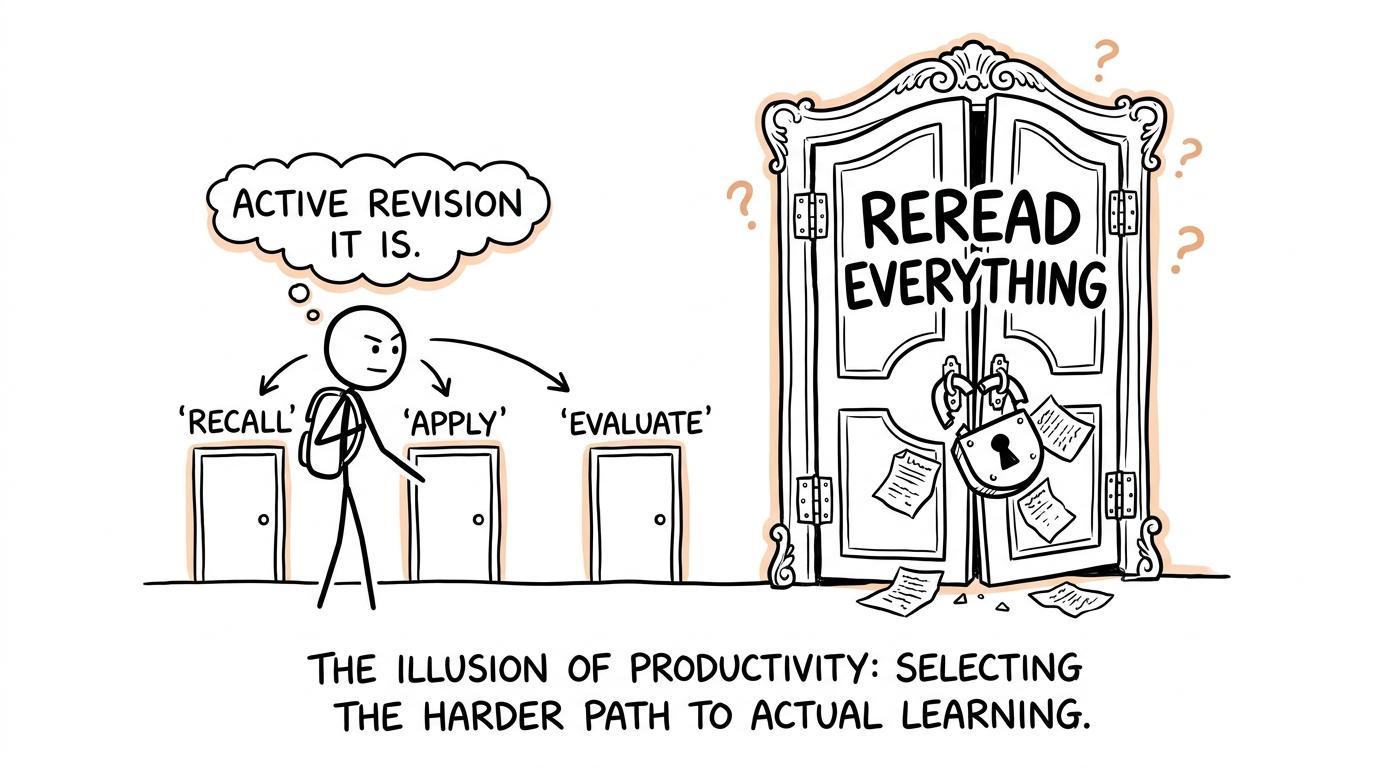 A student chooses small doors marked Recall, Apply and Evaluate while the rereading door is jammed
Common mistakes when you cannot sit still
Turning every break into a long distraction
A movement break should have a clear end. Decide the next task before you move, and keep your phone away unless it is genuinely needed for a timer or recording.
Moving while only rereading
Pacing with a textbook can still be passive. Close the book, retrieve an answer, then reopen it to check.
Revising facts but ignoring AO2 and AO3
Definitions alone cannot prepare you for sources, competing viewpoints or substantiated judgements. Include application and evaluation in every week's revision.
Avoiding timed writing completely
Movement can help you learn, but the examination is written and timed. Increase seated writing in manageable stages so the final paper is not your first sustained attempt.
Using the wrong specification
Topic names and paper structures vary between AQA, Edexcel and OCR. Match your resources to your board and current specification.
Measuring revision by discomfort
A painful hour is not automatically productive. Judge a session by what you can retrieve, apply and improve afterwards.
Revise in a way you can repeat
Good revision is not a performance of stillness. It is a repeatable process that changes what you can do: recall a precise term, apply it to an unfamiliar context, weigh competing evidence and reach a supported judgement.
Start today with one small Citizenship Studies topic. Retrieve it while standing or walking, check the gaps, apply it to a source and finish with a short written response. Then schedule a later retest.
When you switch back to maths, let MathsGenie provide the structure. Use free revision lessons and practice questions to repair weak topics, mini tests to check recall, and past papers, predicted papers, mark schemes and video solutions to prepare for exam conditions. If the examination is close, the GCSE night-before revision plan can help you make calm, limited decisions rather than attempting one exhausting final session.