

Revise GCSE Biblical Hebrew Alone or With Others?
Revise GCSE Biblical Hebrew alone or with others using this practical guide to solo study, group sessions, topic choices and a balanced revision plan.

Revision can look productive without producing much learning. A desk may be covered in vocabulary cards, annotated passages and grammar notes, yet the difficult question remains: could you recall any of it with the book closed?
If you are deciding whether to revise GCSE Biblical Hebrew alone or with others, the short answer is to use both. Solo revision is usually better for vocabulary recall, grammar drills, unseen translation and timed practice. Revising with others is valuable when you need to explain grammatical decisions, test one another and compare interpretations of prescribed literature.
The best method depends less on whether company feels motivating and more on the task in front of you.
The quick decision checklist
Choose solo revision when you need to:
- memorise vocabulary accurately
- recognise grammatical forms without prompts
- translate independently
- complete questions under timed conditions
- identify your own weak areas
- concentrate without interruption
Choose revision with others when you need to:
- retrieve vocabulary through rapid questioning
- explain why a translation or grammatical analysis works
- hear alternative interpretations of a literary passage
- practise giving precise answers aloud
- receive feedback on something you have misunderstood
- maintain focus through a structured appointment
For most students, the strongest routine is a cycle: prepare alone, test your understanding with somebody else, then return to independent practice.
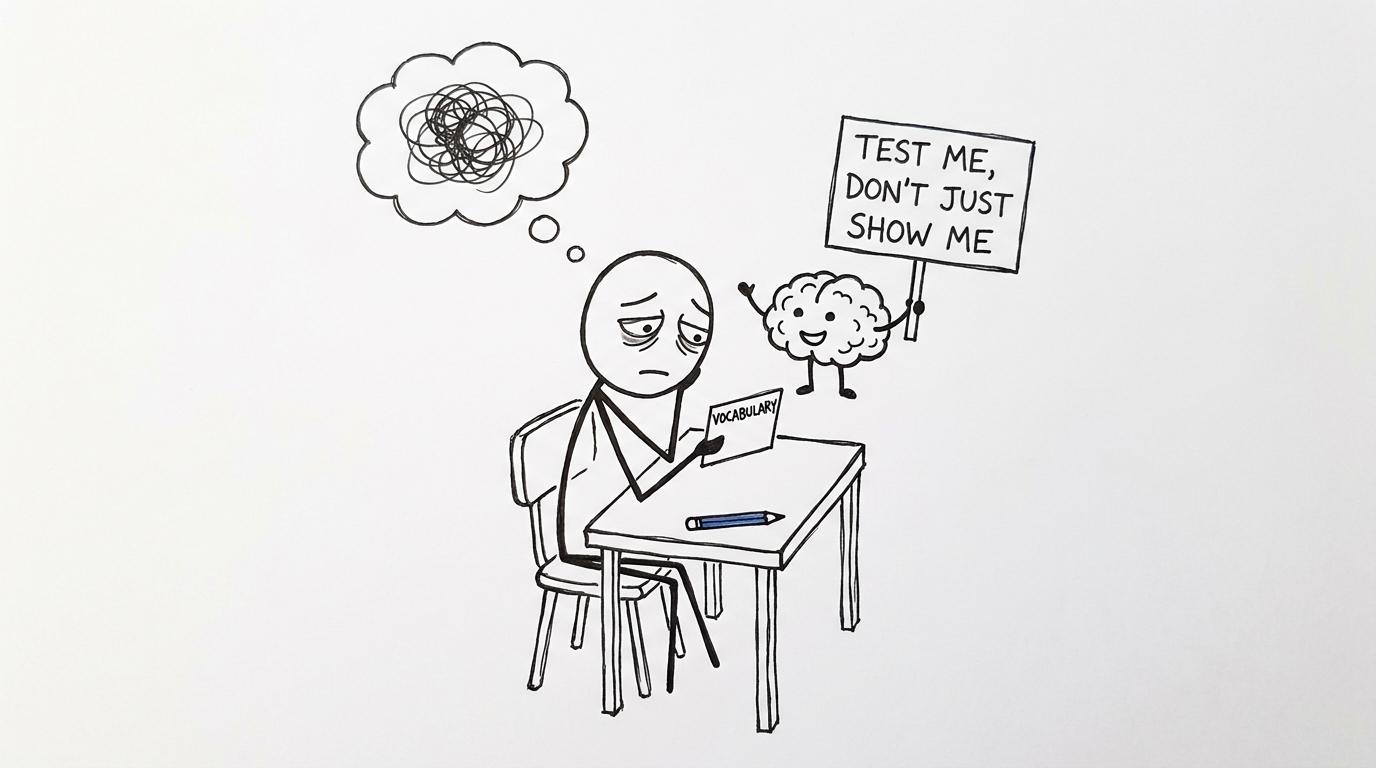 A student discovers that effective solo revision means testing memory rather than staring at vocabulary
Start with what GCSE Biblical Hebrew assesses
A sound revision method begins with the current specification, not with a generic idea of what language revision should involve. GCSE Biblical Hebrew combines language knowledge with the close study of prescribed literary material. Students may need to recognise vocabulary and grammatical forms, understand passages, translate accurately and respond to questions about set texts.
The exact assessment structure, prescribed passages and permitted materials can change between specifications. Confirm the current requirements with your teacher and the official specification for your qualification before building a timetable. Do not assume that an old revision guide or past paper reflects every detail of the paper you will sit.
This distinction matters because language and literature create different revision problems. Vocabulary requires repeated retrieval. Translation requires silent, independent judgement. Literary interpretation benefits from discussion, but your final response must still be your own.
When revising GCSE Biblical Hebrew alone works best
Solo revision gives you something a group cannot: an honest picture of what you can do without help.
Vocabulary and grammatical recall
Vocabulary can feel familiar when you look at a list. That is recognition, not necessarily recall. Close the list and retrieve each meaning before checking it. Reverse the direction occasionally so that you are not relying on the visual pattern of one particular card.
The same principle applies to grammatical forms. Seeing the answer too early removes the mental effort that makes practice useful. Research on retrieval practice across classroom settings generally finds that recalling information is more effective than repeatedly rereading it, particularly when answers are checked and feedback follows.
A useful solo session therefore includes:
- closed-book recall
- immediate checking
- a record of uncertain or incorrect answers
- another attempt after a delay
Unseen translation
Translation is an individual performance in the examination, so some preparation must be individual too. Working alone lets you notice whether you can analyse a form, follow syntax and select an appropriate English rendering without another student supplying the first clue.
It also develops patience. A group often moves at the speed of its quickest voice. Alone, you can remain with a difficult phrase long enough to identify precisely where your understanding breaks down.
Timed examination practice
Complete past-paper questions independently before discussing them. Use the conditions and materials specified for your qualification, then check your response against the mark scheme or teacher guidance.
Timed work is not merely a test at the end of revision. It is a diagnosis. It reveals whether the problem is knowledge, interpretation, accuracy or time management. Maths students can use the same process through MathsGenie's guide to finding weak GCSE topics from real evidence.
When revising with others adds more value
A good revision partner makes your thinking visible. A poor one makes the session comfortable.
Explaining grammar aloud
If you can identify a form but cannot explain the evidence behind your decision, your understanding may be fragile. Explaining your reasoning to another student forces you to organise it. Your partner can ask what feature you noticed, why another analysis is less suitable and how the surrounding passage affects your decision.
This should not become a contest to sound confident. The purpose is to expose uncertainty early enough to correct it.
Testing vocabulary
Partners can make retrieval less predictable. They can vary the order, revisit previous errors and ask for a response without allowing you to depend on the layout of your own cards.
However, both students should answer independently before discussing. Research into collaborative retrieval suggests that working together can reduce mind-wandering and may support later memory, but collaboration can also inhibit individual recall during the activity. The practical lesson is simple: group testing should supplement, not replace, closed-book solo recall.
Discussing prescribed literature
Literature is often where collaboration becomes most useful. Different students may notice different details in a passage or place emphasis on different aspects of its language and context. Comparing interpretations can deepen understanding, provided every claim is checked against the text and your teacher's guidance.
Discussion should finish with an individual written summary. Otherwise, the group may leave with a strong shared conversation but weak personal recall.
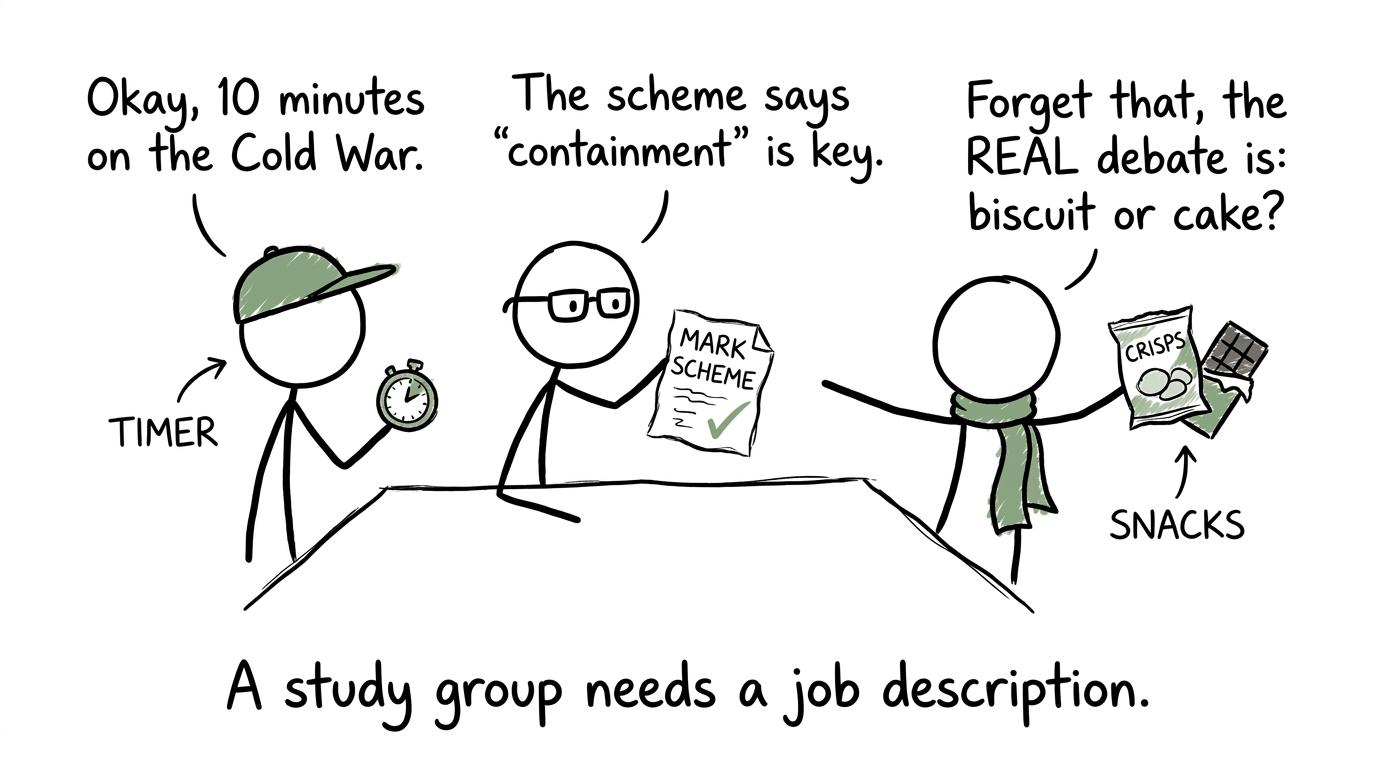 A revision group learns that timers and mark schemes are more useful than a long snack debate
Which method suits each Biblical Hebrew topic?
| Revision task | Best starting method | Why |
|---|---|---|
| Vocabulary recall | Alone | Reveals what you can retrieve without clues |
| Rapid vocabulary testing | With one partner | Adds variety and immediate questioning |
| Grammar recognition | Alone, then together | Independent analysis comes first; discussion checks reasoning |
| Unseen comprehension | Alone | Recreates the need to understand a passage independently |
| Translation | Alone, followed by comparison | Protects independent judgement while allowing useful feedback |
| Prescribed literature | Together, then alone | Discussion broadens interpretation; solo writing secures recall |
| Timed paper practice | Alone | Gives a realistic measure of examination readiness |
| Reviewing mistakes | Alone or with a teacher or partner | The right choice depends on whether the error is identifiable |
The phrase “best starting method” is important. Most topics benefit from a second stage. Translation may begin alone and end with comparison. Literature may begin with discussion and end with closed-book recall. Revision is rarely a permanent choice between isolation and collaboration.
Build a hybrid revision cycle
A simple three-part cycle keeps each format accountable.
Before the group session
Work alone on one clearly defined area. Retrieve vocabulary, analyse a passage or attempt a question without notes. Record the exact places where you became uncertain.
Arriving with identified questions is far more useful than arriving with the broad intention to “do Hebrew”. The same discipline improves maths revision: efficient GCSE maths revision starts by choosing a specific skill, practising it and reviewing the evidence.
During the group session
Give the session a structure:
- state the topic and intended outcome
- begin with individual retrieval
- compare answers only after everybody has committed
- use the text, specification or approved guidance to settle disagreements
- record unresolved questions for your teacher
- finish with a short individual check
A group of two or three is often easier to manage than a large gathering. What matters is not the number of people but whether everyone has to think.
After the group session
Return to the material alone within the next few days. Attempt a fresh question or reproduce the key ideas from memory. If you can only remember what your friend said when they are sitting beside you, the knowledge is not yet secure.
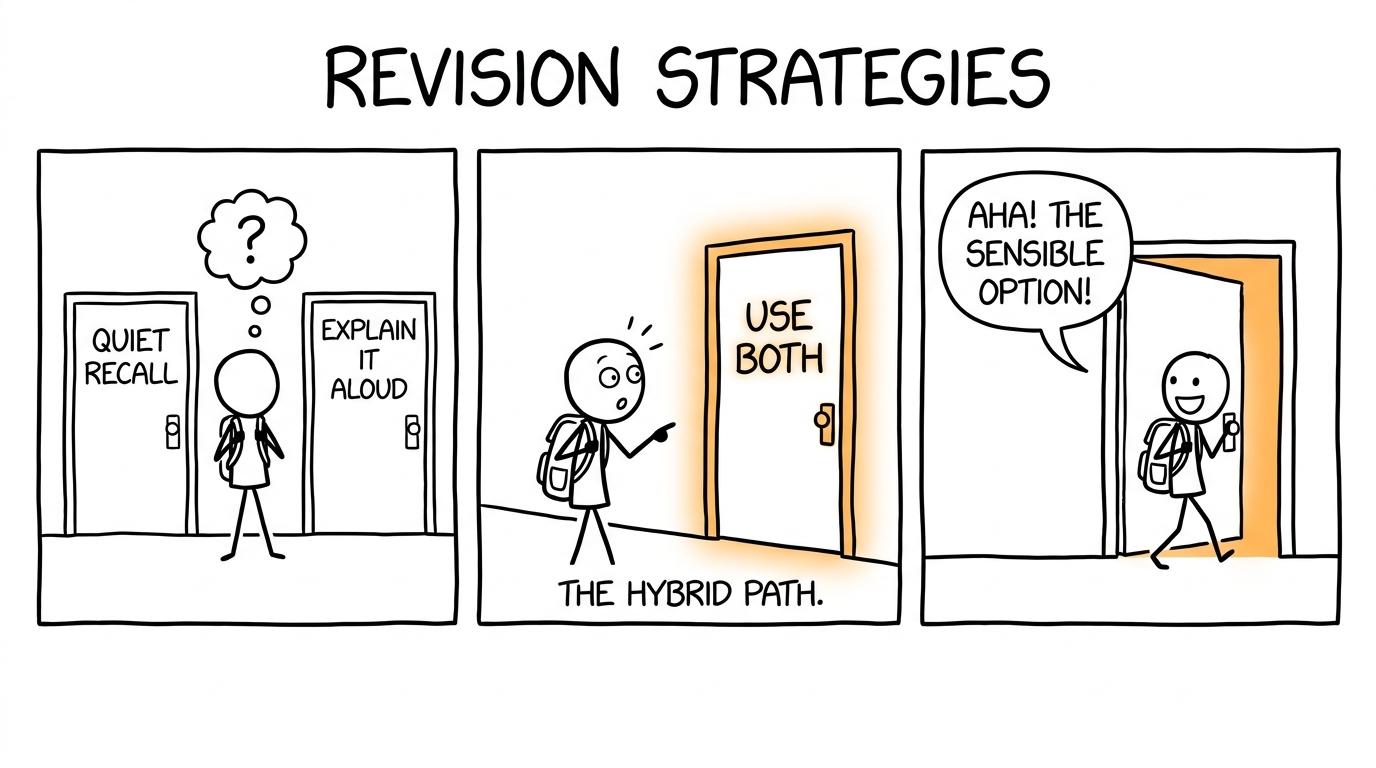 A student wisely chooses the revision door marked Use Both
Keep GCSE maths moving alongside Hebrew
Students rarely revise one subject in isolation. A long Biblical Hebrew session can quietly consume the time intended for maths, especially when a group meeting has no clear finishing point.
Protect maths with a small, repeatable commitment. Open the GCSE Maths revision hub, choose your exam board and complete one defined task. That might be a topic lesson, a mini test or part of a paper appropriate to foundation or higher tier.
Use the same solo-and-group distinction:
- learn and attempt maths questions independently
- compare methods only after committing to an answer
- mark with the official mark scheme rather than agreeing by consensus
- use video solutions when you need to see a method explained
- record the reason for every lost mark
As examinations approach, start GCSE past-paper practice at an appropriate stage rather than saving every paper for the final week. If time is already short, MathsGenie's one-week GCSE maths revision plan can help you prioritise.
Common mistakes when revising alone or with others
Mistaking rereading for recall
Highlighted notes can create familiarity without producing usable memory. Shut the book, retrieve the information and then check it.
Letting the strongest student answer first
Once somebody gives an answer, everyone else can mistake recognition for understanding. Write or say individual answers before comparison.
Turning every disagreement into a vote
A translation or interpretation is not correct because most of the group prefers it. Return to the language, the prescribed text and authoritative teacher or examination guidance.
Avoiding independent timed work
Group discussion cannot tell you how you will perform alone under examination conditions. Timed practice must remain part of the plan.
Using outdated material without checking it
Past papers are valuable, but specifications and prescribed texts must match your course. Confirm relevance before spending hours on a resource.
Allowing one subject to crowd out maths
Revision feels urgent in whichever subject is currently open. Use a written plan so that maths remains visible. The GCSE night-before maths plan is also useful when you need calm priorities rather than an unrealistic final sprint.
Choose the method that makes thinking unavoidable
The real choice is not between being alone and being sociable. It is between revision that requires thought and revision that lets you hide from it.
Revise vocabulary, grammar and unseen translation independently. Use a partner to question your reasoning and broaden discussion of prescribed literature. Then test yourself alone again. That sequence preserves the strengths of both approaches.
MathsGenie does not provide GCSE Biblical Hebrew teaching materials, so use the current specification, resources supplied by your school and guidance from your teacher for subject content. For your maths preparation, make MathsGenie your free revision base: use GCSE revision lessons and practice resources, then move through mini tests, past papers, predicted papers, mark schemes and video solutions.
Choose one Biblical Hebrew task and one maths task today. Keep each specific, mark what you complete and let the evidence decide what comes next.










