

Review Mock Mistakes: GCSE Combined Science Timing
Review mock mistakes GCSE Combined Science: learn why a quick first review and spaced retest beat waiting, then apply the same method to GCSE maths.
A marked mock can feel heavier than the paper it is printed on. You see the grade first, remember the questions that went wrong and feel tempted to place the whole thing out of sight for a few days.
If you are wondering whether to review mock mistakes GCSE Combined Science straight away or wait, the best practical answer is: make a short first review as soon as you receive useful feedback, then return to the mistakes after a gap. Immediate review helps you connect each correction with what you were thinking. The later attempt tests whether the correction has actually become retrievable knowledge.
This principle transfers directly to GCSE maths. A mock is most valuable not as a prediction of your final grade, but as evidence about where marks are leaking and what to practise next.
The short answer: review now, retest later
Use this simple sequence:
- Take a short pause if emotions are high. Calm review is more useful than rushed self-criticism.
- Inspect the paper on the same day you receive it, where practical.
- Classify every important lost mark by cause, not merely by question number.
- Correct the underlying idea or method using your teacher's feedback, the mark scheme and an appropriate revision lesson.
- Attempt a similar question without notes after roughly 242424 two 484848 hours.
- Revisit the topic again later through mixed questions, a mini test or another paper.
This is not a choice between immediate and delayed revision. The stronger system uses both for different purposes: immediate review for diagnosis and delayed practice for retrieval.
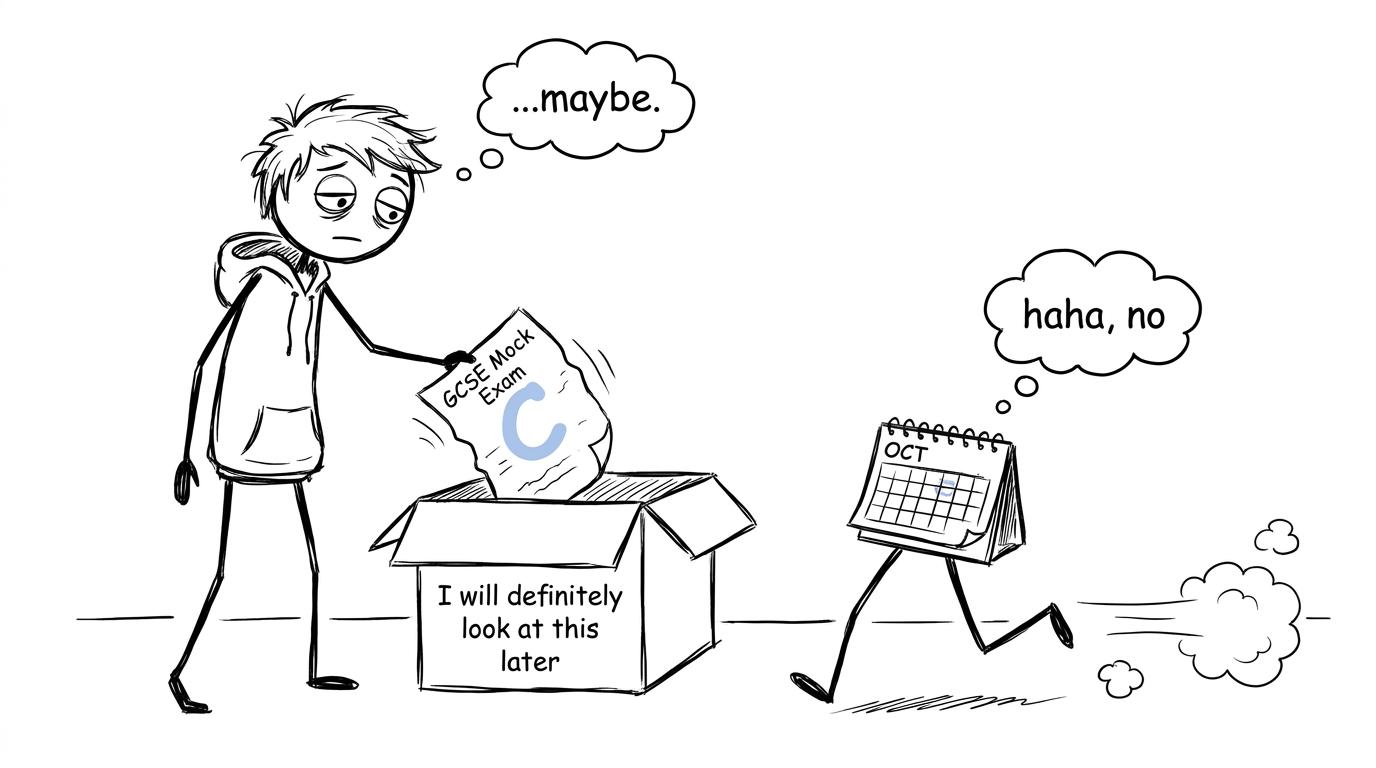 A GCSE student watches the calendar run away with their delayed mock review
Why an immediate first review is useful
The first advantage is context. Soon after a mock, you may still remember whether you misunderstood the wording, changed a correct answer, ran out of time or simply could not recall the content. Several days later, the written response remains, but some of the reasoning behind it may have faded.
That distinction matters. Two blank answers can look identical while having entirely different causes. One may signal missing knowledge. The other may come from poor time management. Revising the whole topic would address the first problem, but not necessarily the second.
Timely feedback also makes comparison easier. You can place your response beside the accepted answer or method and ask:
- What did I understand correctly?
- At which step did my reasoning change direction?
- Was the missing mark about knowledge, application, units, accuracy or exam technique?
- What should I do differently when I see this type of question again?
Research into feedback timing does not support one universal rule for every subject and task. Studies have produced mixed findings: immediate feedback is sometimes more effective, delayed feedback can also support retention, and some comparisons find little meaningful difference. The dependable conclusion is more modest: feedback needs to be used, and a correction should eventually be retrieved again rather than merely read.
What waiting a few days can cost
Waiting is not automatically harmful. A short pause can be sensible if you are upset, exhausted or still waiting for a teacher's explanation. The cost appears when a deliberate pause turns into avoidance.
You lose access to your original thinking
A mark scheme shows what earned marks. It cannot always show why you selected a particular formula, misread a graph or abandoned a question. Reviewing while that thought process is still reasonably accessible gives you better diagnostic evidence.
Incorrect reasoning can remain unchallenged
A wrong answer does not become permanently embedded simply because you wait. However, until it is checked, you have no reliable correction to practise. If the same misconception appears in homework or another revision session, it can continue directing your choices.
Your revision plan stays vague
Without reviewing the mock, “revise science” or “revise maths” remains an enormous task. Once mistakes are classified, the task becomes smaller: revise equations, practise graph interpretation, improve unit conversions or work on multi-step algebra.
Maths students can use the GCSE Maths revision hub to move from a broad concern to a specific lesson and set of exam questions. If the paper reveals several weaknesses, the guide to finding your weakest GCSE topics explains how to prioritise lost marks rather than comfortable topics.
You reduce the time available for retesting
Correction is only the beginning. If you postpone the first review until the next paper is approaching, there may be no time to practise the weakness, leave a gap and test it again. What delay really costs is not a guaranteed number of marks. It costs revision opportunities.
Why you should not stop after reviewing immediately
Immediate correction can create an illusion of mastery. With the mark scheme open, the right response often looks obvious. Recognition is easier than generating a method independently under exam conditions.
A delayed attempt changes the question from “Does this explanation make sense?” to “Can I produce the idea when the support has disappeared?” That is retrieval practice.
A useful rhythm is:
- First contact: diagnose and correct.
- Short delay: attempt the skill without notes.
- Later revisit: meet it among mixed topics and under some time pressure.
Spacing the attempts also prevents one corrected question from becoming a script you have memorised. In GCSE maths, use a different question requiring the same underlying method. The MathsGenie guide to stopping forgotten maths content develops this combination of retrieval, spacing and exam-style practice.
Build a mock mistake review that leads to action
A mock review should produce decisions, not pages of copied answers.
Separate the mark from the cause
For each significant mistake, use one of these categories:
- Knowledge gap: a fact, definition, formula or mathematical rule was missing.
- Understanding gap: the content was familiar, but the question required an unfamiliar connection.
- Method error: you knew the topic but selected or executed the wrong process.
- Accuracy error: arithmetic, signs, copying, rounding or units caused the loss.
- Question-reading error: a command word, condition or required form was missed.
- Timing issue: you rushed, spent too long elsewhere or did not reach the question.
These categories work for Combined Science and maths, although the exact corrections differ. A science response may need more precise terminology or interpretation of experimental evidence. A maths response may need complete working, an exact value or a justified conclusion.
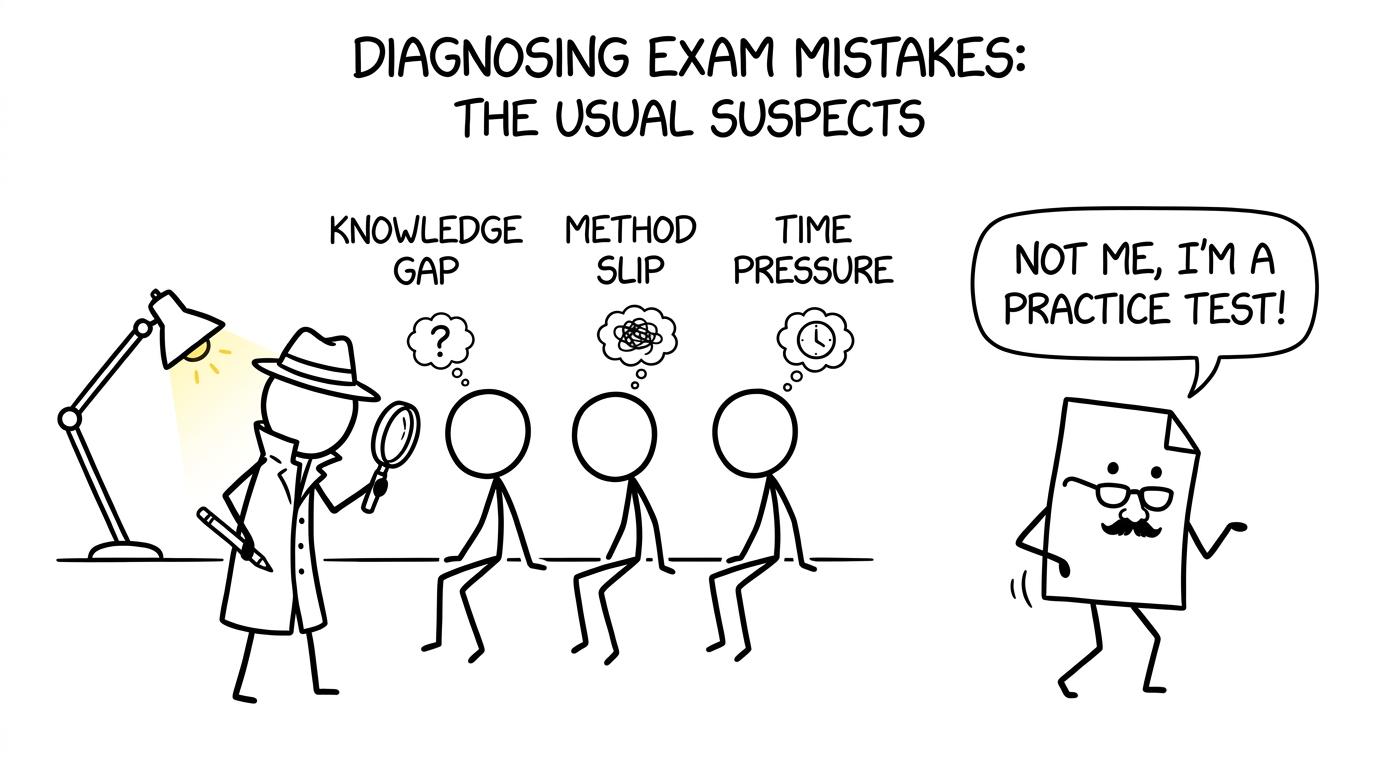 A student detective identifies the suspects behind lost mock marks
Write one specific correction
Avoid notes such as “be more careful”. They describe a feeling, not an action. A useful correction is precise enough to influence your next response: check units before substitution, underline the required form, show each algebraic transformation or move on when a question has stalled.
If you are reviewing maths, use the relevant mark scheme to see whether marks were available for method as well as the final answer. The MathsGenie past-paper library places papers and official mark schemes together, while Edexcel GCSE Maths past papers provide board-specific practice and worked support where available.
Choose the smallest effective repair
Do not automatically repeat an entire paper. Match the repair to the diagnosis:
- relearn a missing concept through a revision lesson;
- answer a small set of targeted practice questions;
- compare your method with a video solution;
- complete a mini test if several related skills are weak;
- practise a timed section if the main issue was pace;
- use a fresh past or predicted paper when you need mixed exam practice.
The aim is to make the next action narrow enough to begin. MathsGenie's short GCSE maths revision routine is useful when a full-paper review feels too large.
A practical schedule after receiving your mock
On the day you get feedback
Spend a focused session identifying the most important mistakes. Check teacher comments and the mark scheme, classify the causes and choose no more than a few priority areas. If you are frustrated, take a genuine break first, but decide exactly when you will return.
After 242424 to 484848 hours
Attempt fresh questions on the same skills without looking at your corrections. Mark them promptly. If the same problem returns, the gap is not yet closed; go back to the explanation and practise again.
About a week later
Mix those skills with other topics. This matters because the real exam will not announce which method to use. A mini test, timed section or selected past-paper questions can reveal whether you can recognise the method independently.
In the next full paper
Check whether the mistake pattern has changed. One correct reattempt is encouraging, but performance across a later paper is stronger evidence. The guide to using GCSE past papers properly shows how to connect papers, error logs, targeted practice and retesting.
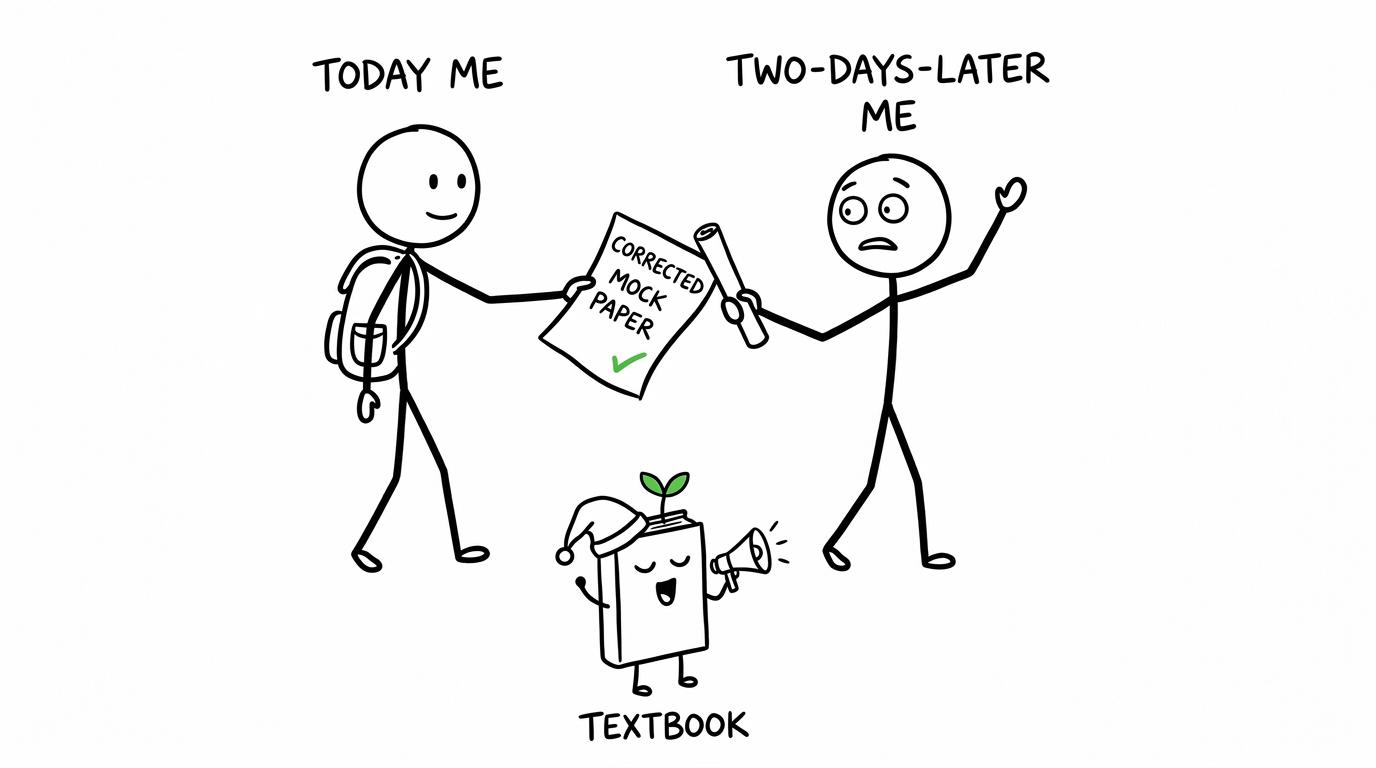 Today’s student passes a corrected mock to their future revision self
Common mistakes when reviewing a mock
Looking only at the total grade
A grade summarises performance across the paper. It does not tell you which change is most likely to recover marks. Review the location and cause of lost marks instead.
Copying the mark scheme word for word
Copying can feel productive because it creates a correct page. It does not prove that you understand or can retrieve the response. Read the scheme, close it, explain the correction in your own words and later answer a fresh question.
Correcting every question with equal intensity
Some losses are isolated slips; others reveal repeated weaknesses. Prioritise misconceptions, recurring errors and accessible marks before spending an entire evening on one unusually difficult question.
Retaking the same question too soon
An immediate reattempt checks whether you followed the correction. It may also rely on short-term memory. Keep that quick check, but add a fresh question after a delay.
Waiting for motivation
“Later” has no place in a timetable. Give the review a date and a manageable duration. A realistic GCSE maths revision timetable can reserve space for correction and retesting rather than treating them as optional extras.
Turn the mock into your next revision plan
The best time to begin reviewing is soon enough that the paper still contains clues about your thinking. The best time to finish reviewing is later, after you have retrieved the corrected knowledge, used it on unfamiliar questions and tested it under pressure.
So do not choose between “immediately” and “in a few days”. Use both moments well. Diagnose now. Retest later. Revisit again.
For GCSE maths, begin at the MathsGenie GCSE revision hub. Use revision lessons and practice questions to repair specific gaps, mini tests to check them, then past papers and predicted papers to test whether the improvement survives exam conditions. Mark schemes and video solutions help you understand where marks come from, but your next independent attempt is what turns that feedback into progress.











