Review Mock Mistakes GCSE Arabic: Now or Later?
Review mock mistakes GCSE Arabic with a two-stage routine: check errors promptly, then re-test after a short delay to improve recall and exam performance.
Finishing a mock creates a peculiar kind of relief. The paper is closed, the pressure has passed, and looking at it again is probably the last thing you want to do. If you searched review mock mistakes GCSE Arabic, the useful answer is simple: review the paper briefly as soon as reliable feedback is available, then return to the mistakes after a short delay without looking at the answers.
Do not choose between immediate correction and delayed revision. Use both. The first review catches what went wrong while your reasoning is still fresh; the later attempt tests whether the correction has actually entered your memory.
This approach works for GCSE Arabic listening, speaking, reading and writing, and it transfers directly to GCSE maths. In both subjects, the mock is not merely a score. It is evidence about what to practise next.
The short answer: review now, re-test later
A strong mock-review cycle has two stages:
- As soon as practical: mark or discuss the paper, identify why each mark was lost, and record a specific correction.
- After two or three days: attempt the difficult material again without copying the previous answer.
- About a week later: use a fresh question, mini test or retrieval task to check whether the skill is secure.
- Before the next mock: revisit recurring errors rather than rereading the whole paper.
Research on feedback timing does not produce one universal rule for every task. Studies have found benefits from both immediate and delayed feedback, while a systematic review of second-language corrective feedback found that immediate feedback was generally more effective or at least equally effective. The Education Endowment Foundation also stresses that feedback can work at different times, provided it is specific, actionable and followed by an opportunity to use it.
That last condition matters most. Feedback that is read but never acted upon is information, not revision.
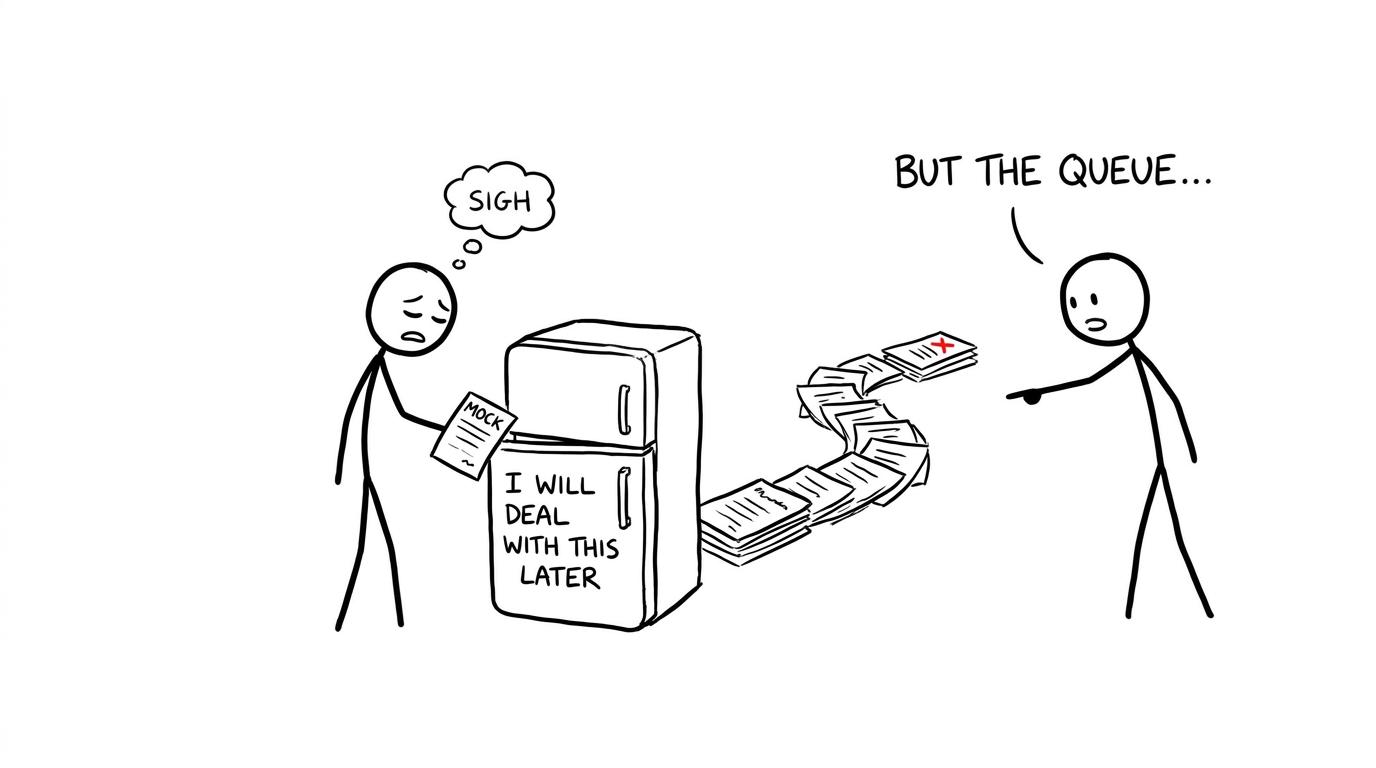 A student stores a mock paper in a tiny later fridge while more papers queue outside
Why an immediate review helps
You can still remember what you were thinking
A wrong answer rarely tells the whole story. You may have misunderstood a word, rushed a calculation, selected the wrong method or known the answer but expressed it unclearly. Shortly after the mock, you can often reconstruct that decision.
Wait several days before doing anything and some of this context disappears. You can still correct the final answer, but it becomes harder to diagnose the thought process that produced it.
In Arabic, that distinction might separate an unknown word from a failure to recognise a familiar word in speech. In maths, it could separate a genuine knowledge gap from a sign error or an incorrectly entered calculator expression. Those problems require different repairs.
Prompt feedback can stop errors becoming familiar
Retrieval practice is valuable because it requires you to recall information rather than simply recognise it. However, incorrect retrieval needs correction. Repeatedly recalling the wrong vocabulary, grammatical form, formula or method can make the error feel increasingly plausible.
A prompt review lets you place the correct information beside the error before you practise again. For maths, start with the GCSE maths revision hub, where you can select your exam board and move from a weak topic to revision lessons and practice questions.
It improves your next revision decision
A mock should change your timetable. If it does not, it has become an expensive way to obtain a grade you already knew was possible.
Reviewing promptly shows whether tomorrow's session should focus on vocabulary retrieval, listening detail, algebraic manipulation, calculator accuracy or time management. Maths students who are unsure where to begin can use the weak-topic diagnostic routine to turn lost marks into specific priorities.
Why you should still wait before trying again
Immediate correction can create an illusion of mastery. The answer is visible, the explanation makes sense, and recognition feels like learning. Yet being able to follow a correction is not the same as producing it independently.
A short delay changes the task. When the answer is no longer sitting in working memory, you must retrieve the vocabulary, rule or method again. That effort provides better evidence of what you can do unaided.
This is why the best routine is prompt feedback followed by spaced re-attempts. The pause belongs between correction and re-testing, not between receiving the mock and acknowledging it.
For GCSE maths, shorter assessments make this easy. After repairing a topic, use an Edexcel GCSE Maths mini test or comparable board-specific practice from the main hub. A different question is usually a better test than memorising the layout of the original one.
What delaying the whole review actually costs
Waiting is not automatically harmful. A short break after a demanding mock can help you approach the paper calmly, especially if reviewing it immediately would become rushed or emotional. The problem is an unplanned delay with no review date.
You lose diagnostic detail
After several days, you may remember that a question was difficult but forget why. That weakens the quality of your error log. “Bad at writing” or “bad at algebra” is too broad to guide revision; “used the wrong tense” or “did not rearrange before substituting” creates a next action.
Weaknesses remain in your revision plan
Every day before diagnosis is another day in which you may revise comfortable material instead of the skill costing you marks. The cost cannot honestly be reduced to a fixed number of marks. It depends on the mistake, the remaining revision time and whether the same skill appears again. But the lost opportunity is real.
Avoidance becomes easier
A paper left untouched for one evening can easily remain untouched for a week. By then, reviewing it feels like a new task rather than the final stage of the mock. A brief same-day action, even just labelling the errors and scheduling the full review, prevents that drift.
MathsGenie's 20-minute GCSE revision routine is useful when time is limited: choose one micro-topic, retrieve the method, answer questions, mark them and log the next step.
A practical two-stage review routine
Stage one: diagnose while the mock is fresh
Use the official or teacher-provided mark scheme when it becomes available. For each lost mark, label the cause:
- Knowledge: vocabulary, fact, formula or rule was missing.
- Recognition: you knew it but did not identify it in context.
- Method: you selected or carried out the wrong process.
- Communication: the idea was present but not expressed sufficiently clearly.
- Accuracy: a transcription, spelling, arithmetic or calculator slip occurred.
- Exam technique: you misread an instruction, overlooked a command word or managed time poorly.
Then write one action. “Revise more” is not an action. “Practise identifying negatives in short listening clips” or “complete a mini test on rearranging formulae” is.
Pearson Edexcel GCSE Arabic assesses listening, speaking, reading and writing, with each skill contributing a quarter of the qualification. Therefore, classify mistakes by skill as well as by topic. Check your own current specification and teacher guidance before assuming that another qualification has the same structure.
Maths students should similarly use the right board and tier. The GCSE maths topics by exam board and tier guide helps distinguish Edexcel, AQA, OCR and Eduqas routes.
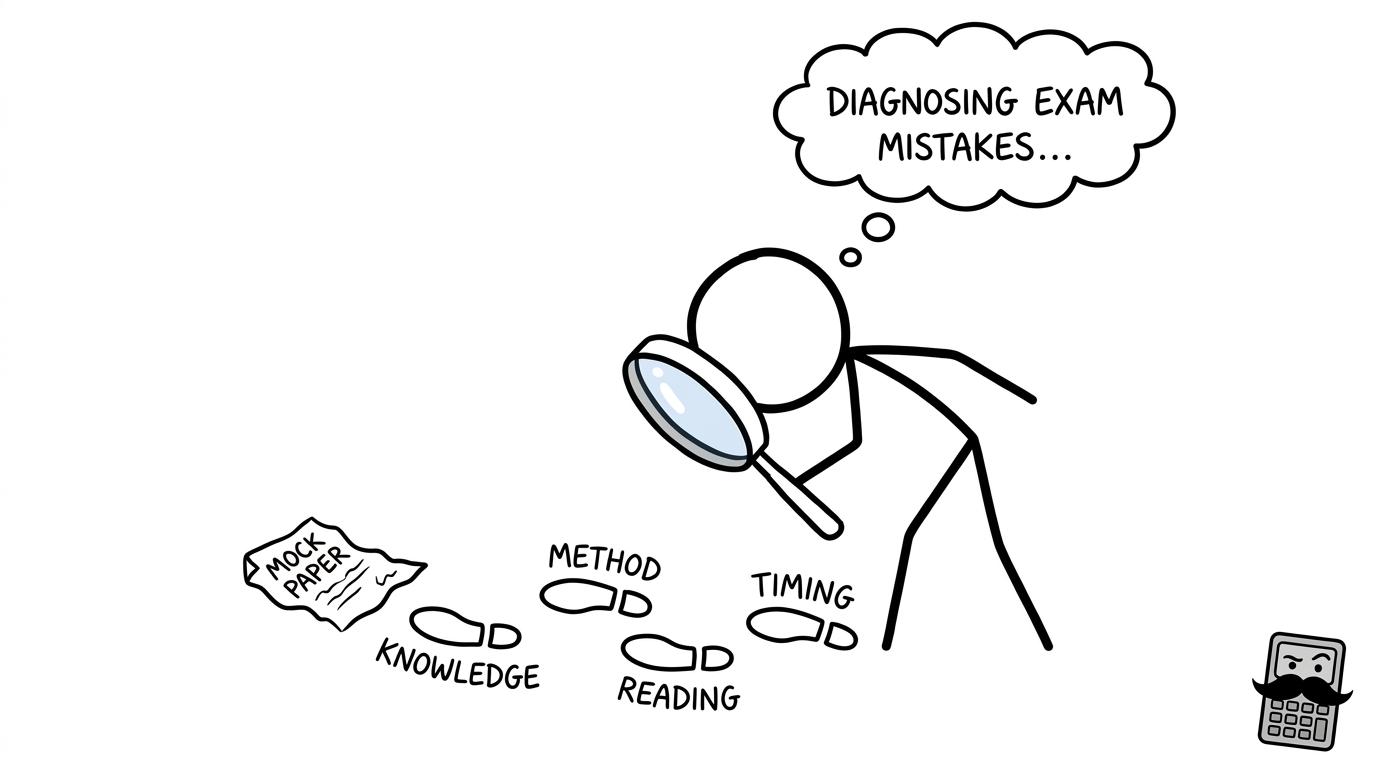 A student detective follows knowledge, method, reading and timing clues while a calculator looks suspicious
Stage two: retrieve after a short gap
Close the mark scheme and put the corrected answer away. After two or three days:
- explain the correction from memory;
- re-attempt the relevant part without notes;
- use a fresh question where possible;
- mark it strictly;
- schedule another revisit if the error returns.
For paper-based maths practice, the Edexcel GCSE Maths past papers place papers and marking support together. If exams are approaching, GCSE predicted papers can provide unseen mixed practice after individual weaknesses have been repaired.
How Arabic and maths mistakes differ
The review principle transfers, but the repair task should match the subject.
A GCSE Arabic error may involve sound discrimination, vocabulary, grammar, register, comprehension or the ability to express and justify an opinion. A correction might therefore involve listening again, retrieving vocabulary, recording a spoken response or rewriting a sentence accurately.
A GCSE maths error may involve conceptual knowledge, method selection, algebraic working, numerical accuracy, units or interpretation. The repair usually requires new questions of the same type, not merely copying a model solution.
This is why generic error logs often fail. They record the result without prescribing the right kind of practice. MathsGenie's guide to how GCSE maths papers are marked can help you distinguish a missing method from a final-answer slip.
Common mistakes when reviewing mocks
Looking only at the total mark
A score measures the paper as a whole. It does not tell you which small changes could improve the next performance. Record the marks lost and their causes.
Copying corrections without retrieval
A neat corrected answer can disguise weak memory. Close the solution and reproduce the idea later without support.
Waiting for the perfect revision session
You do not need an uninterrupted afternoon. A ten-minute diagnostic review today is more useful than a detailed review that remains unscheduled.
Correcting everything in one sitting
Not every error deserves equal time. Prioritise repeated mistakes, foundational gaps and habits that affect several questions. A structured one-month GCSE maths revision plan can help spread repairs across manageable sessions.
Repeating the original question too soon
An immediate redo checks whether you can imitate the correction. A delayed, fresh question checks whether you have learnt the skill. Use both checks, but do not confuse them.
Turn the mock into the next step
A mock result can feel final because it arrives as a grade. It is not final. Its real value lies in the decisions it changes.
Review the mistakes promptly enough to remember your reasoning. Record precise causes rather than broad weaknesses. Then wait briefly and retrieve the corrected knowledge without help. That combination preserves the diagnostic value of immediate feedback while gaining the memory benefits of spaced practice.
For GCSE maths, make MathsGenie your free revision base: begin with revision lessons, repair gaps through practice questions and mini tests, then test the result using past papers and predicted papers. Mark with the available mark schemes and video solutions, add each weak skill to your revision plan, and return to it until the correction survives without support.
Do not leave the mock in a folder as a record of the past. Use it as a map for what happens next.