GCSE Maths Marking Explained: How Papers Get Marks
GCSE maths marking explained: method marks, accuracy marks, working, ECF, grade boundaries and how to use mark schemes to boost grades.
When a GCSE maths paper comes back with a number circled at the top, it can feel like a verdict. But behind that single total is something far less mysterious: a structured marking system designed to reward method, not just magic.
Most students revise as if examiners only care about the final answer. Then they open a mark scheme and realise the truth: GCSE papers are often marked like a story. If your working tells a coherent story, you can still earn marks even when the ending is wrong. That’s why understanding how GCSE papers are marked is a revision skill in its own right.
Below, you’ll learn how exam boards like Edexcel, AQA, OCR and Eduqas typically award marks, what “method marks” really mean, how follow-through works, and how to use Maths Genie resources to practise in a way that matches the marking.
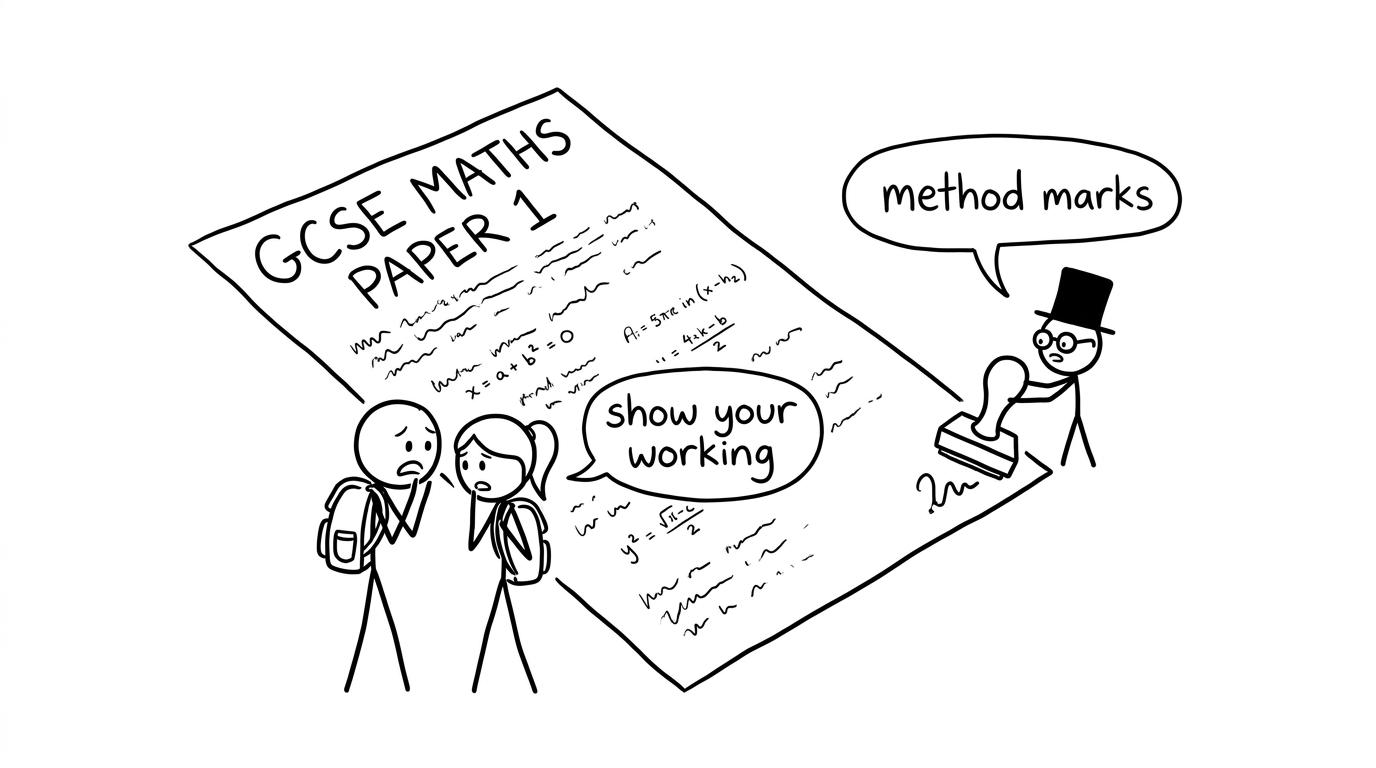 Two students face an enormous GCSE paper while a tiny examiner stamps “method marks”
How GCSE maths marking works in plain English
In most GCSE maths questions, you’re not just being assessed on the destination. You’re being assessed on the route.
Here’s the core idea:
- Marks are split across steps. A 4-mark question is rarely “all or nothing”.
- Correct working can earn marks even with a wrong answer. This is why showing your method matters in GCSE.
- Some questions still have a “final answer” mark. If you lose it, you might still keep earlier marks.
- Mark schemes allow equivalent methods. Examiners aren’t looking for one perfect layout, but they are looking for valid maths.
To see what this looks like on real papers, it helps to practise with full mark schemes. Maths Genie makes that easy through GCSE exam paper pages and worked solutions, such as:
The main types of marks in a GCSE mark scheme
Different exam boards format mark schemes slightly differently, but the logic is very similar across GCSE.
Method marks (M)
A method mark rewards a correct step or approach. Even if your arithmetic slips later, the method can still be worth marks.
Typical places you’ll see method marks in GCSE:
- setting up an equation correctly
- choosing the right formula
- performing a correct algebraic manipulation
- using a valid approach to a geometry or ratio problem
Accuracy marks (A)
An accuracy mark usually depends on you getting the correct result from a correct method. These marks are often “locked behind” a method mark.
So you might only get the accuracy mark if you’ve first earned the method mark.
Independent marks (B)
A B mark is often for a statement, a correct value, or a correct fact that doesn’t depend on previous working.
For example, identifying a gradient from a graph, or stating a correct angle because of a known rule.
Follow-through marks (sometimes called ECF or FT)
Follow-through (error carried forward) means you can still earn later marks using your own earlier answer, even if that earlier answer was wrong.
In GCSE, follow-through is one of the fairest parts of marking. It rewards consistency and good method.
Why showing working matters (even when you think it doesn’t)
The rule of thumb for GCSE is simple:
- If your answer is correct, you’ll often get full marks even with minimal working.
- If your answer is wrong, and you show no working, you usually get no marks.
That’s not examiners being harsh. It’s because the mark scheme can only reward what it can see.
This is why revising with mark schemes is so powerful. You start to write the kind of working that matches how GCSE is actually marked.
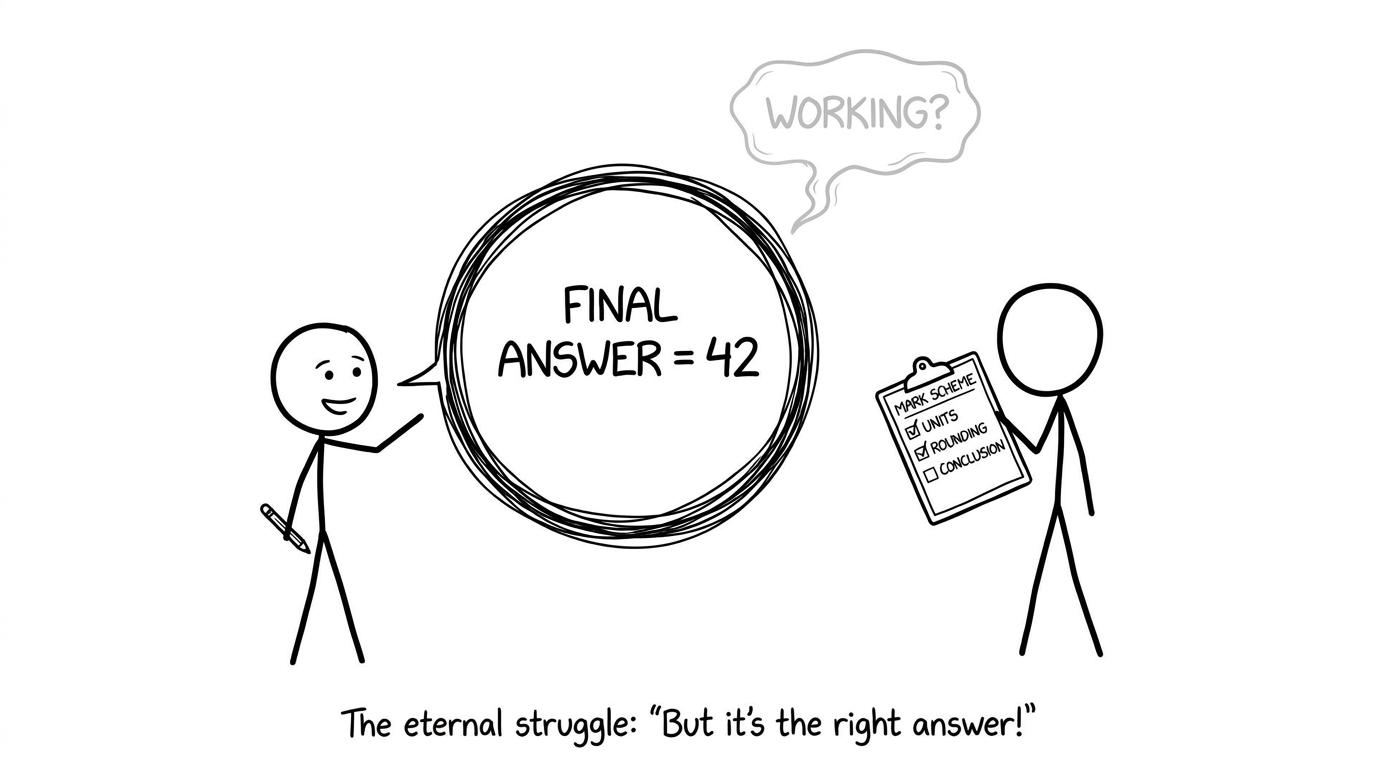 A student writes only a final answer while a ghostly mark scheme asks “Working?”
Worked example: how method marks can save you
Imagine a GCSE question worth 4 marks:
Question: Solve 3(x−2)=2x+73(x-2)=2x+73(x−2)=2x+7.
A clean solution is:
3(x−2)=2x+73(x-2)=2x+73(x−2)=2x+7 3x−6=2x+73x-6=2x+73x−6=2x+7 3x−2x=7+63x-2x=7+63x−2x=7+6 x=13x=13x=13How might it be marked?
- 3x−6=2x+73x-6=2x+73x−6=2x+7 (expanding correctly) could earn a method mark.
- 3x−2x=7+63x-2x=7+63x−2x=7+6 (collecting terms correctly) could earn another method mark.
- x=13x=13x=13 (final correct solution) could earn one or two accuracy marks.
Now suppose you make a slip:
3x−6=2x+73x-6=2x+73x−6=2x+7 3x−2x=7−63x-2x=7-63x−2x=7−6 x=1x=1x=1The final answer is wrong, but the expansion was correct. In a typical GCSE mark scheme, you might still pick up at least one method mark. That can be the difference between a grade boundary later.
To practise algebra in a way that mirrors GCSE marking, use topic practice before papers. Start from the Maths Genie GCSE area and build confidence step by step:
Worked example: follow-through in a GCSE problem
Suppose a GCSE question says:
A rectangle has length 12 cm12\text{ cm}12 cm and width x cmx\text{ cm}x cm. Its area is 84 cm284\text{ cm}^284 cm2.
- Find xxx.
- Find the perimeter.
Correct working:
12x=8412x=8412x=84 x=7x=7x=7Perimeter:
P=2(12+7)=2×19=38 cmP=2(12+7)=2\times 19=38\text{ cm}P=2(12+7)=2×19=38 cmNow imagine you divide wrongly and get x=6x=6x=6.
You would still be able to score follow-through marks for using your xxx consistently:
P=2(12+6)=2×18=36 cmP=2(12+6)=2\times 18=36\text{ cm}P=2(12+6)=2×18=36 cmYou’d lose the mark for xxx, but you might still gain the perimeter method mark. This is classic GCSE marking: you’re being rewarded for structure.
How examiners handle “equivalent” answers
GCSE mark schemes often accept equivalent forms, such as:
- fractions instead of decimals, e.g. 34\frac{3}{4}43 instead of 0.750.750.75
- exact surds instead of rounded values, e.g. 2\sqrt{2}2 instead of 1.4141.4141.414
- alternative algebraic forms, e.g. 2(x+3)2(x+3)2(x+3) instead of 2x+62x+62x+6
However, equivalence has limits. If a question asks for an answer “correct to 2 decimal places”, then 1.41.41.4 is not the same as 1.411.411.41.
Rounding, units, and “final answer” marks
Some GCSE questions include a final “communication” expectation even if it isn’t labelled that way.
Common examples:
- Money: give answers in pounds and pence when appropriate.
- Measure: include units like cm2\text{cm}^2cm2, m\text{m}m, km/h\text{km/h}km/h.
- Rounding: follow the instruction exactly, such as 1 decimal place or 3 significant figures.
A painful truth: you can do the hard maths correctly and still drop a mark for rounding or units. That’s not bad luck. It’s a predictable habit you can fix in GCSE revision.
How GCSE grade boundaries fit into marking
Marking gives you a raw score. Grade boundaries convert that score into grades 999 to 111 (or UUU).
Boundaries change each series because papers vary in difficulty. That’s why two students can get the same grade with different raw marks in different years.
Maths Genie publishes grade boundary data for reference, for example:
The important revision takeaway is not “guess the boundary”. It’s “collect marks wherever they exist”. In GCSE, method marks are often the easiest marks to reliably collect.
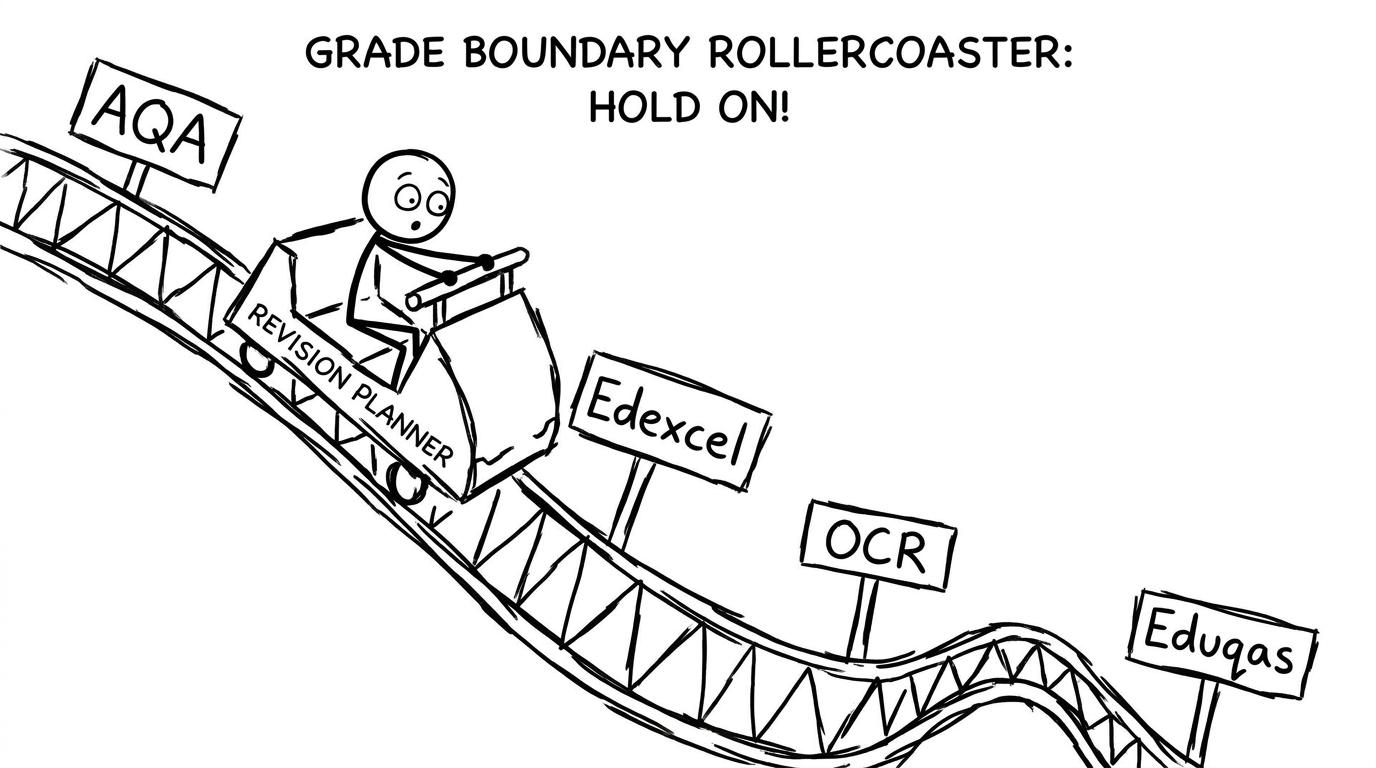 A “grade boundary” rollercoaster with exam board signs and a student holding a revision planner
How to use mark schemes properly (without turning revision into punishment)
Mark schemes can feel brutal because they’re precise. But used well, they become a map.
A simple GCSE mark scheme routine
- Attempt the question under timed conditions.
- Mark it using the mark scheme.
- If you drop marks, write down what type:
- wrong method
- slip in arithmetic
- rounding/units
- didn’t finish
- Redo the question correctly the next day.
This is where Maths Genie shines because you can combine paper practice with support:
- GCSE Predicted Papers for realistic mixed practice
- GCSE Target Tests for short, focused bursts
- GCSE Resources page for revision packs and practice materials
Common mistakes that lose easy GCSE marks
- No working shown. In GCSE, that often turns a near miss into 000 marks.
- Correct method, wrong rounding. If asked for 2 decimal places, write 2 decimal places.
- Units missing or wrong. Area needs squared units like cm2\text{cm}^2cm2. Volume needs cubed units like cm3\text{cm}^3cm3.
- Answer not simplified. Leaving 68\frac{6}{8}86 instead of 34\frac{3}{4}43 can lose a mark depending on the question.
- Misread command words. “Estimate” is not “calculate”. “Show that” needs a clear chain of reasoning.
- Calculator trust issues. Typing errors like entering 32\frac{3}{2}23 as 3÷23\div 23÷2 is fine, but typing 3÷(2×5)3\div (2\times 5)3÷(2×5) by accident is common under pressure.
Bringing it together: revise for marks, not just answers
The quiet advantage in GCSE maths is not being a genius. It’s understanding the rules of the game.
GCSE papers are marked to reward method, accuracy, and clear communication. If you show your working, finish questions even when you’re unsure, and train with mark schemes, you turn marking into something predictable. That predictability is calming, especially close to the exam.
If you want revision that matches how GCSE is actually assessed, build your practice around Maths Genie: use the GCSE Target Tests for focused skill-building, then move to GCSE predicted papers and resources, and finally complete full past papers with mark schemes and video solutions via your exam board pages like AQA GCSE Maths Past Papers. Do that consistently, and you’re not just revising maths; you’re revising how to collect marks.