Reset After Bad Week GCSE Food and Nutrition
Reset after bad week GCSE Food and Nutrition revision with a calm seven-day plan using retrieval, exam questions, feedback and realistic targets today.
A bad revision week rarely looks dramatic. One missed evening becomes three, the notes remain unopened, and by Sunday the unfinished work feels larger than the subject itself. The natural response is to plan an heroic comeback. That is usually where the next bad week begins.
To reset after bad week GCSE Food and Nutrition revision, do something less impressive and more useful: identify one genuine gap, complete one short active task today, check it, and arrange the next two sessions. Do not attempt to repay every missed hour. Your goal is to restore a repeatable rhythm.
This matters when Food Preparation and Nutrition must compete with GCSE maths and other subjects. A reset should protect the whole revision timetable, not allow one neglected subject to consume it.
Your quick revision reset checklist
Use this before creating a new timetable:
- Accept that the lost week has finished. Do not carry its entire workload forward.
- Check the specification for your exam board and list the areas you need to know.
- Choose one weak topic using evidence, not mood.
- Complete a short closed-book recall task today.
- Check your answers against reliable notes, teacher feedback or a mark scheme.
- Record no more than three specific gaps.
- Schedule two follow-up sessions across the next seven days.
- Keep your existing maths and other GCSE commitments visible.
The first session can be small. Small is not the same as pointless. A completed 202020-minute session creates evidence that revision has restarted; a beautiful four-hour plan creates only a promise.
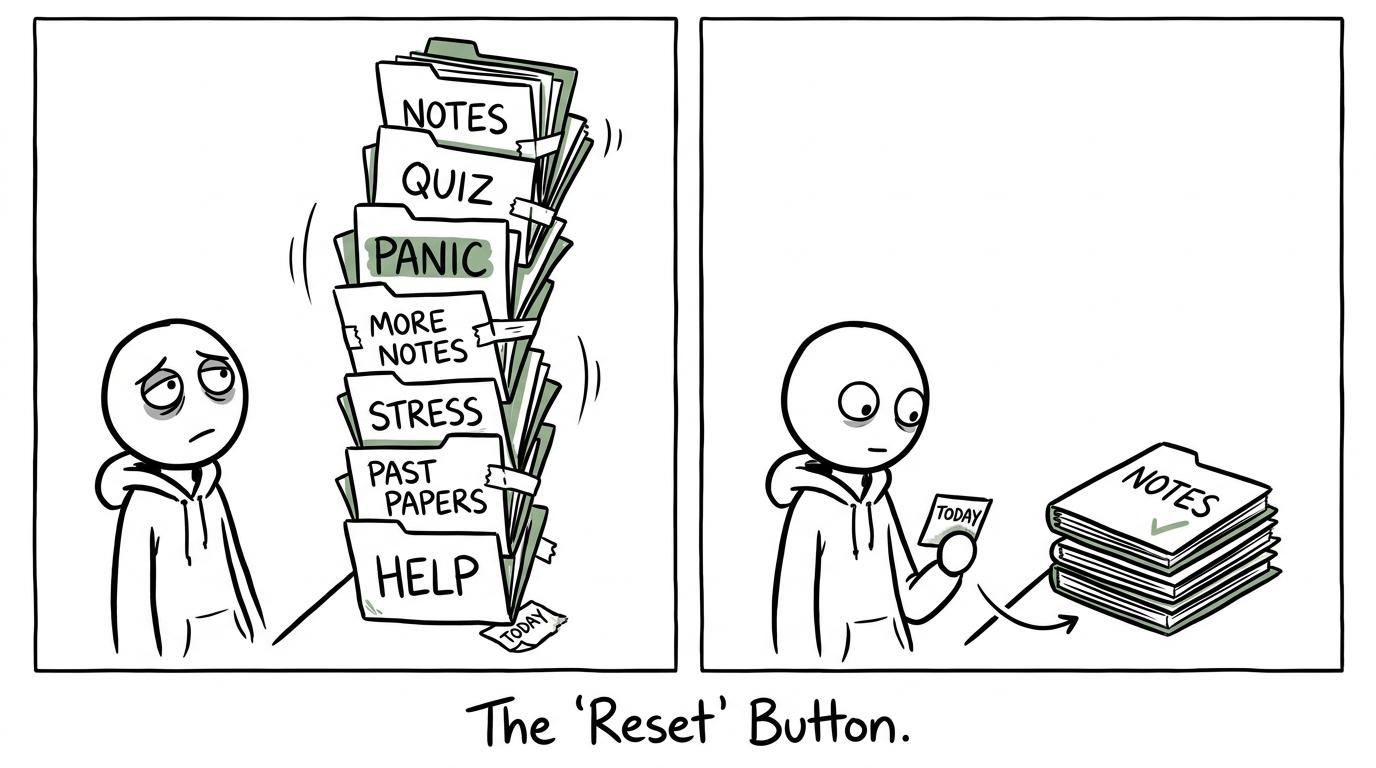 A student turns an impossible revision tower into one manageable task
Stop trying to recover the missing hours
After falling behind, students often perform a kind of emotional arithmetic: five missed sessions must be replaced by five extra sessions. But time does not work like debt. If you force all the missed work into the next week, you remove the spare capacity that makes a timetable survivable.
Reset the plan from today instead. Separate tasks into three groups:
- Essential now: a current class topic, approaching assessment or serious knowledge gap.
- Important later: material that needs revision but is not urgent.
- Optional: rewriting, decorating or reorganising resources that will not directly improve recall or application.
Keep the first group short. If everything is essential, nothing has been prioritised.
This is the same principle behind a sustainable GCSE maths revision timetable: weak areas need attention, but the weekly workload must remain realistic enough to repeat. You can also adapt the structure in MathsGenie's one-month GCSE revision plan across your subjects rather than inventing a completely new system.
Diagnose the problem before revising it
“Food and Nutrition went badly” is a feeling, not a diagnosis. A useful reset asks what actually failed.
Was it a planning problem?
Perhaps sessions had no precise starting task. “Revise nutrition” asks you to make several decisions when you are already tired. “Recall the functions and sources of named nutrients, then check them” removes that friction.
Was it a knowledge problem?
You may have revised but discovered that food science, nutrition, food safety, food choice or provenance was less secure than expected. The exact organisation varies by specification, so use the current specification for your board and your teacher's guidance.
AQA, OCR and Eduqas specifications combine theoretical knowledge with practical and non-examined assessment. Their precise paper lengths and component structures differ, but the written examination accounts for 50%50\%50% of the qualification in each specification checked for this article. That makes theory revision important even when practical work feels more immediate.
Was it an energy or environment problem?
A timetable can fail because the session was placed after an exhausting day, the phone remained within reach or the task was too large to begin. Change the condition, not merely the colour of the timetable. Move the session, shorten it or decide the first question in advance.
For a simple evidence-based diagnostic mindset, adapt MathsGenie's method for finding your weakest GCSE topics. In Food Preparation and Nutrition, classify each gap as recall, application, analysis, practical planning or numerical skill.
Build a minimum viable revision session
The best comeback session is one you can complete without needing a surge of motivation. Try this structure:
- Recall for 555 minutes: write what you remember without opening your notes.
- Check for 555 minutes: compare your recall with the specification, class materials or an approved mark scheme.
- Practise for 101010 minutes: answer a small set of relevant questions.
- Record for 222 minutes: write one correction and the date you will revisit it.
This is active revision. Research and UK educational guidance consistently support purposeful recall, practice questions, feedback and spacing over repeated passive rereading. The important distinction is effort: retrieval requires you to bring knowledge to mind before seeing the answer.
That effort can feel less fluent than highlighting. Do not mistake difficulty for failure. The difficulty is revealing what needs attention.
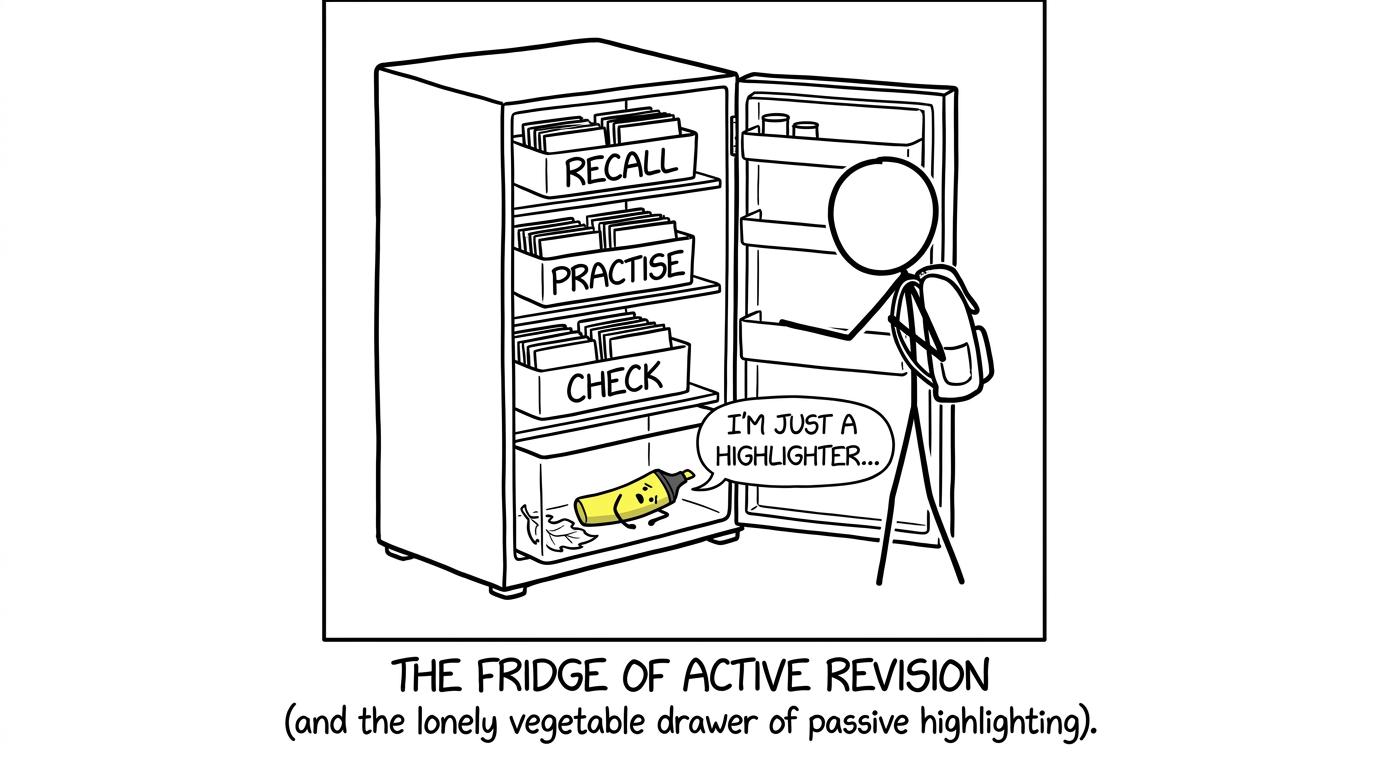 Revision flashcards wait in a fridge while a lonely highlighter hides below
Use a seven-day Food and Nutrition reset
A reset week should rebuild continuity without taking over every evening.
On the first day: restart
Choose one narrow topic. Complete the minimum session above and finish while you still know what the next step is. Write that next step down.
Two days later: retrieve
Return to the same material without looking at your previous answer first. Use flashcards, a blank-page recall exercise or short questions. Then check and correct it.
At the weekend: apply and review
Answer exam-style questions that require you to explain, apply, analyse or evaluate rather than only list facts. Mark them carefully. Record the language or content that was missing, then select the next topic.
This spacing is more valuable than compressing the same activity into one long evening. MathsGenie's guide to stopping GCSE content from being forgotten explains how retrieval, spaced practice and exam questions can form a repeatable cycle.
Your week therefore has a simple rhythm:
recall→check→practise→revisit\text{recall} \rightarrow \text{check} \rightarrow \text{practise} \rightarrow \text{revisit}recall→check→practise→revisitThe cycle matters more than producing perfect notes.
Connect Food and Nutrition revision with GCSE maths
Food Preparation and Nutrition contains numerical thinking, particularly when interpreting nutritional information, scaling quantities, comparing proportions or handling data. Strengthening the relevant maths can support both subjects without turning your reset into two separate projects.
Useful relationships include:
percentage=partwhole×100\text{percentage} = \frac{\text{part}}{\text{whole}} \times 100percentage=wholepart×100and the scale-factor relationship
new quantity=original quantity×scale factor.\text{new quantity} = \text{original quantity} \times \text{scale factor}.new quantity=original quantity×scale factor.Do not practise these ideas only by reading the formulae. Use questions and check the units, the whole being compared and whether the answer is sensible.
MathsGenie provides free revision lessons and practice materials for GCSE percentages, GCSE ratio and GCSE proportion. The listed topic pages are aligned to Edexcel GCSE Maths, so students taking AQA, OCR or Eduqas maths should also check their own specification and teacher's advice.
Keep this support targeted. If scaling recipes is the gap, practise proportion. Do not disappear into an unrelated maths chapter because it feels easier than confronting the Food and Nutrition topic you avoided.
Make feedback the centre of the reset
Revision without checking can preserve misconceptions. After each task, distinguish between four problems:
- Missing knowledge: you could not recall the relevant fact or principle.
- Weak application: you knew the fact but did not connect it to the context.
- Incomplete analysis: you made a claim without developing its consequence.
- Question-reading error: you answered a different command word or ignored the number of marks.
Mark schemes are especially useful because they show what earns credit. Examiners may accept several valid responses, so use the scheme to understand the required precision rather than memorising one sentence mechanically.
When you begin timed maths practice again, apply the same approach through GCSE maths past papers. MathsGenie's guide to using GCSE past papers properly also shows how to move from a result to an error log, focused repair and retesting.
Common mistakes when resetting after a bad week
Designing a punishment timetable
A plan containing hours of extra work may relieve guilt briefly, but it is hard to repeat. Preserve sleep, meals, lessons, practical commitments and revision for other subjects.
Revising the whole specification at once
Broad labels create vague sessions. Replace “food safety” with a precise question or subsection that can be completed and checked.
Copying notes before testing memory
Neat notes can feel productive because the page fills quickly. Attempt recall first. Your mistakes then tell you which notes are worth opening.
Avoiding exam questions until you feel ready
Readiness is partly created by practice. Start with short, low-stakes questions, use feedback and build towards longer responses.
Ignoring the non-examined assessment boundary
Follow your teacher's instructions about what help is permitted for assessed NEA work. Use independent revision to strengthen underlying knowledge and skills, but never seek assistance that would undermine the authenticity of submitted work.
Letting one subject consume the week
Food and Nutrition deserves a clear place in the timetable, not every available place. A balanced plan protects maths, English, science and your other options while leaving room to recover.
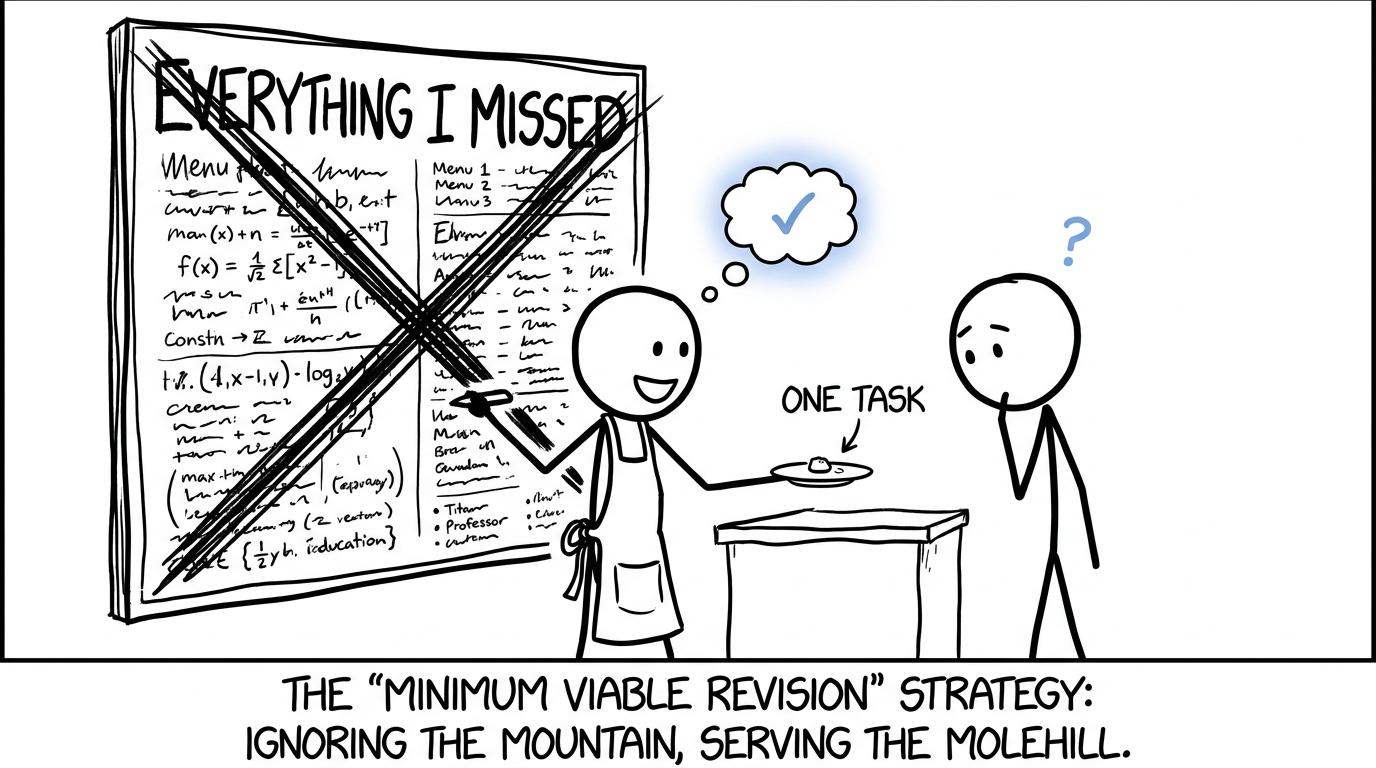 A student chooses one manageable revision task instead of the entire missed menu
Your next step is deliberately small
A bad week is information. It may show that the tasks were vague, the schedule was overloaded or your revision was too passive. None of those problems requires a dramatic comeback. They require a better next action.
Choose one Food and Nutrition topic now. Spend a short session recalling, checking and practising it. Put two follow-up dates in your planner, then stop. Tomorrow's confidence does not need to be manufactured tonight; it can be built from evidence that you kept one modest promise.
For the maths alongside your Food and Nutrition course, open the free GCSE maths revision hub. Use MathsGenie's revision lessons and practice questions to repair individual skills, then progress to mini tests, past papers, predicted papers, mark schemes and video solutions. A reset becomes durable when the next step is clear, and MathsGenie gives you somewhere practical to take it.