Regret Picking GCSE Food and Nutrition?
Regret picking GCSE Food and Nutrition? Explore common concerns, what the course involves and how to protect valuable GCSE maths revision time.
Sometimes a subject looks completely different from the inside. Food and Nutrition may appear to offer a welcome break from written lessons, but practical assessments, food science, deadlines and detailed evaluation can quickly change that impression. If you regret picking GCSE Food and Nutrition, the feeling often comes from a mismatch between the course you expected and the course you actually received.
The short answer is this: GCSE Food Preparation and Nutrition is not simply a cooking course. Current specifications typically combine a written examination with non-exam assessment, or NEA. Students need practical competence, scientific understanding, organisation and clear written analysis. That workload can also compete with GCSE maths revision if it is not planned carefully.
This article explains the most common reasons for regret, what prospective students should check before committing and how current students can regain control.
What to know before choosing the subject
Before selecting Food and Nutrition, find out:
- which exam board and specification your school follows
- how the written examination and NEA are weighted
- how much scientific theory is taught
- how ingredients are supplied and paid for
- when practical sessions and assessment deadlines occur
- whether you enjoy planning, evaluating and writing about food
- how the subject will fit beside maths, English and science revision
- what support is available for allergies, dietary requirements or financial difficulty
The details matter. A subject should be chosen for what happens across two years, not for how enjoyable one demonstration lesson feels.
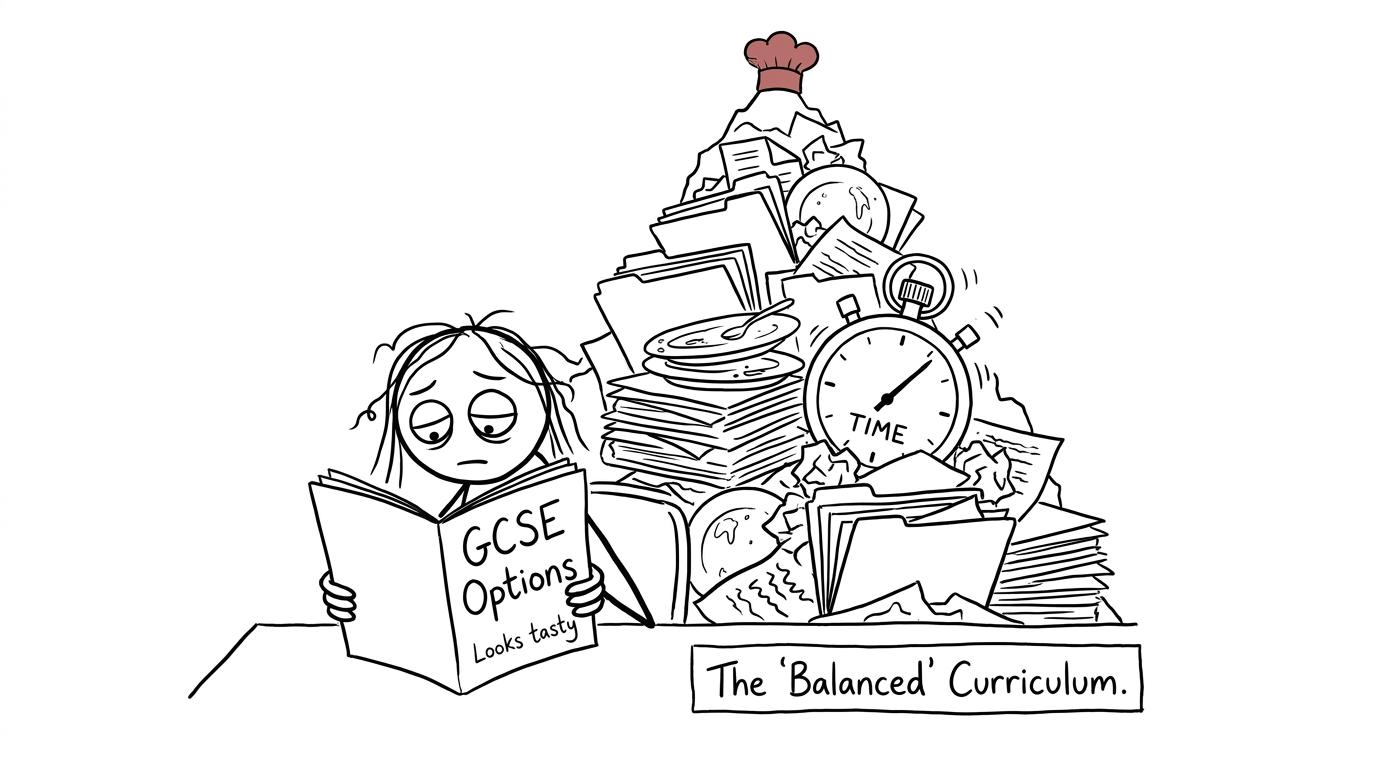 A student discovers a mountain of folders and washing-up behind an options booklet
Why some students regret picking GCSE Food and Nutrition
There is no official league table ranking the causes of subject regret. However, several concerns follow directly from the structure and demands of the qualification. They are worth examining before you make a decision.
They expected cooking, not food science
Cooking is central to the course, but it is only one part of it. GCSE specifications cover areas such as nutrition, food provenance, food safety, food processing, functional properties and the scientific changes that occur during preparation and cooking.
That means understanding why ingredients behave as they do. Students may need to discuss processes such as gelatinisation, coagulation, fermentation and emulsification, as well as the nutritional needs of different groups.
For someone interested in both practical work and science, this can be fascinating. For someone who chose the option mainly because they wanted to bake each week, it can feel unexpectedly theoretical.
The NEA requires more writing than expected
Across commonly taught GCSE specifications, assessment is generally divided between a written paper and NEA. The exact wording and arrangements depend on the board, but a common model is 50%50\%50% written examination and 50%50\%50% NEA. That NEA is often divided into a food investigation worth 15%15\%15% and a food preparation assessment worth 35%35\%35%.
These tasks are not simply awarded marks because the final dish looks attractive. Students may have to research, plan, investigate, justify decisions, demonstrate techniques, record outcomes and evaluate their work against clear criteria.
The writing can surprise students. A practical lesson creates evidence, but that evidence still needs to be organised and explained. Missing photographs, vague evaluations or incomplete records can become difficult to repair later.
Practical lessons can feel pressurised
Cooking at home is flexible. A timed practical assessment is not.
You may need to collect ingredients, organise equipment, follow hygiene procedures, manage several processes and clean your workspace within a fixed period. One delayed component can affect everything that follows. The pressure is less about producing restaurant-perfect food and more about showing control, independence and appropriate technical skills.
Students who enjoy cooking may still dislike cooking under observation. That does not mean they chose badly, but it is something to understand before committing.
Ingredients create extra organisation
Arrangements differ by school. Some departments supply ingredients, some ask families to provide certain items and others use a mixture of both approaches. Students may need to remember containers, transport chilled food safely or adapt plans around allergies and dietary requirements.
The repeated organisation can become frustrating, particularly when several subjects have deadlines in the same week. Before choosing the course, ask the department how ingredients, costs, absences and missed practical work are handled. If cost or access may be difficult, speak to the school early rather than assuming support is unavailable.
The workload arrives in concentrated bursts
Food and Nutrition may feel manageable for much of the term and then become intense near an investigation, practical assessment or portfolio deadline. This concentration is what can interfere with preparation for other GCSEs.
A useful planning principle is:
available revision time=total free time−fixed commitments\text{available revision time}=\text{total free time}-\text{fixed commitments}available revision time=total free time−fixed commitmentsNEA sessions, ingredient preparation and write-ups belong in the fixed-commitment side of that equation. If they are treated as surprises, maths revision is often the first activity pushed aside.
The MathsGenie GCSE maths revision hub helps by keeping lessons, practice questions and papers together, so a short revision window does not disappear while you search for resources.
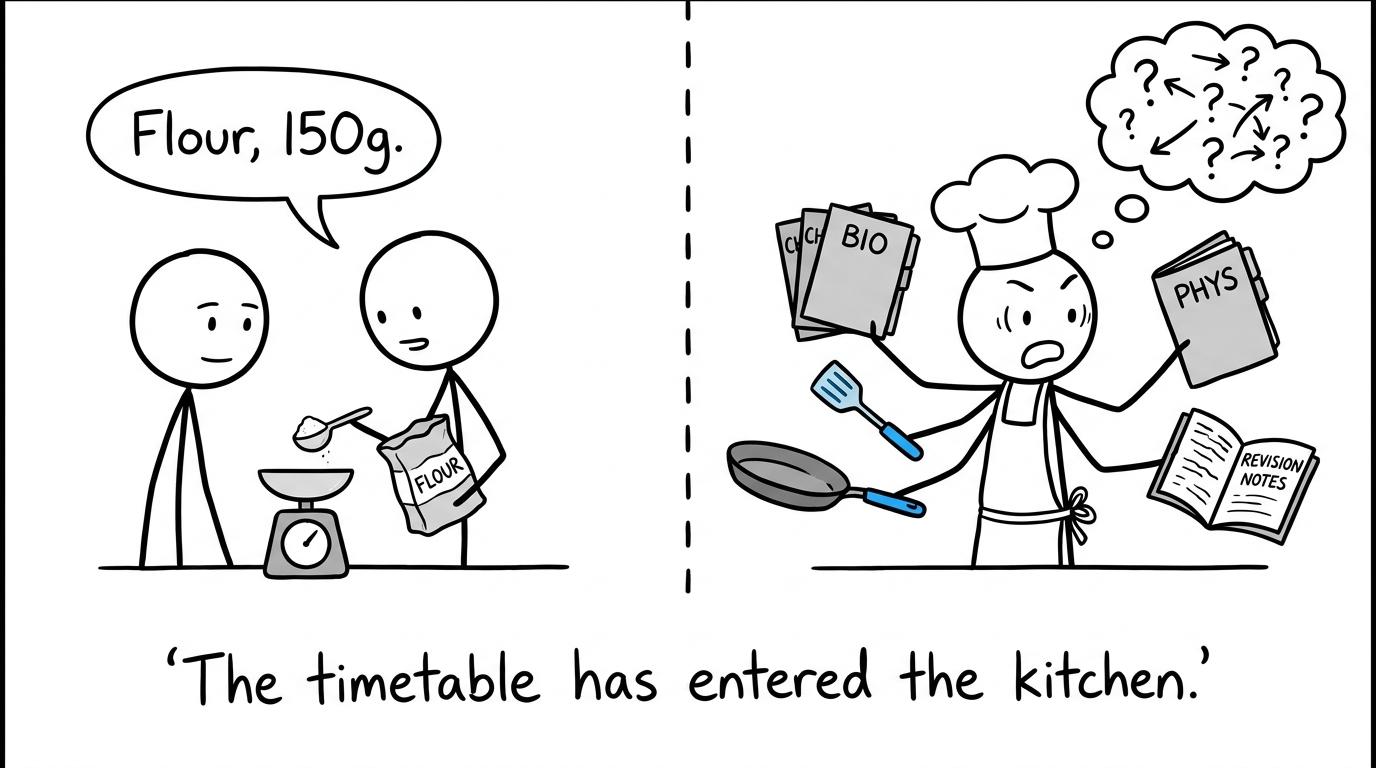 A student attempts to manage a spatula, maths revision and several folders at once
Practical ability does not guarantee high marks
Being a confident cook is useful, but assessment rewards more than confidence. Students must respond to the task, choose suitable techniques and communicate the reasoning behind their decisions.
This is similar to GCSE maths: arriving at an answer does not always demonstrate the full method. In Food and Nutrition, a successful dish without sufficient planning or evaluation may not provide all the required evidence.
Students who dislike documentation can therefore feel that the course rewards paperwork more than they expected. A better interpretation is that the qualification assesses both making and thinking. You need to show the connection between them.
The maths hidden inside Food and Nutrition
Food and Nutrition is not a substitute for GCSE maths, but the two subjects overlap more than students sometimes realise. Recipes and nutritional information can involve:
- ratio and direct proportion when changing quantities
- fractions and percentages when interpreting composition
- conversions between units of mass, volume and temperature
- time calculations when planning practical work
- averages and graphs when presenting investigation results
- comparisons involving cost, quantity and value
These skills can strengthen each other. If ratio or percentage calculations slow you down, use the board and tier filters in the GCSE maths topic guide to locate the right revision support.
The crucial difference is that GCSE maths examinations mix these skills with algebra, geometry, probability and statistics. Food calculations cannot replace dedicated maths practice. The best order for learning GCSE maths topics provides a sensible route if competing deadlines have left your revision feeling fragmented.
What to check before you commit
Read the actual specification
Ask which board your school uses and read the course outline. AQA, OCR, Eduqas and Pearson Edexcel specifications may use different names, task wording and administrative arrangements. Your school also controls its teaching sequence and practical timetable.
Look for the assessment structure, content areas, practical skill expectations and NEA requirements. Do not rely on a friend’s description of the course at another school.
Ask to see typical written work
A finished folder or anonymised model extract can reveal more than a glossy options leaflet. Notice the balance between photographs, scientific explanation, planning and evaluation.
Then ask yourself an honest question: would you enjoy improving this kind of work, or would you only tolerate it to reach the next practical lesson?
Investigate the practical arrangements
Find out how often practical lessons happen, who supplies ingredients and what happens if you are absent. Ask how dietary, allergy, religious and accessibility needs are accommodated. These are practical questions, not reasons to feel awkward.
Examine your whole timetable
Options are rarely difficult in isolation. The difficulty comes from several courses demanding attention simultaneously.
Place known assessment windows on a revision planner. Protect regular maths sessions before the Food and Nutrition workload becomes busy. Short, focused sessions can be effective when they contain active practice. The GCSE one-week maths revision plan shows how to diagnose weaknesses, practise them and review mistakes without drifting into unstructured revision.
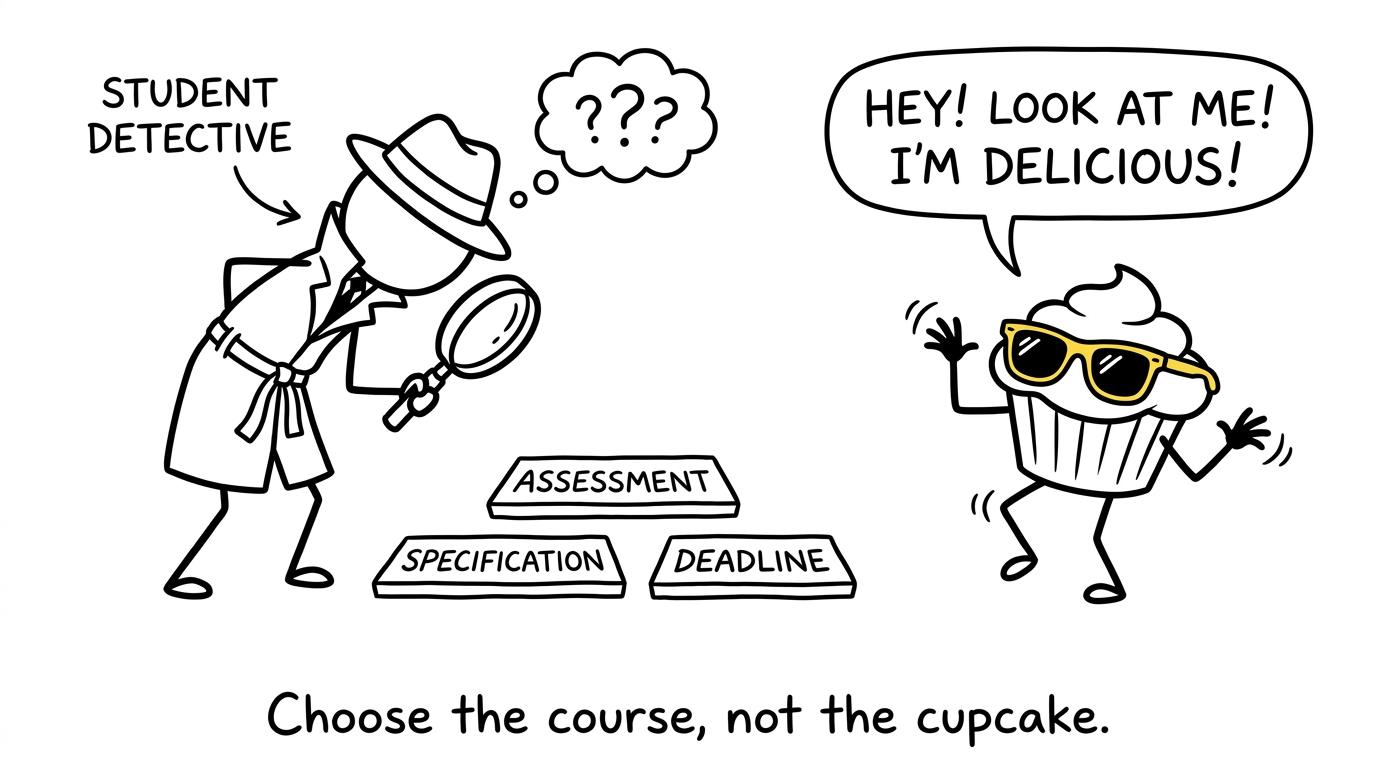 A student detective checks the specification while a cupcake attempts to provide a distraction
What to do if you already regret your choice
Regret is information. It tells you that something is different from what you expected, but it does not automatically mean that you should leave the course.
First, identify the precise problem. Is it theory, practical pressure, cost, workload, missed lessons or uncertainty about assessment? A specific problem is easier to solve than the broad conclusion that you hate the subject.
Next, speak to your teacher, form tutor or options lead. If changing subjects is still possible, the school can explain its deadlines and consequences. Changes are not always available, particularly once substantial course content has been taught, so obtain accurate guidance rather than relying on rumours.
If you remain on the course, separate the workload into three streams:
- theory to recall
- practical skills to practise
- NEA actions with firm deadlines
Use the same discipline for maths. Choose one weak topic, complete practice questions, mark them and record the correction. Then test the skill again. When examinations approach, use guidance on when to start GCSE past papers rather than saving every paper for the final week.
For Edexcel maths students, the Edexcel GCSE revision area brings together Foundation and Higher material. Students following AQA, OCR or Eduqas can choose their board from the main GCSE hub.
Common mistakes when judging the option
Choosing it because it sounds easy
Practical does not mean effortless. The course demands scientific understanding, written communication, preparation and time management.
Choosing it only because a friend did
Friends can make lessons enjoyable, but classes, sets and friendships can change. The assessment requirements do not.
Ignoring the written examination
A substantial written component means theory revision matters throughout the course. Waiting until the final weeks creates unnecessary pressure.
Leaving NEA records until later
Details are easiest to explain while the investigation or practical session is fresh. Keep records organised and follow your teacher’s instructions about permitted support and evidence.
Letting one subject consume the revision timetable
A busy deadline can temporarily need extra attention, but core subjects still require continuity. If time is short, use a mini test or a focused set of maths questions rather than abandoning maths for a fortnight. The guide to revising GCSE maths in three days is designed for emergencies, not as a replacement for steady practice.
Make the decision with your eyes open
Students are most likely to regret a GCSE option when they choose an imagined version of it. Food and Nutrition can be creative, scientific and rewarding, but it also involves theory, written evidence, practical pressure and careful organisation. Check the specification, assessment model and school arrangements before you commit.
If you have already chosen it, turn regret into a plan. Clarify the problem, ask for support and protect regular revision time for your other subjects.
MathsGenie can make the maths side simpler. Start with free revision lessons, move into focused practice questions and mini tests, then use past papers, mark schemes and video solutions to correct your mistakes. Nearer the exams, add predicted papers for fresh practice. The goal is not to make every week perfectly balanced; it is to keep moving forward, one clearly chosen task at a time.