

Can You Revise GCSE Maths in 3 Days?
GCSE maths in 3 days is possible if you prioritise methods, past papers and mistakes. Use Maths Genie lessons, questions and mark schemes fast.
Can you revise GCSE maths in 3 days?
If you have just realised your GCSE maths exam is basically now, you are not alone. It usually happens in a quiet moment: you open your bag, you see a half-used highlighter, and you remember every promise you made to “start revision earlier”. Three days feels like trying to boil the ocean with a teaspoon.
But here’s the honest truth: you can make meaningful GCSE maths progress in 3 days, as long as you stop aiming for “learn everything” and start aiming for “secure marks predictably”. In the GCSE papers (Edexcel, AQA, OCR, Eduqas), marks don’t come from panic. They come from methods you can repeat under pressure.
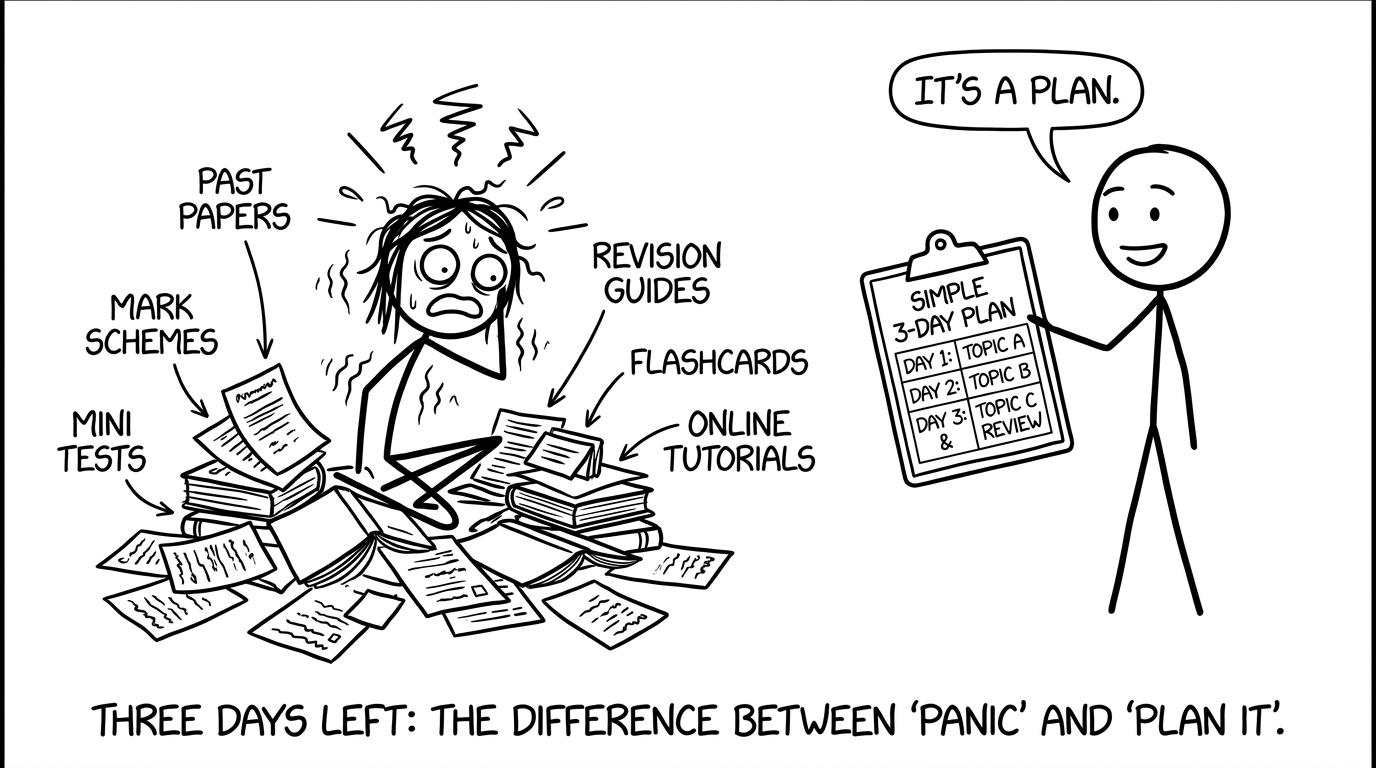 A stressed student meets a calm 3-day plan
The strategy below is built for real life: limited time, a tired brain, and a test that rewards accuracy, exam technique, and a small set of high-frequency topics.
The 3-day GCSE revision checklist (what actually moves your grade)
If you only remember one thing, remember this: in 3 days, GCSE maths revision should be mostly practice, not passive notes.
Use this checklist to keep your revision honest:
- Pick your tier (Foundation or Higher) and your exam board style.
- Do one timed paper (or half-paper) straight away to diagnose.
- Spend most of your time on the highest-return topics: number, algebra, graphs, ratio, percentages, angles, area/volume, probability.
- For every mistake, write a one-line fix: “Next time I will…”.
- Finish each day with mixed questions (because GCSE maths is mixed).
Maths Genie is designed for this style of revision: quick lessons, exam questions, and solutions in one place. Start with the main GCSE course page: Edexcel GCSE Maths revision journey.
The mindset shift: 3 days is not for learning, it’s for scoring
In the final 72 hours, your job is not to “understand maths”. It’s to become the person who can:
- recognise a question type fast,
- choose a method confidently,
- set work out clearly,
- and avoid the same silly errors twice.
That’s why the best short GCSE revision plans look repetitive. They revolve around past papers, mark schemes, and tight feedback loops.
To make this concrete, your revision time should roughly follow a 20/8020/8020/80 rule:
- 20%20\%20% watching/reading a method (only when you’re stuck)
- 80%80\%80% doing exam-style questions and correcting them
Maths Genie makes that cycle quick because each topic comes with revision support and solutions. When you don’t have long, speed matters.
A realistic 3-day GCSE maths plan (Foundation and Higher)
Day 1: Diagnose and patch the biggest leaks
Goal: find your top 5 weaknesses and fix them with focused topic practice.
- Do a timed paper (or half a paper if you’re short on stamina).
- Use predicted and practice sets: GCSE predicted papers.
- Mark it brutally honestly.
- List mistakes as topics, not as “I’m bad at maths”.
- Do targeted revision lessons and exam questions for those topics.
Good “first fix” topics for most GCSE students:
- Percentages and percentage change
- Ratio and proportion
- Solving equations
- Graphs and straight lines
- Angles and basic geometry
If you’re not sure where to begin, work through the staged structure. It’s built to cover Foundation first, then Higher: Maths Genie scheme of learning.
Day 2: Build stamina with mixed practice
Goal: turn methods into habits.
- Sit one full paper under timed conditions.
- Immediately re-do the questions you dropped marks on.
- End with 30-45 minutes of short topic bursts.
If you’re an AQA student, you can use the built-in paper lists here: AQA GCSE past exam papers.
Day 3: Exam technique, non-calculator confidence, and calm
Goal: maximise marks without burning out.
- Do a non-calculator practice (Paper 1 style).
- Practise showing working for method marks.
- Do a final mixed set, then stop early enough to sleep.
If you want a tighter list of what tends to be useful right before the papers, Maths Genie’s predicted paper resources are made for this window: Predicted papers hub.
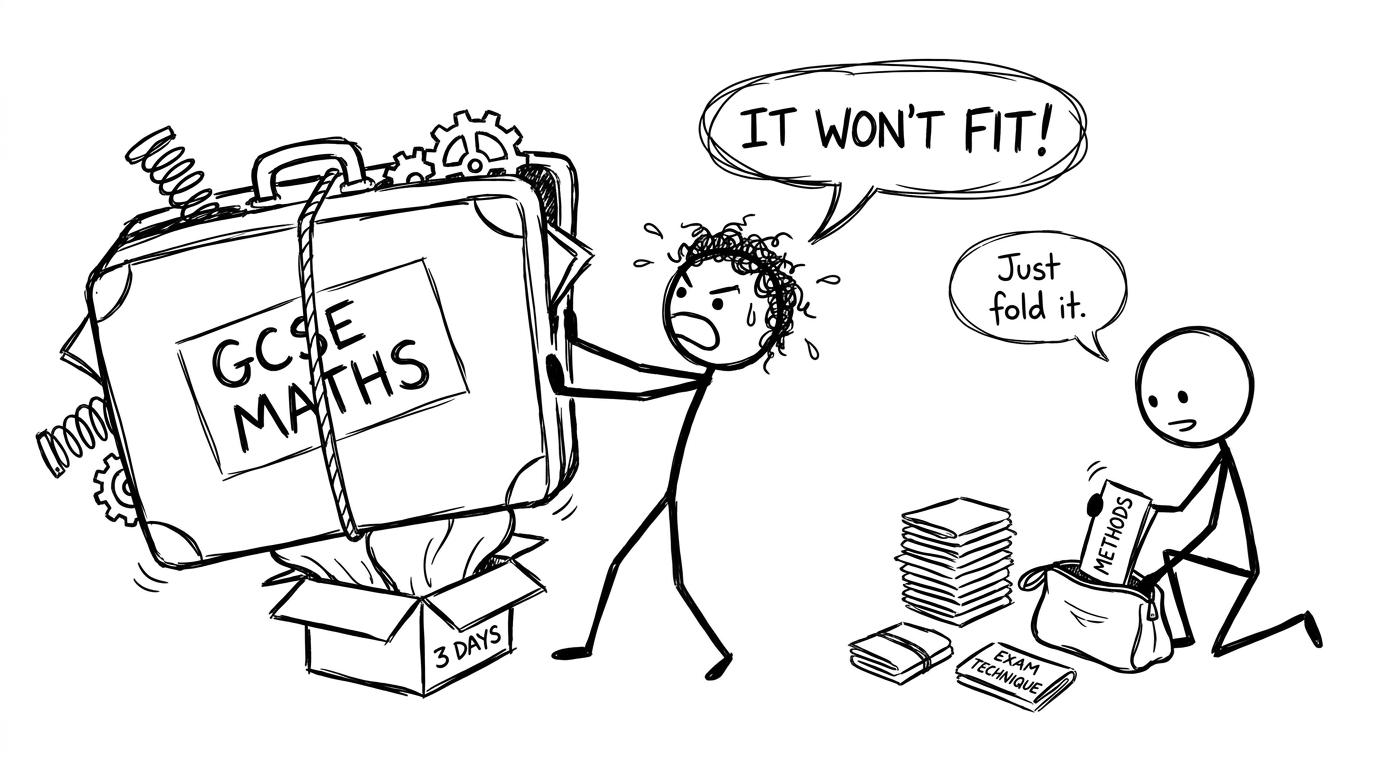 Cramming a suitcase labelled GCSE Maths into 3 days
Two worked examples to secure easy GCSE marks fast
These aren’t “trick” questions. They’re the kind of methods that show up again and again in GCSE maths.
Worked example: percentage change (a frequent GCSE win)
A laptop costs £480. In a sale it is reduced by 15%15\%15%. What is the sale price?
Method: find 15%15\%15% of £480, subtract, or multiply by the multiplier 0.850.850.85.
Using the multiplier:
Sale price=480×0.85\text{Sale price} = 480 \times 0.85Sale price=480×0.85 480×0.85=480×85100=480×0.85=408480 \times 0.85 = 480 \times \frac{85}{100} = 480 \times 0.85 = 408480×0.85=480×10085=480×0.85=408So the sale price is £408.
A lot of GCSE marks come from recognising multipliers quickly. If percentage change is a weak spot, focus your practice: Percentages topic practice (scroll to the Percentages resources) and then return to mixed papers.
Worked example: solving a linear equation (method marks matter)
Solve 3(2x−5)=4x+73(2x - 5) = 4x + 73(2x−5)=4x+7.
Expand the brackets:
6x−15=4x+76x - 15 = 4x + 76x−15=4x+7Collect like terms by subtracting 4x4x4x from both sides:
2x−15=72x - 15 = 72x−15=7Add 151515 to both sides:
2x=222x = 222x=22Divide by 222:
x=11x = 11x=11In GCSE maths, even if you make an arithmetic slip, clear algebra steps often earn method marks. That’s why writing one line per transformation is not “wasting time”; it’s buying reliability.
Where to spend your time (the GCSE topics with the best return)
You don’t need a perfect topic list. You need a useful one.
Number and calculator skills
On Foundation and Higher GCSE papers, marks come from clean calculation and sensible rounding. If you tend to rush, rebuild your habits with short, focused practice. Use the scheme stages to locate the level that matches you and then move up.
Algebra and graphs
Algebra is the language the papers are written in. If you improve one thing in 3 days, improve your algebra fluency: simplifying, solving, and interpreting graphs.
Shape, angle facts, and area/volume
Geometry questions reward calm recall. Angle rules, circle formulae, and basic area/volume show up constantly. Maths Genie’s shape route can help you organise this quickly: Shape and geometry revision overview.
Probability and averages
These are often “do the method, get the mark” topics. If you practise a few common structures (relative frequency, averages from tables), you can pick up dependable marks.
If you also take GCSE Statistics, Maths Genie keeps the extra content separate and clear: GCSE Statistics revision.
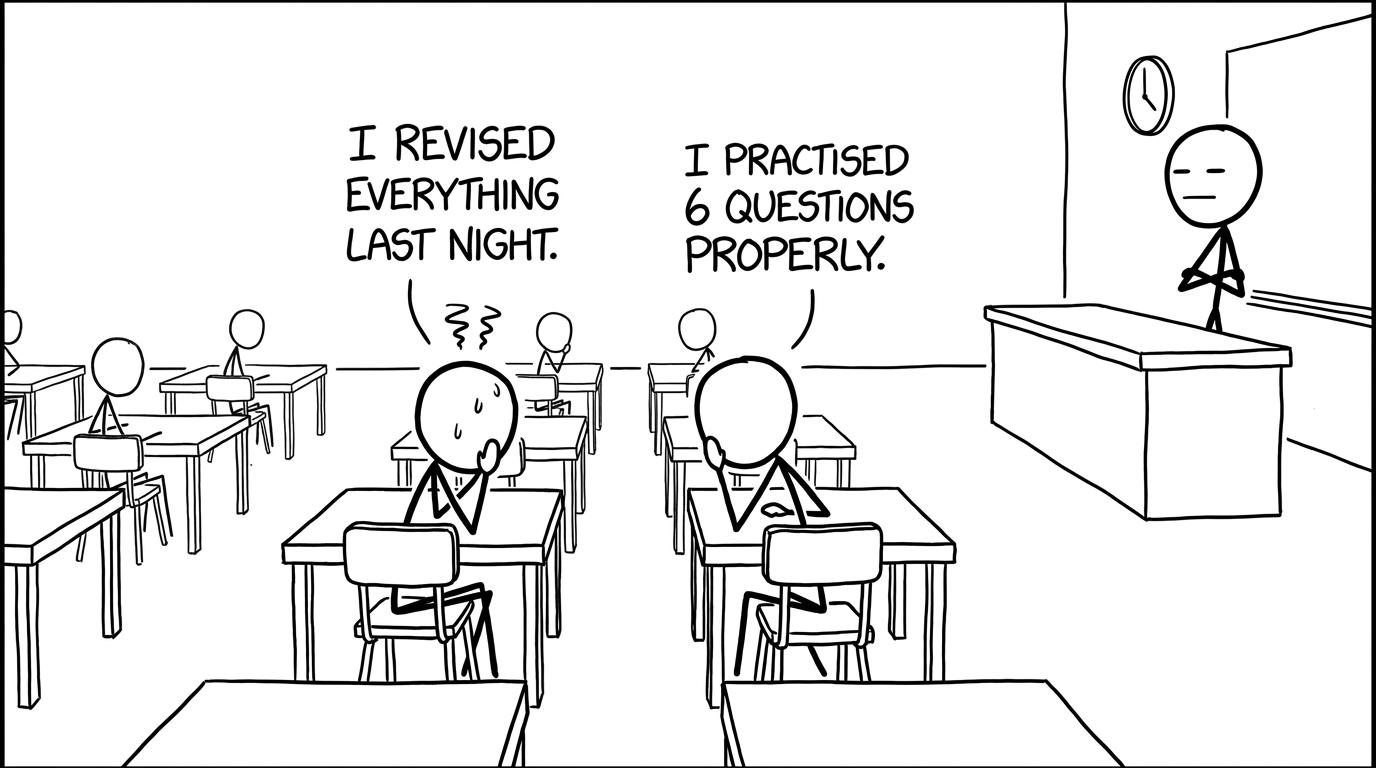 Two students compare last-minute revision strategies
Common mistakes when revising GCSE maths in 3 days
These are the traps that waste the most time in short GCSE revision windows.
- Rewriting notes instead of practising questions. Notes feel productive, but past papers create exam-ready memory.
- Doing only your favourite topics. In GCSE maths, your grade rises fastest when weaknesses shrink.
- Marking without learning. The mark scheme isn’t just a score; it’s a list of methods you need to copy.
- Ignoring non-calculator skills. Paper 1 style questions punish over-reliance on a calculator.
- Not showing working. Even on calculator papers, method marks matter. Write algebra steps and unit conversions clearly.
- Staying up too late. The final night is not for heroics. Tired brains make expensive mistakes.
The bottom line: yes, you can revise GCSE maths in 3 days (if you revise like it’s an exam)
Three days is not enough time to become a different person. But it is enough time to become a more reliable GCSE maths candidate: someone who recognises question types, uses repeatable methods, and stops donating marks to avoidable mistakes.
Your best next step is simple:
- Use Maths Genie revision lessons to patch methods quickly.
- Practise with exam-style questions and solutions.
- Finish with past papers and GCSE predicted papers, marked carefully with the mark schemes.
Start here and keep it focused: Maths Genie resources and revision hub, then move straight into GCSE predicted papers and your board’s paper list like AQA GCSE past exam papers.
If you only have 3 days, make them count. Practise like the exam is the revision, because, in a way, it is.










