Recover From a Bad GCSE Arabic Mock: Your Plan
Recover from a bad GCSE Arabic mock with a calm plan to diagnose lost marks, rebuild each skill and protect your GCSE maths revision time.
A disappointing mock result can make months of effort feel invisible. One number appears on the page and suddenly it seems to describe everything: your memory, your ability and what might happen in the real exam.
It does not.
To recover from a bad GCSE Arabic mock, first separate the emotion from the evidence. Review where you lost marks, classify the causes, choose the two weakest skills and build a short cycle of targeted practice, feedback and retesting. The mock is not a verdict. It is an unusually detailed revision map.
This matters when you are also preparing for GCSE maths. Arabic may need attention, but panic should not be allowed to consume the time assigned to every other subject. The aim is a controlled recovery plan, not an emergency timetable.
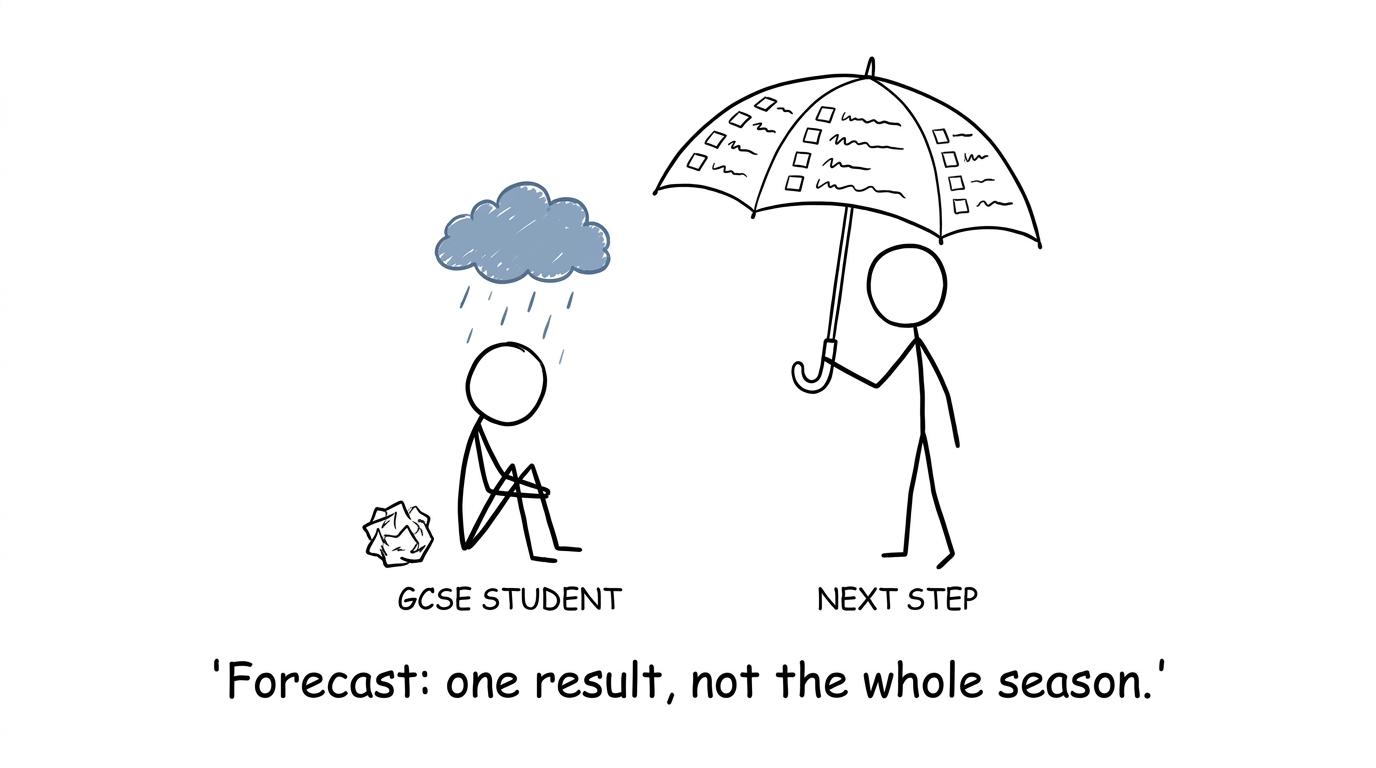 A student shelters from one disappointing result beneath a checklist umbrella
Your recovery checklist
Start with these actions:
- Wait until you can inspect the paper calmly.
- Confirm which paper, tier and skills the mock assessed.
- Ask for the mark scheme and specific teacher feedback.
- Record every lost mark by skill and cause.
- Prioritise two weaknesses rather than revising everything.
- Use short retrieval, practice and correction sessions.
- Retest with unfamiliar questions after a gap.
- Protect the maths sessions already in your timetable.
- Review your plan weekly using evidence, not mood.
A poor result creates an urge to act immediately. But useful action begins with diagnosis. Otherwise, you may spend hours learning vocabulary when the real problem was listening technique, or rewriting notes when timing caused most of the damage.
Understand what the Arabic mock actually measured
If you take Pearson Edexcel GCSE Arabic, the qualification covers listening, speaking, reading and writing. Each assessment objective contributes 25%25\%25% of the qualification. Students are entered for one tier across the papers: Foundation or Higher.
However, a school mock may assess only part of that structure. It may use an adapted paper, combine selected sections or apply provisional boundaries. Before interpreting the result, ask:
- Which components were included?
- Was the paper Foundation or Higher tier?
- Was it completed under full timed conditions?
- How was the mock grade calculated?
- Were any speaking marks estimated or omitted?
A weak result in one shortened mock does not automatically mean weakness across the complete qualification. It may reveal a concentrated problem in one skill.
Do not compare a raw mock mark casually with a previous year's qualification boundary. Official GCSE grades are awarded from the total subject mark, and boundaries can vary between examination series. Your teacher is better placed to explain what the school assessment means.
Turn the paper into a lost-marks log
The total tells you that marks disappeared. It does not tell you why. Your first practical task is to inspect each error and give it a cause.
Use four broad categories:
- Knowledge: vocabulary, grammar or structures were not secure.
- Comprehension: you knew individual words but misunderstood the message.
- Exam technique: you missed an instruction, gave too much or too little information, or did not answer the precise question.
- Timing and accuracy: you rushed, left work unfinished or made avoidable transcription errors.
For speaking, add pronunciation, spontaneity and response development where relevant. For writing, look separately at communication, range, accuracy and whether every bullet point was addressed. Use your teacher's marking guidance rather than guessing what an examiner might reward.
The same diagnostic habit is powerful in maths. MathsGenie's guide to finding your weakest GCSE topics shows how to turn lost marks into specific priorities rather than a vague belief that you are “bad” at a subject.
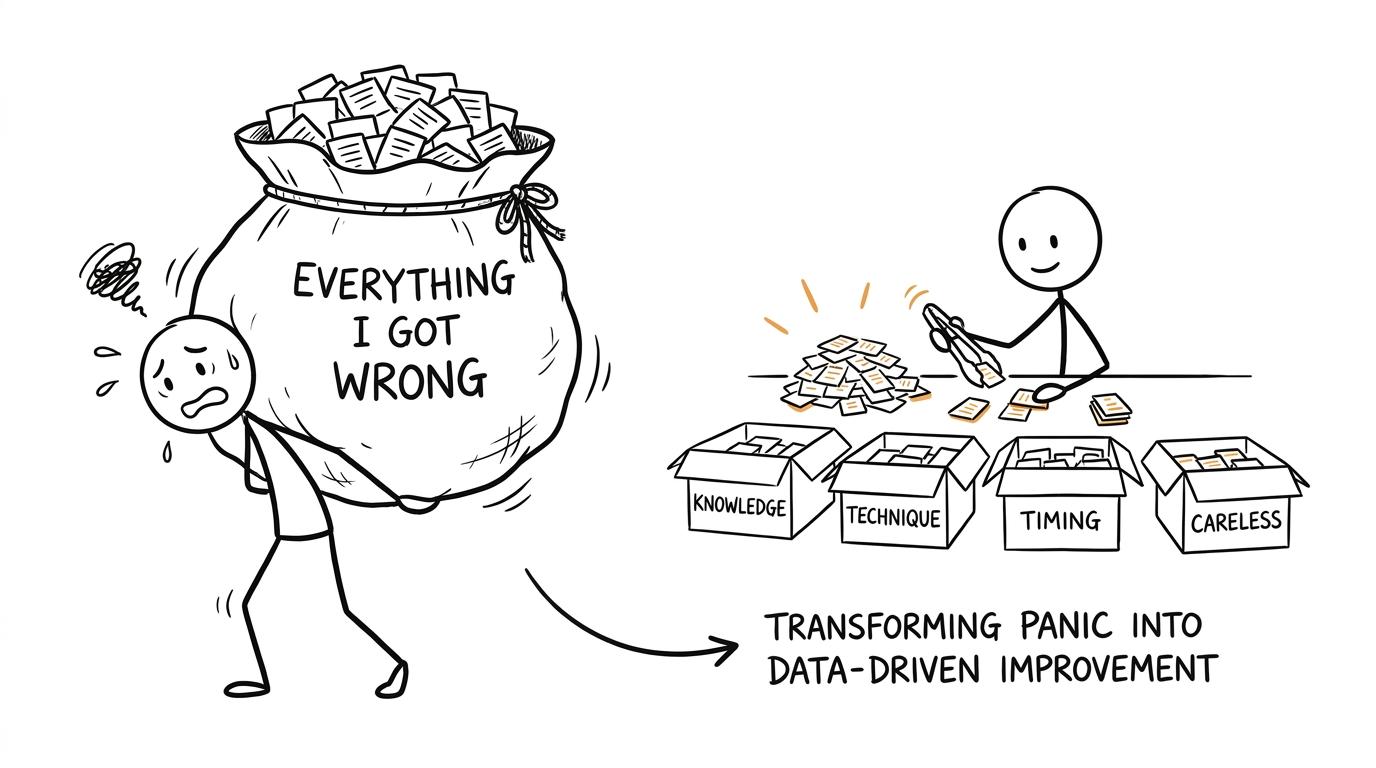 A large sack of mistakes becomes four manageable boxes
Build a plan around the weakest skill
Once you have classified the errors, count which categories recur. Choose the two areas responsible for the greatest loss. They become your first repair targets.
Listening
Listening improves through repeated, purposeful contact with unfamiliar speech. Use recordings approved by your teacher and attempt a short section without a transcript. Check it, identify the words or phrases that blocked understanding, then listen again.
Avoid trying to translate every word. Practise identifying who is speaking, the time frame, opinions, negatives and changes of viewpoint. Record confusing sound patterns so that future practice is based on real weaknesses.
Speaking
Speaking needs retrieval aloud, not silent recognition. Practise giving short answers without reading from a complete script, then develop them with reasons, opinions or another time frame where appropriate.
Ask your teacher to identify whether your main issue is hesitation, pronunciation, grammatical accuracy or limited development. Those problems require different practice. Memorising longer paragraphs will not necessarily improve spontaneous interaction.
Reading
For reading, separate vocabulary gaps from interpretation errors. Retrieve unfamiliar words from memory over several sessions, but also practise using the surrounding sentence to infer meaning.
Pay particular attention to negatives, connectives, pronouns and shifts between past, present and future. A single overlooked word can reverse the meaning of an otherwise familiar passage.
Writing
Writing revision should be guided by the marking criteria used for your paper. Build a checklist from teacher feedback: answering every prompt, communicating clearly, selecting suitable vocabulary and checking recurring grammatical errors.
Write under a short time limit, review the response against the checklist and improve only the sentences that need attention. Recopying an entire answer neatly may feel productive, but it can hide the specific decision that cost the mark.
Use a repeatable revision cycle
Effective recovery is less dramatic than panic suggests. A reliable session can follow this sequence:
- Retrieve vocabulary or structures without notes.
- Check the attempt and correct errors immediately.
- Practise one exam skill under a short time limit.
- Use feedback or a mark scheme to identify one improvement.
- Retest that skill on a later day with different material.
This approach reflects well-established guidance on self-regulated learning: plan the task, monitor performance and evaluate what should happen next. Retrieval also needs feedback. Recalling an incorrect form repeatedly can strengthen the wrong answer, so correction is not an optional final step.
Short sessions make this process easier to sustain. Maths students can apply the same structure through the 20-minute GCSE maths revision routine, which combines recall, exam-style questions and immediate marking.
Protect your GCSE maths revision
A bad Arabic mock can create tunnel vision. You give the subject every free evening because it currently feels most threatening. Two weeks later, algebra, geometry and ratio have quietly become less secure.
Instead, assign Arabic additional time with boundaries. Keep your existing maths appointments and adjust the flexible parts of your timetable. The GCSE Maths revision hub lets you choose your exam board and move between revision lessons, practice questions, mini tests and papers without wasting time searching.
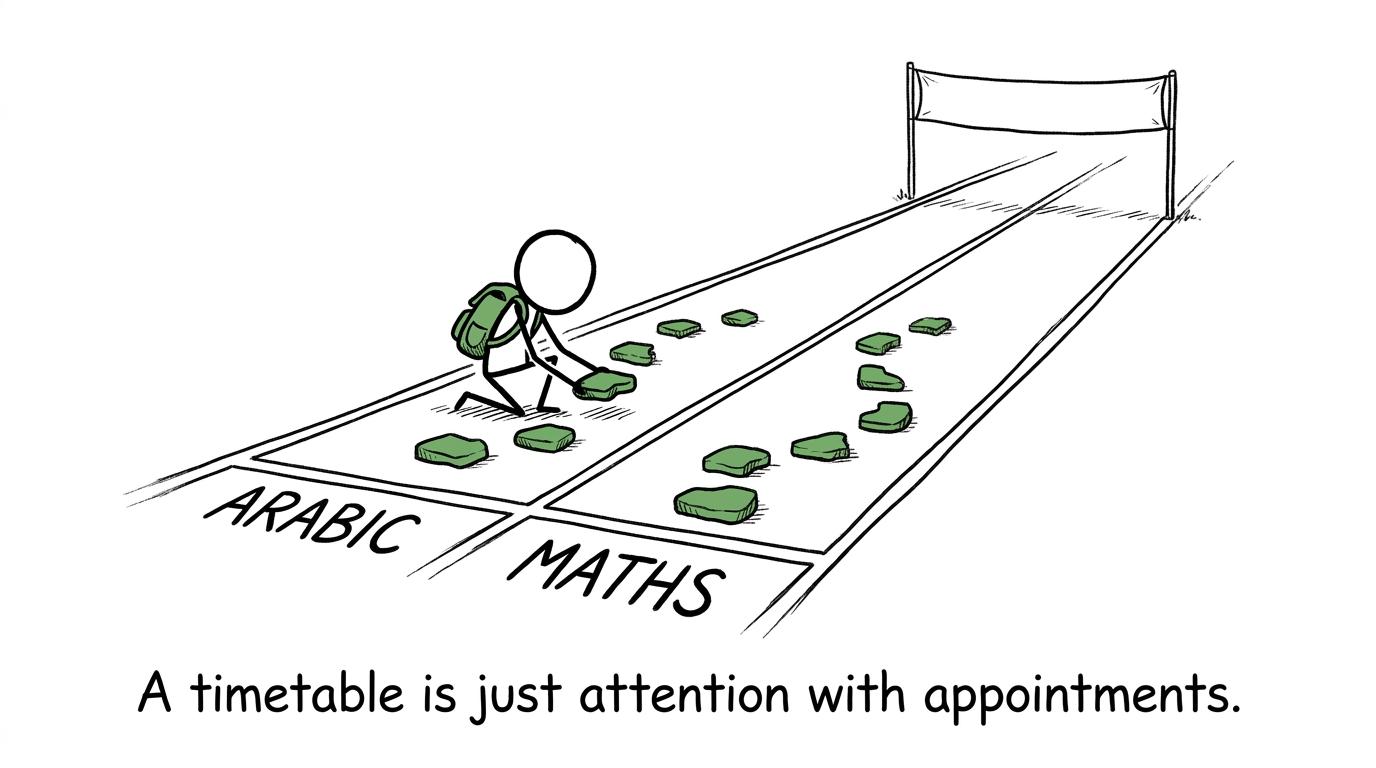 A student places steady revision steps in both Arabic and maths lanes
A balanced week might contain several short Arabic skill sessions and separate maths blocks based on current weaknesses. The precise schedule depends on your exam dates, teacher guidance and other commitments. What matters is that each block has a defined task.
“Revise maths” is too broad. “Complete a mini test, mark it and repair one topic” is usable. For a longer structure, adapt the rhythm in MathsGenie's one-month GCSE maths revision plan.
Measure recovery without chasing a grade every day
Progress first appears in small signals:
- fewer repeated vocabulary errors;
- more complete responses;
- better recognition of negatives and time frames;
- less hesitation in speaking;
- fewer unfinished questions;
- more accurate self-marking.
Track these before expecting a dramatic grade change. A grade compresses many decisions into one label. Your revision plan needs more detailed information.
After a suitable gap, complete a fresh task under realistic conditions. Do not immediately repeat the same paper and mistake familiarity for improvement. In maths, the equivalent process is explained in how to use GCSE past papers properly: complete, mark, diagnose, repair and retest.
As the maths exams approach, use Edexcel GCSE Maths predicted papers as additional practice rather than as promises about exact questions. Match all paper practice to your actual exam board and tier.
Common mistakes after a poor mock
Revising the entire course at once
This replaces one large disappointment with an impossible task. Begin with the two skills that cost the most marks.
Reading notes instead of retrieving
Recognition is comfortable but unreliable. Close the book and attempt to recall vocabulary, structures or response plans before checking.
Ignoring the mark scheme
An answer can contain relevant knowledge without meeting the demand of the question. Learn what was credited and why.
Repeating the same paper immediately
A higher mark may reflect memory of the questions. Repair the weakness first, leave a gap and then use fresh material.
Dropping maths until Arabic feels fixed
No subject is ever completely “finished”. Maintain regular maths contact through targeted topic practice and mini tests. Near the examination period, MathsGenie's GCSE maths exam-week checklist can help you keep that practice calm and proportionate.
Treating the mock grade as a prediction
A mock records performance on particular tasks, on a particular day, under your school's assessment arrangements. Its value lies in the information it gives you about the next step.
Make the mock useful
The emotional sting of a poor result is real, but it does not need to remain the most important part of the story. Once the paper has been broken into skills, causes and next actions, the result becomes smaller. More precise. More useful.
Ask for feedback, build your lost-marks log and begin with one focused Arabic repair session. Then return to the wider timetable.
For maths, make MathsGenie GCSE revision your free base: learn through revision lessons, strengthen methods with practice questions, check progress using mini tests and build exam confidence with past papers, predicted papers, mark schemes and video solutions. A mock shows where you were. Your next revision decision determines where you go.