Read GCSE Sociology Specification: Is It Worth It?
Read GCSE sociology specification documents wisely: discover what the official version reveals, what revision guides miss and how to use it efficiently.
There is a particular kind of revision anxiety that begins with a simple thought: What if my revision guide has missed something? If you are wondering whether to read GCSE sociology specification documents yourself, the short answer is yes, but selectively. The official specification is the final authority on assessable content, paper structure and assessment objectives. It can reveal details that a guide simplifies or overlooks. It is not, however, designed to teach the course or replace lessons, questions and past-paper practice.
The best approach is to treat the specification as a map. You consult it to confirm where the course can take you, then use better teaching resources to make the journey.
The quick verdict
Reading the official GCSE Sociology specification is worthwhile if you use it to:
- confirm that you have the correct exam board and qualification;
- see the complete list of topics, concepts, theories and research methods;
- understand what AO1, AO2 and AO3 require;
- identify small content gaps in your notes or revision guide;
- check which content belongs to each paper or component;
- build a final revision checklist.
It is not worth spending hours reading administrative sections that do not affect your answers. Nor should you mistake recognising a specification bullet point for being able to answer a question about it.
That distinction matters in every GCSE subject. A specification tells you what may be assessed. Practice tells you whether you can actually earn the marks.
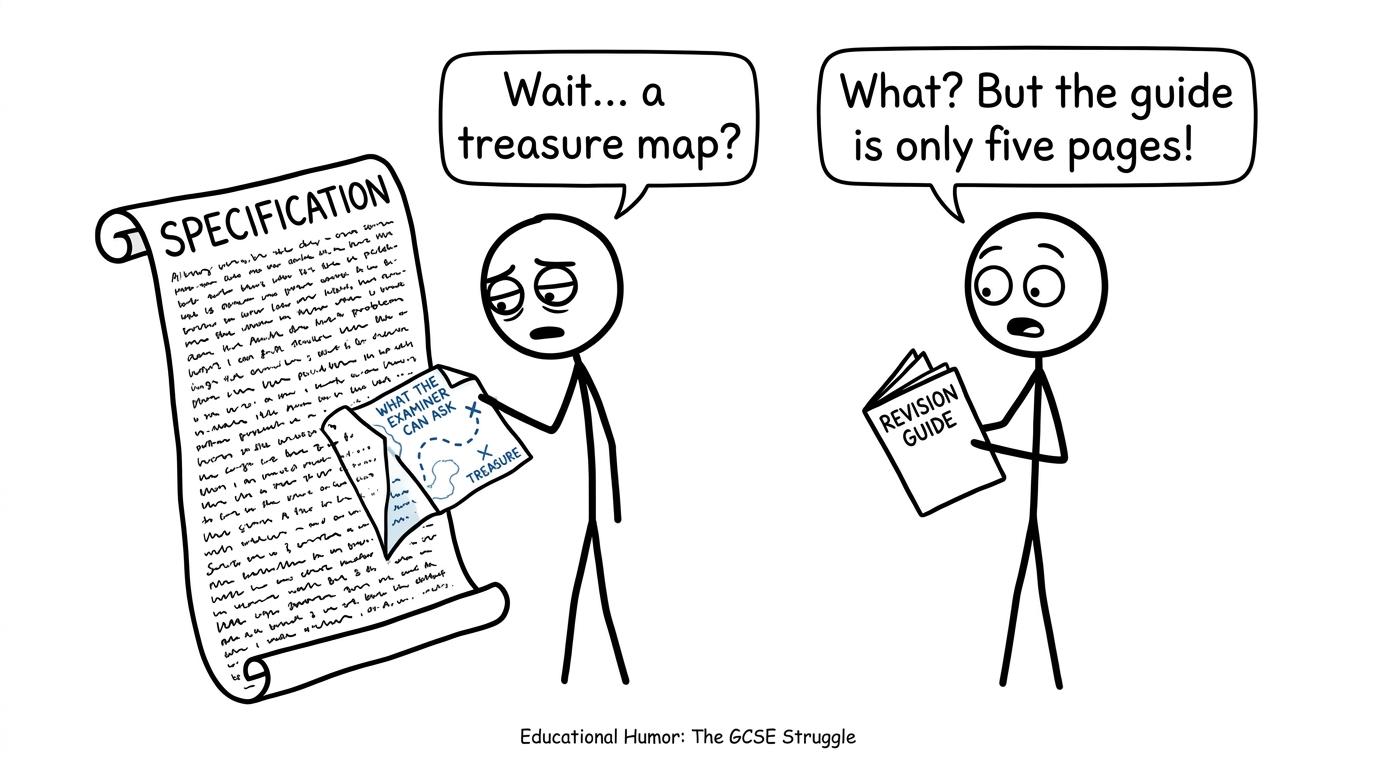 A student discovers a useful treasure map inside an enormous specification document
What the official specification gives you
A revision guide is written for students. A specification is written to define a qualification. That makes the guide easier to read, but it also means the official document contains a different kind of value.
The exact boundaries of the course
Specifications describe required content with deliberate wording. A guide may combine several ideas into one friendly chapter, while the specification separates the concepts, evidence, methods and connections students are expected to understand.
Reading those statements can expose quiet gaps. You may have revised the functions of education, for example, but not noticed that your board expects you to compare perspectives, apply evidence or connect education with broader patterns of inequality.
The specification also helps prevent revision drift. Sociology is connected to current affairs, politics, psychology and history, so it is easy to collect interesting material that is not central to your qualification. The official content list tells you what deserves priority.
The real assessment objectives
For GCSE Sociology qualifications regulated by Ofqual, the assessment objectives are weighted as follows:
| Assessment objective | What it rewards | Overall weighting |
|---|---|---|
| AO1 | Knowledge and understanding of theories, concepts, evidence and methods | 40%40\%40% |
| AO2 | Applying that knowledge and understanding | 40%40\%40% |
| AO3 | Analysis and evaluation used to construct arguments, make judgements and draw conclusions | 20%20\%20% |
This is one of the strongest reasons to read the document. Students sometimes revise as if sociology were entirely a memory test. The weighting shows why that is risky. Knowing a theory is valuable, but you must also be able to use it in the context of a question and assess its strengths, limitations or implications.
Research methods cannot be treated as an optional extra either. Current subject-level requirements state that at least 15%15\%15% of the qualification's marks must assess knowledge and understanding relating to research methods, across the assessment objectives.
Your actual paper structure
Your exam board matters. Do not download the first sociology specification that appears in a search and assume it is yours.
For example, the current AQA GCSE Sociology qualification is linear and has two written papers. Each lasts one hour and forty-five minutes, carries 100100100 marks and contributes 50%50\%50% of the qualification. Paper 1 focuses on families and education, while Paper 2 focuses on crime and deviance and social stratification. Relevant theory and methodology are assessed across the course.
The Eduqas qualification also has two equally weighted components, each assessed by a written examination lasting one hour and forty-five minutes. Its content is organised differently: Component 1 covers cultural transmission, families, education and research methods, while Component 2 covers social differentiation and stratification, crime and deviance, and applied methods of enquiry.
Those differences are not trivia. They affect how you organise folders, build revision sessions and choose past papers. Always confirm the board and qualification code with your teacher before using the document.
What a revision guide may not show clearly
A good revision guide translates formal requirements into manageable explanations. That is useful, but translation always involves choices.
A guide may:
- shorten the official wording;
- prioritise common theories or studies;
- place connected ideas in different chapters;
- provide a limited selection of examples;
- focus on knowledge more visibly than application;
- omit administrative detail that most students do not need.
None of this makes the guide unreliable. It simply means the guide and specification perform different jobs. The specification establishes coverage; the guide supports understanding.
Think of the same principle in maths. A topic list can tell you that algebraic fractions are included, but it cannot develop the fluency needed to simplify one under exam pressure. For that, students need revision lessons, questions and feedback. MathsGenie's GCSE maths revision hub is organised around that movement from content to practice.
How to read the GCSE Sociology specification efficiently
Reading every page from beginning to end is rarely the best use of revision time. Official documents often include information for teachers, centres and exam administrators alongside the sections students need.
Start with five high-value sections
Find and read:
- the specification at a glance;
- the subject content;
- the scheme or summary of assessment;
- the assessment objectives and weightings;
- any appendix containing required key terms or concepts.
Skip administrative material unless it answers a specific question you have. Your aim is not to become an expert in qualification regulation. It is to understand what you must know and what you must do.
Turn content statements into a checklist
Copy each assessable topic into a document or spreadsheet. Beside every item, use three columns:
| Status | Meaning | Next action |
|---|---|---|
| Secure | You can explain and apply it without notes | Revisit through mixed questions |
| Developing | You recognise it but cannot use it reliably | Review notes, then practise |
| Missing | You cannot explain it accurately | Ask your teacher and relearn it |
Be strict. “I remember seeing this” is not the same as “I can construct an answer about this”. A specification is most valuable when it produces an honest diagnosis.
This mirrors an effective maths revision system: identify the gap, learn the method, practise it, mark the work and retest it. The GCSE maths revision timetable guide explains how to build those actions into a realistic week.
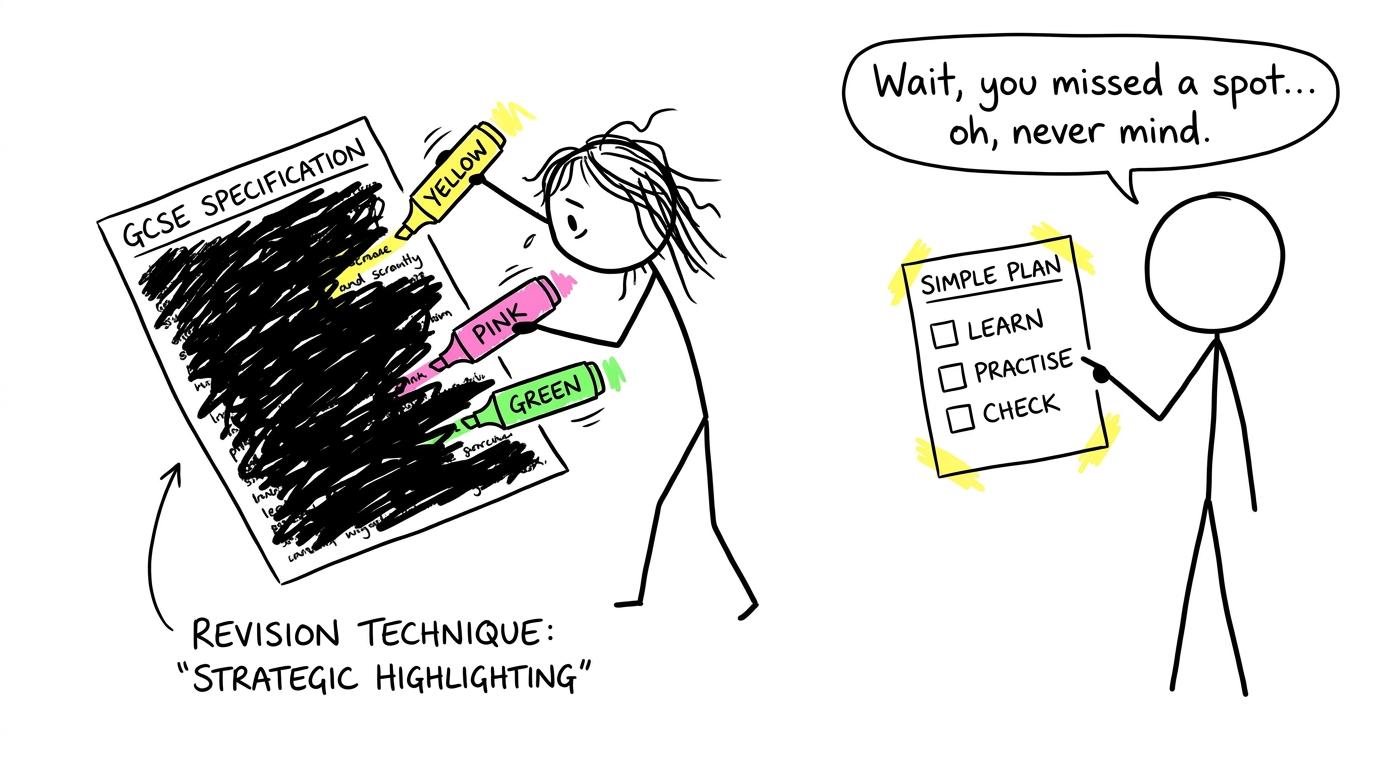 A student learns that highlighting the entire specification is not a revision strategy
Translate each statement into a question
A content bullet only becomes useful revision when it prompts retrieval. Turn “understand the strengths and limitations of questionnaires” into questions such as:
- What are the practical strengths of questionnaires?
- How can question wording affect validity?
- When might questionnaires produce more reliable data?
- How would I apply these ideas to an unfamiliar investigation?
This is not a worked answer. It is a method for converting passive reading into active revision. The same principle underpins MathsGenie's twenty-minute GCSE revision routine: attempt, check, record the weakness and return to it.
Use the specification with papers and mark schemes
The specification alone cannot show how broadly a topic may be framed, how stimulus material is used or what a successful response looks like. For that, you need assessment materials.
Use three documents together:
- Specification: defines the content and skills.
- Past paper: shows how those requirements become questions.
- Mark scheme: shows how credit is awarded.
After reading a specification section, find relevant questions from your own exam board. Notice the command words and decide which assessment objectives are involved. Then compare your response with the mark scheme and any teacher guidance.
This three-part method is equally powerful in maths. The guide to using GCSE past papers properly explains why the important work happens after a paper, when errors are classified and repaired. Maths students can also use Edexcel GCSE Maths past papers or the board-specific OCR GCSE Maths revision hub to keep their practice aligned with the correct course.
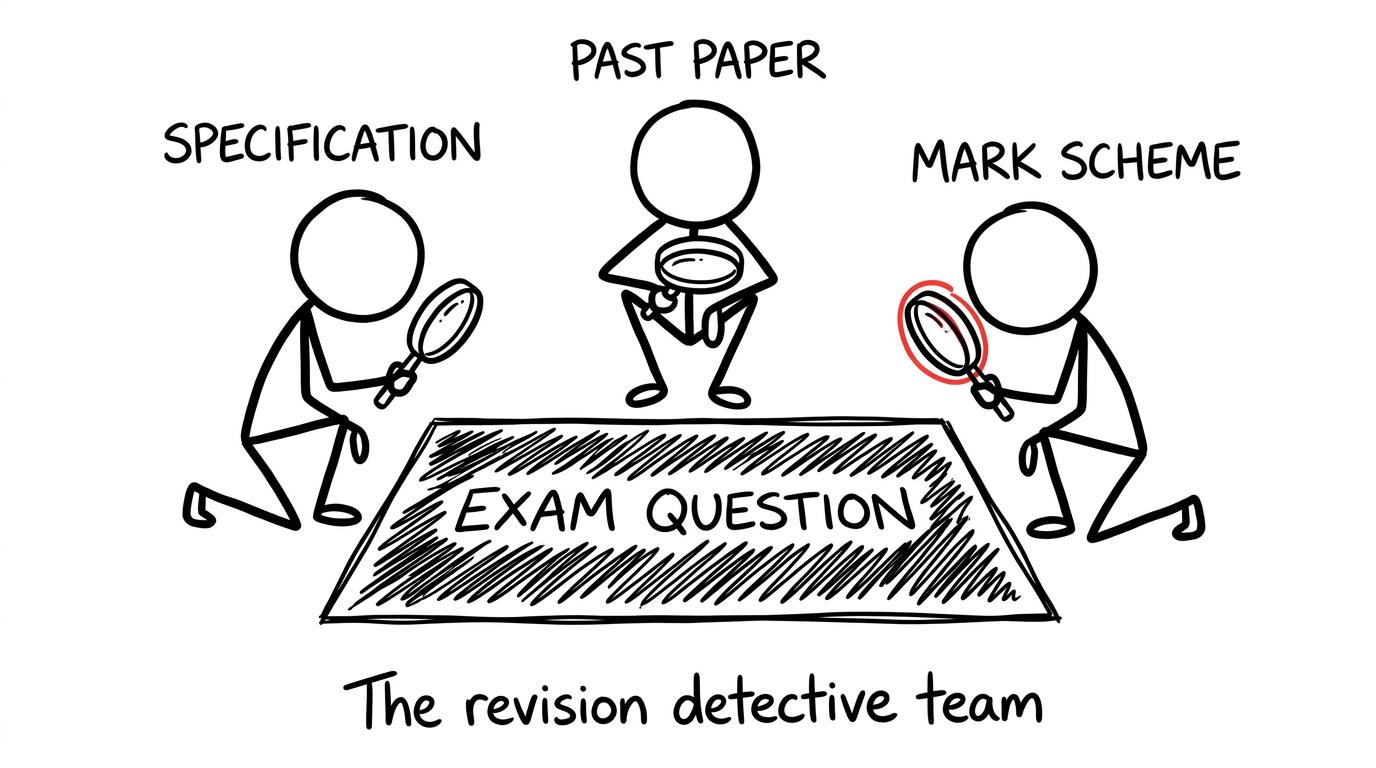 A specification, past paper and mark scheme form the revision detective team
Why this matters for students preparing for maths exams
You may be reading about sociology while maths is the exam causing the most worry. The useful lesson transfers directly: official specifications define coverage, but improvement comes from doing the subject.
For sociology, that means retrieving concepts, applying theories, evaluating evidence and writing answers. For maths, it means selecting methods, showing working, checking accuracy and responding to unfamiliar problems.
You do not need to read the entire GCSE Maths specification every week. A board-specific topic map is usually more practical. MathsGenie's GCSE maths topics by exam board and tier helps you check the content for Edexcel, AQA, OCR and Eduqas while distinguishing foundation and higher tier expectations.
Once the map is clear, move into active work. Use revision lessons to rebuild understanding, topic questions to create fluency, mini tests to check recall and full papers to practise decisions under time pressure. A one-month GCSE maths revision plan can help you fit that cycle around other subjects, including sociology.
Common mistakes when using a specification
Reading the wrong exam board's document
AQA and Eduqas organise GCSE Sociology differently. Check the board, qualification title and code with your teacher rather than relying on a familiar logo or search result.
Highlighting without testing yourself
Colouring a content statement may create a sense of progress, but it provides no evidence that you can recall, apply or evaluate the idea. Convert statements into questions and answer them without notes.
Treating every page as equally important
Subject content and assessment sections deserve close attention. Centre administration generally does not. Read with a purpose rather than measuring success by pages completed.
Assuming the specification teaches the topic
Official wording can be brief and technical. If a bullet point is unfamiliar, take it to your teacher, class materials or a trusted revision resource. Do not invent your own interpretation.
Replacing exam practice with document reading
Checking coverage is preparation for revision, not the whole of revision. Your plan must still include retrieval, timed responses, past papers and careful use of mark schemes. Maths students can strengthen that habit with MathsGenie's guide to learning from GCSE mark schemes.
The best final decision
Yes, it is worth reading the official GCSE Sociology specification yourself. But the return comes from reading the right sections with a pen, a checklist and a clear question: What does this reveal that I need to learn or practise?
Use the document once to map the course, again to audit your revision and briefly near the exam to check for neglected areas. Between those checks, spend most of your time retrieving knowledge, applying it and answering questions.
Apply the same discipline to maths. Begin at the MathsGenie GCSE maths revision hub, confirm your board and tier, then work through free revision lessons, practice questions and mini tests. When your foundations are secure, use past papers, predicted papers, mark schemes and video solutions to turn the specification's content into marks you can actually earn.