

Should You Read the GCSE Combined Science Specification?
Read GCSE Combined Science specification documents selectively to uncover exact content, maths skills and practical requirements without wasting revision time.
A revision guide can make science feel manageable. It shortens explanations, highlights key facts and removes the language that exam boards use behind the scenes. That is useful, until you begin wondering whether something important has been left out.
So, should you read GCSE Combined Science specification documents yourself? Yes, but selectively. You do not need to read every page from beginning to end. Instead, use the official specification as a checklist of what can be assessed, then use lessons, questions and past papers to learn how that content appears in an exam.
For a student preparing for both science and maths, the specification has an extra benefit: it reveals exactly which mathematical skills can appear in Biology, Chemistry and Physics. Those links are easy to miss when you rely entirely on a condensed guide.
The quick answer
The specification is worth opening if you use it to:
- confirm that you have the correct exam board and qualification;
- identify assessable topics and required practical work;
- find mathematical skills attached to science content;
- distinguish foundation and higher tier requirements;
- check equations, units and scientific terminology;
- turn broad revision headings into a precise checklist.
It is not worth reading as if it were a textbook. Specifications are written primarily to define qualifications, not to teach students. They tell you what must be known, understood or applied, but often not how to learn it.
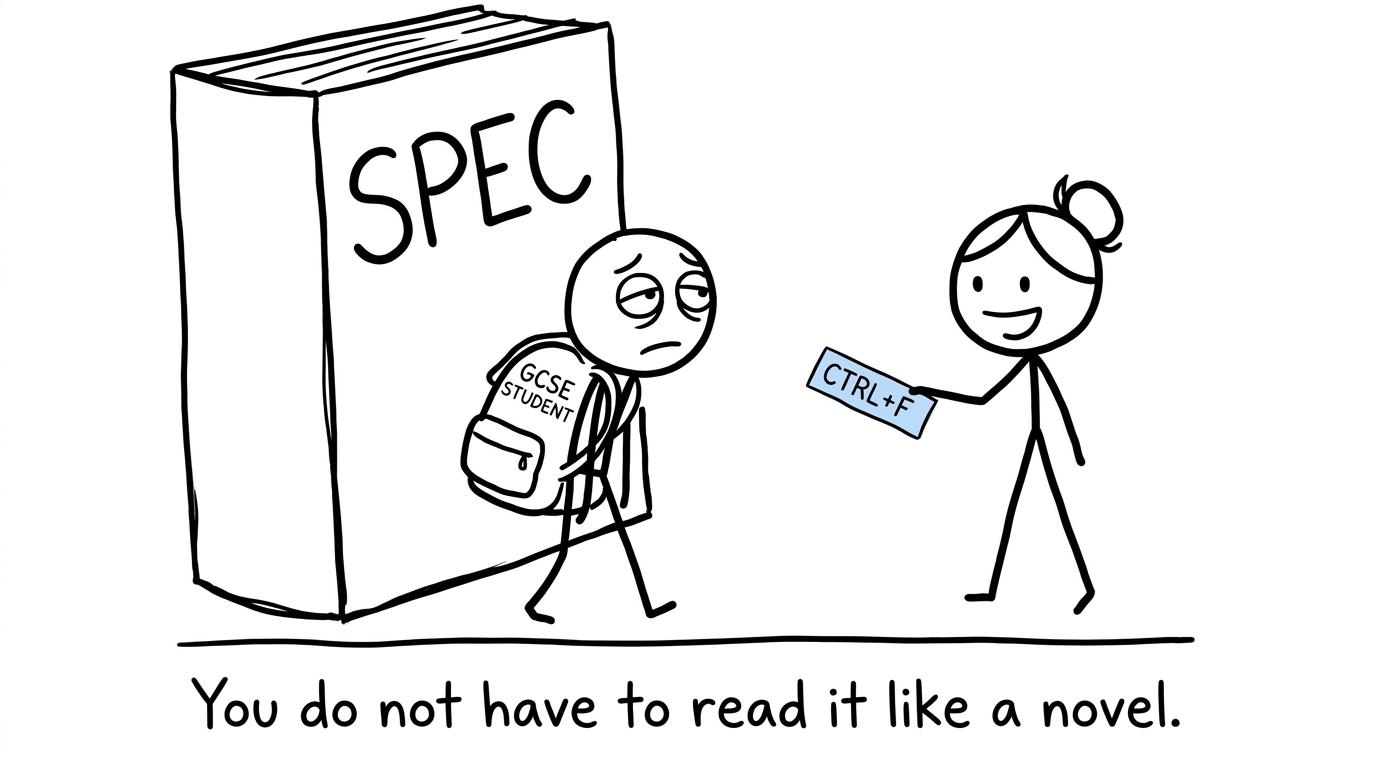 A student discovers that an official specification does not need to be read like a novel
What the official specification gives you that a guide may not
Revision guides are interpretations. Good ones are careful interpretations, but they still involve decisions about what to shorten, combine or emphasise. The official specification is the exam board's own definition of the qualification.
The exact boundary of assessable content
The most useful specification statements usually begin with language such as “students should be able to”, “learners should” or “students must”. These statements are more precise than chapter titles.
A guide might call a section “forces”, for example. The specification breaks that large idea into smaller knowledge and skills: interpreting motion graphs, applying equations, converting units and explaining physical relationships. That detail helps you see whether “I revised forces” really means “I can do every assessed part of forces”.
This is why the document works well as a final coverage check. It can expose small gaps hidden inside familiar topics.
Your board's organisation of the course
AQA, Pearson Edexcel, OCR and Eduqas all work within regulated GCSE Combined Science requirements, but they organise specifications and assessments differently. OCR also offers distinct Combined Science routes, so recognising the exact qualification title and code matters.
Before using any checklist, confirm:
- your exam board;
- the qualification name and code;
- whether you take foundation or higher tier;
- the current issue or version of the document;
- which content belongs to each paper or component.
Do not assume that a checklist made for another board will match your paper structure. The science may overlap substantially, but the organisation, terminology and required practical arrangements can differ.
The distinction between knowledge and application
A list of facts can create the impression that science is mainly recall. Official specifications show a wider picture. Students must also apply ideas, interpret evidence, analyse data, evaluate methods and work scientifically.
That matters because recognising a definition is not the same as answering a question in an unfamiliar context. The specification can tell you that data analysis is assessable; only practice questions and past papers can develop the judgement needed to do it reliably.
The maths hidden inside Combined Science
For maths students, this is the strongest reason to inspect the document. Current GCSE Combined Science requirements specify that at least 20%20\%20% of qualification marks assess mathematical skills in a science context. Those marks are distributed across Biology, Chemistry and Physics in the ratio 1:2:31:2:31:2:3.
The precise question will still be scientific, but the underlying skill may already be familiar from GCSE Maths. Common requirements include:
- decimals, fractions, ratios and percentages;
- standard form and orders of magnitude;
- arithmetic means and significant figures;
- probability and sampling in suitable contexts;
- rearranging and substituting into equations;
- unit conversions;
- plotting and interpreting graphs;
- gradients, intercepts and tangents;
- areas and volumes.
At foundation tier, mathematical assessment is not set below the expected Key Stage 3 level. At higher tier, it is not set below the level of foundation tier GCSE Maths questions. The mathematics must remain within the requirements of the appropriate GCSE Maths tier, but scientific context can make familiar operations feel less obvious.
A percentage question about yield, a ratio in genetics and a gradient representing reaction rate may look unrelated. Mathematically, they draw on a small collection of transferable ideas.
If these skills feel uncertain, use MathsGenie's GCSE Maths topics by exam board and tier to locate the underlying topic. Particularly useful starting points include standard form revision, direct and inverse proportion and speed and density revision.
What you will not gain from reading it
The specification cannot replace teaching, retrieval practice or exam questions.
It rarely gives a student-friendly explanation of why an idea works. It does not provide enough repetition to make equation use automatic. Nor does it show the full range of wording, diagrams and unfamiliar situations that an examiner might place around a familiar principle.
There is also a danger in confusing recognition with mastery. Reading “use ratios, fractions and percentages” can feel reassuring because the words are familiar. Yet the real test is whether you can identify the required operation, select relevant data, maintain consistent units and communicate a justified answer under time pressure.
Treat the specification as a map. A map can confirm that a road exists; it cannot walk the road for you.
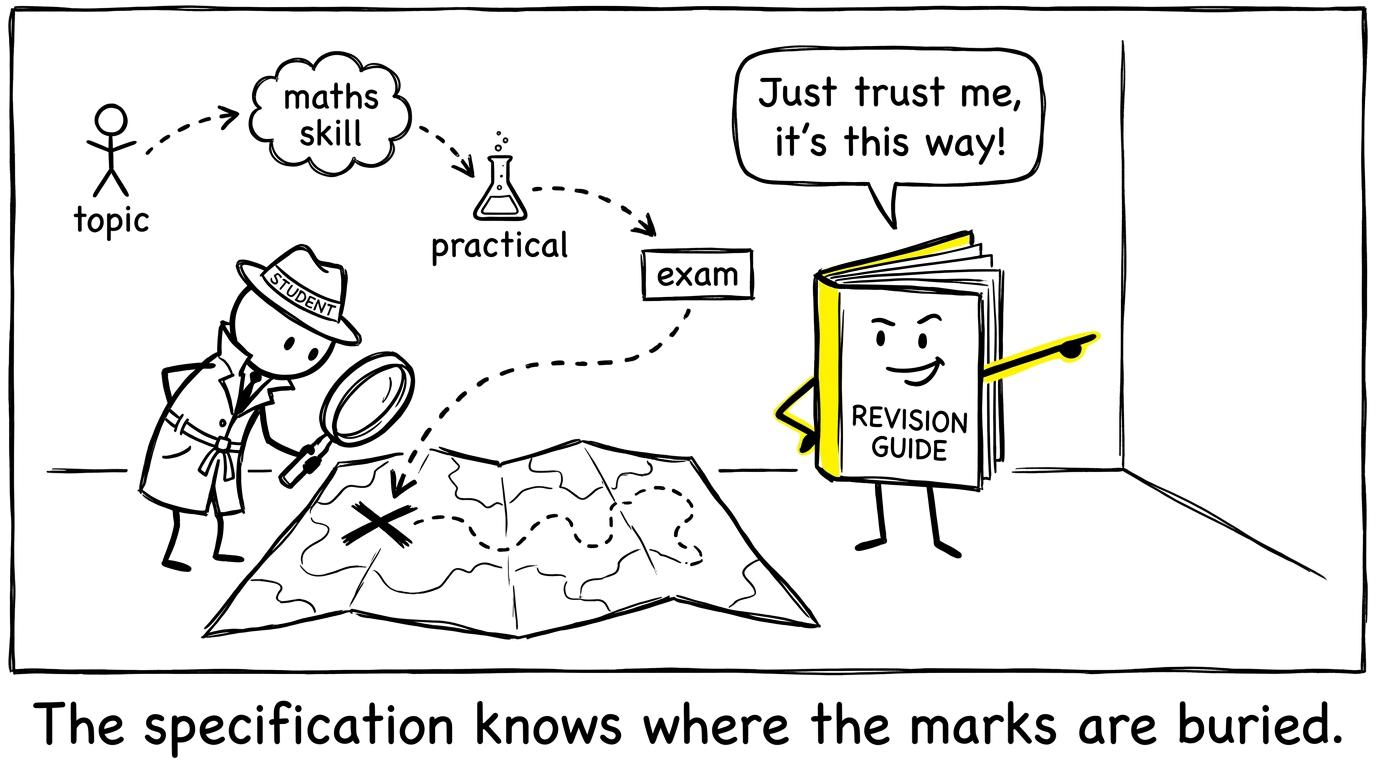 A student detective follows specification clues towards the exam
How to read the specification without wasting time
Begin with the assessment overview
Read the opening pages that identify the qualification and explain its assessment structure. Confirm the papers or components, tiering and broad content allocation. Skip administrative material that is intended mainly for centres unless it answers a specific question.
Search rather than scroll
Use the document search function for a topic, practical, equation or skill. Useful searches include “mathematical skills”, “working scientifically”, “higher tier”, “equations”, “students should” and the name of the topic you are revising.
This turns a long document into a reference tool. You are looking for requirements, not trying to remember every paragraph.
Convert statements into a traffic-light checklist
Mark each relevant statement:
- Green: you can explain it and answer questions without notes;
- Amber: you recognise it but need prompts or make errors;
- Red: you cannot yet explain or apply it.
Be strict. A green statement should survive an exam question, not merely look familiar. Your amber and red statements then become the next items in your revision plan.
MathsGenie's GCSE maths revision timetable guide explains how to turn identified weaknesses into manageable sessions rather than an unrealistic list.
Match requirements to exam evidence
After checking a specification statement, find questions that assess the same knowledge or skill. Complete them without notes, mark them and record why any marks were lost.
For mathematical weaknesses, the useful cycle is:
- revisit the method through a revision lesson;
- complete focused practice questions;
- mark your work immediately;
- repeat the skill in a scientific context;
- test it later in a mixed or timed paper.
The GCSE past-paper timing guide can help you decide when to move from topic work into complete papers.
Equations, units and practical requirements
Specifications are especially valuable when details matter.
The appendices or content sections often identify mathematical skills, scientific units, apparatus and practical techniques. They may also distinguish equations or content by tier. Read those annotations carefully because bold type, symbols and footnotes can carry meaning.
Formula and equation-sheet arrangements have changed during the lifetime of current qualifications. For the present specifications, exam boards provide official information about the equation sheets used in current assessments. Always check the latest page for your own board and exam year rather than relying on an old guide, teacher handout or social-media post.
Even when an equation is supplied, you still need to recognise when it applies, understand its quantities, substitute correctly, rearrange where necessary and use compatible units. The SI units, prefixes and standard form guide is useful for strengthening that bridge between GCSE Maths and science calculations.
Required practical work deserves similar attention. The specification clarifies which apparatus, techniques or practical experiences belong to the course. But revision should go beyond memorising a method: you may need to interpret results, discuss variables, evaluate limitations or suggest improvements.
Common mistakes when using a science specification
Reading the wrong document
Separate Science, Combined Science and different board routes are not interchangeable. Check the title and qualification code before building a checklist.
Reading every page with equal attention
Administrative rules, teacher guidance and assessable student content do not have equal revision value. Prioritise assessment information, content statements, mathematical requirements, practical requirements and relevant appendices.
Treating it as a complete revision resource
A specification identifies destinations but does not provide enough explanation or practice. Pair it with lessons, questions, mark schemes and past papers.
Ignoring small command phrases
Words such as “calculate”, “explain”, “evaluate”, “interpret” and “compare” indicate different performances. Do not reduce every statement to a fact that needs memorising.
Assuming supplied equations remove the maths
An equation sheet does not choose the equation, convert the units or complete the rearrangement. Those are the parts where mathematical confidence earns marks.
Turning the checklist into procrastination
Formatting a perfect spreadsheet can feel productive while avoiding questions. Keep the checklist simple. Its purpose is to decide what you will practise next.
Is reading the full document worth your time?
Reading the whole specification line by line is rarely the best use of limited revision time. Reading the relevant sections carefully is worthwhile.
The document gives you certainty: the correct scope, exact wording, mathematical expectations, tier distinctions and practical requirements. A guide gives you accessibility. Lessons build understanding. Questions reveal whether that understanding works under pressure.
The strongest revision combines all four.
Open your correct specification and check one topic today. Identify one mathematical skill beneath it, then use MathsGenie's free GCSE revision routine to turn that discovery into action. Follow revision lessons with practice questions, mini tests and past papers; then use mark schemes and video solutions to repair mistakes. Nearer the exams, add GCSE predicted papers to sharpen timing and expose the final gaps.
The specification tells you where the boundaries are. MathsGenie helps you build the skills that carry you across them.











