

Pomodoro Technique GCSE French: Does It Work?
Pomodoro technique GCSE French: learn when 25-minute bursts help vocabulary, when longer practice works better, and how to build a balanced revision plan.
Revision often begins with a bargain: concentrate for the next few hours, and then you can relax. The trouble is that the brain rarely agrees to the terms. Ten minutes later, the vocabulary list is open but your attention is elsewhere.
The Pomodoro technique for GCSE French can help, particularly when procrastination is the main problem. A timer creates a clear starting line: work on one defined task for about 252525 minutes, take a short break, then repeat. But it is not automatically better than every other revision method. Short bursts suit vocabulary retrieval, grammar drills and focused listening. Longer, flexible sessions are usually better for complete writing tasks, speaking practice and full exam papers.
The useful question is not simply, “Does Pomodoro work?” It is: Which French task are you trying to complete?
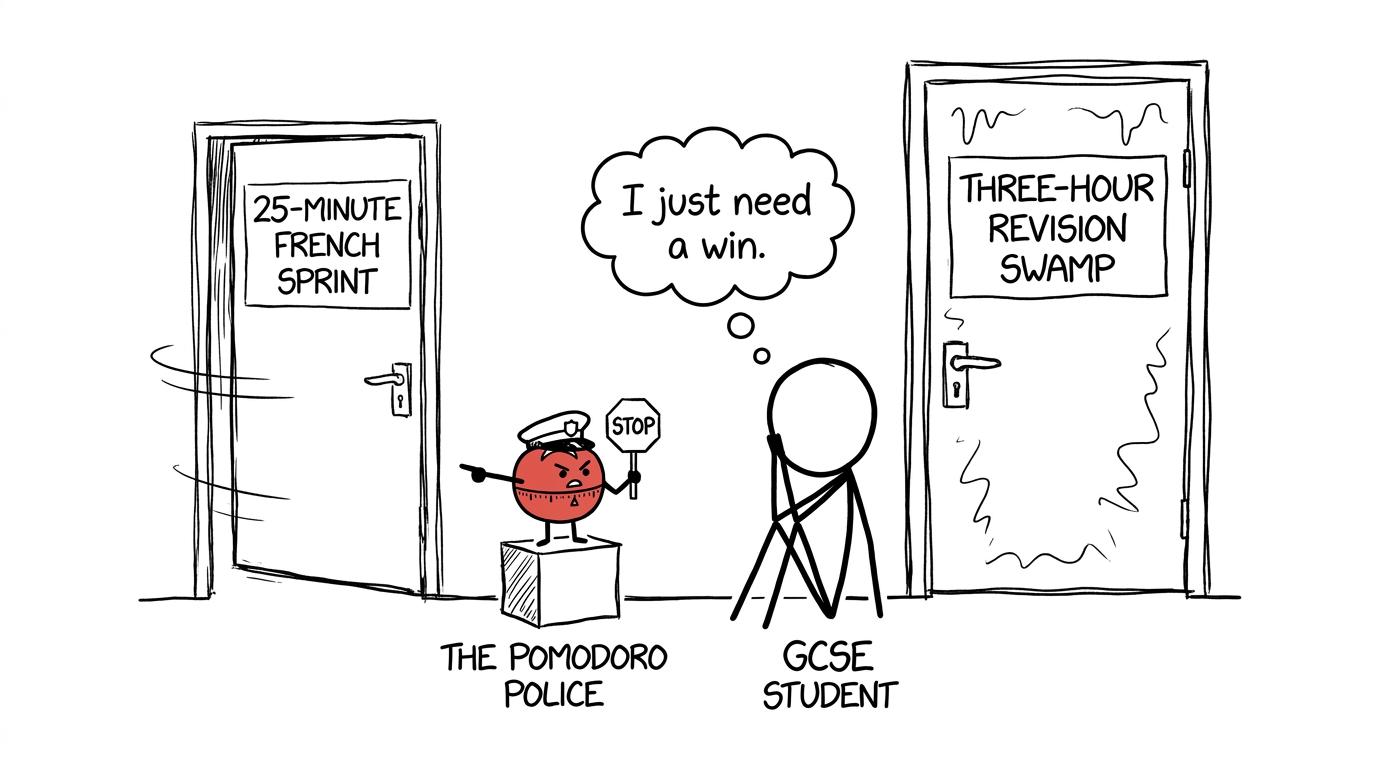 A student chooses between a short French revision sprint and a revision swamp
The quick verdict
Use this checklist before starting:
- Choose one specific French task, not “revise French”.
- Try a 202020 to 303030 minute focus period followed by a 555 minute break.
- Use active recall rather than simply rereading notes.
- Stop the timer only for a genuine interruption.
- Join two focus periods when a speaking or writing task needs continuity.
- Review your work after each block.
- Revisit vocabulary on later days rather than cramming it once.
- Use longer timed sessions as the examination approaches.
Pomodoro is therefore best understood as a time-management framework, not a learning method in itself. The timer may get you into the chair. What happens during the timed period determines what you learn.
What does the Pomodoro Technique involve?
The traditional structure is straightforward:
- select one task;
- work without switching tasks for 252525 minutes;
- take a break of roughly 555 minutes;
- repeat the cycle;
- take a longer break after several cycles.
There is nothing scientifically sacred about exactly 252525 minutes. In a 2023 study involving university students, researchers compared self-regulated breaks with predetermined schedules, including 242424 minutes of work followed by 666 minutes of rest and 121212 minutes followed by 333 minutes. The structured groups reported less fatigue and distraction, but there was no clear difference in task completion.
A later 2026 experiment involving 176176176 university students found no statistically significant learning-performance advantage for systematic short breaks over self-regulated breaks. Students choosing their own breaks reported a more positive experience in that particular task.
That distinction matters. Current evidence suggests that predetermined breaks can support concentration and effort regulation, but it does not prove that a fixed 252525-minute timer improves GCSE French grades. Most direct Pomodoro research has involved university students rather than GCSE language learners.
The sensible conclusion is modest: timers can make revision easier to begin and contain, but timing should remain flexible.
Why short revision bursts can help GCSE French
GCSE French requires several kinds of performance. Depending on your exam board and specification, you will need to understand spoken and written language, apply grammar and vocabulary accurately, and communicate through speaking and writing. The reformed French GCSE specifications first assessed in England in summer 2026 retain foundation and higher tiers, with students taking their assessments at one tier.
A single revision format cannot prepare every skill equally well. Short intervals are particularly effective for contained tasks with immediate feedback.
Vocabulary retrieval
A 252525-minute block is long enough to test a manageable set of words in both directions: French to English and English to French. Covering the answer and retrieving it from memory is more useful than repeatedly looking at a list.
Research into second-language vocabulary consistently supports spacing and retrieval practice. Words are more likely to be retained when encounters are distributed across separate sessions and learners actively recall them. Pomodoro can provide the container for that process, but the spacing must continue across different days. Four consecutive blocks on one evening are not the same as revisiting vocabulary throughout the week.
Grammar drills
Focused blocks also suit a narrow grammar target such as adjective agreement, verb forms or selecting an appropriate tense. A precise goal reduces decision-making and makes correction easier.
A useful session ends with a short error record. Write down the pattern behind each mistake rather than merely copying the corrected answer. This resembles the learn, practise, mark and retest cycle used in the free MathsGenie GCSE maths revision hub. The subject changes, but the principle survives: feedback turns completed work into better future performance.
Short listening practice
Listening demands close attention, so a limited interval can be helpful. One block might include listening to a short extract, answering questions, checking the transcript or mark scheme, and replaying the sections you misunderstood.
Do not spend the whole interval passively replaying audio. Pause to identify why an answer was missed: unfamiliar vocabulary, a tense, a negative expression, pronunciation or loss of concentration.
When GCSE French needs longer sessions
A timer becomes unhelpful when it interrupts the very skill you are trying to develop. Some tasks need continuity, stamina and room to think.
| French revision task | Better session structure |
|---|---|
| Vocabulary recall | 202020 to 252525 focused minutes |
| One grammar target | 202020 to 303030 focused minutes |
| Short listening extract | One focused block with review |
| Speaking conversation | Flexible block without stopping mid-answer |
| Extended writing | 404040 to 606060 minutes, depending on the task |
| Complete practice paper | Official time for your board and tier |
Writing needs planning and sustained attention
An extended response involves interpreting the task, planning ideas, choosing vocabulary, controlling tenses and checking accuracy. Stopping at 252525 minutes simply because a timer rings may break a productive chain of thought.
You can still use Pomodoro around the task. One short block could review relevant vocabulary and grammar. The next, longer block could be reserved for uninterrupted writing. A final block could be used for checking against the task instructions and mark scheme.
Speaking should not stop at the bell
Speaking fluency develops by sustaining an answer, responding to prompts and recovering when a word does not arrive immediately. A timer can define the overall practice session, but it should not end a response halfway through.
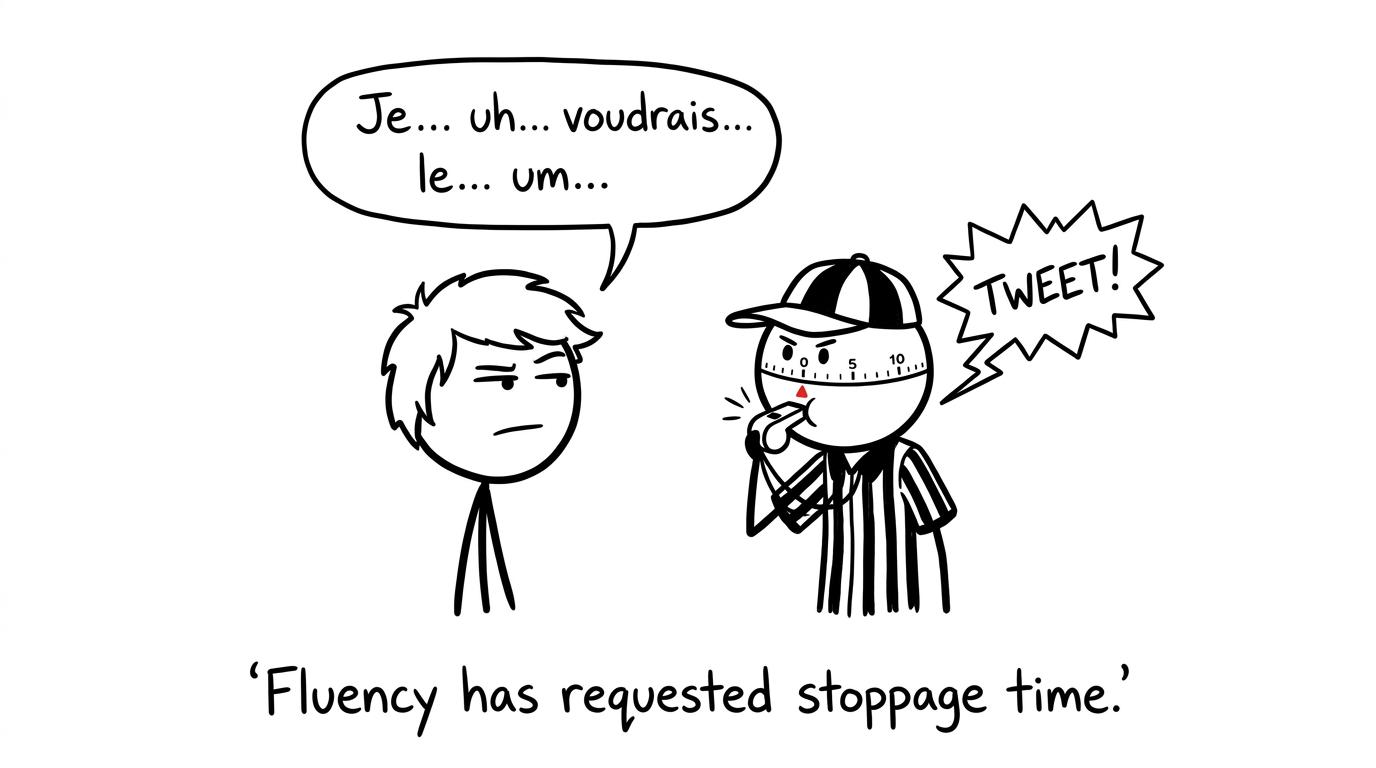 A strict tomato timer interrupts French speaking practice
Practise a complete role-play, reading-aloud activity, visual task or conversation section in the format required by your specification. Record yourself where appropriate, then use the remaining time to notice hesitation, pronunciation and repeated grammatical errors.
Exam papers require examination stamina
Short bursts are excellent while building knowledge. They are not a substitute for sitting complete papers under realistic conditions.
The same progression applies in maths. Topic practice builds individual skills, while timed papers reveal whether those skills survive under pressure. Maths students can use guidance on when to begin GCSE past papers and the GCSE one-week revision plan to move gradually from short sessions towards sustained exam practice.
How to build an effective French Pomodoro session
Before starting the timer, define an outcome you can check. “Learn vocabulary” is vague. “Recall the French for a selected set of school-topic words and record the ones I miss” is observable.
A strong revision cycle looks like this:
- Prepare: choose the resource and remove unrelated tabs.
- Retrieve: answer from memory before checking notes.
- Check: use a reliable answer, transcript or mark scheme.
- Correct: explain the reason for each error.
- Schedule: decide when you will test the material again.
Keep the difficulty appropriate to your tier and specification. For maths, the GCSE topics by exam board and tier guide serves the same purpose: it prevents students from spending valuable time on a task that does not match their course.
If 252525 minutes feels too long, begin with 151515 or 202020. If you regularly reach the timer while still concentrating, try 353535 or 404040. The best interval is one that helps you start without repeatedly interrupting useful thought.
Plan breaks that actually restore attention
A short break works only if it remains short. Social media is designed around continuation, so “one quick look” can consume the next focus period.
Stand up, stretch, drink water, look away from the screen or prepare the materials for the next task. Keep the timer visible and avoid beginning anything without a natural stopping point.
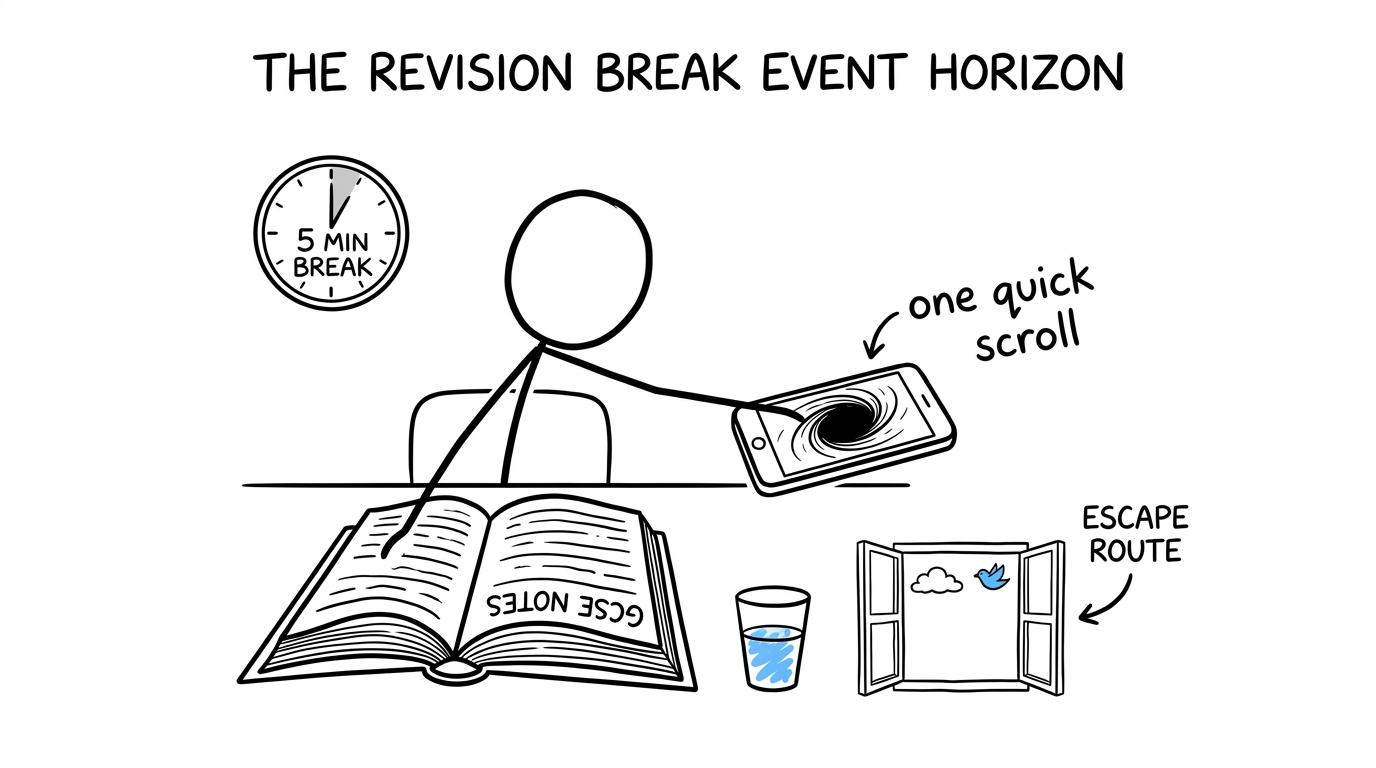 A revision break phone becomes a cartoon black hole
Students balancing French with maths can assign each block deliberately rather than switching impulsively. Use the best order for learning GCSE maths topics to select a precise maths target, then return to French in the next planned session. Deliberate switching is useful; distracted switching is not.
Common Pomodoro mistakes in GCSE revision
Measuring time instead of learning
Completing six timed blocks may feel productive, but the number of blocks says nothing about recall or accuracy. Track words retrieved, errors corrected or marks gained instead.
Rereading throughout the focus period
Familiarity can be mistaken for knowledge. Close the book, produce an answer and then check it. Retrieval makes the gap visible.
Treating every task identically
Vocabulary cards and extended writing do not demand the same rhythm. Use short blocks for precise practice and longer sessions for performance tasks.
Ignoring mistakes after marking
Marking is not the end of revision. It tells you what to do next. Maths students can see this process in MathsGenie's guide to using Edexcel past papers properly, while the broader principle applies to any exam board and subject.
Avoiding full papers because short sessions feel safer
Pomodoro lowers the barrier to beginning, which is valuable. Eventually, however, you must practise sustained concentration. Build from topic drills to sections and then to full timed assessments.
Make the timer serve the subject
The Pomodoro Technique works best when it removes friction: one task, one starting point and one protected interval. For GCSE French, it is particularly useful for vocabulary retrieval, grammar, corrections and short listening activities. It is less suitable when a rigid bell interrupts speaking, writing or full-paper practice.
That balance also improves maths revision. Begin with a focused lesson or question set, then progress towards mini tests and complete papers. If you take Edexcel, the guide to revising GCSE maths without wasting time provides a practical cycle. Students preparing for any supported board can start from the free GCSE maths revision hub.
Use MathsGenie as your maths revision base for free revision lessons, practice questions, mini tests, mark schemes, video solutions, past papers and predicted papers. Set your first timer, choose one specific weakness and begin, but when deeper concentration arrives, let the timer wait.










