

Physical Flashcards vs App: GCSE Citizenship Studies
Physical flashcards vs app GCSE Citizenship Studies: compare recall, spacing, distraction and effort to choose a revision system you will sustain.

Revision tools have a habit of becoming revision projects. You begin intending to learn how Parliament works and, half an hour later, you are choosing card colours or adjusting an app's settings.
So, in the debate over physical flashcards vs app GCSE Citizenship Studies revision, which is worth your time? The short answer is simple: paper is often better for focus and deliberate card-making; an app is better for portability, organisation and automated spacing. Neither format is inherently superior. The better choice is the one that makes you retrieve knowledge regularly without creating extra distraction.
For most students, a small hybrid system works best: use paper for difficult concepts and planning arguments, while an app schedules short reviews of facts, terminology and examples.
The quick decision checklist
Choose physical flashcards if you:
- concentrate better away from your phone;
- remember ideas more clearly after writing them;
- want to arrange cards into themes or argument chains;
- prefer a visible, finite revision task;
- will reliably organise cards into review piles.
Choose a flashcard app if you:
- revise in short gaps during the day;
- need reminders and automated spaced repetition;
- want to search, edit and reorganise a large deck quickly;
- frequently lose paper notes;
- can use your device without drifting towards messages or videos.
Choose a hybrid method if you want the convenience of digital review but still need screen-free sessions for demanding topics.
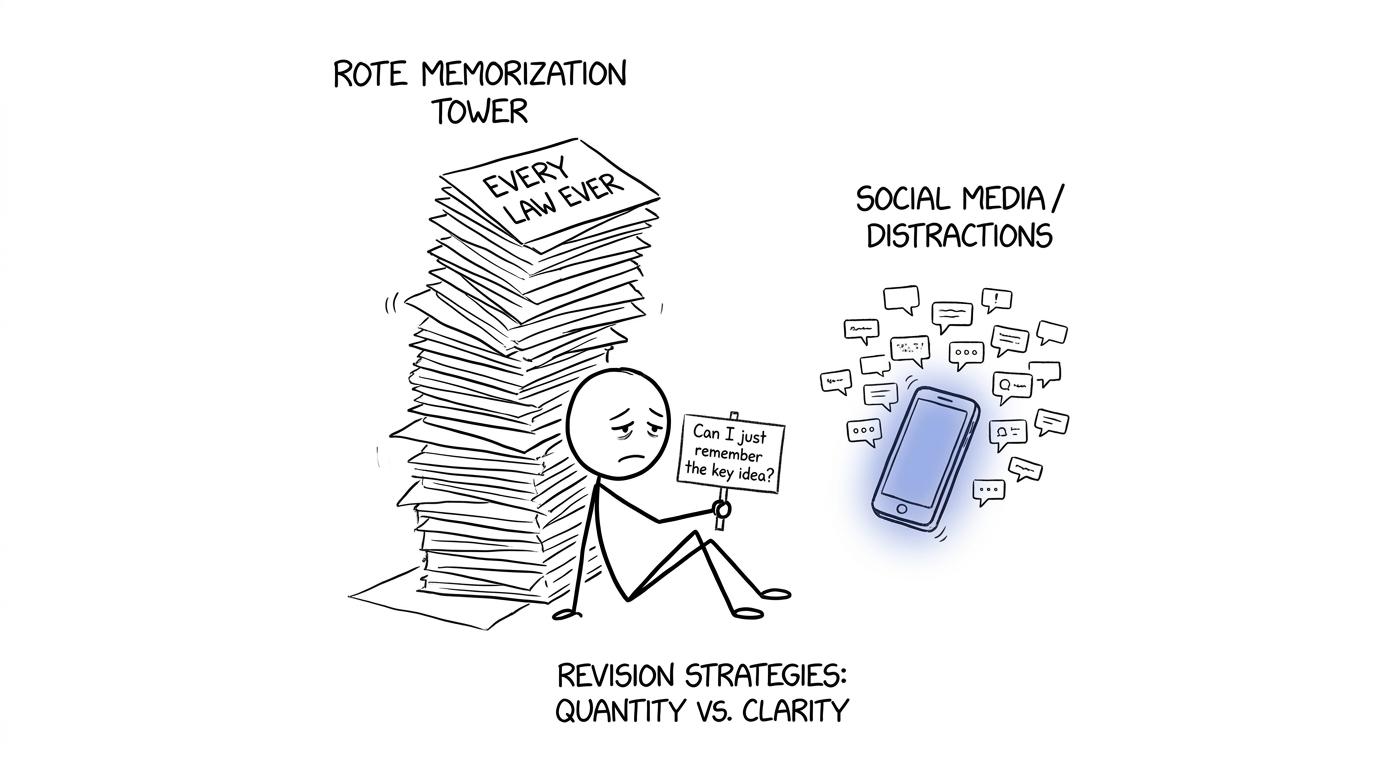 A GCSE student caught between an enormous paper flashcard tower and a phone full of notifications
What makes flashcards effective in the first place?
A flashcard is useful because it can create retrieval practice. You see a prompt, attempt to bring the answer to mind and only then check the reverse. Retrieving knowledge strengthens your ability to recall it later more effectively than simply rereading the same material.
Spacing matters too. Revisiting a card after a gap requires more effort than repeating it immediately, but that effort is useful. Digital apps can schedule this automatically. Paper users can achieve a similar effect by separating cards into piles such as “tomorrow”, “this week” and “secure”.
Research comparing paper and digital flashcards does not establish one universal winner. One published comparison involving university students found similar recall from paper and tablet cards, although outcomes differed on computers and students reported different levels of satisfaction and control. That study concerned vocabulary learning rather than GCSE Citizenship Studies, so it should not be treated as a direct prediction of your grade. Its useful message is narrower: the way a platform affects attention, effort and regular use can matter as much as the platform itself.
The same principle applies in maths. MathsGenie's GCSE maths revision hub includes active-recall flashcards alongside lessons, questions and papers, but recall is only one part of effective exam preparation.
The real advantages of physical flashcards
Paper creates helpful friction. Writing a card takes time, so you are more likely to decide what genuinely belongs on it. That decision can expose whether you understand an idea or are merely copying a paragraph.
Physical cards also make relationships visible. You can place cards about Parliament, elections, pressure groups and citizen action across a desk, then sort them by institution, method, advantage or limitation. For a subject built around connected concepts and competing viewpoints, that flexibility is valuable.
Most importantly, paper removes the phone from the session. If notifications repeatedly break your concentration, the theoretical efficiency of an app is irrelevant. A less sophisticated system used with full attention will usually beat an advanced system interrupted every few minutes.
Paper does have costs. Large decks become bulky, editing is awkward and self-managed spacing requires discipline. Rewriting every card because it is untidy is also an easy way to make revision look productive without testing any knowledge.
Where a flashcard app is stronger
An app reduces the practical work around revision. Cards can be tagged by theme, searched instantly and reviewed anywhere. Many apps also offer some form of scheduled review, although exact features, costs and privacy arrangements vary by provider and can change. Check these before committing your whole revision system to one platform.
The strongest digital advantage is not animation or a streak counter. It is consistency. If an app places the cards you are due to review in front of you, there is less need to decide what to study each time.
That convenience can become a weakness. It is easy to tap “known” after vaguely recognising an answer. Recognition feels fluent, but the exam asks you to produce and apply knowledge without seeing the completed response first. Say the complete answer aloud or write its main points before revealing it.
An app also sits beside everything else your phone can do. Use focus mode, silence notifications and set a short, defined session. When a device produces more switching than retrieval, return to paper.
Physical flashcards vs app for the Citizenship Studies exam
GCSE Citizenship Studies does not assess memory alone. Ofqual's assessment objectives across the subject allocate approximately 30%30\%30% to knowledge and understanding, 30%30\%30% to application, and 40%40\%40% to analysing evidence, evaluating viewpoints and producing reasoned judgements.
That balance changes how you should build cards.
| Revision need | Better starting format | Why |
|---|---|---|
| Key terms, institutions and processes | App | Fast review and automatic scheduling suit concise factual prompts. |
| Comparing arguments and viewpoints | Paper or hybrid | Larger cards and physical sorting make relationships easier to see. |
| Remembering your citizenship action | Either | Consistent prompts can cover aims, methods, evidence, impact and evaluation. |
| Extended responses | Neither on its own | You must practise planning and writing answers under timed conditions. |
| Avoiding phone distraction | Paper | The distracting device is removed from the session. |
| Managing a large specification | App | Tags and search tools reduce organisational effort. |
Flashcards are strongest for the foundations of AO1. Better cards can also support AO2 and AO3, but they need prompts such as:
- “How could this concept apply to a local campaign?”
- “What evidence might challenge this viewpoint?”
- “Give one strength, one limitation and a justified conclusion.”
- “How does this institution differ from another one?”
These are not worked exam responses. They are retrieval prompts designed to make you explain, connect and evaluate rather than recite.
Build cards around your exam board
Do not download a huge generic deck before checking what you are actually required to know. Use the current specification for your board and your teacher's guidance as the boundary of your deck.
AQA organises content around citizenship skills, life in modern Britain, rights and responsibilities, politics and participation, and active citizenship. Pearson Edexcel uses themes including living together in the UK, democracy at work, law and justice, power and influence, and taking citizenship action. The wording and paper organisation differ, even though regulated assessment objectives are shared.
Create one tag, colour or card bundle per specification section. Then mark each item as:
- fact: a term, role or process;
- application: using knowledge in a context;
- analysis: explaining relationships or consequences;
- evaluation: weighing evidence and reaching a judgement.
This prevents a common imbalance: owning hundreds of definition cards while barely practising the skills carrying most of the marks.
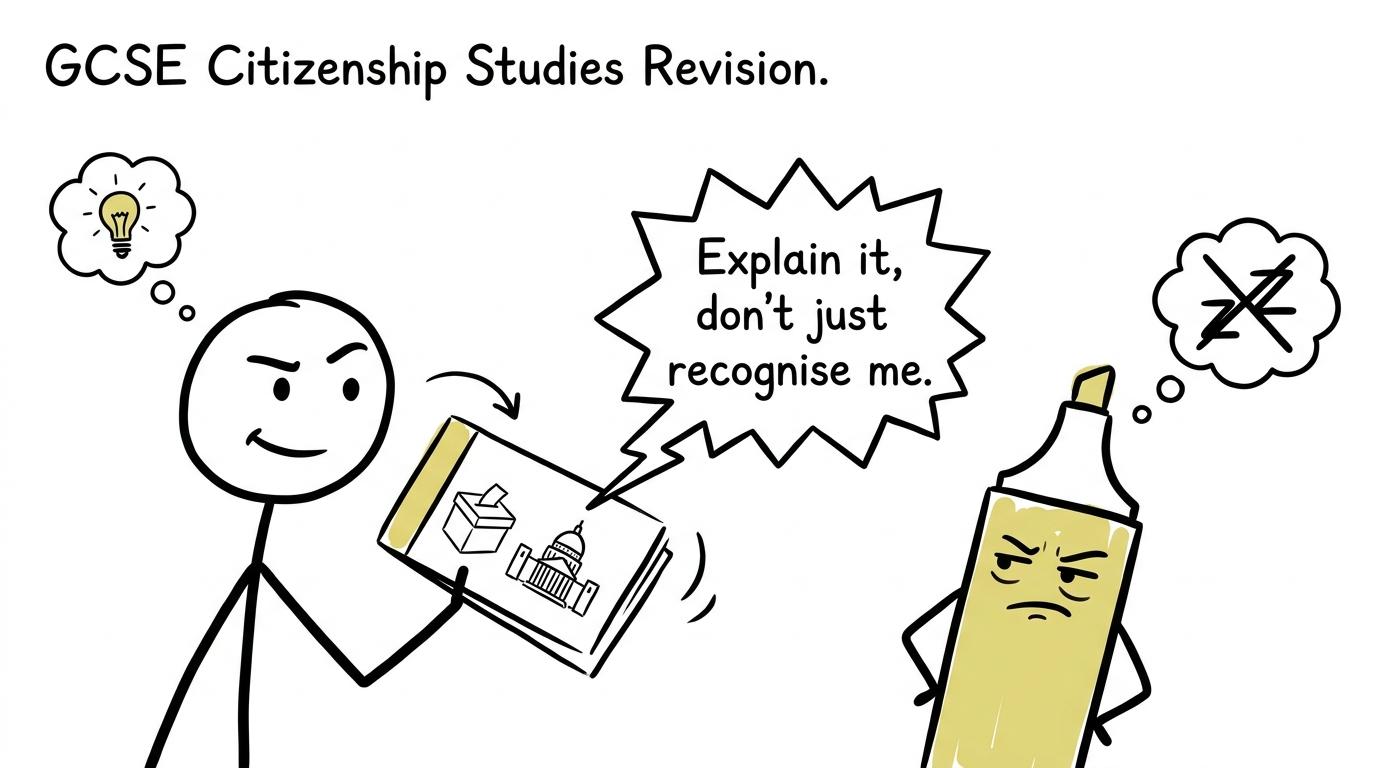 A flashcard reminds a student to explain rather than merely recognise the answer
A sustainable hybrid revision system
You do not have to turn this into a permanent identity choice between paper and technology. Try a simple two-week experiment.
Create a small core deck
Begin with the topics currently being taught or the weaknesses revealed by a test. Keep each card focused on one retrievable idea. If the reverse needs several dense paragraphs, split the card or turn it into an exam-planning task.
Retrieve before checking
Answer aloud or on scrap paper. Only reveal the reverse when you have made a genuine attempt. Shuffle paper cards; with an app, avoid relying on a familiar sequence.
Review after increasing gaps
Revisit missed cards soon. Leave secure cards for longer, but do not retire them after one correct answer. Digital scheduling can manage this automatically; paper users can move cards between dated envelopes or labelled piles.
Convert knowledge into exam practice
Every few sessions, stop using cards and answer an exam question. Mark it, identify whether lost marks came from knowledge, application or evaluation, then modify the deck accordingly.
This is the same feedback logic explained in MathsGenie's guide to finding your weakest GCSE topics. A revision tool becomes valuable when it responds to evidence rather than habit.
If you are balancing Citizenship Studies with maths, use a single weekly timetable rather than separate plans competing for the same evening. MathsGenie's guide to the best order for learning GCSE maths topics can help structure the maths side of that timetable.
Common flashcard mistakes
Copying instead of questioning
Transcribing a textbook produces a smaller textbook. Turn headings into questions and write answers briefly in your own words.
Revealing the answer too quickly
A familiar-looking card creates an illusion of knowledge. Commit to an answer before turning or tapping.
Making cards for everything
Not every detail deserves repeated review. Follow your specification, lesson content and errors from marked work.
Using only definition cards
Citizenship exams require application, analysis, evaluation and reasoned judgement. Include comparison, evidence and conclusion prompts, then practise full questions separately.
Spending longer designing than retrieving
Colours and tags should make the deck easier to use. If decoration consumes the session, simplify it.
Treating a streak as proof
App statistics measure activity, not necessarily exam readiness. A timed question and its mark scheme provide stronger evidence. The same distinction underpins MathsGenie's advice on using GCSE past papers properly.
Ignoring the rest of your revision timetable
Citizenship is only one part of your GCSE workload. Keep maths moving with short, focused sessions, using the GCSE maths exam-week checklist when examinations are close. Avoid replacing question practice with endless card-making.
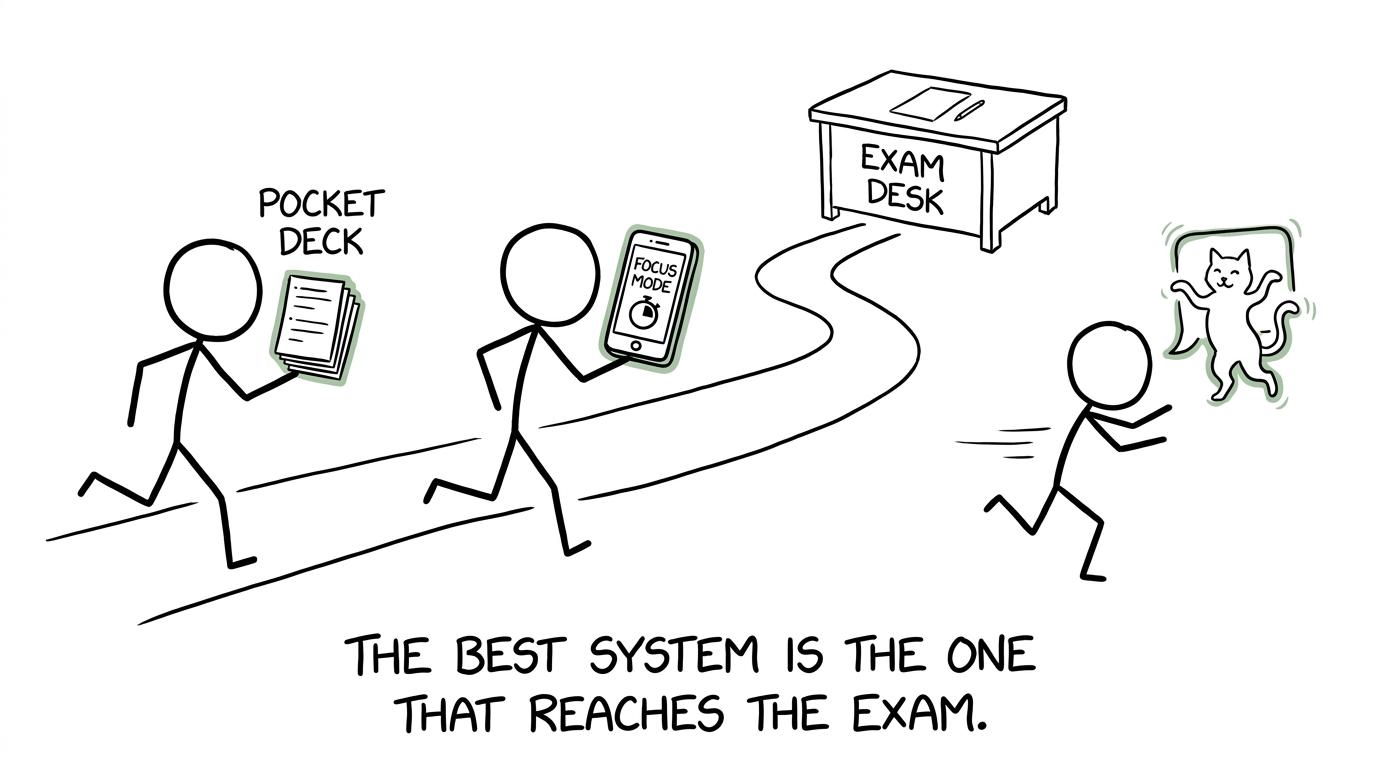 Paper and app revision systems race towards an exam while a third student chases a notification
Choose the system you will still use next month
Physical flashcards are worth making when writing, sorting and screen-free concentration improve the quality of your retrieval. An app is worth using when portability, search and scheduled review help you return consistently. If both solve different problems, use both, but avoid duplicating every card simply to maintain two perfect collections.
The format is not the learning. The learning happens when you retrieve an answer, check it honestly, correct it and return after a gap. For Citizenship Studies, complete that cycle with source questions and extended responses so factual recall grows into application and judgement.
Then carry the same disciplined approach into maths. Start at the MathsGenie GCSE maths revision hub, use revision lessons and practice questions to repair weak topics, and test them with mini tests, past papers and predicted papers. Mark schemes and video solutions show you what to fix next. If an exam is close, follow the GCSE maths night-before plan rather than building one last enormous deck.
Choose one system today. Make a small deck. Retrieve before you reveal. Then let your next marked answer tell you whether it is working.











