

Perfectionism in GCSE Biblical Hebrew Revision
Perfectionism GCSE Biblical Hebrew revision can turn care into avoidance. Learn to practise imperfectly, use feedback and protect your GCSE maths time too.

Revision can look responsible while quietly avoiding the work that matters. You rewrite a vocabulary list until the headings align. You delay a translation because you want uninterrupted time. Then you promise yourself that tomorrow's session will be better organised.
This is how perfectionism GCSE Biblical Hebrew revision can become procrastination wearing a school uniform. The answer is not to care less. It is to replace flawless preparation with regular retrieval, honest marking and manageable practice. For students balancing Biblical Hebrew with GCSE maths, that change also protects time for both subjects.
Perfectionism often does more damage than ordinary delay because it feels productive. You are busy, but you are not producing evidence that you can recall vocabulary, analyse grammar or respond under exam conditions.
A quick perfectionism checklist
Perfectionism may be interfering with your revision if you regularly:
- wait for the ideal mood, desk or block of time before beginning;
- spend longer designing a timetable than following it;
- rewrite complete notes when only one weak area needs attention;
- avoid unseen material because mistakes feel uncomfortable;
- abandon a session after one interruption;
- mark work as either "excellent" or "awful" rather than identifying specific gaps;
- sacrifice maths practice to finish a Hebrew task to an unnecessary standard;
- repeat familiar content instead of testing what you cannot yet recall.
One sign proves little. A repeated pattern matters. Ask a simple question: Is this action improving recall or performance, or merely making revision look tidy?
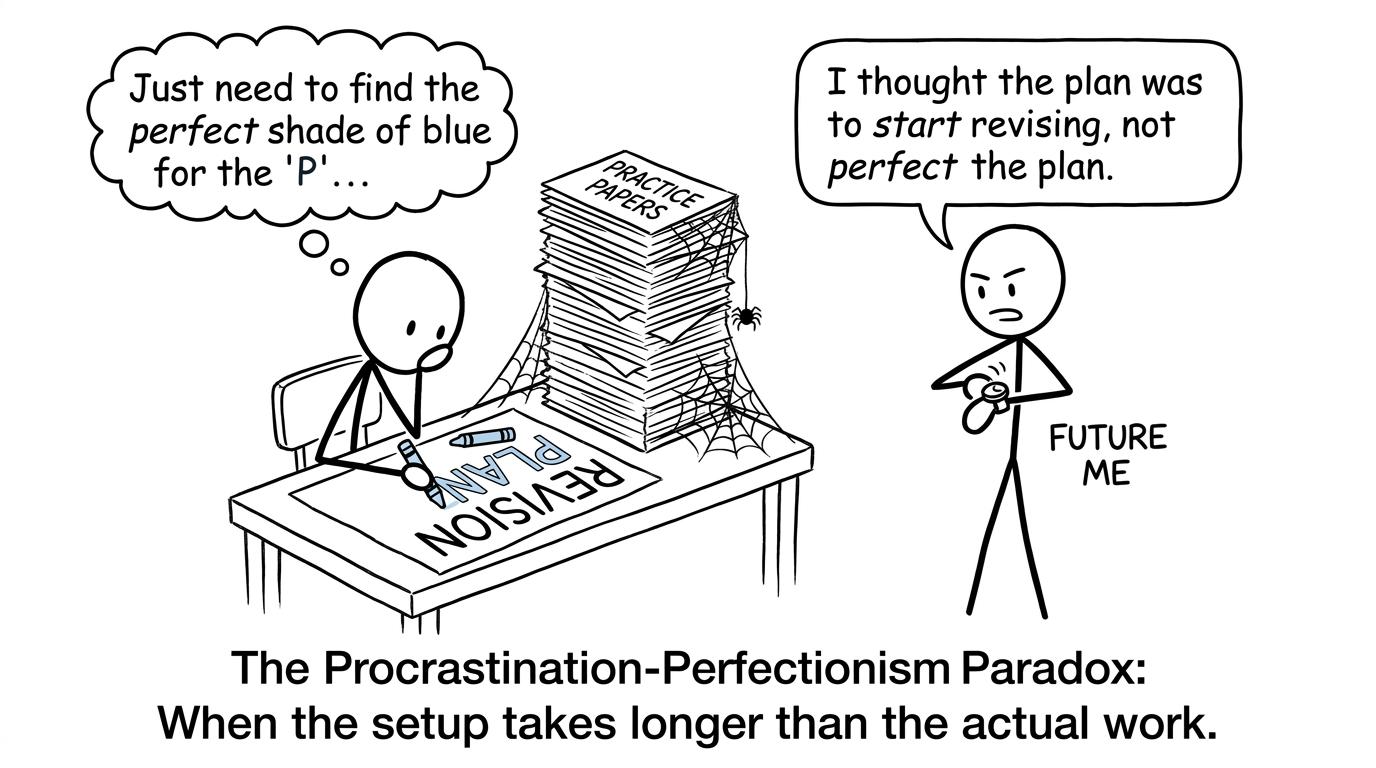 A student perfects a revision-plan heading while practice papers wait
How perfectionism appears in GCSE Biblical Hebrew revision
Perfectionism is not the same as working carefully. Accuracy matters when learning vocabulary, grammatical forms and prescribed literature. The problem begins when high standards become rigid conditions for starting, finishing or receiving feedback.
The perfect vocabulary list
A useful vocabulary resource helps you retrieve a word without seeing its meaning first. A perfectionistic resource may contain beautiful handwriting, elaborate categories and repeated colour coding, yet involve very little testing.
Copying can create familiarity. Exams require recall. Close the list, test yourself in both directions and record the words you missed. An imperfect test gives better information than a perfect page.
The translation you keep postponing
Translation exposes uncertainty. You may misidentify a form, overlook context or choose an awkward English expression. A perfectionist therefore waits until they feel "ready" for unseen material.
But readiness grows through attempts. A short passage completed now reveals more than another hour spent preparing to begin. Your first version does not need to be elegant; it needs to exist so that it can be checked.
Notes that are always being restarted
Some students restart a notebook because earlier pages seem untidy or incomplete. That resets the appearance of progress without repairing the original knowledge gap.
Keep the old notes. Add corrections clearly. Revision should leave evidence of changing understanding. A corrected mistake is not a blemish on the page; it is a record that learning happened.
Literature answers that must sound finished
For prescribed literature, students can become trapped trying to produce polished paragraphs before they have securely recalled the relevant content and understood what a question demands. Separate the jobs. First retrieve the relevant material. Then select evidence. Only afterwards refine the response.
Always use the current OCR specification and materials supplied by your school to confirm the texts, language content and assessment requirements for your examination series. A general revision habit cannot replace qualification-specific guidance.
Why it can be worse than ordinary procrastination
Ordinary procrastination is often visible. You know you watched videos instead of revising. Perfectionistic procrastination is harder to challenge because it borrows the language of ambition: "I am getting organised", "I need to understand everything first" or "I will do it properly at the weekend".
Research on perfectionism commonly distinguishes high personal standards from perfectionistic concerns, such as intense fear of mistakes and harsh self-criticism. Wanting to improve is not automatically harmful. Trouble arises when mistakes feel like judgements about you rather than information about your present knowledge.
The cycle often looks like this:
- set an unrealistically demanding standard;
- feel uncertain about meeting it;
- delay the task or over-prepare;
- lose practice time;
- feel guilty about the delay;
- set an even stricter plan to compensate.
This cycle also distorts subject balance. If a Biblical Hebrew session expands until every card is complete, the planned maths session disappears. The next day, maths feels more urgent, Hebrew gets postponed and both subjects begin to carry guilt.
Replace flawless revision with a feedback loop
The most useful revision cycle is small enough to repeat:
- choose one defined task;
- retrieve or answer without notes;
- check against reliable material;
- classify each error;
- correct the smallest underlying gap;
- return to it after a delay.
This principle transfers directly to maths. Maths Genie explains a similar diagnose, practise and retest approach in its guide to finding your weakest GCSE topics. The subject content is different, but the learning decision is the same: let evidence choose what happens next.
A missed Hebrew word may indicate a vocabulary gap. A weak literature response may show insecure recall, poor selection or misunderstanding of the question. A lost maths mark might come from missing knowledge, inaccurate execution or exam technique. Specific labels lead to specific fixes. "I am bad at this" leads nowhere.
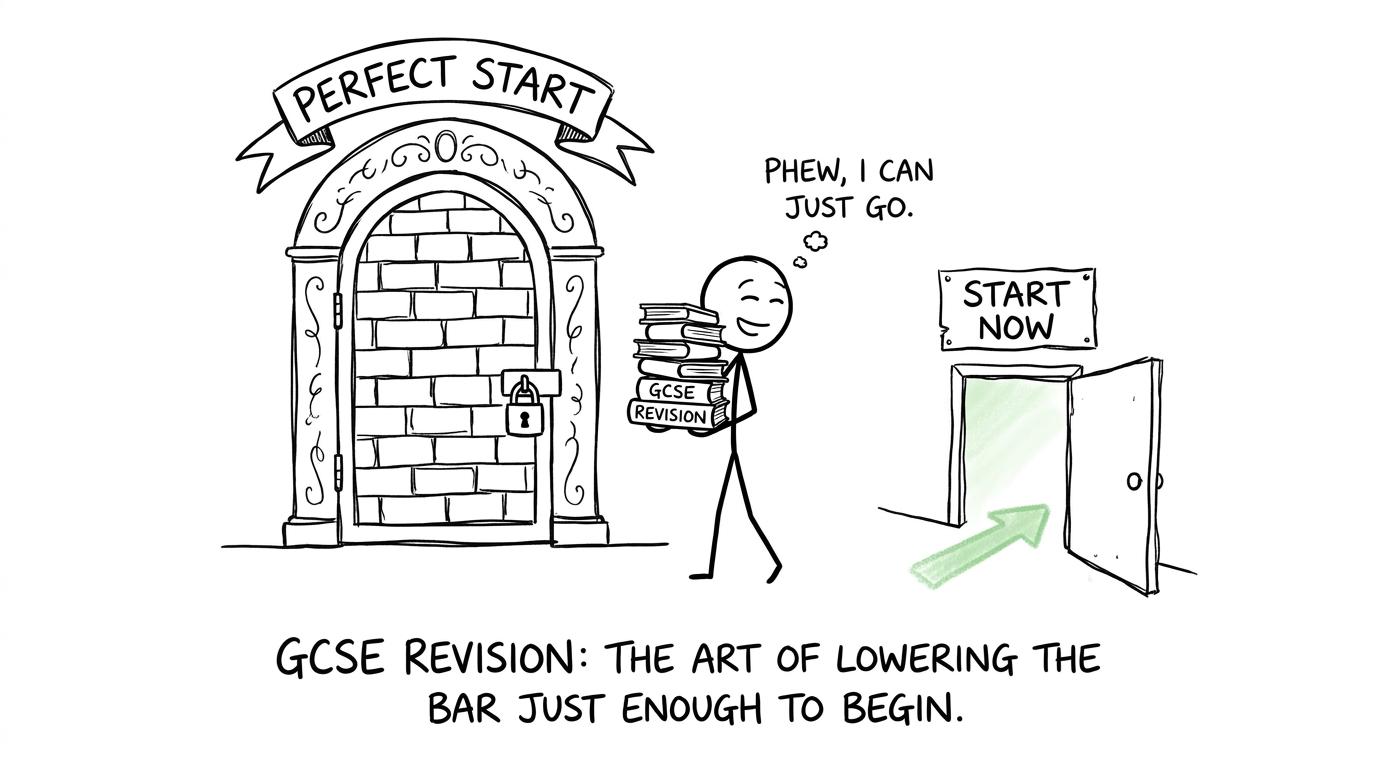 A student chooses the small open door marked Start Now
Build a minimum viable revision session
A minimum viable session is the smallest session that still produces useful evidence. It prevents the all-or-nothing thought that a short session is worthless.
For Biblical Hebrew, it might include:
- a closed-book vocabulary retrieval set;
- a short section of translation;
- focused identification of grammatical forms;
- recall of one portion of prescribed material;
- checking and recording a small number of errors.
Set the task by output, not aspiration. "Revise Hebrew" has no finish line. "Test one vocabulary group and correct every missed item" does.
Apply the same rule to maths. Rather than promising to "do algebra", choose a lesson and its exam questions from the GCSE maths revision hub. When time is limited, a focused mini test or a section of a paper is more useful than waiting for the perfect evening.
The GCSE one-month maths revision plan can help you organise repeated, manageable sessions. If your timetable itself has become a perfectionism project, use the practical structure in the GCSE maths revision timetable guide rather than continually rebuilding your own.
Use mistakes without turning them into a verdict
Marking can trigger perfectionism because it converts a vague feeling into visible evidence. That is precisely why it is valuable.
After checking a task, classify each mistake as one of the following:
- recall: the fact, word or form was not available;
- recognition: you knew it once shown but did not identify it independently;
- application: you knew the knowledge but used it incorrectly;
- interpretation: you misunderstood the wording or context;
- execution: you rushed, copied inaccurately or omitted something;
- timing: you could complete it, but not efficiently enough.
Then write one next action. Do not write a verdict about your ability.
For maths papers, follow Maths Genie's guide to using GCSE past papers properly. You can also use the Maths Genie past-paper library to practise with papers and mark schemes. A score is a snapshot. The reviewed errors are the part that can improve your next score.
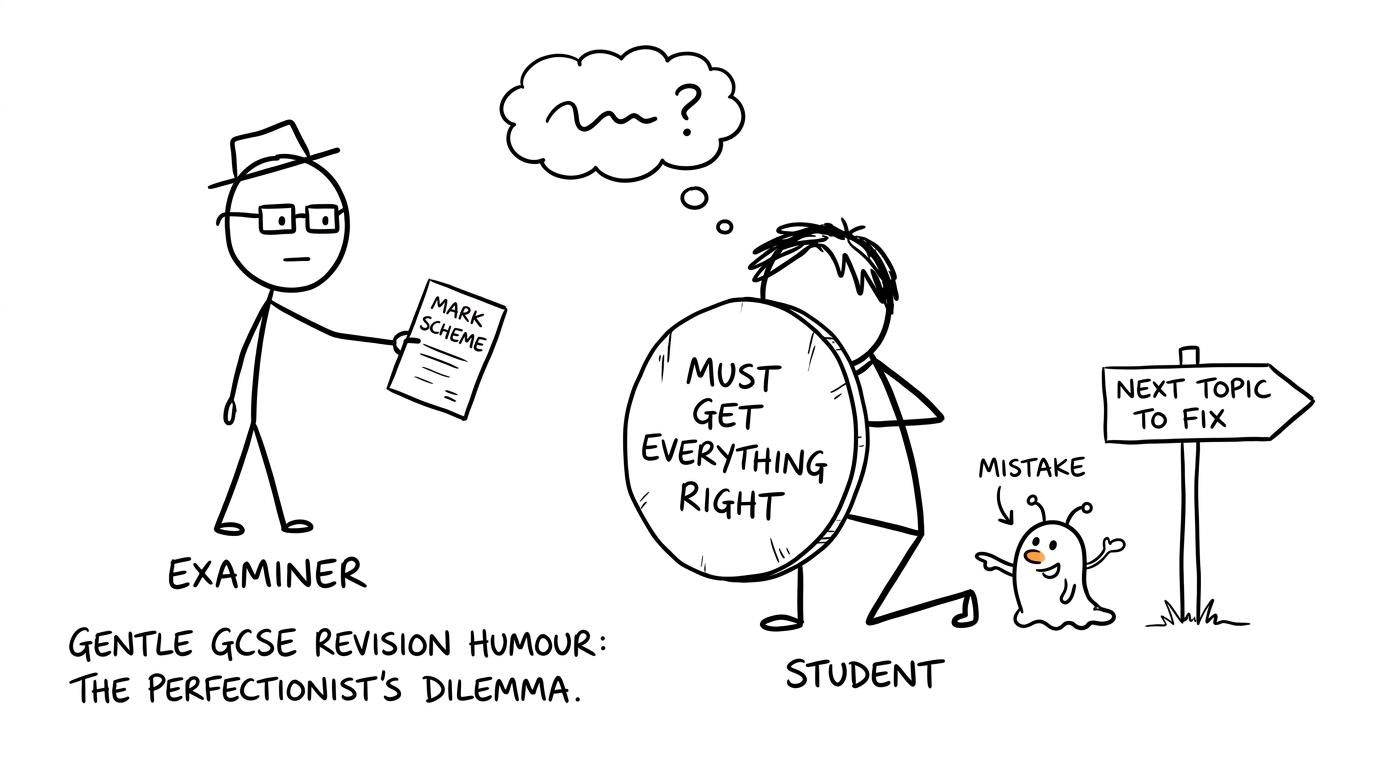 A tiny mistake points towards the next topic to fix
Protect both Hebrew and maths revision time
Perfectionism makes plans expand. Give each subject a boundary before starting. Decide what "done" means and stop when you reach it, even if the notes could be neater.
A balanced week should contain several kinds of work:
- retrieval of older knowledge;
- focused repair of current weaknesses;
- timed or exam-style practice;
- careful marking;
- a later retest.
Do not allow one difficult Hebrew passage to consume the entire evening. Record the unresolved issue, ask your teacher where appropriate and move to the next scheduled task. Equally, do not let one challenging maths question erase time reserved for another subject.
As maths exams approach, the advice in when to start GCSE past papers helps separate topic practice from full timed papers. Maths Genie predicted papers can sharpen preparation near the exam, but they work best after errors from earlier practice have been reviewed.
Common mistakes when trying to overcome perfectionism
Creating another perfect system
A complicated anti-perfectionism tracker can become the next avoidance activity. Use one short task list and one error log. Nothing more is required.
Lowering standards instead of changing the process
The aim is not careless work. Keep accuracy as the destination while allowing rough first attempts, corrections and repeated practice as the route.
Doing only comfortable retrieval
Repeatedly testing secure vocabulary feels successful but supplies little new information. Mix confidence-building recall with material that is currently uncertain.
Treating one missed session as a failed week
Do not restart next Monday. Resume at the next available session with the smallest useful task. Consistency is the ability to return, not the ability never to be interrupted.
Checking answers too quickly
Immediate checking can protect you from the discomfort of uncertainty, but it weakens the diagnostic value of practice. Commit to an answer before opening notes or a mark scheme.
Progress is allowed to look unfinished
Good revision rarely looks flawless. It contains crossed-out answers, uncertain first attempts and lists of things not yet secure. Those are not signs that the system has failed. They are signs that the system is finding work worth doing.
Begin with one imperfect Biblical Hebrew retrieval task today. Mark it, choose one gap and schedule a retest. Then give your maths revision the same honesty: open the free GCSE maths revision hub, choose a lesson or practice set, and produce evidence rather than promises.
Maths Genie brings together revision lessons, practice questions, mini tests, past papers, predicted papers, mark schemes and video solutions. You do not need a perfect plan before using them. You only need to start, check and return.










