

Peaking Too Early in GCSE Sociology Revision?
Peaking too early GCSE Sociology revision can feel worrying. Learn why confidence fades, how to retain knowledge, practise essays and stay ready until May.
There is a strange moment in revision when feeling confident becomes unsettling. You know the sociologists, theories and research methods. Your notes are organised. Yet the exam is still months away, and you start wondering whether all that knowledge will disappear before May.
If peaking too early GCSE Sociology revision describes your worry, the short answer is reassuring: feeling ready early is not a problem. It simply means your revision needs to move from learning into maintenance, application and exam practice. You do not have to preserve today’s confidence perfectly. You need a system that repeatedly brings important knowledge back to mind.
That distinction matters. A peak sounds like somewhere you can only descend from. Revision is better understood as a series of smaller climbs, each strengthening what you already know.
The quick answer: what should you do now?
If you feel confident months before the examination, use this checklist:
- Test yourself without notes rather than judging confidence by familiarity.
- Revisit topics at increasing intervals instead of reviewing everything daily.
- Practise applying theories and evidence to unfamiliar questions.
- Include extended responses, not only definitions and flashcards.
- Mark answers against your exam board’s assessment objectives.
- Keep an error log containing forgotten knowledge and weak argument structures.
- Protect time for maths and your other GCSE subjects.
- Increase timed paper practice gradually as May approaches.
The aim is not to keep Sociology permanently at the front of your mind. It is to make the knowledge retrievable when a question asks for it.
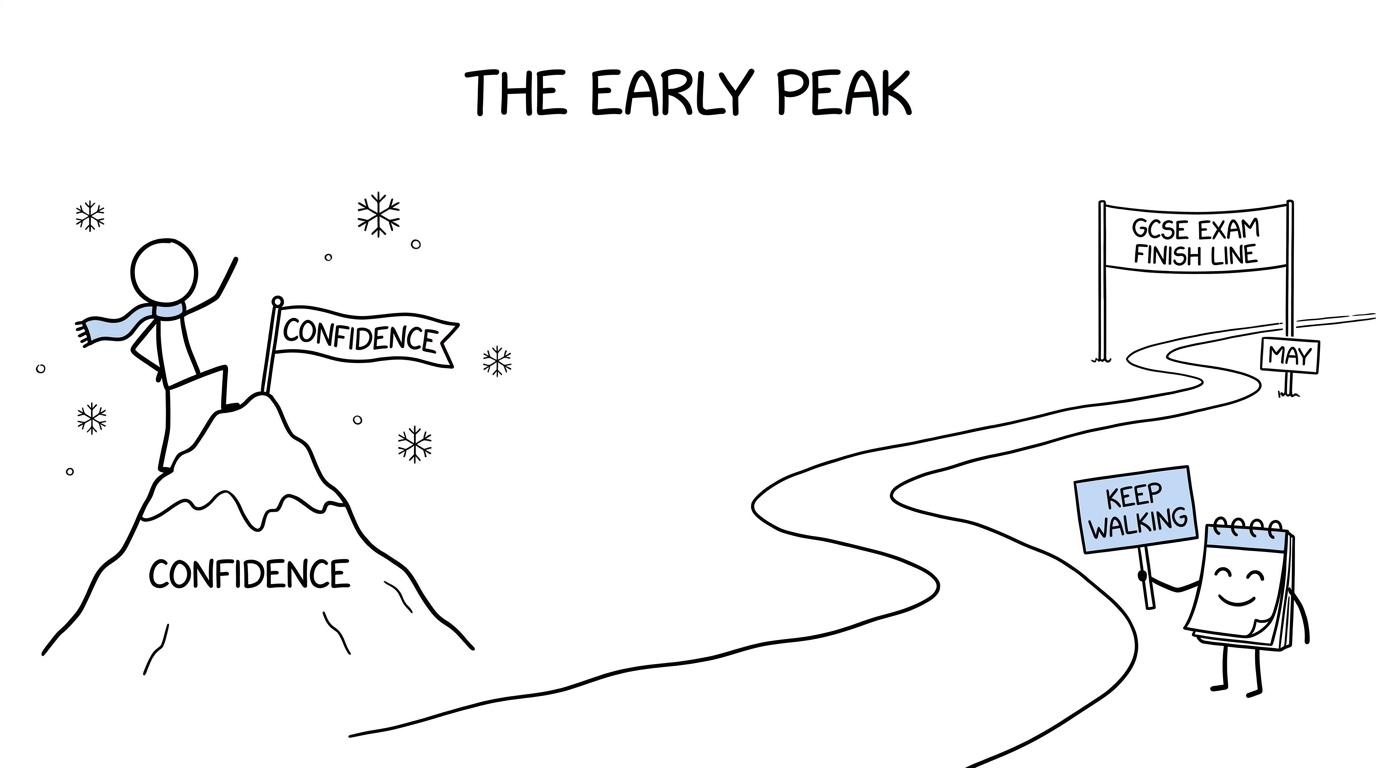 A student reaches the confidence summit long before the GCSE finish line
Why confidence can arrive months before the exam
Early confidence often appears after a period of concentrated revision. Perhaps you have completed the course, produced flashcards and recently performed well in a mock. The material feels familiar because you have encountered it repeatedly.
But familiarity and recall are not identical. Recognising a paragraph about functionalism while reading your notes is easier than reconstructing the argument from memory. Likewise, recognising a sociologist’s name does not guarantee that you can select, apply and evaluate their ideas under timed conditions.
This does not mean your confidence is false. It means confidence provides only one piece of evidence. A closed-book question, delayed self-test or marked essay gives you better information about what is secure.
For students balancing Sociology with GCSE Maths, the feeling may be especially noticeable. Sociology can seem finished while maths continues to expose new gaps through problem-solving. A clear GCSE maths revision timetable helps you distribute attention without abandoning the subject that currently feels strongest.
You are not trying to remember everything continuously
Memory is not a shelf on which information sits untouched. Access can become harder when knowledge has not been recalled for a while. That temporary difficulty is not proof that the original revision failed.
Evidence reviews discussed by the Education Endowment Foundation support retrieval practice as a useful approach to learning. They also stress important qualifications: retrieval should happen after a delay, include feedback and extend beyond easy factual questions. Current evidence does not provide one perfect spacing timetable for every student, age group and subject.
So avoid treating any fixed sequence of days as a scientific guarantee. Use a flexible cycle instead:
- recall a topic without notes;
- check the accuracy of what you produced;
- correct omissions or misconceptions;
- apply the knowledge in a question;
- schedule another check after a longer gap if it was secure;
- revisit it sooner if recall was weak.
This is why forgetting a little can be useful. It turns the next attempt into genuine retrieval rather than another comfortable reread.
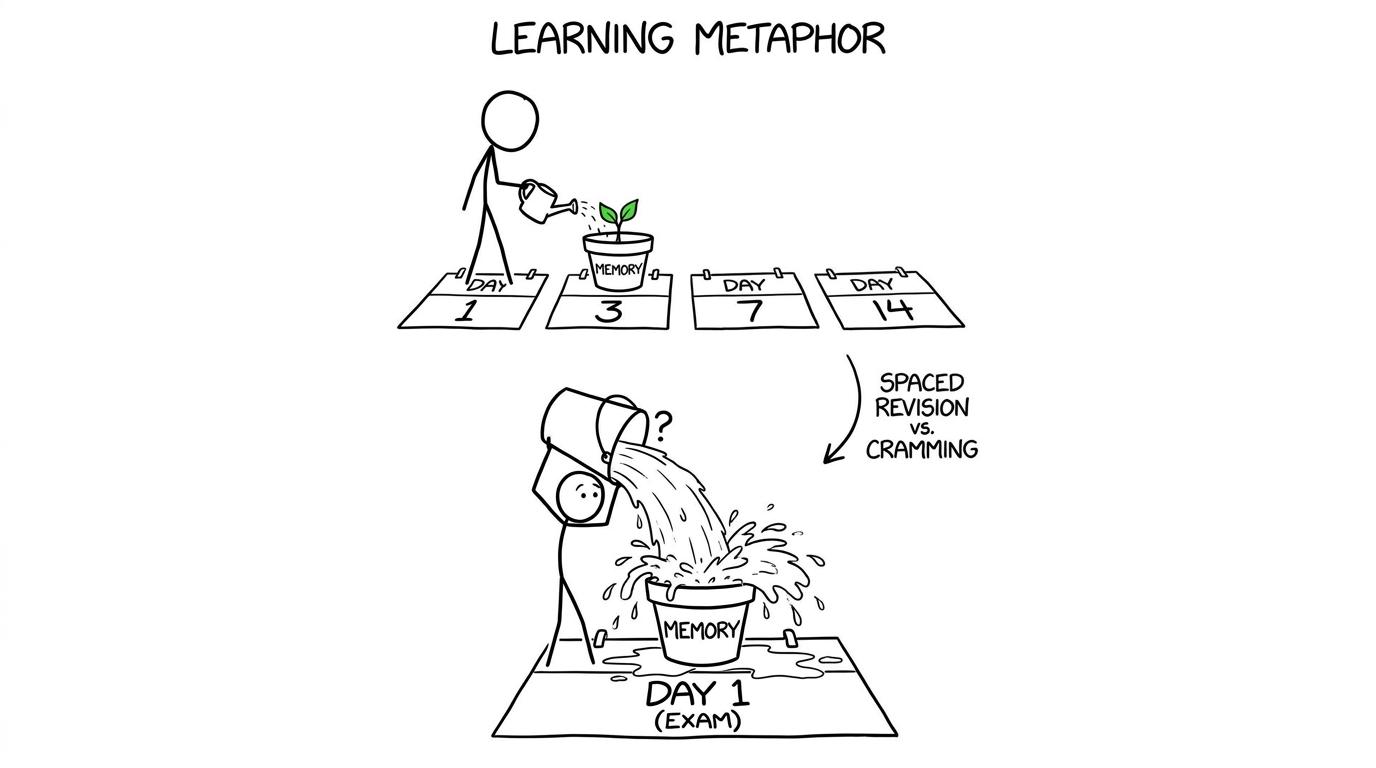 Two students discover that memory prefers small spaced watering sessions
Build a maintenance plan that lasts until May
A maintenance plan should be small enough to continue during busy weeks. If Sociology already feels secure, it should not consume the time needed for weaker subjects.
Divide the specification into retrievable units
Use your own exam board’s specification as the boundary of what you need to know. Do not rely on a generic online checklist because GCSE Sociology content and paper structures can differ.
For AQA, for example, the current specification includes families, education, crime and deviance, social stratification, relevant theory and research methods. Eduqas students should follow the content and assessment requirements given for their own qualification rather than assuming the courses are interchangeable.
Break each area into small prompts, such as:
- key concepts and definitions;
- perspectives and theories;
- named studies or sociologists required by your course;
- supporting and challenging evidence;
- research methods and methodological issues;
- possible applications to social situations;
- comparisons and evaluative arguments.
A unit is manageable when you can test it in a short session without opening an entire folder.
Use a weekly check-in
Once a week, select material from several topics. Begin with a blank page or unanswered questions. Only consult notes after making a serious attempt.
Your session might contain a short factual recall task, an application question and one paragraph requiring analysis or evaluation. Rotate the topics so that apparently secure content is not quietly ignored for two months.
A planner reduces the mental work of deciding what to revisit. MathsGenie’s free revision planner can help you see Sociology alongside maths and your other commitments. Schedule specific actions such as “closed-book education retrieval” rather than vague blocks labelled “revise Sociology”.
Let performance control the spacing
Use a simple traffic-light system:
- Red: important content was missing or substantially inaccurate. Relearn it and retest soon.
- Amber: the core knowledge was present, but application or evaluation was weak. Practise a related question next week.
- Green: recall and application were accurate without prompts. Leave a longer gap before checking again.
Green does not mean “never revisit”. It means “spend less time here for now”. This protects your timetable from becoming a celebration of topics you already enjoy.
Move from knowing Sociology to producing marks
The examination rewards more than possession of notes. On the current AQA GCSE Sociology specification, AO1 and AO2 each account for approximately 40%40\%40% of the overall assessment, while AO3 accounts for approximately 20%20\%20%. In broad terms, students must demonstrate knowledge, apply it, and analyse or evaluate ideas. Always check the assessment objectives and command words for your own board.
This explains why flashcard success can create premature confidence. Flashcards may test terminology efficiently, but they do not automatically teach you to construct a focused argument, use an item, compare explanations or reach a justified conclusion.
As the exam gets closer, shift the balance towards:
- planning responses to unfamiliar questions;
- writing paragraphs from memory;
- selecting evidence that directly addresses the question;
- comparing explanations rather than listing them;
- evaluating claims with specific reasoning;
- completing timed sections and full papers;
- checking your work against official mark schemes and teacher feedback.
Treat a paper as a diagnosis, not a verdict. Maths students can use the same principle through MathsGenie’s guide to using GCSE past papers properly: attempt, mark, identify the gap, repair it and retest. The content changes between subjects, but the feedback loop remains valuable.
Balance Sociology with GCSE Maths revision
Peaking early in one subject can be an advantage. It creates room to strengthen another subject without letting the first one decay.
Begin by identifying where maths marks are actually being lost. The GCSE Maths revision hub brings together free revision lessons, practice questions, mini tests, past papers, predicted papers, mark schemes and video solutions for boards including Edexcel, AQA, OCR and Eduqas. Make sure you select the correct exam board and foundation or higher tier.
Then use two different modes:
- Sociology maintenance: short retrieval, application and occasional timed writing.
- Maths development: focused lessons, deliberate question practice and regular correction of errors.
If choosing the next maths topic feels difficult, the GCSE maths topics by board and tier guide can help you map the specification, while the guide to the best order for learning GCSE maths topics provides a sensible route through connected skills.
Nearer the examinations, both subjects should include timed work. Build towards this rather than exhausting every paper too early. MathsGenie’s one-month GCSE maths revision plan shows how diagnosis, topic repair and paper practice can fit together during the final phase.
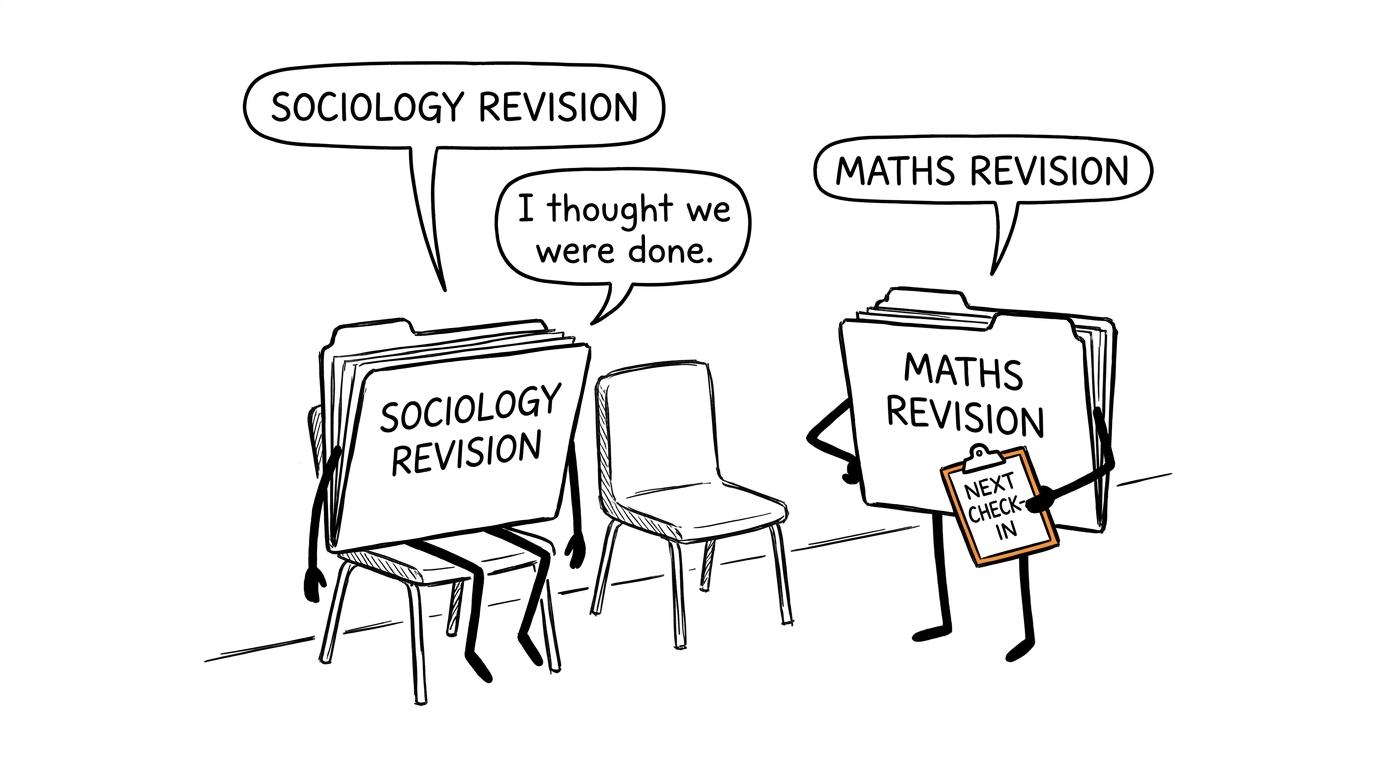 Sociology and Maths folders negotiate their next revision check-in
Common mistakes when you feel ready too soon
Repeating comfortable revision every day
Daily rereading may make notes look increasingly familiar without revealing whether you can retrieve or apply the ideas. Put the notes away first. Check them afterwards.
Stopping Sociology completely
A subject that feels secure still needs occasional retrieval. A brief weekly or fortnightly check is usually more manageable than having to rebuild several topics close to the exam.
Testing only definitions
Definitions matter, but GCSE Sociology also requires explanation, application, analysis and evaluation. Include questions that make you connect ideas and construct arguments.
Writing essays without feedback
Producing many responses is not enough if the same weakness survives each attempt. Use official mark schemes, your teacher’s guidance and the assessment objectives to identify one improvement for the next answer.
Using resources for the wrong specification
Check the exam board, qualification and current specification before revising from a checklist or paper. A named study that matters on one course may not occupy the same place on another.
Giving every subject equal time
Equal time can feel fair while being strategically unhelpful. Let evidence guide you. Secure Sociology topics may need maintenance; weak maths topics may need teaching and repeated practice.
Confidence should become a system
Feeling ready before May is not a warning that your best performance has already passed. It is evidence that the first phase of revision may be working. Your task now is quieter: retrieve knowledge after delays, correct what has faded, practise applying it and gradually introduce exam conditions.
Keep Sociology alive with short, honest check-ins. Use the time you release to strengthen maths through MathsGenie’s free revision lessons, practice questions and mini tests, then build towards past papers and predicted papers with mark schemes and video solutions.
Start by adding one Sociology retrieval session to the MathsGenie revision planner. Then open the GCSE Maths revision resources, choose one weak topic and complete the next useful task. A peak is fragile. A repeatable revision system can carry you all the way to the examination.











