

Should Parents Help with GCSE Sociology Revision?
Parents involved in GCSE Sociology revision can support routines and recall, but too much pressure can weaken confidence, independence and focus.
Revision can make an ordinary question feel strangely loaded. A parent asks, “How is Sociology going?” The student hears, “Why are you not doing more?” Both people may mean well, yet the conversation ends with less revision than it started with.
Getting parents involved in GCSE Sociology revision can be genuinely useful, but only when their role is clear. Parents are usually most helpful when they protect revision time, provide practical support and act as a willing quiz partner. They become less helpful when they take control of the timetable, teach unfamiliar content or turn every conversation into a progress check.
The goal is not maximum involvement. It is the right involvement, enough support to make independent revision easier, but not so much that the student loses ownership.
A quick checklist for students and parents
Parental involvement is probably helping when:
- the student has agreed what support they want;
- questions encourage recall rather than simply rereading notes;
- revision sessions have a clear beginning and end;
- mistakes are treated as useful information;
- the parent supports the routine without controlling every task;
- the student remains responsible for checking the specification and mark scheme.
It may be creating friction when:
- revision becomes a repeated argument;
- the parent gives explanations that conflict with the teacher;
- every break is interpreted as laziness;
- the student waits to be told what to revise;
- questioning continues after the student has asked to stop;
- marks are compared with siblings, friends or expectations.
This distinction matters across a busy GCSE timetable. Sociology revision has to coexist with English, science and maths. Students can use the GCSE maths revision hub to keep their maths resources organised while agreeing separate, realistic Sociology sessions at home.
Should you get parents involved in GCSE Sociology revision?
Yes, if the involvement supports independence. No, if it replaces it.
Evidence about parental engagement is positive overall, but the Education Endowment Foundation also notes that evidence is less extensive for secondary pupils than for younger children. Its guidance is particularly cautious about parents becoming directly involved in an older child’s academic tasks. At secondary level, helping with routines, planning and perseverance may be more useful than trying to complete or teach the work.
That is a helpful principle for GCSE Sociology. A parent does not need to know the difference between functionalism, Marxism and feminism to provide useful support. They can ask the student to explain those perspectives, listen for clarity and use a prepared answer sheet to check essential points.
The student remains the sociologist. The parent provides the conditions in which the student can practise.
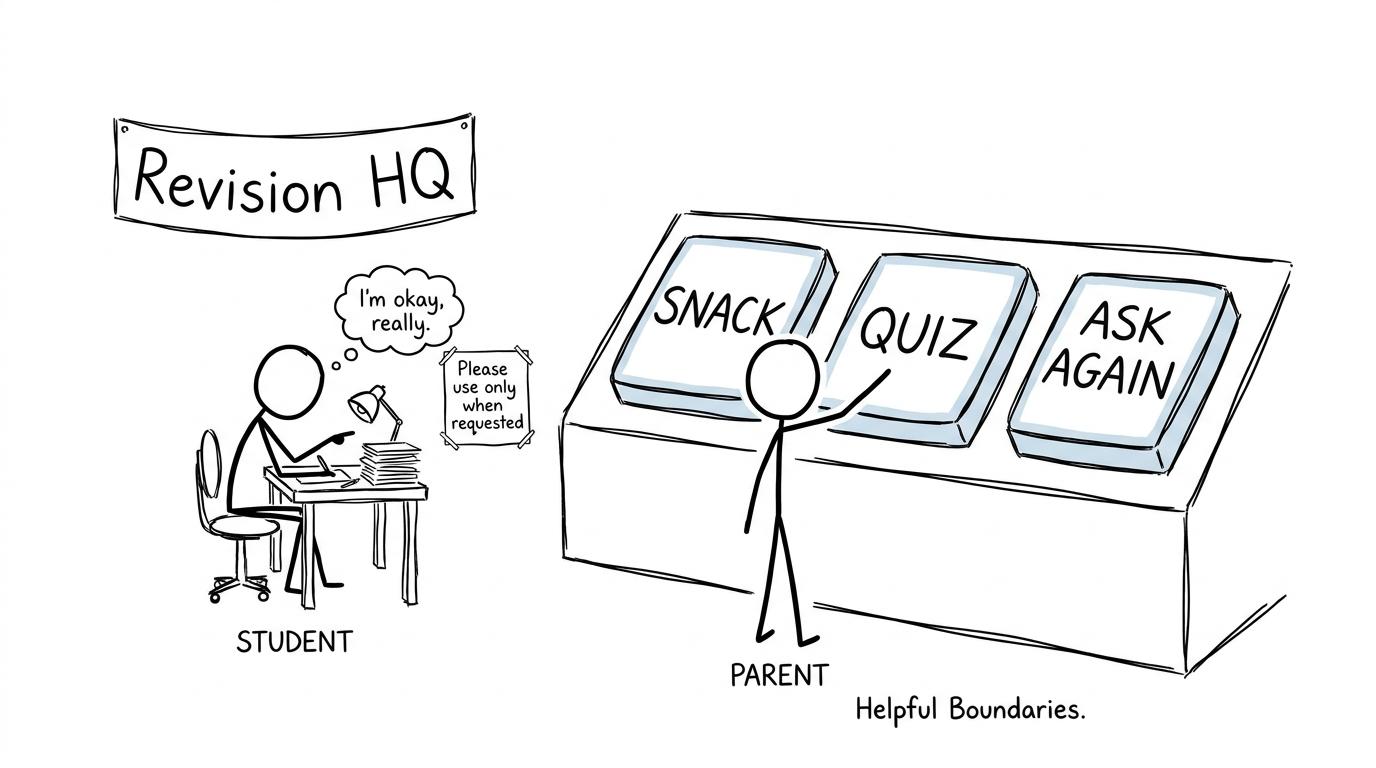 A student sets boundaries at Revision HQ while a parent operates an oversized support panel
Where parental involvement actually helps
Creating a predictable routine
Revision is often lost in the space between intending to begin and actually beginning. A parent can help remove that uncertainty by agreeing a calm routine: when the session starts, where it happens and what interruptions should wait.
This is support rather than surveillance. The student should still choose the specific task, perhaps revising research methods, planning an extended response or recalling sociologists linked to education.
A routine also needs to fit around other subjects. The GCSE maths revision timetable guide shows how focused weeknight sessions and longer weekend practice can be organised without filling every evening. The same broad planning principle works for Sociology: make the plan repeatable before making it ambitious.
Acting as a retrieval-practice partner
One of the simplest parental roles is also one of the most useful: holding the questions.
The student can prepare flashcards containing key concepts, theories, evidence, methods and possible evaluation points. The parent reads the prompt without offering hints too quickly. The student answers from memory, checks the answer and separates secure knowledge from material that needs another look.
Useful prompts include:
- “What does this concept mean?”
- “Which perspective would support that argument?”
- “What evidence could challenge it?”
- “How could you apply this idea to the question?”
- “What judgement would you reach, and why?”
These prompts reflect the real demands of GCSE Sociology. Across GCSE Sociology specifications, the assessment objectives cover knowledge and understanding, application, and analysis and evaluation. Ofqual sets their overall weightings at 40%40\%40%, 40%40\%40% and 20%20\%20% respectively. AQA and Eduqas both use these objectives, although students must follow the precise content and paper structure for their own board.
Parents should therefore avoid making every quiz a memory test. Knowing a definition matters, but students must also apply ideas and construct supported arguments.
Listening to an explanation
Explaining a topic aloud reveals gaps that silent reading can hide. A parent can listen while the student explains a sociological perspective, compares two explanations or justifies a research method.
The parent does not need specialist knowledge. Their best questions are often ordinary ones:
- “What does that term mean?”
- “Why does that evidence support the argument?”
- “Is there another interpretation?”
- “Have you answered the precise question?”
If the explanation becomes vague, the student has found something worth revisiting. That is progress, not failure.
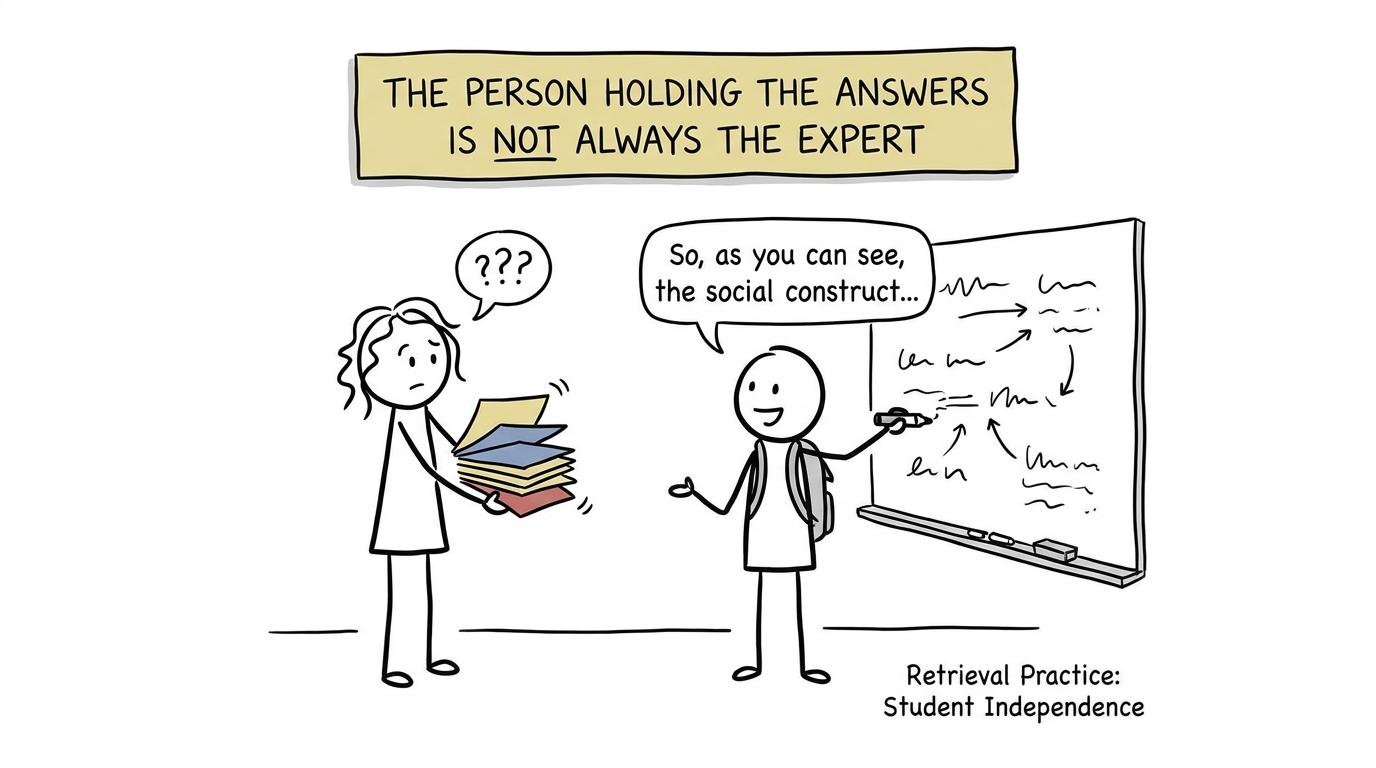 A student teaches Sociology while a parent holds the revision cards upside down
Protecting the practical conditions for revision
Sometimes the most valuable help has little to do with Sociology. It might mean reducing interruptions, helping the student find a quiet space, making sure they have access to school materials or agreeing that a phone will stay elsewhere for one short session.
Parents can also help students protect sleep, meals and sensible stopping times. These actions are easy to overlook because they do not resemble teaching. Yet they make focused work more achievable.
For especially busy days, the structure in MathsGenie’s 20-minute GCSE revision routine offers a useful model: set up quickly, retrieve knowledge, complete active practice and record the next step. Sociology sessions can follow the same rhythm without copying the mathematical content.
Encouraging reflection after practice
A weak question is “What mark did you get?” A better sequence is:
- What went well?
- Where were marks lost?
- Was the problem knowledge, application, evaluation or timing?
- What will you do before the next attempt?
This keeps attention on a changeable process rather than a single score. The same approach is central to using GCSE past papers properly: attempt, mark, identify the gap, repair it and retest.
For Sociology, students should use papers and mark schemes from their own exam board and specification. Parents can help record recurring difficulties, but the student should decide what those results mean for the next revision session.
Where parental involvement creates friction
Taking over the revision plan
A detailed colour-coded timetable may look reassuring, but it is not useful if the student had no role in creating it. When parents control every session, students can become passengers in their own revision.
A better division of responsibility is simple: the student chooses the academic priorities; the parent helps test whether the plan is realistic. If Sociology, maths and science are all scheduled for one exhausted evening, the parent can ask what should move rather than issuing a new timetable.
Students who need a starting structure can adapt the principles in the one-month GCSE revision plan, including diagnosis, short retrieval and regular review.
Trying to teach unfamiliar content
Sociological arguments can be nuanced. A confident but inaccurate explanation may be harder to undo than an admitted gap in knowledge.
Parents should not guess. If a disagreement appears, return to class materials, the current specification, an approved textbook or the teacher. A parent can still help by asking the student to locate the reliable answer and explain it afterwards.
This matters because boards organise content differently. AQA GCSE Sociology covers families and education in one paper, then crime and deviance and social stratification in the other. Eduqas uses its own component titles and content organisation. Students should never assume that a resource matches their course merely because it says “GCSE Sociology”.
Turning support into constant monitoring
Frequent questions about revision can make students feel that they are never off duty. Eventually, even a neutral check-in may sound like criticism.
Agreeing a review point reduces this friction. One conversation at the end of the week is often calmer than repeated daily questions. During that conversation, discuss what was completed, what changed and whether any practical help is needed.
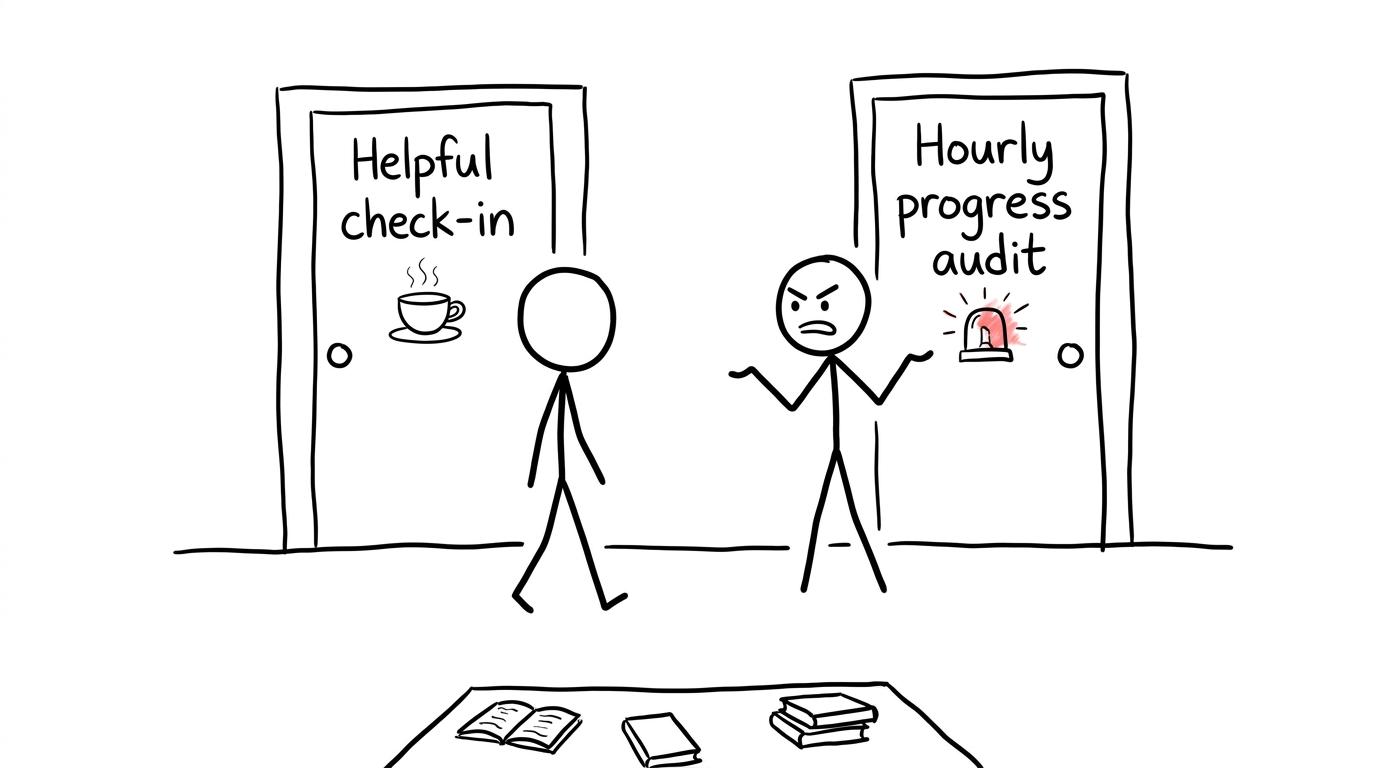 A student chooses a calm check-in instead of an hourly revision audit
Focusing only on hours or marks
Time spent is not the same as learning achieved. Three hours of copying notes may produce less useful recall than a short session of self-testing and answer planning.
Similarly, one disappointing mark does not diagnose the problem. The useful detail lies underneath it: missing knowledge, weak application, unsupported evaluation, poor timing or misreading the command word.
Maths students can learn the same lesson by following a process for finding their weakest GCSE topics. Evidence should shape the next task. It should not become a label for the student.
A practical agreement that reduces conflict
Before revision intensifies, the student and parent can agree four things:
What help is wanted
Choose specific roles, such as holding flashcards, timing an answer, providing a quiet space or checking that planned sessions happened.
What help is not wanted
The student might ask the parent not to interrupt sessions, rewrite answers, compare marks or introduce extra resources without discussing them first.
How often progress will be discussed
Set a regular but limited check-in. This gives parents information without making revision the subject of every conversation.
What happens when the plan slips
A missed session should lead to adjustment, not drama. Decide whether the task still matters, then move it, shorten it or replace it. Revision plans should guide behaviour, not become another source of guilt.
MathsGenie’s free GCSE resources can reduce the planning burden for maths by keeping mini tests, predicted papers and other practice materials together. That leaves students with more attention for deciding what their Sociology revision actually needs.
Common mistakes to avoid
- Quizzing without permission: an unexpected test can feel like an ambush, even when the intention is helpful.
- Giving hints immediately: allow thinking time before rescuing the answer.
- Checking only definitions: GCSE Sociology also assesses application, analysis and evaluation.
- Using the wrong exam board materials: always confirm the board and current specification.
- Treating the mark scheme as a script: it illustrates creditworthy content, but extended answers still require relevant reasoning and judgement.
- Correcting every sentence aloud: note patterns and discuss them after the student finishes.
- Removing all independence: support should gradually make the student more capable of planning, practising and evaluating alone.
- Ignoring the rest of the GCSE timetable: Sociology support should not quietly consume the time needed for maths, English or science.
Support should make independence easier
Parents do not need to become Sociology teachers. Their most productive role is quieter: helping establish a routine, listening, asking useful questions and making it easier for the student to act on evidence from practice.
The test is straightforward. After parental support, can the student revise more independently next time? If the answer is yes, the involvement is probably working. If revision increasingly depends on reminders, arguments or parental approval, the arrangement needs resetting.
Keep Sociology revision aligned with the correct specification and school guidance. For maths, begin with the MathsGenie GCSE revision hub, then combine free revision lessons and practice questions with mini tests, past papers, predicted papers, mark schemes and video solutions. A calm system will not remove every difficult evening. It will, however, make the next useful action much easier to see.











