Miss GCSE Combined Science Exam Through Illness?
Miss GCSE Combined Science exam through illness? Learn what to do, how special consideration works, and how an exam board may calculate your final grade.

Missing an exam can feel frightening because the timetable looks absolute. A paper begins at a fixed time, everyone else sits it, and there appears to be no space for illness. But if you miss GCSE Combined Science exam illness is a genuine reason for your absence, the result is not automatically zero.
Your school or exam centre may apply to the exam board for special consideration. If the application is accepted and you have completed enough of the qualification, the board may calculate the missing component using your performance in the papers you did sit. You do not normally take the same paper a few days later, and the process is not based simply on a teacher's predicted grade.
The important thing is to contact your school immediately and follow its instructions. Special consideration is possible, but it is not automatic.
The essential checklist
If illness may prevent you from sitting a Combined Science paper:
- Tell your school or exam centre as soon as possible, preferably before the exam starts.
- Ask to speak to the exams officer if you can.
- Explain clearly what has happened and when your symptoms began.
- Follow the centre's instructions about medical or other supporting evidence.
- Do not assume that a doctor's note is always required, or that it is never required.
- If you attend but become unwell, tell an invigilator immediately.
- Keep preparing for later papers when you are well enough.
- Ask the exams officer to confirm whether a special consideration application will be submitted.
Your parent or carer can contact the school for you if you are too unwell to do it yourself. Private candidates should contact the centre that entered them for the qualification.
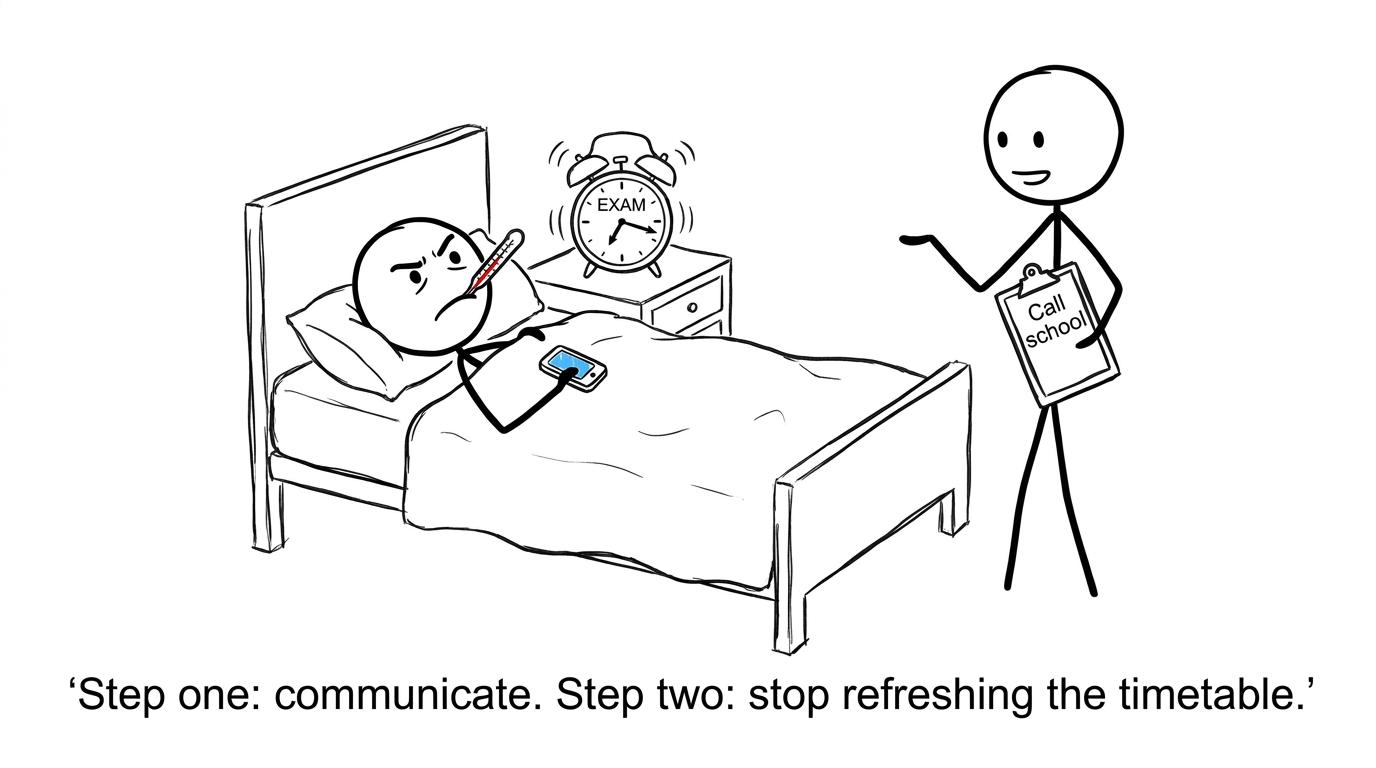 A student sensibly calls school instead of repeatedly refreshing the exam timetable
What actually happens when you miss the paper?
GCSE Combined Science is assessed through several components. The exact paper structure depends on the specification and exam board, such as AQA, Edexcel, OCR or Eduqas. Your marks from those components contribute to an overall double grade.
When you miss a paper through a temporary illness beyond your control, your centre records you as absent for that component. The exams officer can then submit a special consideration application to the relevant awarding organisation.
Under current JCQ rules for linear GCSE qualifications offered by AQA, OCR, Pearson and WJEC, a candidate normally needs to have completed at least one whole component worth a minimum of 15%15\%15% of the total assessment. The exam board, rather than the school, makes the final decision about eligibility and the resulting award.
This matters because missing one paper is very different from missing every paper. Combined Science contains multiple components, so a student who has completed other papers may still have enough assessed evidence for an award. If no component has been completed, special consideration cannot normally produce a qualification grade.
Students taking AQA can also read MathsGenie's guide to GCSE Combined Science AQA grade boundaries to understand how marks across the papers normally contribute to one double grade.
How special consideration works
Special consideration is a post-assessment process for circumstances that temporarily and materially affect a student's ability to take an assessment or demonstrate their usual attainment. Temporary illness at the time of an exam can qualify.
It does not rewrite what happened. Instead, it gives the awarding organisation a regulated way to reach the fairest result available from the evidence that exists.
If you miss a paper completely
When an acceptable absence is approved and the minimum assessment requirement has been met, the exam board may calculate a mark for the missing component. Awarding organisations can use your relative performance in comparable components and compare it with the national cohort.
In simple terms, the board considers how strongly you performed on the papers you completed relative to other candidates, then uses that evidence when dealing with the missing component. It is not a free pass, an automatic full-mark award or a direct copy of your mock result.
The outcome therefore depends heavily on the assessed work you actually completed. Teacher estimates, revision test results and target grades do not simply replace the missed paper.
If you sit the paper while ill
A different form of special consideration may apply if you attend but your performance is materially affected by illness. You should tell an invigilator as soon as you feel unwell so that the centre can record what occurred.
If an application is approved, the exam board may apply an allowance to the affected component. JCQ guidance permits tariffs up to 5%5\%5% of the maximum raw mark for that component, depending on the severity and timing of the circumstances.
That does not mean adding 5%5\%5% to your final grade, and it does not guarantee a grade increase. The actual tariff may be smaller or may be 0%0\%0% after the circumstances are considered.
Who submits the application?
You cannot normally submit the formal application yourself. Your school, college or examination centre must support and send it to the exam board.
That is why early communication matters. Do not wait for results day before mentioning an illness that affected an exam. Tell the centre at the time, provide what it requests and keep a record of your communication.
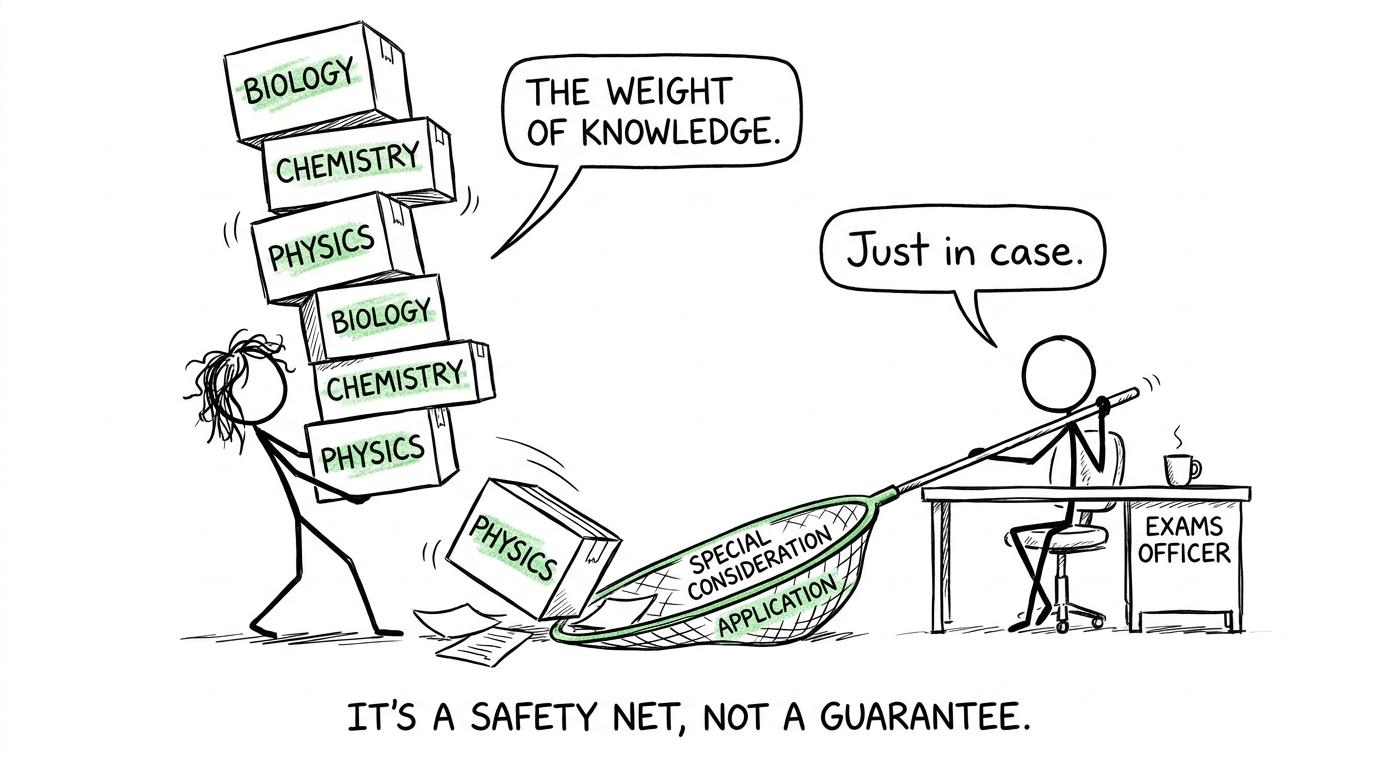 An exams officer places a special consideration safety net beneath a fallen exam paper
Which illnesses are likely to count?
There is no useful list in which every named condition automatically qualifies. The key question is whether a temporary illness at the time of the assessment had, or was reasonably likely to have had, a material effect on your ability to attend or perform normally.
A serious short-term infection, acute symptoms or an unexpected medical episode may support an application. A minor symptom that did not materially affect attendance or performance may not.
Long-term health conditions need careful handling. The condition itself is not automatically special consideration, because planned access arrangements or reasonable adjustments may be the appropriate support. However, an unexpected worsening at the time of the exam may be relevant. Speak to your school's special educational needs team and exams officer rather than trying to classify the situation yourself.
Special consideration is also different from being unprepared. It cannot normally compensate for missed teaching, incomplete revision, joining the course late or not covering the specification.
Can you take the missed science paper later?
Usually, no. GCSE papers are nationally timetabled, so an individual student cannot normally sit the same live paper later that week. Doing so would undermine exam security.
For many GCSE qualifications, the next opportunity is not until a later examination series, often the following year. The availability of a resit depends on the qualification and exam board. Do not assume that Combined Science will have the same November opportunities commonly associated with GCSE English language and maths.
If special consideration cannot produce an award, ask your school what future entry options are available. The exams officer can check the current specification and timetable for your board.
What to do about your remaining exams
One missed science paper can dominate your thoughts, but it should not be allowed to consume the papers still ahead. Once your school has the information it needs, move your attention to recovery and the next assessment.
If maths is approaching, use the GCSE maths revision hub to choose the correct exam board and tier. A short, controlled session is usually more useful during recovery than an exhausting attempt to compensate for lost time.
A sensible return might include:
- one revision lesson on a weak topic;
- a small set of practice questions;
- immediate marking with the mark scheme;
- one correction written clearly;
- rest before another short session.
The GCSE maths exam week checklist can help you organise the next paper without turning recovery into panic. If the exam is tomorrow, follow the calmer GCSE maths night-before plan rather than beginning a full paper late at night.
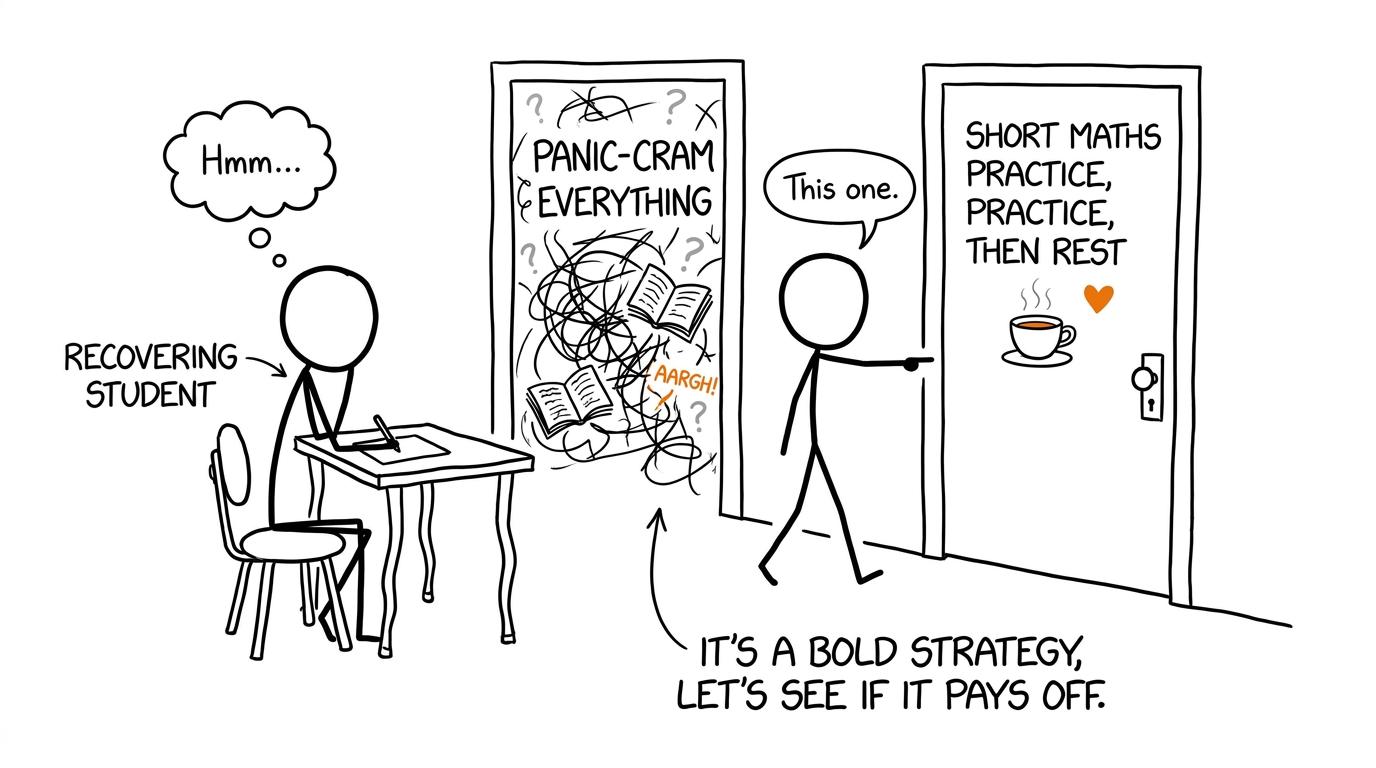 A recovering student chooses short maths practice and rest instead of panic-cramming
Common mistakes after missing a GCSE exam
Assuming the missed paper automatically receives zero
A genuine, documented absence may be eligible for special consideration. Contact the centre before deciding that your qualification has been lost.
Assuming special consideration is guaranteed
The school must support an application, and the exam board decides whether the rules have been met. Reporting illness does not itself guarantee an adjustment or grade.
Waiting until results day
The centre needs to know at the time of the assessment. Late disclosure can make the circumstances harder to verify and may fall outside normal application arrangements.
Forcing yourself to attend without telling anyone
If you are well enough to attend but your illness affects you, tell an invigilator. Silently struggling through the paper leaves the centre with less contemporaneous information. If you may be seriously ill, follow medical advice rather than attending simply to avoid an absence.
Treating a mock grade as the replacement mark
Missing-component calculations are not simply your mock result or predicted grade. They are handled by the awarding organisation under its special consideration procedures.
Abandoning revision for every remaining subject
The missed paper has already happened. Protect the exams you can still influence. Use short mini tests and structured GCSE resources, then mark and correct your work.
Avoid the habits in MathsGenie's guide to GCSE revision mistakes that waste time. If you have several days available, the one-week GCSE maths revision plan gives that time a calmer structure.
Focus on the next controllable step
Illness creates uncertainty because it removes a choice. You did not choose the timing, and you cannot personally rearrange a national examination. But you still have useful actions available: report the illness, follow the centre's evidence requirements, ask whether an application is being made and protect your recovery.
Then return to the work you can control. MathsGenie provides free revision lessons, practice questions, mini tests, past papers, predicted papers, mark schemes and video solutions for GCSE maths. Use past papers at the right stage of revision, identify the next weakness and fix it one step at a time.
A missed Combined Science paper does not automatically erase the papers you completed. Let your exams officer handle the formal process. Your task is to communicate early, recover properly and prepare calmly for what comes next.