GCSE Combined Science AQA Grade Boundaries 2026
GCSE combined science AQA grade boundaries explained with the latest confirmed table, double grades, tier rules and a calm results-day checklist for students.
Results day can make a small number feel enormous. You open your results and see two grades beside Combined Science, while a table of marks appears online beside it. The essential answer is simple: GCSE Combined Science AQA grade boundaries convert your total mark across six papers into one double grade. The boundaries for the current exam series are not confirmed before results day.
For students receiving June 2026 results, GCSE results day is Thursday 20 August 2026. AQA publishes its boundaries at 8.00 am8.00\text{ am}8.00 am. Until then, the June 2025 figures below are the latest confirmed boundaries and should be treated as historical guidance, not predictions.
GCSE Combined Science results day checklist
- Check that your qualification is AQA Combined Science: Trilogy, code 846484648464.
- Identify whether you sat Foundation, code 8464F8464\text{F}8464F, or Higher, code 8464H8464\text{H}8464H.
- Read the paired grade as a double award, such as 6-56\text{-}56-5.
- Compare your total with the correct tier table only.
- Speak to your school if anything appears missing or unexpected.
You can prepare before the day through the free AQA GCSE Combined Science revision hub, where MathsGenie brings together lessons, revision materials and paper practice.
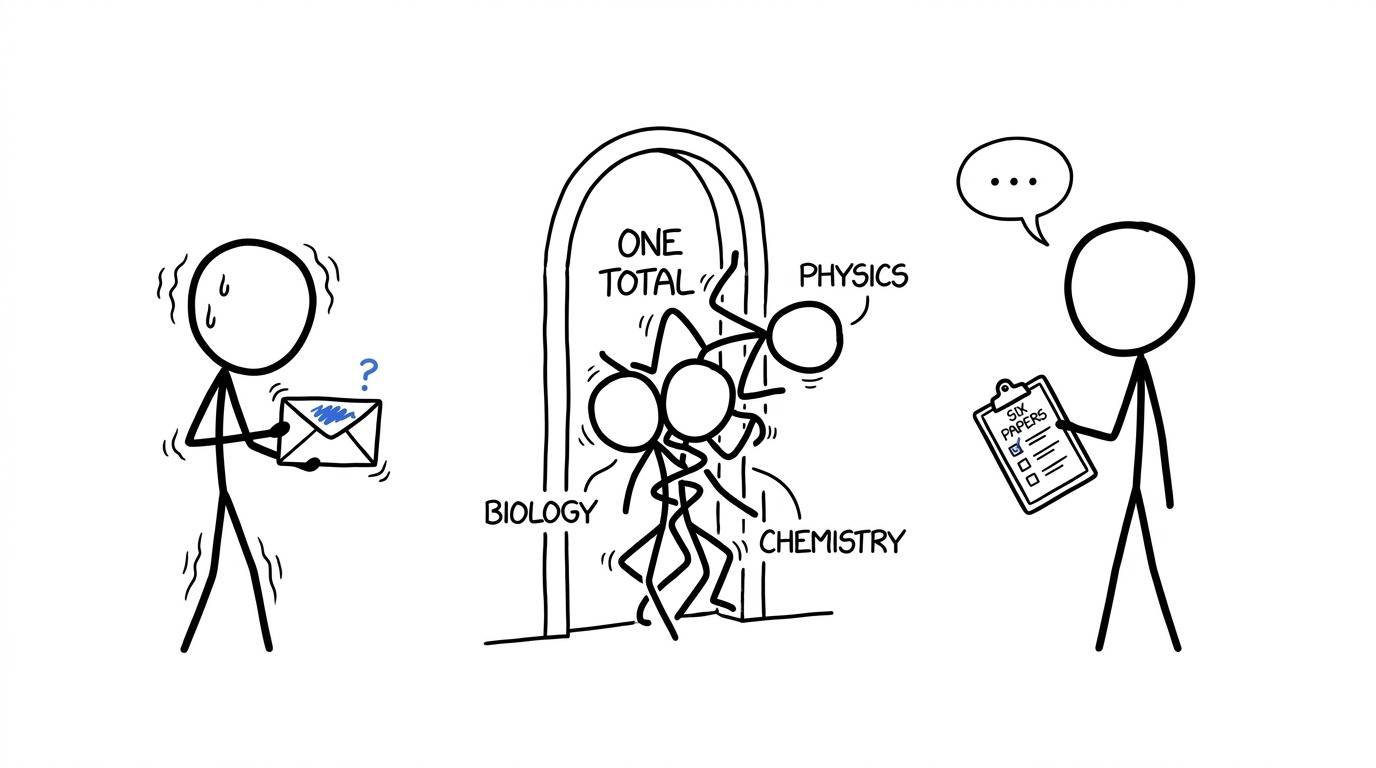 Three science subjects squeezing through one doorway marked one total
How AQA Combined Science grade boundaries work
AQA Combined Science: Trilogy has six equally weighted papers: two Biology, two Chemistry and two Physics. Each paper is worth 707070 marks and lasts 111 hour 151515 minutes. The maximum qualification mark is therefore:
6×70=4206 \times 70 = 4206×70=420Your marks are added across all six papers. AQA then compares that total with the subject-level boundary, producing one double grade rather than separate Biology, Chemistry and Physics grades.
The scale contains 171717 outcomes, from 9-99\text{-}99-9 to 1-11\text{-}11-1. The two grades are equal or adjacent, so 7-77\text{-}77-7 and 7-67\text{-}67-6 are possible, but 7-57\text{-}57-5 is not. Combined Science is worth two GCSEs, which is why two numbers appear.
Latest confirmed AQA Combined Science grade boundaries
These are the official June 2025 subject boundaries for AQA Combined Science: Trilogy. Each figure is the minimum total mark out of 420420420 required for that grade.
| Double grade | Foundation 8464F8464\text{F}8464F | Higher 8464H8464\text{H}8464H |
|---|---|---|
| 9-99\text{-}99-9 | Not available | 299299299 |
| 9-89\text{-}89-8 | Not available | 281281281 |
| 8-88\text{-}88-8 | Not available | 263263263 |
| 8-78\text{-}78-7 | Not available | 245245245 |
| 7-77\text{-}77-7 | Not available | 228228228 |
| 7-67\text{-}67-6 | Not available | 206206206 |
| 6-66\text{-}66-6 | Not available | 184184184 |
| 6-56\text{-}56-5 | Not available | 162162162 |
| 5-55\text{-}55-5 | 271271271 | 140140140 |
| 5-45\text{-}45-4 | 251251251 | 118118118 |
| 4-44\text{-}44-4 | 231231231 | 969696 |
| 4-34\text{-}34-3 | 202202202 | 858585 |
| 3-33\text{-}33-3 | 173173173 | Not available |
| 3-23\text{-}23-2 | 145145145 | Not available |
| 2-22\text{-}22-2 | 117117117 | Not available |
| 2-12\text{-}12-1 | 898989 | Not available |
| 1-11\text{-}11-1 | 616161 | Not available |
Foundation normally awards grades from 1-11\text{-}11-1 to 5-55\text{-}55-5. Higher normally awards 4-44\text{-}44-4 to 9-99\text{-}99-9, with 4-34\text{-}34-3 as an allowed safety-net grade for students narrowly below 4-44\text{-}44-4. Below that Higher threshold, the result is unclassified.
Why the 2026 boundaries cannot be known early
Boundaries move because papers cannot be made exactly equal in difficulty every year. Once marking is nearly complete, assessment evidence and senior examiners’ judgements are used to maintain a consistent standard. A more demanding paper may lead to lower boundaries; a less demanding paper may lead to higher ones.
That is why last year’s table is useful for interpreting the system but unreliable as a target for 2026. There is also no fixed percentage that always guarantees a particular grade.
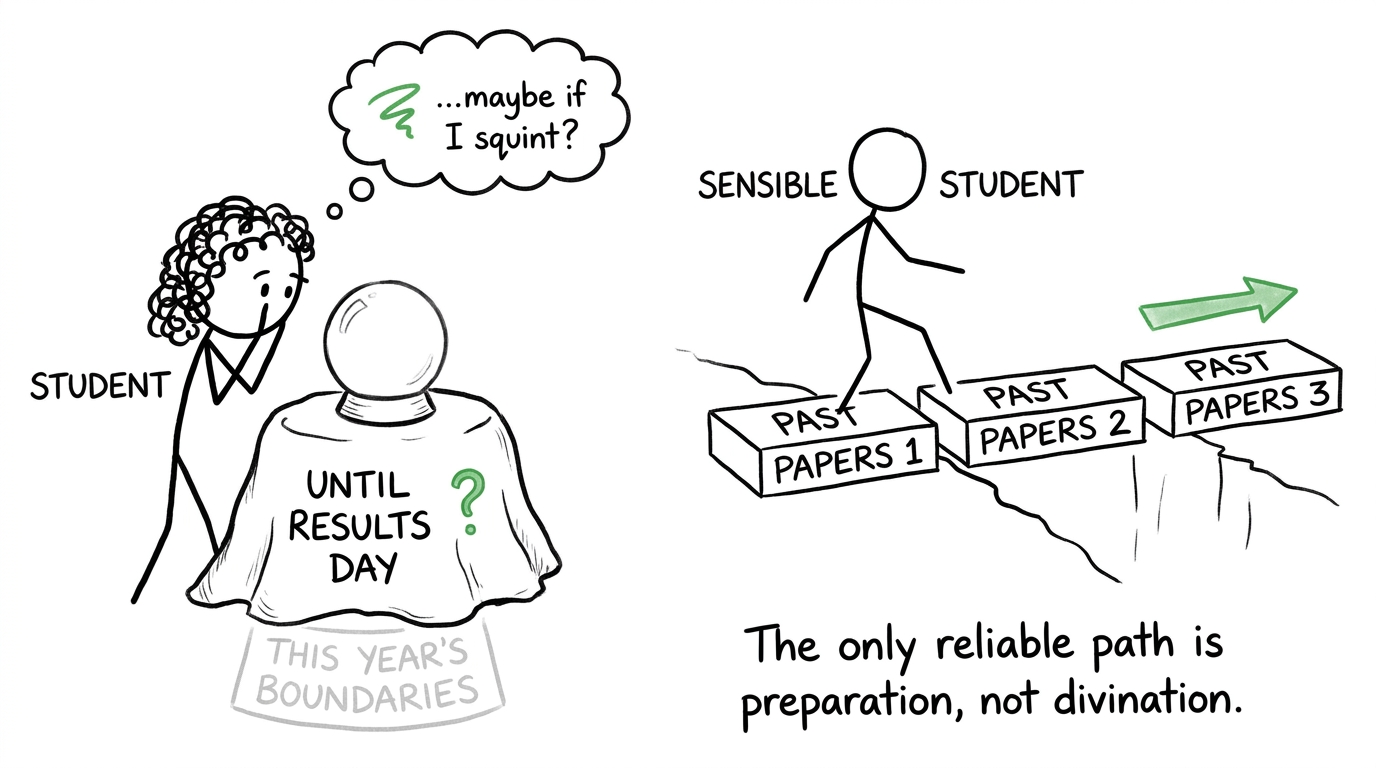 Student choosing past-paper stepping stones instead of a covered grade-boundary crystal ball
Turn boundary curiosity into useful revision
A boundary tells you where a grade ended after the exams. It does not tell you which knowledge will earn your next mark. That comes from practising the specification.
Start with the AQA Combined Science revision guides, then focus on identifiable gaps such as cell structure, atomic structure and relative atomic mass or forces and motion.
Science calculations also reward habits developed in maths: selecting an equation, rearranging it, converting units and checking whether an answer is sensible. The AQA GCSE Maths revision hub can strengthen those foundations, while the Combined Science key ideas guide helps connect calculations to scientific reasoning.
Common mistakes with AQA grade boundaries
Using a boundary from the wrong tier. Foundation and Higher papers have separate thresholds. Always check the entry code.
Reading the two numbers as separate science grades. A result such as 6-56\text{-}56-5 is the overall double grade, not one grade for Biology and another for Chemistry.
Comparing one paper with the overall boundary. The published subject boundary applies to the combined total out of 420420420, not an individual paper out of 707070.
Treating 2025 marks as a 2026 promise. Boundaries are set for each exam series after the papers have been marked.
Assuming one weak paper decides everything. Marks are combined, so stronger performances elsewhere can compensate. Every mark across every paper contributes to the same total.
Approach results day with a plan
The waiting can feel uncertain because the boundary is outside your control. Your next action is not. Check the correct AQA table, read your double grade carefully and ask your school for guidance if the result affects your sixth-form or college plans.
If you are still preparing, begin with MathsGenie’s AQA GCSE Combined Science revision guides. Move from a focused lesson to practice questions, then test yourself with past papers, predicted papers, mini tests, mark schemes and video solutions. Boundaries describe where marks landed. Good revision is how you build them.