Is GCSE Food and Nutrition Hard? An Honest Guide
Is GCSE Food and Nutrition hard? Discover what students find difficult, how assessment works and how to balance practical work with maths revision.
A practical subject can look like a welcome break from equations and written exams. Then you discover the food science, nutritional knowledge, written investigation, planning and timed cooking assessment hiding behind the apron.
So, is GCSE Food and Nutrition hard? The straight answer is: it can be demanding, but not because you need to be an exceptional cook. Students discussing the course commonly describe the volume of written work, food science and time pressure as harder than expected. Others enjoy it precisely because the qualification combines practical work with theory rather than depending entirely on final exams.
Your experience will depend on your organisation, confidence in the kitchen, ability to explain decisions and willingness to keep coursework moving. If you prepare steadily, it is manageable. If you expect every lesson to involve relaxed baking, it may surprise you.
The quick verdict
GCSE Food Preparation and Nutrition is likely to suit you if you:
- enjoy learning through practical tasks as well as writing;
- can follow instructions safely and accurately;
- are prepared to learn nutrition, food science, safety and provenance;
- can plan ahead rather than leaving work until the deadline;
- are willing to analyse and evaluate your results;
- want a subject assessed through both an examination and non-exam assessment.
It may feel harder if you dislike extended writing, become flustered when several tasks happen at once or already struggle to balance coursework with GCSE maths, English and science revision.
The important distinction is this: cooking is only one part of the course.
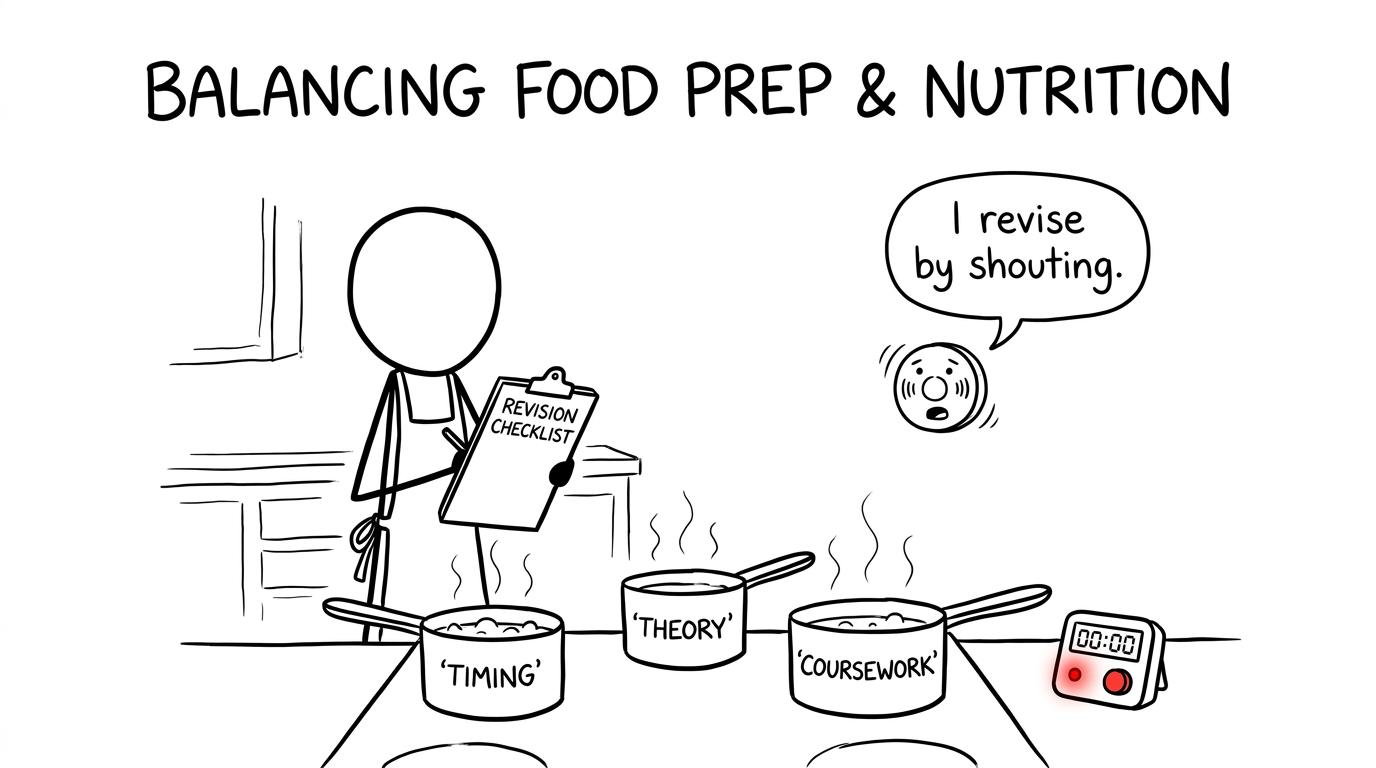 A student balancing timing, theory and coursework in a kitchen
What does GCSE Food Preparation and Nutrition involve?
The exact structure depends on your exam board, so check the specification used by your school. AQA, OCR and Eduqas all offer GCSE Food Preparation and Nutrition qualifications graded 999 to 111.
Across these specifications, the broad assessment balance is similar:
- a written examination worth 50%50\%50% of the qualification;
- non-exam assessment, usually called NEA, worth the remaining 50%50\%50%;
- a food investigation examining the scientific properties of ingredients;
- a food preparation task involving research, planning, practical skills and evaluation.
For AQA, the written paper lasts 111 hour 454545 minutes and is worth 100100100 marks. Its NEA includes a food investigation and a larger food preparation assessment. Students prepare, cook and present three dishes within a single session of no more than three hours.
Eduqas also uses a 111 hour 454545 minute written examination worth 50%50\%50%, with two NEA tasks making up the other half. OCR's written examination lasts 111 hour 303030 minutes and contributes 50%50\%50%. Its food investigation is worth 15%15\%15%, while the food preparation task is worth 35%35\%35%.
This is not a foundation or higher tier subject. Unlike GCSE maths, everyone following the same exam-board specification is assessed through the same qualification structure.
What students say is genuinely difficult
Online student discussions are anecdotal, not representative surveys. They cannot tell you how every school teaches the course or how you personally will find it. They do, however, reveal several recurring concerns that match the demands visible in the official specifications.
There is more writing than many students expect
A common surprise is the amount of written evidence attached to practical work. The food investigation is not simply an afternoon of testing ingredients. You must record what you did, present findings, explain the relevant science and evaluate the quality of your investigation.
For AQA and OCR, the investigation report is expected to be approximately 1,5001{,}5001,500 to 2,0002{,}0002,000 words. The preparation task also requires evidence of research, planning, technical skills and evaluation.
That workload becomes difficult when it is postponed. A photograph without an explanation, or a result without analysis, rarely demonstrates everything the assessment criteria require.
Food science requires precise understanding
You may study protein coagulation, carbohydrate gelatinisation, aeration, emulsification, heat transfer and the functional properties of ingredients. Knowing that bread rises or a sauce thickens is not enough. You need to explain why.
This is where some students find the subject more academic than its reputation suggests. Food science contains specialist vocabulary, linked processes and application questions. It rewards understanding rather than vague descriptions.
The practical assessment creates time pressure
Cooking three dishes in a restricted session requires more than culinary skill. You must sequence tasks, use equipment efficiently, maintain food safety and recover sensibly if something goes wrong.
Students often describe this time pressure as intimidating. Yet the final session is planned in advance. The goal is not improvisation. A realistic time plan, practised techniques and sensible dish choices matter more than attempting the most complicated menu imaginable.
The final examination still matters
Because the written examination contributes 50%50\%50%, strong practical work cannot replace theory revision. Questions may test nutrition, food safety, food choice, provenance, preparation methods and food science. They can also require you to apply knowledge to unfamiliar contexts or write extended responses.
This explains why some students describe the paper as the hardest part. Remembering facts is only the beginning; you must select relevant knowledge and use it to answer the question actually asked.
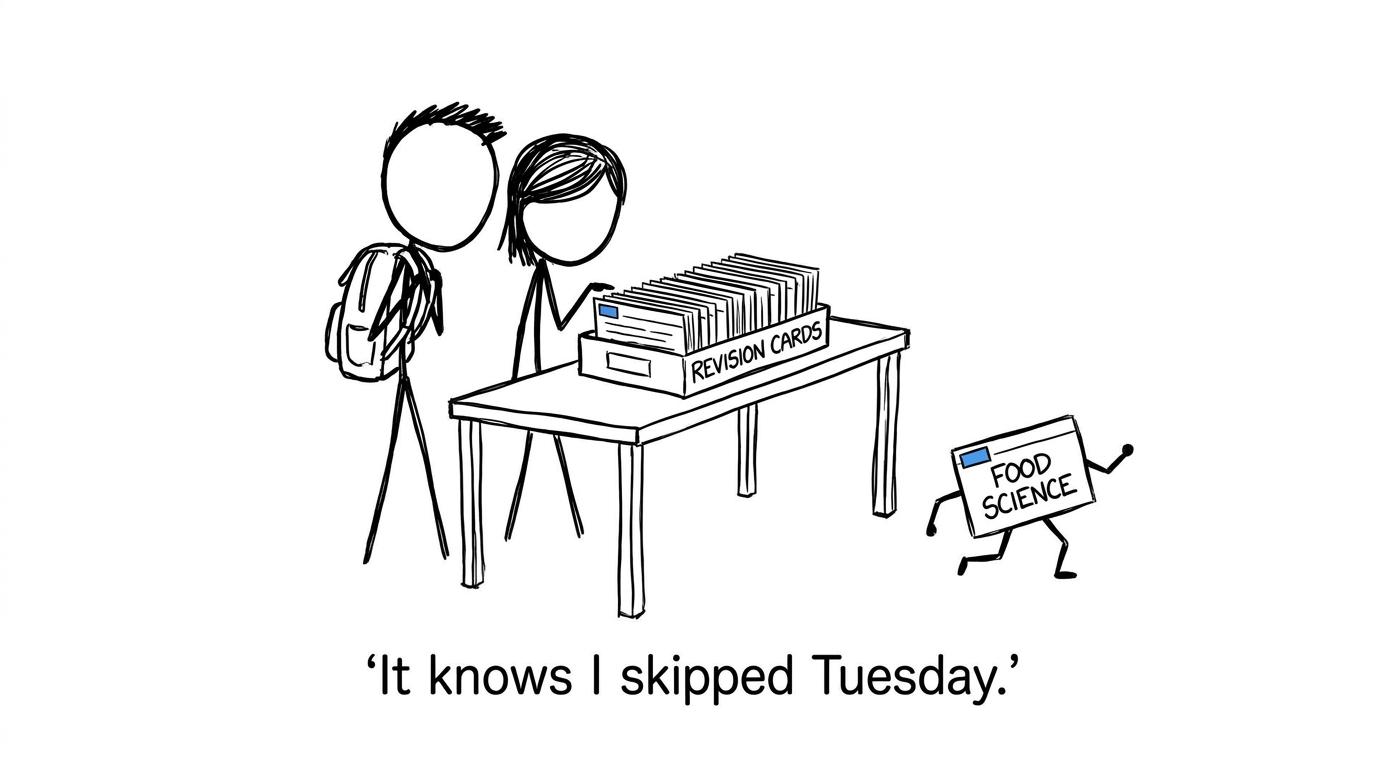 Revision cards discover that food science was skipped
What can make the course feel easier?
Difficulty is not fixed. Much of it comes from a mismatch between the course and the way a student works.
Consistent organisation
NEA rewards accumulated evidence. After a practical investigation, organise photographs, observations and results while the details are fresh. Keep file names clear and maintain a list of unfinished sections.
A student who completes small updates regularly may experience the same specification very differently from someone reconstructing several weeks of work near a deadline.
Choosing dishes strategically
A complicated dish is not automatically a high-mark dish. Your choices need to respond to the task, demonstrate appropriate technical skills and be achievable safely within the available time.
Ask whether your menu gives you opportunities to demonstrate planning, nutrition, preparation skills and presentation. Your teacher can explain the assessment criteria and what level of guidance is permitted.
Active theory revision
Reading notes repeatedly can create familiarity without recall. A stronger routine is to close the book and retrieve the information:
- define a food-science term from memory;
- explain the function of an ingredient;
- compare two cooking methods;
- answer an examination question;
- check the mark scheme and improve the response.
This is the same learn-practise-check cycle used throughout MathsGenie's GCSE maths revision hub. The subject changes, but effective revision remains active.
How much maths is in GCSE Food and Nutrition?
Food Preparation and Nutrition is not a maths-heavy GCSE, but numerical confidence helps. Depending on the specification and task, you may need to interpret nutritional information, compare quantities, scale recipes, calculate proportions, use temperatures and times, or present investigation results clearly.
The most useful GCSE maths skills include:
- fractions, decimals and percentages;
- ratio and direct proportion;
- reading tables and graphs;
- calculating averages;
- converting units;
- checking whether an answer is reasonable.
Recipe scaling is closely connected to ratio and proportion. If that is a weak area, use the GCSE ratio revision guide to rebuild the underlying method. Maths students can also use MathsGenie's guide to the best order for learning GCSE maths topics when number skills need attention before proportion and data.
Do not assume that every calculation must be difficult. Accuracy, units and interpretation are usually more important than advanced algebra.
Balancing Food and Nutrition with maths revision
For students preparing for maths exams, the hidden challenge may be timetable pressure. Food NEA can demand concentrated attention during Year 111111, while maths improves through regular practice rather than occasional long sessions.
Protect maths with a small, repeatable minimum. A sensible weekly pattern might include:
- two short topic sessions using revision lessons and practice questions;
- one GCSE mini test or mixed revision session;
- one timed paper section when examinations approach;
- a review of errors using mark schemes or video solutions.
When coursework becomes busy, shorten the maths session rather than deleting it. Twenty focused minutes can preserve familiarity. MathsGenie's one-month GCSE revision plan offers a structure for turning limited time into specific daily actions.
Past papers should also be introduced in stages. The guide to when to start GCSE past papers explains how to move from short diagnostic work to full timed practice. Near the exams, GCSE predicted papers can provide fresh questions, but they should complement rather than replace past papers and topic revision.
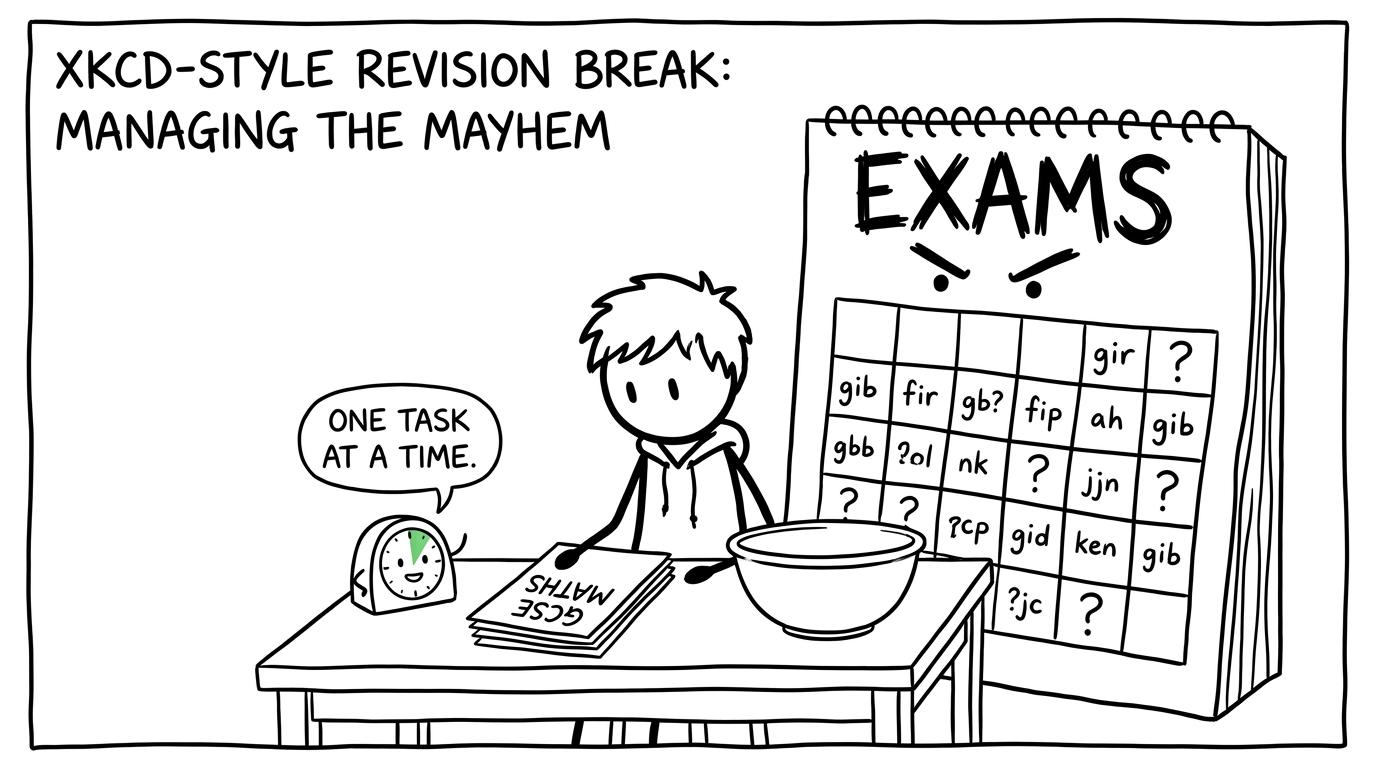 A kitchen timer encourages a student to tackle one revision task at a time
Common mistakes that make the GCSE harder
Choosing it because it sounds easy
The course is creative and practical, but it is not a free period built around cooking. Read your school's exam-board specification and look at an assessment task before deciding.
Treating practical lessons as separate from theory
A practical result is evidence you can analyse. Connect each investigation to the underlying food science, nutritional purpose and sensory outcome.
Leaving evaluation until much later
Specific observations fade quickly. Record what worked, what changed and what you would improve soon after completing the task.
Attempting an unrealistic final menu
Technical ambition needs to be balanced with timing, safety and consistency. Three manageable dishes completed well can demonstrate more than an elaborate plan that cannot be finished.
Revising only favourite topics
Students often return to familiar nutrition content while avoiding food science or extended responses. Use questions to identify the weakest area, then revise that area first. The same principle applies to maths: the GCSE maths topics by board and tier guide can help you organise mathematical gaps rather than revising randomly.
Is GCSE Food and Nutrition worth taking?
It can be a rewarding choice if you value practical learning and want to understand the science, safety and decision-making behind food. The course develops planning, evaluation and time-management skills alongside cooking knowledge.
But the honest answer to is GCSE Food and Nutrition hard is not simply yes or no. It is demanding in a particular way: half examination, half NEA; practical but academically explained; creative but carefully assessed.
Before choosing it, ask your teacher which board your school uses, how practical lessons are organised and what current students found most time-consuming. Look at the specification and a past paper. Make the decision from evidence, not from the idea that practical subjects must be easier.
Then protect the rest of your timetable. Keep Food and Nutrition coursework moving in small stages, and make MathsGenie your free base for maths revision. Start with GCSE maths revision lessons and practice, check your work with mark schemes and video solutions, build confidence through mini tests and finish with past papers and predicted papers. One well-chosen task at a time is how difficult courses become manageable.