Imposter Syndrome in Top Set GCSE Chinese
Imposter syndrome top set GCSE Chinese: why capable students feel out of depth and practical ways to rebuild confidence before GCSE exams.

A place in top set can feel like proof that you are doing well. Strangely, it can also make every hesitation feel more serious. One forgotten character, one difficult listening task or one fluent answer from somebody else may seem to confirm a private fear: perhaps you do not really belong there.
The phrase imposter syndrome top set GCSE Chinese describes that conflict well. Yes, impostor feelings are found among school-age students, including high-achieving students. However, there is no reliable research showing exactly how common they are specifically in top set GCSE Chinese. The honest answer is that the feeling is more normal than it appears, but no trustworthy subject-specific percentage exists.
That distinction matters. You are not unusual, but you are also not defined by a label. Feeling out of your depth is an experience to understand, not evidence that you have been placed in the wrong class.
A quick reality check
If top set GCSE Chinese has started to feel uncomfortable, remember:
- Top set means the work is intended to stretch you, not that you should already know everything.
- Your classmates' confident moments do not reveal their private doubts.
- Speaking, listening, reading and writing develop at different speeds.
- A difficult lesson is weak evidence about your overall ability.
- Confidence often follows repeated practice rather than arriving before it.
- If worry is affecting your sleep, concentration or daily life, speaking to a trusted adult is more important than finding a better revision technique.
These principles apply beyond languages. A student can feel perfectly capable in Chinese but fraudulent in higher-tier maths, or the other way around. The subject changes. The comparison trap does not.
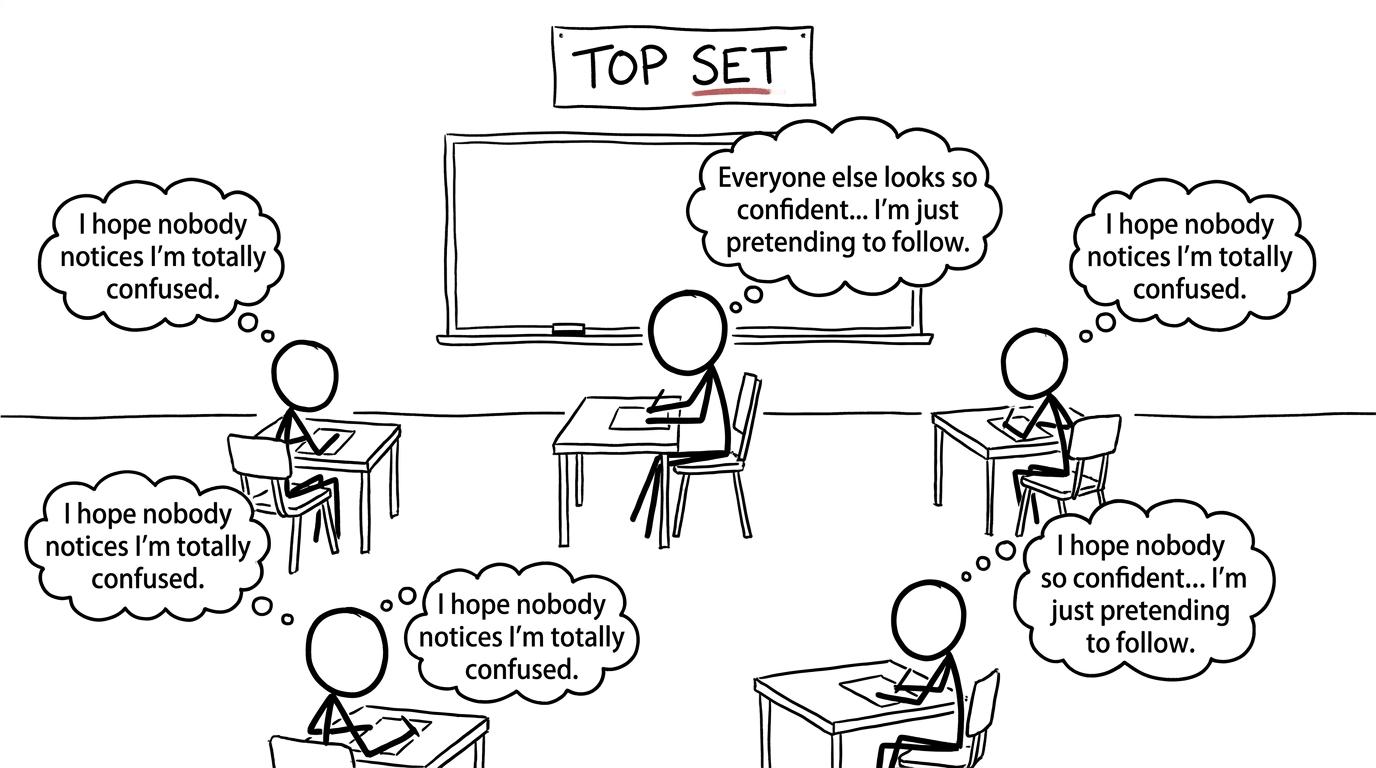 A top-set classroom where every apparently confident student privately feels confused
Why top set can make self-doubt louder
The reference group changes
Moving into a stronger class changes the people against whom you compare yourself. You may previously have been among the quickest students in the room. In top set, you are surrounded by other capable learners, so your relative position can feel different even when your actual knowledge has improved.
This is easy to misread. You notice that someone recalls vocabulary faster, gives a longer speaking answer or recognises a character immediately. You do not see the practice behind that moment, the topics they find difficult or the errors they made yesterday.
Top sets therefore create a visibility problem: other people's strengths are public, while much of their uncertainty remains private.
Language performance feels unusually exposed
A maths error can remain quietly on a page. Speaking another language happens in real time. Pauses, pronunciation and forgotten words feel visible, even though hesitation is a normal part of developing fluency.
Research into the impostor phenomenon in students has linked it with fear of displaying imperfection, pessimistic expectations and exam anxiety. Evidence specifically about adolescents is more limited than evidence about adults and university students, so dramatic prevalence claims should be treated cautiously. Still, the central pattern is recognisable: objective progress and subjective confidence do not always move together.
Top set is not the same as knowing everything
A top set is a school's teaching arrangement. It is not a national GCSE category and does not have one universal entry standard. Schools may use assessments, teacher judgement, prior attainment and timetable considerations when organising classes.
Nor is a set identical to an examination tier. For example, the established AQA GCSE Chinese (Spoken Mandarin) specification has Foundation and Higher tiers, with students taking listening, speaking, reading and writing at the same tier. Each skill contributes to the qualification, but you should check your own exam board's current specification because task formats and timings differ.
Being in top set usually means your teacher believes that more demanding work is appropriate. It does not promise that the work will feel easy.
Signs that this may be impostor thinking
Ordinary uncertainty becomes impostor-style thinking when the mind repeatedly explains success away while treating every mistake as decisive evidence.
You might notice thoughts such as:
- My good assessment was just an easy paper.
- The teacher overestimated me.
- Everyone else understands immediately.
- Asking a question will reveal that I should not be here.
- Unless my answer is fluent, I should stay silent.
- One low mark proves that previous high marks were luck.
None of these thoughts is a diagnosis. The term impostor syndrome is commonly used, but the impostor phenomenon is not itself a formal verdict that a student should apply to every period of low confidence.
A better question is: what does the evidence show? Look at several assessments, teacher feedback and performance across different skills. One lesson is a snapshot. A pattern across time is more informative.
What actually helps in GCSE Chinese
Separate the four skills
Saying that you are bad at Chinese is too broad to produce a useful action. Identify whether the difficulty is listening, speaking, reading or writing, then narrow it again.
For example, the true issue might be recognising familiar language at normal speed, recalling vocabulary without prompts, forming extended spoken responses or writing characters accurately under time pressure. A precise gap can be practised. A global judgement about your intelligence cannot.
This is also an excellent rule for maths revision. Do not write down algebra as a weakness if the real issue is factorising quadratics or rearranging formulae. The MathsGenie GCSE Maths revision hub organises lessons and questions by topic, making it easier to turn a vague worry into a specific next step.
Replace impressions with evidence
Impostor feelings thrive on selective memory. The mind remembers the awkward speaking pause but forgets the reading marks, the improved paragraph and the vocabulary that now feels automatic.
Keep a short evidence log containing:
- the task you completed;
- what you could do without help;
- one correction from feedback;
- the next small action;
- the date on which you will try it again.
This is not a collection of compliments. It is a record of learning. Include mistakes because corrected errors are evidence too: they show that feedback has become a plan.
In maths, a similar diagnostic process begins with real questions. The guide to finding your weakest GCSE topics explains how to log lost marks and prioritise the gaps that matter most.
Practise before you feel ready
Waiting for confidence creates a circular problem. You avoid speaking because you feel uncertain, then remain uncertain because you have little experience of speaking.
Choose a manageable version of the uncomfortable task. That might mean rehearsing aloud alone, answering one question in class or practising with a partner before attempting a longer exchange. The aim is not to remove every nervous feeling. It is to gather evidence that you can act while feeling nervous.
The same principle works with exam papers. GCSE mini tests offer a smaller step than a full paper, while the 20-minute maths revision routine makes consistent practice possible on busy school days.
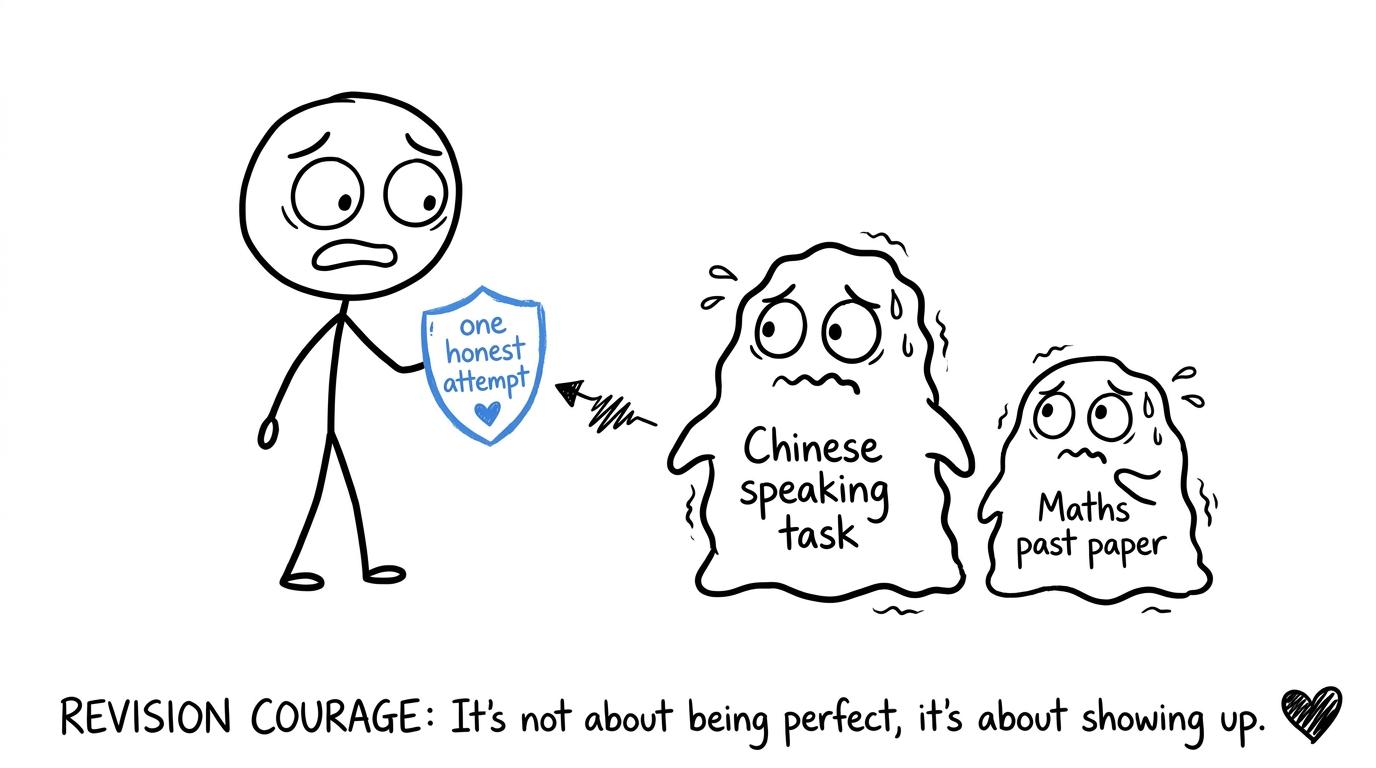 A student using one honest attempt as a shield against revision worries
Use feedback as information, not identity
A mark scheme describes what earned credit on a particular task. It does not describe your worth or set a permanent ceiling on your grade.
After an assessment, classify each lost mark:
- knowledge not yet secure;
- misunderstanding of the question;
- incomplete response;
- accuracy error;
- timing or exam technique.
Each category suggests a different repair. This prevents the unhelpful conclusion that everything is wrong.
For maths, using GCSE past papers properly means completing the paper, marking it carefully, repairing the weakest topics and retesting them. Students taking Edexcel can use the Edexcel GCSE Maths past papers with mark schemes and available solutions.
A revision routine that reduces uncertainty
A calm routine removes the daily question of whether you are doing enough. Try this structure across Chinese and maths:
Diagnose
Complete one small, relevant task without notes. In Chinese, choose one skill. In maths, choose material matching your exam board and tier. The GCSE maths topics by exam board and tier guide can help you locate suitable revision.
Review
Mark the task using reliable feedback. Record what was successful as well as what needs correction. If you only record failures, your evidence log becomes another form of distorted comparison.
Repair
Practise one narrow weakness. Keep the session short enough that you can repeat it rather than turning it into a heroic, exhausting evening.
Retest
Return to the skill later without looking at the earlier answer. Improvement becomes believable when you can see it twice.
Build towards exam conditions
Once individual skills are steadier, combine them in timed tasks and full papers. A structured schedule such as the GCSE one-month maths revision plan can stop last-minute panic from deciding what you practise.
Common mistakes when dealing with impostor feelings
Trying to prove that you belong by overworking
Excessive revision may briefly quiet self-doubt, but it can damage sleep, concentration and consistency. Set a clear task and stopping time. More work is not automatically better work.
Avoiding questions to look capable
Silence protects your image for a moment while preserving the knowledge gap. Ask the specific question. Teachers expect students to need clarification, especially in a demanding class.
Comparing your weakest skill with someone else's strongest
The fluent speaker beside you may struggle with writing. The fast mathematician may lose marks through careless checking. Compare your current performance with your own earlier evidence instead.
Treating one mark as a verdict
Assessments are useful because they reveal what to do next. They become harmful when every result is treated as a permanent ranking of ability.
Revising only what feels comfortable
Rereading familiar material can create the feeling of fluency without testing recall. Use questions, timed tasks and active retrieval. In maths, revision lessons should lead into practice questions, mini tests and eventually past or predicted papers.
Keeping serious anxiety private
If worry is persistent, getting worse, or affecting sleep, school, relationships or everyday life, tell a parent, carer, teacher, school pastoral lead or GP. Study advice is not a substitute for appropriate mental health support.
You do not need to feel certain to make progress
Feeling out of place in top set GCSE Chinese does not prove that you are an impostor. Often, it means you are learning in a room where the standard is high and uncertainty is less visible than achievement.
The most useful response is neither empty reassurance nor relentless work. It is better evidence: identify one skill, practise it, use feedback, retest it and let repeated performance update the story you tell yourself.
Bring that same approach to your maths exams. Start at the free MathsGenie GCSE revision hub, choose your exam board and tier, then move from revision lessons to practice questions, mini tests, past papers and predicted papers. Use mark schemes and video solutions to turn every lost mark into a clear next action. Confidence may arrive quietly, but the work that produces it can begin today.