How to Get Grade 9 GCSE Portuguese: Revision Plan
How to get grade 9 GCSE Portuguese: strengthen listening, speaking, reading and writing with a focused, practical revision plan for top marks.
There is a frustrating stage in language revision when you understand almost everything in class but still lose marks in an exam. A listening detail disappears. A speaking answer becomes hesitant. A strong writing task is weakened by avoidable verb errors.
If you are searching for how to get grade 9 GCSE Portuguese, the short answer is this: practise all four skills regularly, use Higher-tier exam material, study mark schemes and turn every mistake into a specific revision task. Grade 9 performance is not simply fluent Portuguese. It is accurate, flexible Portuguese delivered under exam conditions.
The most effective changes are usually small: listening without subtitles, speaking aloud every day, retrieving vocabulary instead of rereading it and completing timed exam tasks before you feel entirely ready.
Your grade 9 Portuguese checklist
- Confirm your exam board, specification and Higher-tier entry with your school.
- Diagnose your weakest skill using an official practice or past paper.
- Practise listening, speaking, reading and writing every week.
- Build vocabulary around the specification themes, not random word lists.
- Strengthen tense control, opinions, reasons and complex structures.
- Keep an error log and revisit mistakes within a few days.
- Complete timed tasks and mark them using official criteria.
- Treat fluent communication and grammatical accuracy as equally important.
This is the same evidence-led approach used in an effective GCSE revision timetable: diagnose, practise, check, correct and retest.
Understand what the Portuguese GCSE assesses
Students should always check the details supplied by their school, but the current Pearson Edexcel GCSE Portuguese qualification, specification code 1PG0, contains four papers:
| Paper | Skill | Weighting |
|---|---|---|
| Paper 1 | Listening and understanding | 25%25\%25% |
| Paper 2 | Speaking | 25%25\%25% |
| Paper 3 | Reading and understanding | 25%25\%25% |
| Paper 4 | Writing | 25%25\%25% |
Pearson’s current specification states that students take one tier across all four papers. Foundation tier targets grades 1 to 5, while Higher tier provides access to grades 4 to 9. A student aiming for grade 9 therefore needs to be entered for Higher tier.
The final grade comes from the total subject mark rather than separate grades for individual papers. That creates an important strategic lesson: you cannot build a grade 9 plan around writing alone, even if writing is your strongest skill. A persistent weakness in listening or speaking affects a substantial part of the qualification.
Grade boundaries are set after each examination series and can change. Do not build your plan around an assumed raw-mark threshold. Aim to make your performance secure across every paper and use published boundaries only to interpret completed assessments.
Replace broad revision with a feedback loop
A student can spend an hour “doing Portuguese” without discovering whether anything improved. Grade 9 revision needs a tighter loop:
- Attempt a short task without notes.
- Check it against the mark scheme, transcript or teacher feedback.
- Identify the exact reason for every lost mark.
- Practise that small weakness.
- Attempt a similar task later without support.
Your error log should be precise. “Listening is bad” does not suggest an action. “I confuse negative statements when the speaker changes their mind” does.
Separate errors into useful categories: missing vocabulary, misunderstood meaning, grammar, pronunciation, task coverage, timing and careless reading. The method in MathsGenie’s guide to finding your weakest GCSE topics transfers neatly to language revision. Evidence is more useful than instinct.
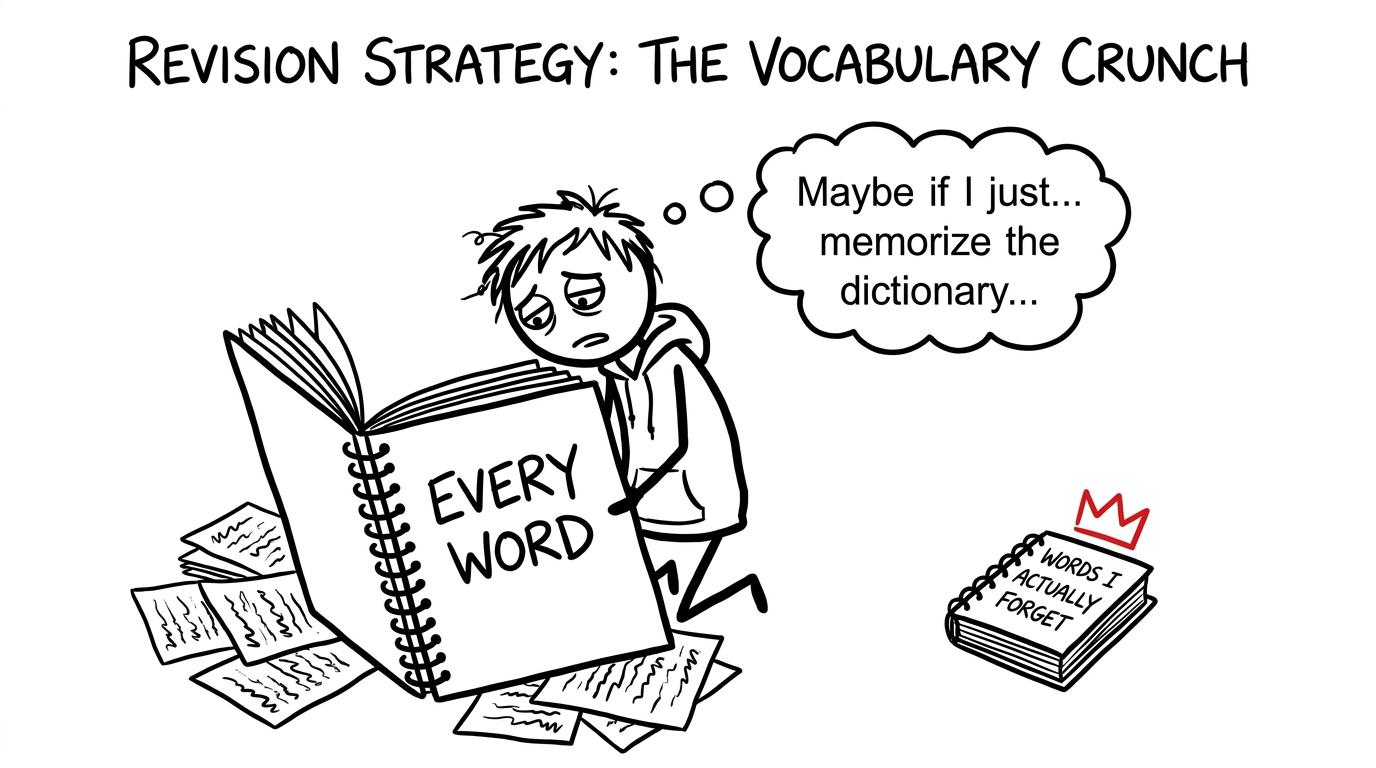 A tiny useful vocabulary notebook defeats an enormous list of every possible word
Build vocabulary that you can actually retrieve
Recognising a word on a page is not the same as producing it during a speaking assessment. Grade 9 candidates need active vocabulary: language that can be recalled quickly and adapted to unfamiliar questions.
Organise vocabulary around the five Edexcel themes: identity and culture; local area, holiday and travel; school; future aspirations, study and work; and the international and global dimension. Within each theme, prioritise:
- high-frequency verbs and their key forms;
- opinions with developed reasons;
- connectives that create logical answers;
- descriptive language;
- time phrases and sequencing expressions;
- language for comparing, qualifying and disagreeing;
- words you repeatedly miss in exam questions.
Use retrieval rather than copying. Cover the Portuguese, recall it, say it aloud and then check. Reverse the direction as well: translate from Portuguese into English and from English into Portuguese. Revisit difficult items after a short delay instead of testing them repeatedly in one sitting.
The principle mirrors MathsGenie’s advice on stopping GCSE content from being forgotten: space your practice, retrieve before checking and return to errors on different days.
Train listening as an active skill
Listening often feels unpredictable because spoken language arrives once, at someone else’s speed. The solution is not simply to play more audio in the background. You need deliberate listening.
Use official recordings and complete this sequence:
- Listen once for the overall topic and attitude.
- Listen again for names, times, reasons, opinions and changes of mind.
- Write down the words or sounds that blocked understanding.
- Check the transcript only after making a genuine attempt.
- Replay the difficult section and imitate its rhythm aloud.
Pay particular attention to negatives, distractors and corrections. A speaker may mention one plan before explaining why it changed. Catching isolated vocabulary is not enough; you must follow the complete message.
Short, frequent sessions are better than one exhausting weekly session. Even ten focused minutes can train attention if you record what went wrong and replay the difficult phrases.
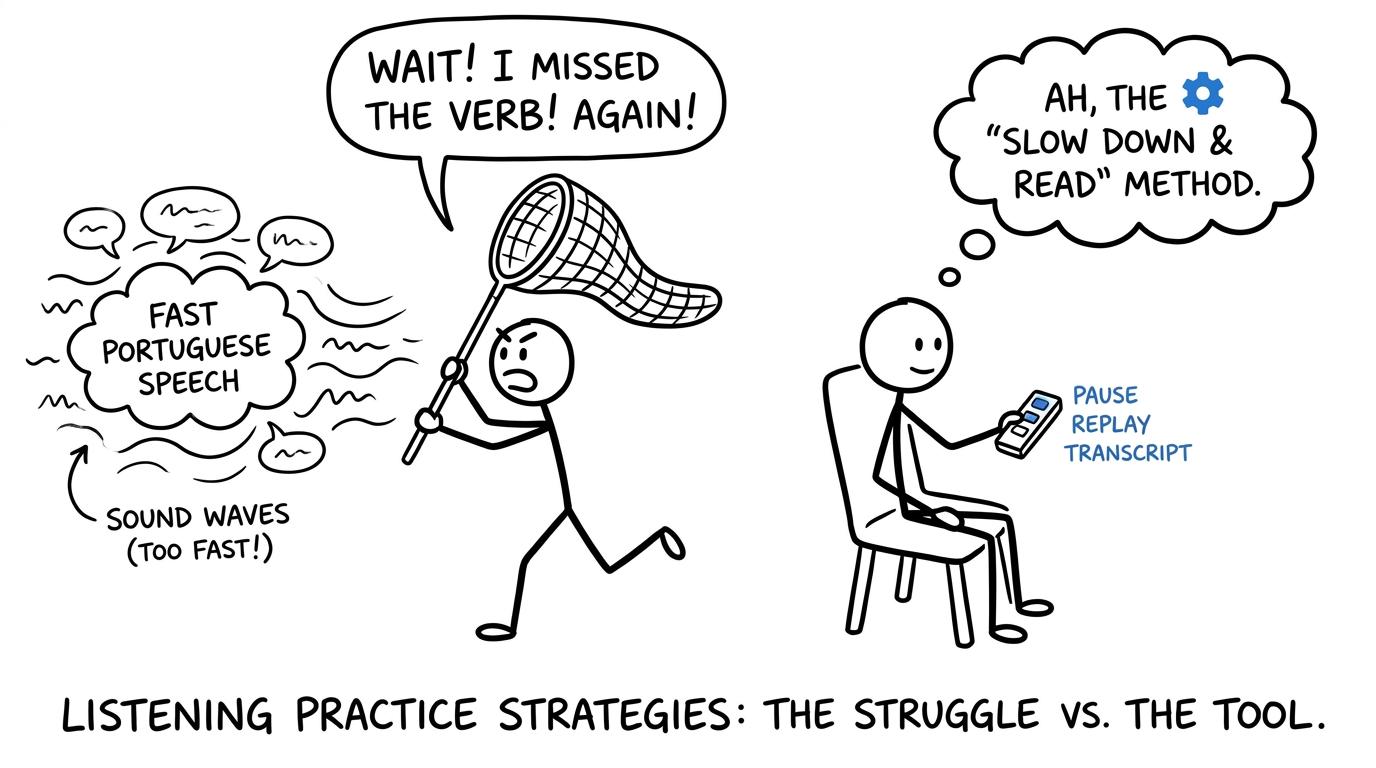 One student chases fast speech while another uses pause, replay and a transcript
Make speaking practice unavoidable
Speaking improves when Portuguese becomes something you produce, not something you silently recognise. Waiting for confidence before speaking reverses the process: confidence normally grows because you have spoken repeatedly.
Practise aloud each day. Record responses to specification questions, listen back and check three things: whether you answered the question, whether your meaning remained clear and whether you varied your language.
Prepare flexible building blocks rather than memorised speeches. A memorised paragraph can collapse when the examiner changes the wording. A bank of adaptable opinions, reasons, tense phrases and follow-up details lets you respond naturally.
The Higher-tier speaking assessment includes a role play, a picture-based task and a conversation. Rehearse each format. For conversations, ask a teacher or partner to vary the order and wording of questions. For picture tasks, practise describing visible details before moving into opinions, interpretation and wider discussion.
Pronunciation matters because communication must be intelligible. Focus particularly on sounds or stress patterns that repeatedly cause misunderstanding rather than trying to imitate a perfect accent.
Write for communication, range and accuracy
Strong writing is not the longest writing. It is relevant, controlled and clearly organised.
Before starting, identify every bullet point and the time frame required. Missing part of the task can limit an otherwise impressive response. Plan briefly, write and leave time to check:
- verb endings and tense consistency;
- agreements;
- accents and spelling;
- word order;
- whether each bullet point is covered;
- whether reasons and details develop your ideas.
At Higher tier, the writing paper includes open-response tasks and translation into Portuguese. Translation deserves separate practice because it exposes weaknesses that free writing can hide. You cannot quietly avoid a difficult structure when the English sentence requires it.
Build a reliable core of accurate structures before adding complexity. Sophisticated language helps only when it communicates the intended meaning. Ask your teacher to mark selected timed responses using the official criteria, then rewrite the weakest section rather than merely reading the feedback.
Read for meaning, not word-by-word translation
Reading questions reward comprehension, not the production of a perfect English version of every sentence. Begin by identifying the text type, topic and broad viewpoint. Then locate evidence for each question.
Train yourself to notice synonyms and paraphrases. The question may express an idea differently from the text, so searching for an identical word can be misleading. Also watch pronouns, negatives, time markers and contrasts: they often determine who did what and when.
The Higher-tier reading paper includes translation from Portuguese into English. Your translation should preserve the full meaning in natural English. Check that small words, negatives and time references have not disappeared.
Turn past papers into improvement
Past papers are valuable only when they change the next revision session. Begin with individual sections if a complete paper is overwhelming, then progress towards full timed assessments.
After marking, do more than record a total. Ask:
- Which questions could I not begin?
- Which answers showed partial understanding?
- Did I lose marks through language knowledge or exam technique?
- Which error appeared more than once?
- What will I practise before the next paper?
Official Portuguese papers and mark schemes should come from Pearson or your school. MathsGenie does not provide Portuguese papers, but its guide to using GCSE past papers properly explains the attempt-mark-fix-retest cycle clearly. The advice on when to start GCSE past papers can also help you move gradually from short sections to complete papers.
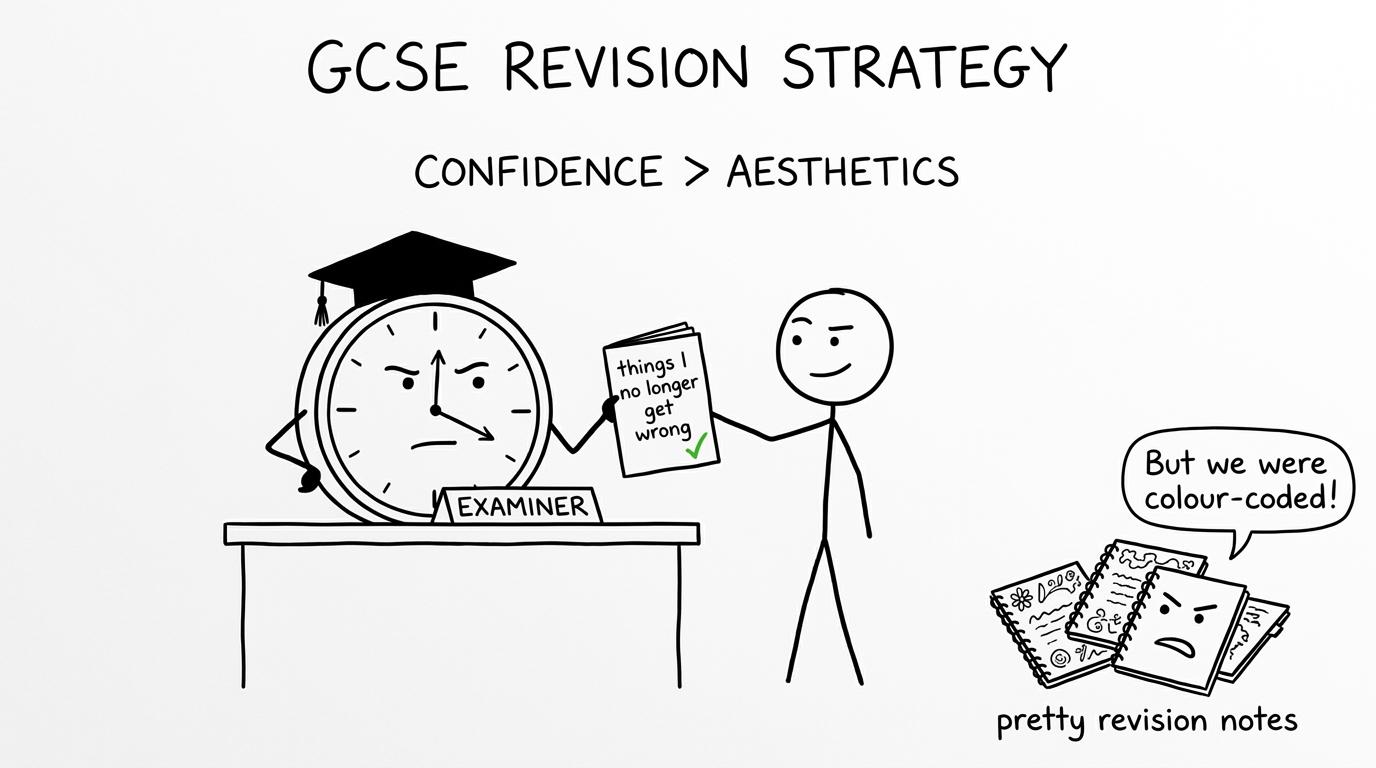 An error log impresses the exam clock while untouched decorative notes look jealous
A weekly routine that can move you towards grade 9
A repeatable week matters more than an ambitious timetable abandoned after three days. One practical structure is:
| Session | Main focus |
|---|---|
| Monday | Vocabulary retrieval and short listening practice |
| Tuesday | Speaking recording and pronunciation correction |
| Wednesday | Timed reading questions and translation |
| Thursday | Grammar repair based on your error log |
| Friday | Timed writing task or paragraph plan |
| Weekend | Mixed past-paper section, marking and corrections |
Keep sessions focused. A one-month GCSE revision plan shows how short weekday blocks and a longer weekend assessment can create useful momentum. You can apply that rhythm to Portuguese while using the MathsGenie GCSE maths hub to keep your maths revision organised alongside it.
Common mistakes that block grade 9 progress
Revising only the strongest skill
Writing feels productive because it leaves visible evidence. Listening and speaking are easier to postpone. Give each skill scheduled time because each contributes equally to the current Edexcel qualification.
Memorising answers word for word
Memorised responses can sound unnatural and may not fit the question asked. Learn flexible structures, then practise adapting them to unexpected prompts.
Collecting vocabulary without retrieving it
Highlighting and copying create familiarity, not dependable recall. Test yourself without notes and remove words from the active list only after recalling them correctly on different days.
Ignoring small repeated errors
One agreement error may seem harmless. The same error throughout a speaking or writing task becomes a pattern. Track repeated mistakes and practise the precise structure causing them.
Saving timed work until the final weeks
Timing is a skill. Introduce short timed sections early, then increase the length. This is less intimidating and gives you longer to correct weaknesses.
Treating fluent home Portuguese as automatic exam readiness
A heritage or fluent speaker may communicate confidently but still need to practise spelling, formal registers, translation, task coverage and specification-specific technique. Fluency is a major strength, but the assessment still rewards evidence produced in the required format.
Make the next session count
Getting a grade 9 in GCSE Portuguese is less about finding a secret resource and more about changing what happens after each mistake. Listen closely. Speak before you feel ready. Retrieve vocabulary. Write under time. Mark honestly. Then return to the weakness until it stops costing marks.
Use official Pearson materials and your teacher’s feedback for Portuguese-specific preparation. For your maths exams, make MathsGenie your free revision base: explore the GCSE maths revision resources and MathsGenie resource hub for revision lessons, practice questions, mini tests, past papers, predicted papers, mark schemes and video solutions. The subjects are different, but the habit that produces progress is the same: attempt, check, fix and retest.