

How to Get Grade 8 GCSE Russian: Revision Habits
How to get grade 8 GCSE Russian with practical habits for vocabulary, grammar, speaking and past papers, plus a calm, focused weekly revision plan that works.
A student can spend hours revising Russian and still feel strangely unprepared. The vocabulary looks familiar in a notebook, but disappears in a listening paper. Grammar rules make sense at home, then collapse when the clock starts.
The answer to how to get grade 8 GCSE Russian is not simply to revise for longer. You need to practise all four skills, learn vocabulary actively, use grammar accurately and turn every marked paper into a plan for the next session. Grade 8 performance also requires more than memorised sentences: you must understand complex language, justify opinions and respond when a question is unfamiliar.
There is no guaranteed recipe for any grade, and boundaries can change between exam series. But the right habits make a grade 8 far more realistic.
Your grade 8 revision checklist
Use this as the foundation of your plan:
- Confirm that you are entered for Higher tier.
- Divide revision across listening, speaking, reading and writing.
- Retrieve vocabulary without looking at your notes.
- Learn grammar through complete, reusable sentences.
- Practise responding to unpredictable questions.
- Complete timed tasks using official past materials.
- Mark carefully and keep a short error log.
- Reattempt weak questions rather than merely reading corrections.
Pearson Edexcel's current GCSE Russian qualification has four components: listening, speaking, reading and writing. Each contributes 25%25\%25% of the qualification. Students must take the same tier for every component, and dictionaries are not permitted, including during speaking preparation. Foundation tier offers grades 1 to 5, so a student aiming for grade 8 must be entered for Higher tier.
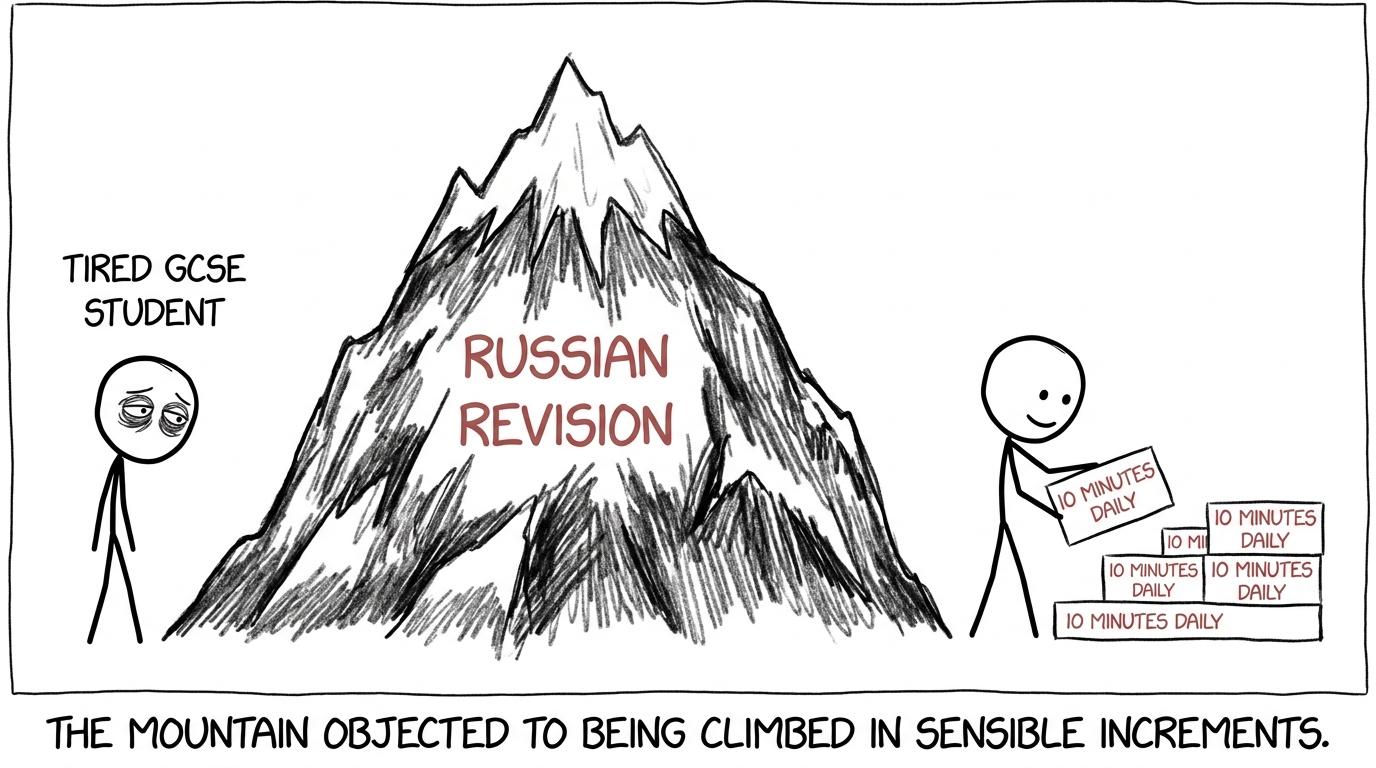 A student climbing the Russian revision mountain through small daily steps
Understand what grade 8 Russian actually demands
A grade 8 is not awarded for knowing the longest list of impressive phrases. Official GCSE modern foreign language grade descriptors emphasise effective responses to complex and extended material, identification of opinions, inference and the ability to draw conclusions.
In speaking, this means sustaining detailed conversation, justifying ideas and dealing with unpredictable questions. In writing, it means manipulating vocabulary and grammar, including some complex language, with mostly accurate results.
That word manipulating matters. A memorised paragraph about school may help when the question is exactly as expected. It becomes much less useful when the task changes tense, audience or emphasis. A grade 8 candidate can reshape familiar language to fit the question.
Think of revision as building adaptable language rather than collecting model answers.
Replace recognition with active vocabulary recall
Reading a vocabulary list creates recognition: the Russian word looks familiar when you see it. The exam demands recall and interpretation. You must retrieve language while writing, recognise it at natural speed and distinguish it from plausible distractors.
A stronger routine has three stages:
- Look at the English meaning and produce the Russian word aloud or in writing.
- Reverse the direction and translate Russian into precise English.
- Use the word in a new sentence, changing the tense, person or opinion where appropriate.
Organise vocabulary by the specification themes, but also group words by function. Create small sets for giving reasons, contrasting ideas, expressing uncertainty, describing past events and discussing future plans. These building blocks travel between topics.
Short, frequent recall sessions are usually more manageable than one enormous weekly list. Record words that repeatedly escape you and test those more often. The difficult vocabulary deserves more attention than the vocabulary you already enjoy getting right.
This same principle helps across your GCSEs. Maths students can use the MathsGenie GCSE revision hub to move from reading a method to answering practice questions without support.
Build grammar that survives exam pressure
Grammar can feel like a set of separate rules: cases in one folder, verbs in another and adjective endings somewhere else. In an exam, however, those systems have to work together inside a sentence.
Create a grammar audit covering the areas your teacher and specification require, including:
- present, past and future time frames;
- verb conjugation and agreement;
- noun cases and their common functions;
- adjective and pronoun agreement;
- negatives, connectives and word order;
- comparative or more complex structures you can use accurately.
Do not label a topic as “done” because you understand an explanation. Test whether you can produce it without notes. Write a few original sentences, check every ending and revisit the same structure later in a different theme.
Accuracy should come before decoration. One controlled complex structure is more valuable than several ambitious phrases whose endings or meanings are uncertain. Once a structure is dependable, add it to a personal sentence bank and practise adapting it.
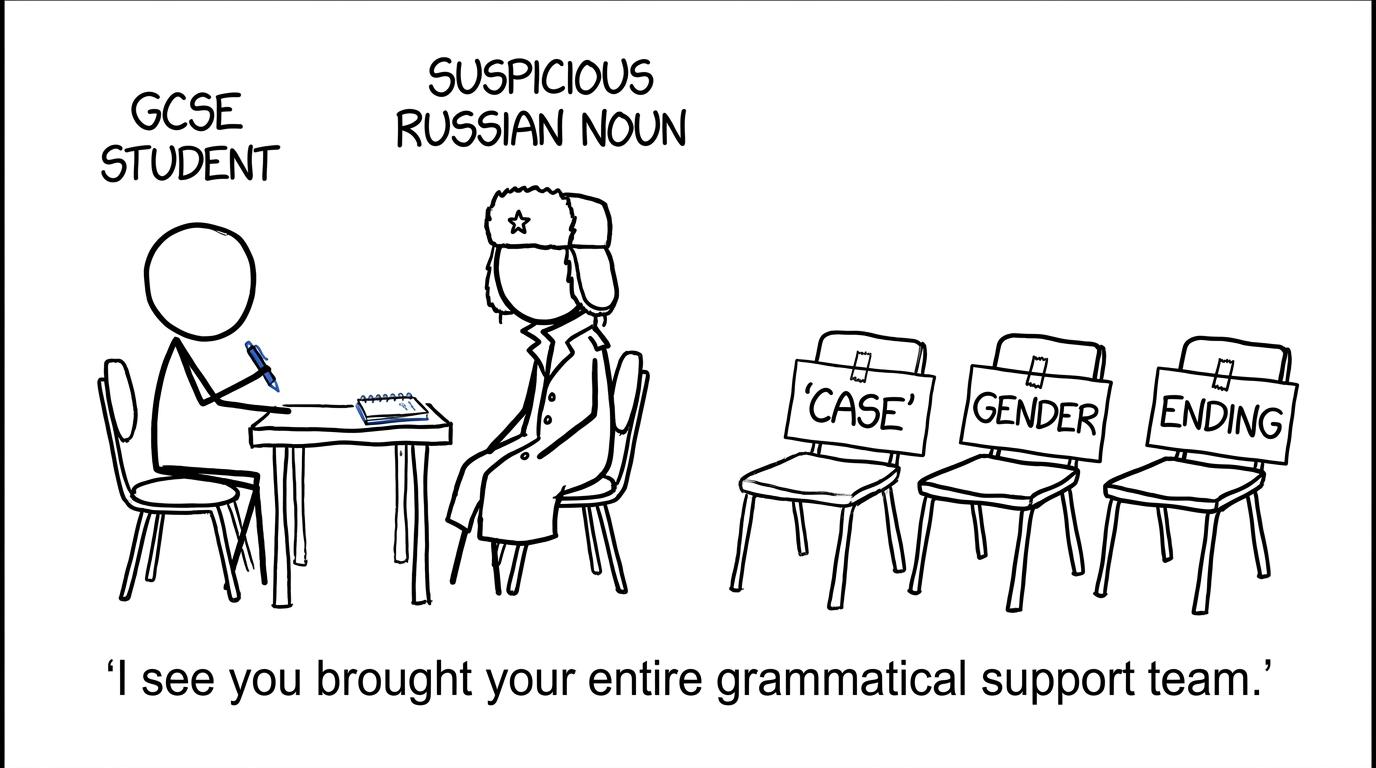 A Russian noun arriving with its grammatical support team
Train each GCSE Russian paper differently
Equal weighting does not mean identical revision. Each component places a different kind of pressure on your knowledge.
Listening
Listening improves when you analyse why an answer was missed. Was the vocabulary unknown? Did a negative reverse the meaning? Did you recognise an individual word but miss the speaker's overall opinion?
Before the recording begins, read the questions carefully and predict the kind of information required. During review, replay difficult sections in short chunks. Use a transcript when one is available, then listen again without it. Note paraphrases rather than expecting the recording to repeat the wording in the question.
Speaking
The Higher tier speaking assessment includes a role-play, a picture-based task and a conversation. Grade 8 preparation therefore needs both secure content and genuine interaction.
Practise aloud several times each week. Record yourself answering unseen prompts, then listen for hesitation, unclear pronunciation, repetitive vocabulary and incomplete justification. Ask a teacher or revision partner to use follow-up questions you have not prepared.
Build answers around a simple internal structure: answer the question, add detail, give a reason and extend into another time frame where it is relevant. Do not force every technique into every response. The aim is a sustained, natural answer rather than a checklist spoken at speed.
Reading
Strong reading is partly vocabulary and partly disciplined interpretation. Train yourself to identify who holds an opinion, when an event happened and whether the writer is positive, negative or undecided.
When translating into English, preserve meaning rather than copying Russian word order mechanically. Check small words, negatives, pronouns and time markers. If you infer an unfamiliar word from context, verify that your interpretation makes sense across the entire sentence.
Writing
Start by decoding the task. Identify every bullet point, required purpose and time frame before drafting. Missing a content point can cost marks even if the remaining Russian is impressive.
Leave time to check work systematically. Look separately for verb endings, noun cases, adjective agreement, spelling and whether each sentence communicates what you intended. Trying to check everything in one hurried reading makes errors easier to overlook.
Use past papers as diagnosis, not proof of effort
Completing a paper is only the first half of the work. The valuable part begins when you identify what each lost mark reveals.
Keep an error log with four headings:
| Error | Likely cause | Specific correction | Re-test date |
|---|---|---|---|
| Unknown language | Vocabulary gap | Add the word and its phrase to recall practice | Within the next few sessions |
| Wrong interpretation | Missed negative, tense or opinion | Annotate the clue and review similar questions | Later that week |
| Inaccurate Russian | Grammar or spelling gap | Correct the sentence and create a new version | Within two days |
| Unfinished task | Timing or planning issue | Repeat a timed section with a checkpoint | Next timed session |
Use official Russian assessment materials supplied by your school or exam board, along with the correct mark scheme and examiner guidance. Do not chase a fixed percentage supposedly needed for grade 8. GCSE boundaries are set for each series, and the qualification is graded using the total subject mark rather than separate grades for individual papers.
The review method is transferable. MathsGenie's guide to using GCSE past papers properly explains how to diagnose mistakes, target weak areas and reattempt questions. You can also read when to start GCSE past papers when planning revision across several subjects.
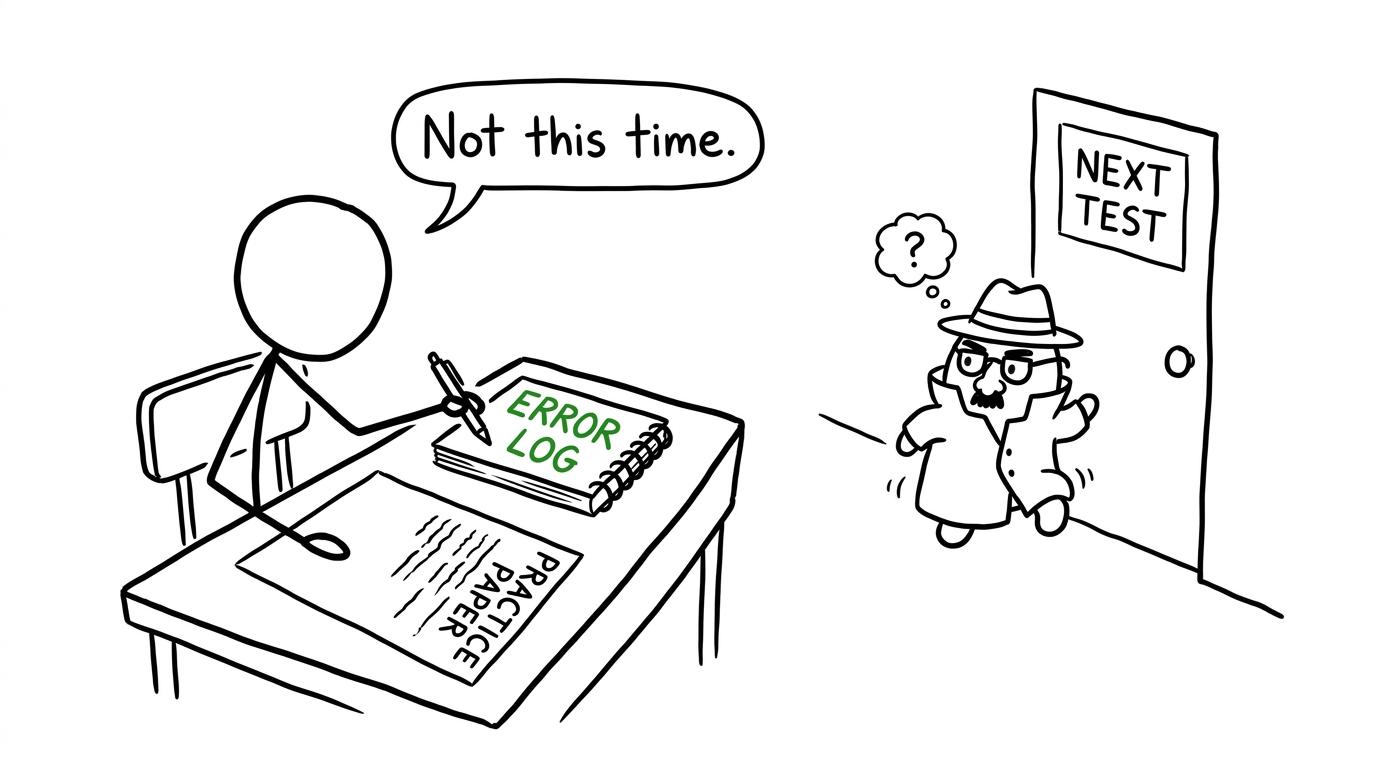 A revision mistake attempting to return after being recorded in an error log
Create a weekly routine you can repeat
A useful grade 8 plan is balanced enough to cover every skill and small enough to survive a busy school week.
A repeatable week might contain:
- two short vocabulary retrieval sessions;
- one focused grammar session followed by independent sentences;
- one listening or reading task with detailed correction;
- one recorded speaking practice;
- one timed writing task or past-paper section;
- one review of the error log.
Rotate the major skills so no component disappears for weeks. If your latest evidence shows that listening is much weaker than reading, adjust the balance. Equal paper weighting does not require equal revision time when your current strengths are unequal.
For help organising Russian alongside maths and other subjects, adapt the structure in the GCSE maths revision timetable. If deciding what to revise first causes delay, the best order for learning GCSE maths topics also demonstrates how to turn a large specification into manageable stages.
Common mistakes that hold students below grade 8
Memorising answers without practising adaptation
Prepared material has value, but only if you can change the person, tense, detail and opinion. Practise answering altered versions of familiar questions.
Revising silently for a speaking examination
Knowing an answer internally is not the same as delivering it clearly. Speak aloud, record yourself and rehearse recovery phrases for moments when you need thinking time.
Avoiding weak skills
Students naturally return to activities that feel fluent. Let recent marked work decide what comes next instead. Revision should reduce weaknesses, not repeatedly confirm strengths.
Using complexity without control
Complex language can support a high-level response, but persistent errors can obscure meaning. Secure a smaller set of flexible structures before expanding it.
Marking and immediately moving on
Corrections that are merely read are easily forgotten. Produce the corrected language yourself and re-test it after a gap.
Cramming vocabulary before the examination
Last-minute review may refresh familiar language, but it is a poor substitute for regular recall. Near the exam, use a calm checklist rather than trying to relearn the course. MathsGenie's GCSE night-before plan offers a useful model for keeping final preparation focused.
Turn steady revision into grade 8 performance
Grade 8 Russian is built through a series of modest but demanding habits: recalling rather than rereading, speaking before you feel perfectly ready, checking grammatical detail and returning to mistakes until they stop recurring.
Begin with one honest diagnosis. Choose the weakest of the four skills, complete a suitable task and record the three issues that cost you the most marks. Your next revision session should respond directly to that evidence.
MathsGenie can help you apply the same disciplined process to your maths preparation. Use free revision lessons and practice questions to repair topic gaps, then move to Edexcel GCSE Maths past papers, mark schemes and video solutions. Near the exams, Edexcel predicted papers and mini tests can provide fresh timed practice.
A high grade rarely comes from one heroic weekend. It comes from a useful session repeated often enough to change what you can do under pressure.










