How to Get Grade 8 GCSE Further Maths
How to get grade 8 GCSE Further Maths through targeted practice, careful marking, stronger algebra, timed papers and an effective revision routine.
A grade 8 can feel strangely close and far away at the same time. You may understand most lessons, yet lose marks through an awkward algebraic step, an unfamiliar matrix question or a sign error made under pressure. The practical answer to how to get grade 8 GCSE Further Maths is not to revise everything for longer. It is to identify where marks leak away, strengthen the algebra beneath the course and repeatedly practise exam questions under realistic conditions.
Further Maths rewards depth. You need to recognise familiar ideas when they arrive in unfamiliar clothing, then communicate a logical method accurately. That ability is built through a consistent cycle of practice, marking, correction and retesting.
Your grade 8 revision checklist
Before changing your timetable, check that your revision includes these essentials:
- Confirm the exact qualification and specification used by your school.
- Make Higher tier GCSE Maths algebra secure.
- Audit every Further Maths topic rather than revising from memory.
- Complete questions without notes or copied methods.
- Keep a record of every lost mark and its cause.
- Reattempt mistakes after a short gap.
- Practise both calculator and non-calculator work.
- Move gradually from topic questions to timed papers.
- Use mark schemes to understand how methods earn marks.
- Protect sleep, breaks and ordinary schoolwork as the exams approach.
The first item matters. “GCSE Further Maths” is often used informally for different qualifications. A common course is the untiered AQA Level 2 Certificate in Further Mathematics. Its current specification is intended for students expected to achieve grades 777 to 999 in GCSE Mathematics and contains number, algebra, coordinate geometry, calculus, matrix transformations and geometry. AQA assesses it through two papers taken in the same series: one non-calculator paper and one calculator paper, each lasting 111 hour 454545 minutes and carrying 808080 marks.
Start from the AQA GCSE Further Maths revision hub, but confirm your qualification code with your teacher before relying on any topic list or paper format.
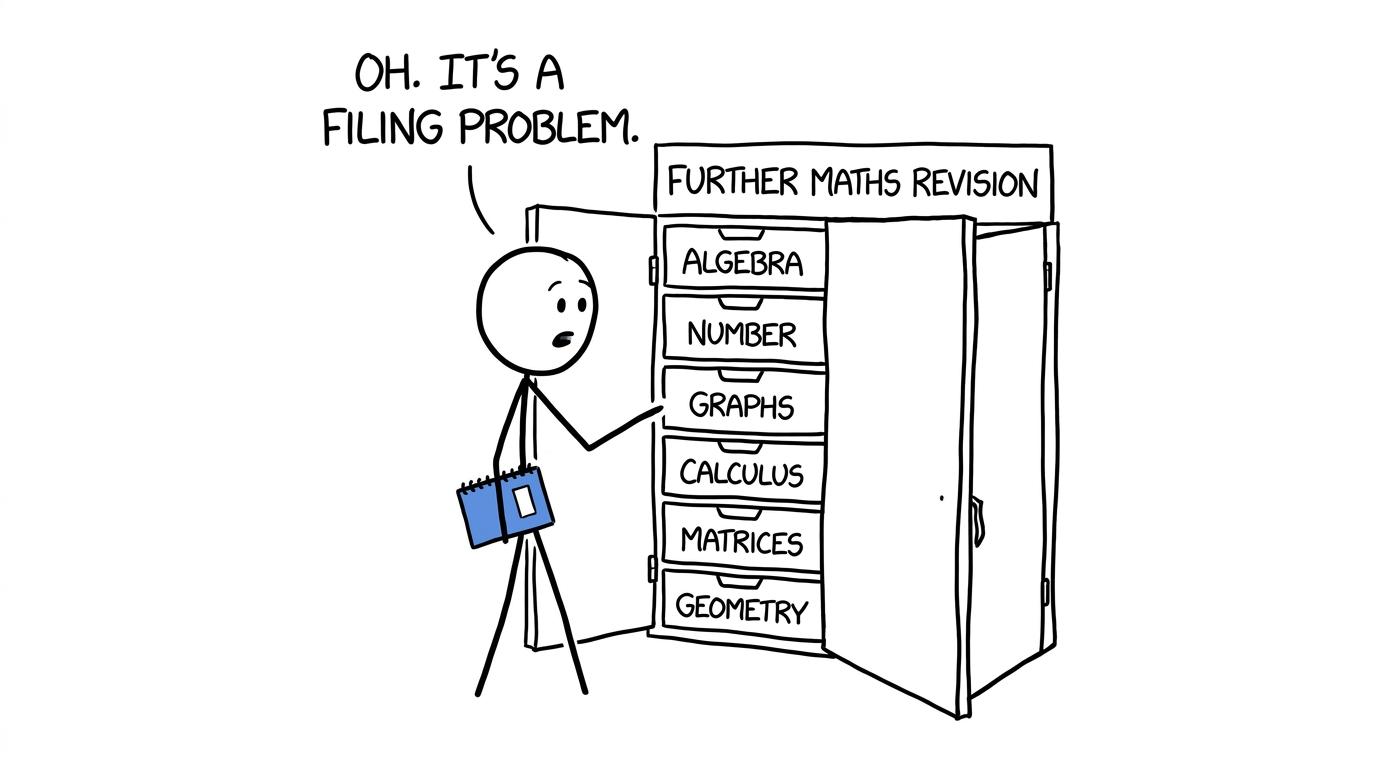 A student discovers that Further Maths is six manageable revision drawers rather than one monster
Build the GCSE Maths foundation first
Further Maths does not replace ordinary GCSE Maths. It sits on top of it. If expanding brackets, manipulating fractions or rearranging formulae still consumes most of your attention, harder ideas become unnecessarily exhausting.
The highest-return foundations usually include:
- expanding and factorising expressions;
- solving linear and quadratic equations;
- rearranging formulae;
- working with indices and surds;
- interpreting functions and graphs;
- using exact trigonometric values;
- handling gradients and coordinate geometry;
- writing algebraic arguments clearly.
Think of fluency as spare attention. When simplifying x2−9x^2-9x2−9 to (x−3)(x+3)(x-3)(x+3)(x−3)(x+3) is immediate, you have more attention available for the real demand of a multi-step question. When basic manipulation is hesitant, every later step becomes fragile.
Use the GCSE Maths topics by exam board and tier to audit your foundation knowledge. The best order for learning GCSE Maths topics can also help if several prerequisite areas need rebuilding.
Learn the specification as a map
Strong students sometimes revise only what has appeared recently in class. That feels productive because the material is familiar, but it leaves hidden gaps.
Turn your specification into a simple traffic-light audit:
- Green: you can complete exam-style questions independently.
- Amber: you understand the lesson but need prompts or make frequent errors.
- Red: you cannot reliably choose a method.
Judge a topic by what you can produce on a blank page, not by whether a solution looks sensible after you read it. Recognition is not recall.
For the AQA Level 2 qualification, pay particular attention to the areas that extend beyond standard GCSE Maths, including calculus and matrix transformations. However, do not assume every difficult question must involve a new topic. Demanding algebra, graphs and geometry can be just as costly when several familiar ideas are combined.
A useful weekly split is to spend most topic-practice time on amber areas, a smaller amount repairing red areas and a short retrieval block maintaining green ones. This prevents confident topics from fading without allowing comfortable work to dominate the timetable.
Use a revision loop that produces evidence
Reading notes can explain an idea, but only independent questions reveal whether you can use it. A grade 8 routine should therefore create evidence every time you revise.
Learn one precise skill
Choose something narrow, such as finding a gradient function, transforming a shape with a matrix or applying the factor theorem. Review one revision lesson and write a short method checklist. Avoid copying pages of notes that you will never retrieve from memory.
Practise without support
Close the lesson and answer practice questions independently. If you become stuck, first identify the exact decision you cannot make. “I do not know which theorem applies” is useful information. “I cannot do calculus” is too broad to guide tomorrow’s revision.
Mark immediately and diagnose
Use the mark scheme or video solution while your reasoning is still fresh. Record the cause of every lost mark under one of four headings:
- knowledge gap;
- method-choice error;
- algebra or arithmetic error;
- exam-technique error.
This distinction matters. Rewatching a lesson will not necessarily cure rushed substitution, while doing another full paper may not repair a missing theorem.
Reattempt after a delay
Correcting a question while the answer is visible tests copying, not learning. Return to it after roughly 484848 hours, then test the skill again in mixed practice the following week. Your aim is not to remember the answer. It is to reconstruct the method.
If you need a practical framework, adapt the GCSE Maths revision timetable around your Further Maths specification.
Turn mistakes into a marks-leak list
A paper score tells you what happened. A marks-leak list tells you what to do next.
For each mistake, note the topic, the precise error, the correction and the date for a retest. Keep the wording short. Entries such as “lost the negative when differentiating”, “gave a decimal when an exact value was required” or “multiplied matrices in the wrong order” are far more useful than “careless”.
Look for repetition. Five different questions may expose one underlying habit: weak bracket discipline, incomplete reasoning or failure to check the form requested. Fixing that habit can recover marks across several topics.
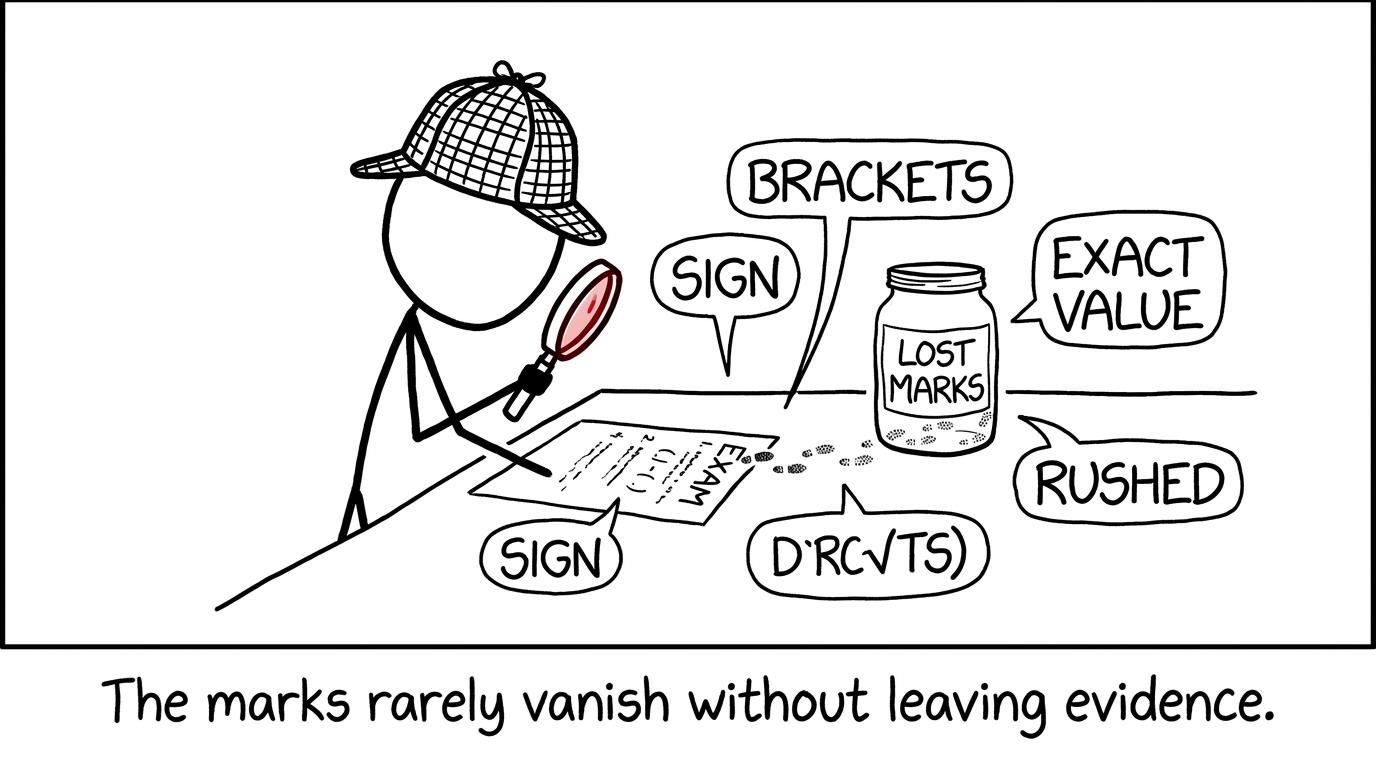 A revision detective follows the evidence left behind by missing marks
Move from topic fluency to exam fluency
Topic questions tell you which skill to use. An exam does not. That difference is where many students plateau.
Build paper practice in stages:
- Begin with untimed topic questions while learning methods.
- Combine several topics in short mixed sets.
- Complete timed sections without notes.
- Progress to full papers under exam conditions.
- Mark, repair and reattempt before starting another paper.
For the AQA course, practise non-calculator work deliberately. Exact arithmetic, factorisation and algebraic structure need to remain dependable when a calculator is unavailable. On the calculator paper, technology should check or execute your reasoning rather than replace it. Write enough method for an examiner to follow what you intended.
Use the papers and mark schemes within the AQA Further Maths revision area. The wider MathsGenie resources collection also provides useful mini tests, practice materials and predicted papers. Predicted papers can add fresh practice, but they should never be used to guess away parts of the specification. The guide to using predicted topics sensibly explains why coverage matters more than prediction.
Grade boundaries are set after papers have been marked and can change between exam series. Do not build your plan around a boundary from one particular year. Track raw marks across several comparable papers and aim for a margin above the historical grade 8 boundary rather than treating one past figure as a promise.
Improve what happens inside the exam
A grade 8 performance is not simply knowledge transferred onto paper. It also depends on decisions.
On your first pass, collect questions you can begin confidently. If a difficult problem stalls, write any valid setup or relevant relationship before moving on; partial methods may earn credit. Return later with more time and less emotional weight attached to the question.
Use the marks available as a rough guide to the expected depth. A long response with almost no working deserves a second look. Before finishing, check signs, brackets, exact values, units and whether you answered the question actually asked.
On Paper 111, reserve time to inspect arithmetic and algebra. On Paper 222, check calculator mode and avoid rounding intermediate values unless instructed. In both papers, clear lines of working reduce your own errors as well as making your reasoning visible.
Common mistakes that block grade 8
Revising only the hardest topics
Calculus and matrices look distinctive, so they attract attention. Yet dropped marks in quadratics, graphs or exact arithmetic count just as much. Revise from evidence, not from what feels most advanced.
Doing paper after paper without repair
Quantity can disguise repetition. If every paper exposes the same weakness, another score is not the solution. Pause, revisit the relevant revision lesson, complete focused practice questions and then retest.
Treating small errors as unavoidable
Repeated sign and bracket errors are habits, not weather. Slow the vulnerable step down, write an extra line and include it in your checking routine.
Using solutions too early
Looking after a few seconds creates familiarity without independence. Give yourself time to choose a route, and record precisely where your reasoning stopped.
Neglecting ordinary GCSE Maths
Further Maths preparation should not damage your main GCSE Maths result. Skills overlap, but the qualifications are assessed separately. Keep both in your timetable and use the one-month GCSE Maths revision plan when you need a balanced final approach.
Make grade 8 the result of a repeatable system
The students best placed to earn grade 8 are not necessarily those who complete the most hours. They are the ones whose revision keeps answering three questions: What can I do independently? Where exactly am I losing marks? When will I prove that the weakness is fixed?
Begin today with one timed diagnostic set. Mark it honestly, choose one marks leak and repair it using MathsGenie's free revision lessons and practice questions. Then retest it before moving on. As the exam approaches, add mini tests, past papers, predicted papers, mark schemes and video solutions so that both knowledge and timing are ready.
Open the AQA GCSE Further Maths revision hub, build your plan and let each session leave behind evidence of improvement. Grade 8 stops feeling mysterious when the process becomes specific.